For the 11th week of the Read 52 Books in 52 Weeks challenge, I chose a book that tied into the Spiritual Practices A to Z Countdown that I'm doing: Radical Forgiveness by Colin Tipping.
As I started reading the book, it seemed very familiar. I continued reading and then realized that I had, indeed, read it before when I was doing the Wellspring program a couple years ago.
I went back on my notes, and found that I already typed quite a few passages that I wanted to remember. So, I re-read them and chose ones that seemed still relevant to my life today. These are things I want to continue to remember:
- If you want to know what your beliefs are, look at what you have in your life. Life always reflects our beliefs.
- He provided you with an opportunity to get in touch with your original pain and to see how a certain belief about yourself was running your life. In so doing, he gave you the opportunity to understand and change your belief, thus healing your original pain.
- 90% of the healing occurs when you become willing to let in the idea that your soul has lovingly created this situation for you.
- Even though you repressed the pain to get rid of it, the belief kept working in your life at a subconscious level. That’s when your soul decided to create some drama in your life so you would bring it to consciousness again and have the opportunity to choose healing once more.
You attracted people into your life who would confront you directly with your own pain and you relive the original experience through them.
- What would happen if, instead of understanding what was going on underneath the situation, you simply avoid it? Your soul would have brought in someone else to help you heal.
- Through the law of resonance, we attract the people who resonate with our issues so that we can heal them. For example, if abandonment is our issue, we will tend to attract people who abandon us. In that sense, these people serve as our teachers.
- What appears to be cruel and nasty behavior on somebody’s part might be exactly what we need and have indeed called forth. Situations that appear to be the worst that could possibly befall us may hold the key to our healing something deep within us that keeps us from being happy and prevents our growth. The people who seem to us to be the most troublesome and the least likable may therefore be our greatest teachers. What we think they do to us, they actually do for us.
- The idea that nothing wrong took place and that is in fact there was nothing to forgive. This is Radical Forgiveness.
- Anger actually exists as a secondary emotion. Beneath anger lies a primary emotional pain, such as hurt pride, shame, frustration, sadness, terror, or fear.
- Anger that persists serves no useful purpose.
- You know when you have reached a placed of forgiveness by how you feel. When you can feel neutral when meeting the person again, speaking to them, or even thinking about them, you are probably 90% there. You are 100% there when you can feel nothing about love for that person.
- Burning scented woods, sage, sweetgrass, and incense will intensify any ritual and bring special significance to a forgiveness ceremony. The smoke from sage and sweetgrass also cleanses your aura, thus removing unwanted energies from your energy field.
- Ritualized washing, immersing, and floating are good rituals as well.
One of the suggestions for healing one's life is the following: Write three letters to the person who you feel has wronged or hurt you in some way.
- Vent all your anger in the first letter.
- The next day write another letter. There should be less anger in this one. Bring compassion, understanding, and generosity, as well as the possibility of some sort of forgiveness, into the equation.
- The next day, write a third letter. Attempt to describe a new interpretation of the situation based on the principles of Radical Forgiveness.
- ****NONE of these letters are ever mailed. They are designed to shift your energy, not the energy of the recipient. Use the ritual of fire to transform them. Something powerful happens when you see your words turn into ashes and rise up in a column of smoke. Say a prayer as the item burns.
Sunday, March 15, 2015
Radical Forgiveness - Read 52 Books in 52 Weeks - Week 11
Labels:
books,
health,
read,
reading,
Spiritual Practices from A to Z,
therapy,
Unitarian Universalism
Thursday, March 12, 2015
Spiritual Practices A to Z: Enthusiasm
For the fifth spiritual practice this year, I focused on Enthusiam. The Spiritual Practices website had many interesting ideas and activities to do related to Enthusiam.
Spiritual Practices: Enthusiasm
Enhances: Energy
Balances/Counters: Apathy, Boredom
The word enthusiasm is derived from the roots en — in or within — and theos — God. It means having God within or being one with God. People with this gift carry a special kind of energy. They bring warmth and feeling to their relationships and vigor and freshness to their activities.
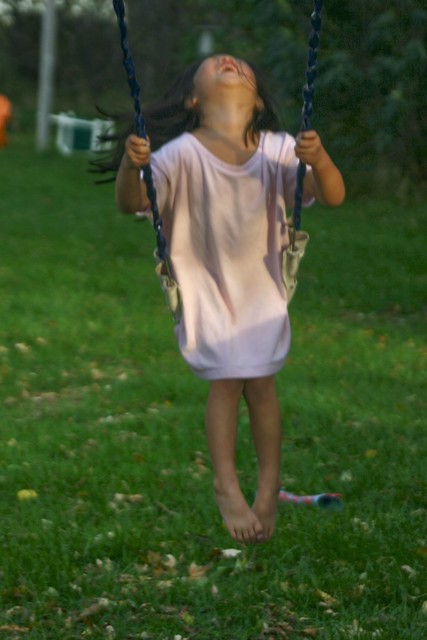
Olivia laughing with joy and enthusiasm as she swings
in the backyard.
(Taken on September 29, 2007.)
To practice enthusiasm, make others aware when you are excited about something. Throw yourself into your projects. Be known for your eagerness, your curiosity, your willingness to give it all you've got. Proclaim your passions. Hold nothing back. Sing your heart out.
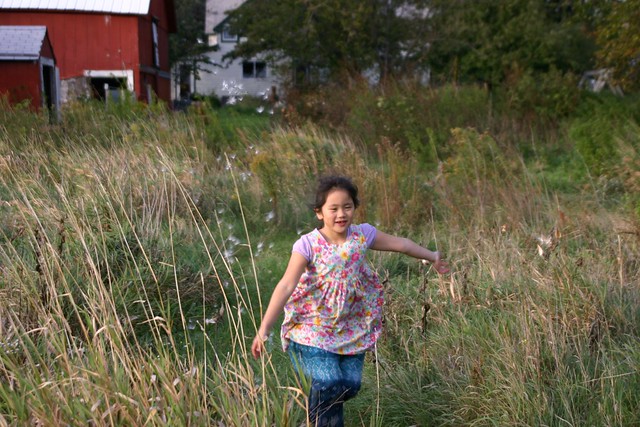
Sophia running with enthusiasm through the pasture
as she spreads milkweed seeds.
(Taken on September 29, 2007.)
Why This Practice May Be For You
Enthusiasm is invigorating. It helps you get up and go. It is a good prescription, then, when you are feeling lethargic and listless, when your energy seems frozen.
Enthusiasm counterbalances apathy and boredom, two common blocks to an engaged spiritual life. A sluggish spirit just doesn't care about anything. The world isn't interesting enough; there's a dreary sameness to all your activities.
September 29, 2007, must have been a great day.
I kept finding pictures of things that
brought back so much joy as I looked at them.
I remember how excited (or enthusiastic) I was when
I saw this amazing cloud formation in the morning.
When fatigue or another of these conditions has you dragging through your days, when you find that you've replaced wonder with whatever, go for enthusiasm. If you can't muster it from within, surround yourself with enthusiastic people.
Quotes
It is important to energize our everyday practice and
daily good works with enthusiasm,
without anyone else telling us to,
but doing it for our own sake.
— The Dalai Lama
Enthusiasm is the greatest power.
For one endowed with enthusiasm
nothing in this world is impossible.
— The Ramayana
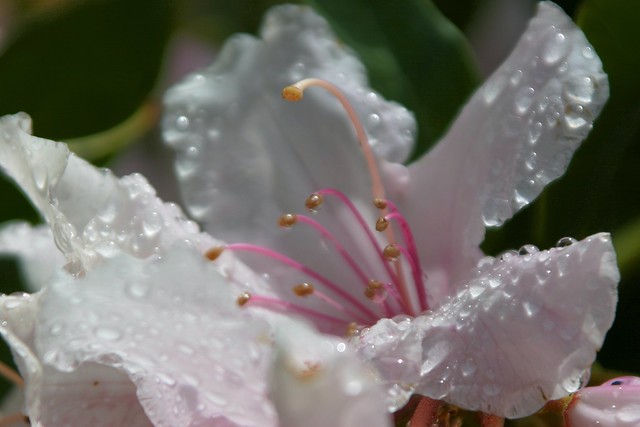
A flower after a rainstorm.
(Taken on May 21, 2007.)
Who are the happiest, richest people you know?...
These are the people who are living joyful, enthusiastic lives,
regardless of their possessions or lack of possessions.
— Shoni Labowitz in Miraculous Living
Nothing great was ever achieved without enthusiasm.
The way of life is wonderful; it is by abandonment.
— Ralph Waldo Emerson quoted in Lighting a Candle by Molly Young Brown
Books
I read Exuberance: The Passion for Life by Kay Redfield Jamison. This book was about the topic of exuberance as an elated state, a cousin to enthusiasm, happiness, and joy.
The other book I'm planning on reading is Jesus Laughed and Other Reflections on Being Human by Jean Maalouf. "We need not study merely the biography of Jesus. Rather, we need to discover him living now, in our everyday life," wrote Jean Maalouf.
Maalouf is awed by Jesus's ability to learn spiritual lessons from plants, to accept the presence of the kingdom in everyday events, and to proclaim love as the linchpin of our relationship with our neighbors. The author also revels in Jesus's spiritual practices of enthusiasm, joy, attention, freedom, listening, and zeal.
For Maalouf, the heart rather than the head is the gateway to a spiritual life in Christ. This book presents a creative and empowering interpretation of the life and ministry of Jesus Christ.
Film
The Accidental Tourist directed by Lawrence Kasdan.
Music
Almost any recording in the gospel music genre is a good example of enthusiasm. Although there are many single gospel singers, the most enthusiastic performances usually are by groups and choirs.
For great samples of the latter, the Spiritual Practices website suggested listening to the Smithsonian Folkways recordings African American Spirituals. I found the Afro-American Spirituals, Work Songs, and Ballads CD. There are 17 songs on it, all recorded between 1933 and 1939 in the rural south.
I listened to Trouble So Hard, I'm Going to Leland, and The Blood-Stained Banders. Out of the three, the last one was the most enthusiastic and fast-paced. The other two songs were songs I would associate with working.
The other CD I checked out was African American Spirituals: The Concert Tradition. I listened to Wade in the Water. It was sung by the Howard University Chamber Choir so it was a completely different listening experience than the other CD. I liked this one much better.
The other song I enjoyed listening to was Oh Freedom that was sung by The Princely Players. The song was beautifully sung and sounded like one that I would hear in a church service or funeral (but it was not depressing to listen to because of the lovely voices and lyrics).
The third song from the CD that I listened to was Roll, Jordan, Roll sung by The Princely Players. As I listened to the music, it made me miss listening to the choir at White Bear Unitarian Universalist Church. They have an incredibly talented group of women and men who come together to sing a wide variety of music. This song I could see them singing.
Art
The spiritual practice of enthusiasm arises out of deep passion and visceral energy. Both qualities, according to the Spiritual Practices website, are apparent in Sonia Delaunay's Flamenco Singer.
Spheres of bright colors — reds, oranges, yellows, blues, greens — radiate away from the central figure of the singer. Some of the disks become spirals before moving off the canvas. The power of such a vocal performance must come from a place deep within, the source of all enthusiasm.
Daily Cue, Reminder, Vow, Blessing
There are three reminders from the Spiritual Practices website that would be ones that I can see using throughout my life.
• Seeing an audience clapping for a performer, is a cue for me to practice enthusiasm.
• Looking up at the radiance of the stars, I am reminded to let my enthusiasm for life shine brightly.
• Watching someone who obviously relishes what he or she is doing, I vow to practice enthusiasm.
Practice of the Day
The antidote to exhaustion may not be rest.
It may be wholeheartedness.
You are so exhausted because all of the things
you are doing are just busyness.
There's a central core of wholeheartedness
totally missing from what you're doing.
— Brother David Steindl-Rast quoted in I Will Not Die an Unlived Life by Dawna Markova
I rarely take naps - instead my days are filled from the moment I wake up to the time I go to bed. Periodically, though, when I am exhausted I do fall asleep and usually it ends up being for a good two hours. Then I feel refreshed.
However, if I'm just dragging for some reason, simply getting outside can lift my spirits. The weather has been getting warm again so I started taking the dogs for walks since I'm not worried about falling on the ice any more if they pull me.
It seems like yesterday, in some ways,
that both Montague and Gretel were with us.
This was taken on April 8, 2009, on
one of our spring walks.
March 21st marks the one year anniversary
of Montague's death, and - interestingly -
the birth of the other Golden Retriever we had (Sydne)
who was born in 1990.
What I want to start doing again is doing creative projects. The year my father died (2012) I did so many creative projects. Even the two years proceeding his death, I was doing a lot of creative activities. In 2013, it was as if everything just came to a halt. I'm hoping that in 2015 I can begin to carve out time for something that I used to be very enthusiastic about.
Spiritual Exercises
Select a favorite hymn or religious song to use in a worship service or ritual. Let yourself go as you sing it. John Wesley, the founder of Methodism, gave some very specific instructions for singing: "Sing lustily and with a good courage. Beware of singing as if you were half dead, or half asleep; but lift up your voice with strength."
Although there are religious songs that I enjoy listening to like On Eagles Wings or Meditation on Breathing or many different Christmas songs, I don't sing in public. Rather, in my mind I sing along with a perfect voice - one very unlike the one I sound like if I was to sing aloud.
Journal Exercises
Both of these topics I wrote about in my personal journal:
• Do an enthusiasm examination of yourself. When do you feel most alive? What are you passionate about? Do you always feel free to express your enthusiasm? If not, what tends to stifle this spiritual energy?
• Write a profile of a person you would call a "living saint" who is infused with a good spirit. How has this individual moved you? How do you feel in the company of this person? Try to come to terms with your reactions to "holy people" in this exercise.
Discussion Questions, Storytelling, Sharing
• Describe a specific incident when you were enthusiastic about a project. What was it? How did the people around you respond to your excitement? Did anyone try to take the wind out of your sails? How did you handle the situation?
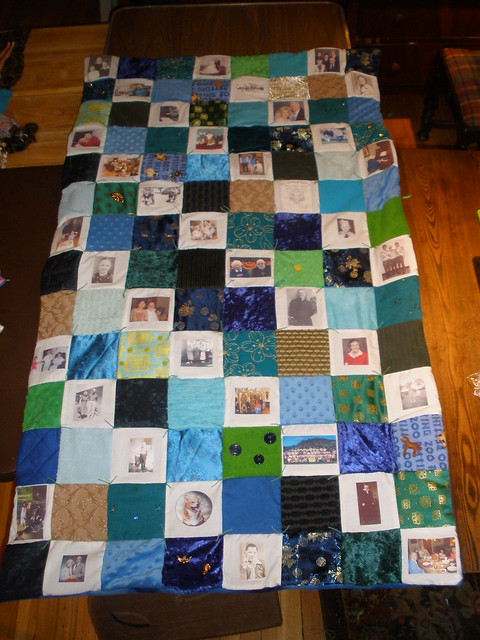
This is the sensory and memory quilt I made for my dad.
(The photograph was taken on December 21, 2009)
I made a sensory and memory quilt for my dad who had Alzheimer's Disease. The fabrics had different textures, and the pictures were ones that he picked out that were meaningful to him. The back was a very soft fleece.
I gave it to my father on December 27th since there was a big snowstorm. Anyway...he opened the box and looked at the quilt, and immediately started recalling memories and sharing stories about some of the pictures.
He cried when he looked at other pictures. "I've had a good life," he said.
• What do you do to revive your spirits when you are feeling sluggish, bored, or apathetic? The most consistent thing that I do to revive my spirits is spend time in nature. Taking a walk with the dogs, exploring a new trail, going to a state park, or even just stepping outdoors to take a walk around the farm can revitalize me when I most need it.
Beautiful tulips that I saw on April 30, 2009.
I was on a trip to Pella, Iowa, with
my parents and daughters.
Household, Group, and Community Projects
At some point in the future, I would like to do these things:
• Create a scrapbook of Enthusiastic Souls, perhaps organized around saint days or birthdays. Read about the lives of people you admire. Copy down meaningful lines from their writing. Find one way to honor this person - with a prayer, a reading, or a specific action.
• Make supporting other people's enthusiasms an ongoing activity in your household. Send thank you notes to people whose commitments you admire, just as you would acknowledge a gift. Regularly share your passions with family and friends - send a favorite book with a note about why you love it, recommend a film, e-mail a meaningful quote. And when you spot enthusiastic people, cheer them on.
Labels:
Alzheimer's Disease,
art,
books,
butterflies,
flowers,
gardening,
grief,
memories,
movies,
music,
nature,
nature walk,
quilt making,
Spiritual Practices from A to Z,
Unitarian Universalism
Sunday, March 8, 2015
Healing Labyrinth - Read 52 Books in 52 Weeks - Week 10
For the tenth week of the Read 52 Books in 52 Weeks challenge, I read The Healing Labyrinth - Finding Your Path to Inner Peace by Helen Raphael Sands. I chose this book for the theme of Enthusiasm which is part of the A to Z Spiritual Practices challenge that I'm doing during 2015.
There aren't a lot of books written about enthusiasm per se, so when I was reading The Healing Labyrinth and saw a section about how to enthusiastically dance and move through labyrinths, this book seemed like an appropriate fit.
There were several things that I learned while reading the book:
- The fish symbol that people sometimes put on their cars is called a vesica piscis. "It is a basic shape of sacred geometry and means 'fish's bladder.' It is formed with two intersecting circles and symbolizes the marriage of opposites, such as Heaven and Earth, the masculine and feminine, light and dark, not unlike the Chinese yin and yang symbol."
- A labyrinth has universal appeal because it is not attached to any one faith or tradition. So, each person who follows its path can draw from it what he or she needs. It is a means of meditation offering us space to listen to ourselves.
- It can be a slow and contemplative experience or fast and energizing; it can help us shed layers of emotion and unravel a problem; or it can stimulate the mind and offer inspiration.
- We can see the shape of the labyrinth all around us in the spiraling and turnings of nature: in the swirl of a thumbprint, in water rippling outwards, in spiders' webs, in the uncoiling of a fern.
- You can connect the labyrinth (that you're walking) but thinking of or naming out loud someone who has died and who was very important to you. Ask this person to accompany you on your journey through the labyrinth.
- If you have a portable labyrinth and want to remember the people who have walked it or the places it has visited, you can make an Ariadne memory thread. You need a ball of brightly colored string, on to which you can attach tags or mementos that are symbolic of your journey. Twine your Ariadne's thread around a cylinder to store it in between each labyrinth event. When you close down the labyrinth in time, you can read out the names of people and the places visited to link the labyrinth with time present, thereby creating a sense of continuity and community. (In the book the author had a shell, mental figurines, an envelope that was hole-punched in one corner and attached to the thread, and a button on the Ariadne's memory thread.)
- Choosing different materials: using Christmas fairy lights to mark the pathways of the labyrinth, mow a pathway for the labyrinth, or flat/smooth rocks. Another idea was to plant a labyrinth with spring bulbs so that each spring the labyrinth would bloom to welcome the new season.
There aren't a lot of books written about enthusiasm per se, so when I was reading The Healing Labyrinth and saw a section about how to enthusiastically dance and move through labyrinths, this book seemed like an appropriate fit.
There were several things that I learned while reading the book:
- The fish symbol that people sometimes put on their cars is called a vesica piscis. "It is a basic shape of sacred geometry and means 'fish's bladder.' It is formed with two intersecting circles and symbolizes the marriage of opposites, such as Heaven and Earth, the masculine and feminine, light and dark, not unlike the Chinese yin and yang symbol."
- A labyrinth has universal appeal because it is not attached to any one faith or tradition. So, each person who follows its path can draw from it what he or she needs. It is a means of meditation offering us space to listen to ourselves.
- It can be a slow and contemplative experience or fast and energizing; it can help us shed layers of emotion and unravel a problem; or it can stimulate the mind and offer inspiration.
- We can see the shape of the labyrinth all around us in the spiraling and turnings of nature: in the swirl of a thumbprint, in water rippling outwards, in spiders' webs, in the uncoiling of a fern.
- You can connect the labyrinth (that you're walking) but thinking of or naming out loud someone who has died and who was very important to you. Ask this person to accompany you on your journey through the labyrinth.
- If you have a portable labyrinth and want to remember the people who have walked it or the places it has visited, you can make an Ariadne memory thread. You need a ball of brightly colored string, on to which you can attach tags or mementos that are symbolic of your journey. Twine your Ariadne's thread around a cylinder to store it in between each labyrinth event. When you close down the labyrinth in time, you can read out the names of people and the places visited to link the labyrinth with time present, thereby creating a sense of continuity and community. (In the book the author had a shell, mental figurines, an envelope that was hole-punched in one corner and attached to the thread, and a button on the Ariadne's memory thread.)
- Choosing different materials: using Christmas fairy lights to mark the pathways of the labyrinth, mow a pathway for the labyrinth, or flat/smooth rocks. Another idea was to plant a labyrinth with spring bulbs so that each spring the labyrinth would bloom to welcome the new season.
Labels:
52 Books in 52 Weeks,
books,
creativity,
health,
labyrinth,
memories,
read,
reading,
Spiritual Practices from A to Z,
Unitarian Universalism
Wednesday, March 4, 2015
Diaper Bassinet and Washcloth Bouquet for a Baby Shower
Sophia, Olivia, and I went to a beautiful and heart-warming baby shower this past weekend for the daughter of our neighbors. We have been neighbors since 1995, and have watched their daughter grow up from a middle-elementary school child to a engaging and thoughtful young woman.
So, I wanted to do a couple crafty gifts along with our other gifts as a way to celebrate this special milestone in her life.
The first project I did was a diaper bassinet. The idea came from this pin on Pinterest that led to Cute as a Fox's tutorial.
I used 14 diapers (size 1) to make the bassinet. There are ten for the bed, one for the backing, one for the top, and two for the base.
The first one took a bit of time to figure out since the tutorial was for size 3 diapers. However, I think they came together nicely.
I made two of them since there were plenty of diapers in the bag. The second one was easier to assemble and didn't take as long to do.
The second project I did was a washrag bouquet. The idea came from a pin on Pinterest as well.
Basically, you take eight washrags and roll them up, insert them into a cone made from scrapbooking paper, and attach some curling ribbon.
As I looked back on the pin and my washrag bouquet, I would re-roll the washrags as shown in the pin. They look a bit more like flowers rather than washrags in the original pin. Regardless, it was still a fun way for me to present a gift rather than just having them sit in their packaging.
When we got to the baby shower, everything was so beautifully decorated. There were other ideas that Jeannine (the grandmother-to-be) had seen on Pinterest that she created - like the balloon clouds with blue raindrops that Holly (the mother-to-be) sat under while she opened the gifts.
The little clothesline of dresses, ruffled diaper covers, and colorful toys brought back nice memories of picking out the same type of clothing for Sophia and Olivia when they were younger.
There were fun games - like a diaper raffle and guessing how many jelly beans filled the baby bottle.
There was the Baby Shower Price is Right game. The total for the products was about $63. Most surprising was how much powdered formula had increased since we had to purchase it back in 2001-2004.
The food was spectacular - everything tasted so delicious - from the fresh fruit kabobs to the chicken salad.
If that wasn't enough: the dessert table was overflowing with beautifully-decorated desserts.
The chocolate-covered strawberries were huge and tasted so fresh - just like they were picked that morning from the strawberry patch.
Holly and her husband (Alfred) received gifts that will completely set up the nursery, and their forthcoming daughter's wardrobe for quite some time.
We had a wonderful time at the baby shower. Seeing how much work and love was put into the baby shower; the handmade gifts that Jeannine and her husband (Kent) made for the baby; and the attentive hospitality of Kent and Holly's brother, Michael, showed toward the guests made the afternoon one that was memorable and special for everyone there.
So, I wanted to do a couple crafty gifts along with our other gifts as a way to celebrate this special milestone in her life.
The first project I did was a diaper bassinet. The idea came from this pin on Pinterest that led to Cute as a Fox's tutorial.
I used 14 diapers (size 1) to make the bassinet. There are ten for the bed, one for the backing, one for the top, and two for the base.
The first one took a bit of time to figure out since the tutorial was for size 3 diapers. However, I think they came together nicely.
I made two of them since there were plenty of diapers in the bag. The second one was easier to assemble and didn't take as long to do.
The second project I did was a washrag bouquet. The idea came from a pin on Pinterest as well.
Basically, you take eight washrags and roll them up, insert them into a cone made from scrapbooking paper, and attach some curling ribbon.
As I looked back on the pin and my washrag bouquet, I would re-roll the washrags as shown in the pin. They look a bit more like flowers rather than washrags in the original pin. Regardless, it was still a fun way for me to present a gift rather than just having them sit in their packaging.
When we got to the baby shower, everything was so beautifully decorated. There were other ideas that Jeannine (the grandmother-to-be) had seen on Pinterest that she created - like the balloon clouds with blue raindrops that Holly (the mother-to-be) sat under while she opened the gifts.
The little clothesline of dresses, ruffled diaper covers, and colorful toys brought back nice memories of picking out the same type of clothing for Sophia and Olivia when they were younger.
There were fun games - like a diaper raffle and guessing how many jelly beans filled the baby bottle.
There was the Baby Shower Price is Right game. The total for the products was about $63. Most surprising was how much powdered formula had increased since we had to purchase it back in 2001-2004.
The food was spectacular - everything tasted so delicious - from the fresh fruit kabobs to the chicken salad.
If that wasn't enough: the dessert table was overflowing with beautifully-decorated desserts.
The chocolate-covered strawberries were huge and tasted so fresh - just like they were picked that morning from the strawberry patch.
Holly and her husband (Alfred) received gifts that will completely set up the nursery, and their forthcoming daughter's wardrobe for quite some time.
We had a wonderful time at the baby shower. Seeing how much work and love was put into the baby shower; the handmade gifts that Jeannine and her husband (Kent) made for the baby; and the attentive hospitality of Kent and Holly's brother, Michael, showed toward the guests made the afternoon one that was memorable and special for everyone there.
Labels:
food,
party,
Pinspiration,
Pinterest
Sunday, March 1, 2015
Exuberance - Read 52 Books in 52 Weeks - Week 9
For the ninth week of the Read 52 Books in 52 Weeks challenge, I read Exuberance - The Passion for Life by Kay Redfield Jamison.
I was excited to read this book and had rather high expectations for it. However, as chapter after chapter passed, it became clear that what I thought this book would be and what it actually is are two completely different things. So, by the middle of the book I was skimming the chapters. Before long, I simply closed the book and felt like I had read enough of it. This book, unfortunately, was not the best use of my time.
That being said, there were some things I found interesting and wanted to remember:
- It is the infectious energies of exuberance that proclaim and disperse much of what is marvelous in life. Exuberance carries us places we would not otherwise go - across the savannah, to the moon, into the imagination - and if we ourselves are not so exuberant we will, caught up in the contagious joy of those who are, be included collectively to go yonder.
- By its pleasures, exuberance lures us from our common places and quieter moods.
- Joy widens one's view of the world and expands imaginative thought. It makes both physical and intellectual exploration more likely, and it provides reward for problems solved or risks taken.
- One joy, the Chinese believer, scatters a hundred griefs, and certainly it can be an antidote to fatigue and discouragement. Into those set back by failure, joy transfuses hope.
- Theodore Roosevelt seems to have burst into the world a full-throated exuberant.
- Roosevelt's vivacity receded when his father died....It was a devastating loss. For the rest of his life he would miss, though himself incorporate, his father's rare mixture of infectious joy and keen sense of public duty."
- John Muir: "He understood nature, felt nature, and then illuminated her to those who did not. The slaying of the wilderness was to him personal and intolerable."
- John Muir spoke of a more inward journey: "I only went out for a walk," he wrote, "and finally concluded to stay out till sundown, for going out, I found, was really going in."
- Nature is self-evidently exuberant. One pair of poppies, given seven years and the right conditions, will produce 820 thousand million million million descendants.
- Lichens, among nature's oldest and slowest of living things, grow nearly everywhere...and an individual community of lichen may survive longer than most human civilizations.
- Wilson "Snowflake" Bentley...was incapable of indifference to the world around him. When there was a winter storm and snow was flying, he was in the fields or hills; he could not stay indoors. His delight in snow made him an astute observer of it; it then made him an infectiously enthusiastic guide. Exuberance gave him passion, stamina, and a lasting voice to speak out for small beauties.
- Every crystal was a masterpiece of design and no one design was ever repeated. He was as stricken by their impermanence as struck by their beauty: "When a snowflake melted," he lamented, "that design was forever lost. Just that much beauty was gone, without leaving any record behind."
- African elephants: expressions of joy are frequent in elephant families...especially when they greet one another after having been apart. The "greeting ceremony" may involve as many as fifty elephants and occurs after elephants have been separated for as short a period as a few hours or as long a time as several weeks.
I was excited to read this book and had rather high expectations for it. However, as chapter after chapter passed, it became clear that what I thought this book would be and what it actually is are two completely different things. So, by the middle of the book I was skimming the chapters. Before long, I simply closed the book and felt like I had read enough of it. This book, unfortunately, was not the best use of my time.
That being said, there were some things I found interesting and wanted to remember:
- It is the infectious energies of exuberance that proclaim and disperse much of what is marvelous in life. Exuberance carries us places we would not otherwise go - across the savannah, to the moon, into the imagination - and if we ourselves are not so exuberant we will, caught up in the contagious joy of those who are, be included collectively to go yonder.
- By its pleasures, exuberance lures us from our common places and quieter moods.
- Joy widens one's view of the world and expands imaginative thought. It makes both physical and intellectual exploration more likely, and it provides reward for problems solved or risks taken.
- One joy, the Chinese believer, scatters a hundred griefs, and certainly it can be an antidote to fatigue and discouragement. Into those set back by failure, joy transfuses hope.
- Theodore Roosevelt seems to have burst into the world a full-throated exuberant.
- Roosevelt's vivacity receded when his father died....It was a devastating loss. For the rest of his life he would miss, though himself incorporate, his father's rare mixture of infectious joy and keen sense of public duty."
- John Muir: "He understood nature, felt nature, and then illuminated her to those who did not. The slaying of the wilderness was to him personal and intolerable."
- John Muir spoke of a more inward journey: "I only went out for a walk," he wrote, "and finally concluded to stay out till sundown, for going out, I found, was really going in."
- Nature is self-evidently exuberant. One pair of poppies, given seven years and the right conditions, will produce 820 thousand million million million descendants.
- Lichens, among nature's oldest and slowest of living things, grow nearly everywhere...and an individual community of lichen may survive longer than most human civilizations.
- Wilson "Snowflake" Bentley...was incapable of indifference to the world around him. When there was a winter storm and snow was flying, he was in the fields or hills; he could not stay indoors. His delight in snow made him an astute observer of it; it then made him an infectiously enthusiastic guide. Exuberance gave him passion, stamina, and a lasting voice to speak out for small beauties.
- Every crystal was a masterpiece of design and no one design was ever repeated. He was as stricken by their impermanence as struck by their beauty: "When a snowflake melted," he lamented, "that design was forever lost. Just that much beauty was gone, without leaving any record behind."
- African elephants: expressions of joy are frequent in elephant families...especially when they greet one another after having been apart. The "greeting ceremony" may involve as many as fifty elephants and occurs after elephants have been separated for as short a period as a few hours or as long a time as several weeks.
Labels:
52 Books in 52 Weeks,
books,
history,
nature,
read,
reading,
Spiritual Practices from A to Z
Thursday, February 26, 2015
Spiritual Practices A to Z: Devotion
This is the fourth focus of the "Spiritual Practices A to Z" challenge that I'm doing that is based on the spiritual practices that are shared on the Spirituality & Practice website. So far I have focused on Attention, Beauty, and Compassion. For the past two weeks, I focused on the spiritual practice of Devotion.
The Basic Practice
The Spiritual Practices website noted that "the world's religions demonstrate an amazing variety of ways to practice devotion. To name just a few: Sufis dance. Buddhists chant. Catholics pray with a rosary. Protestants sing hymns. Orthodox Christians meditate on icons. Hindus gather to receive blessings in temples. Jews wrap themselves in a prayer shawl. Native Americans bring up the sun. Muslims make a pilgrimage."
It is suggested to begin by cultivating one's own garden of devotion. The Spiritual Practices website said, "Pick as many seeds to plant as you desire. Water them with love. Be vigilant in your caretaking. Add new plants to the garden for variety. And be happy knowing that this garden" pleases not only yourself, but the world.
Why This Practice May Be For You
Devotion is not something that is done once a week, only on religious holidays, or in response to a particular event in one's life. Special devotions may be called for at those times, but as a spiritual practice, it needs to be part of one's daily routine.
Devotion helps build self-discipline. Being constant in one's prayers prepares a person for other disciplines needed in life. On the other hand, if a person lacks commitment and doesn't tend to follow through in the long run, a devotional life will suffer as well. This practice needs to be done regularly.
Quotes
Books
I read and wrote a review about Chanting from the Heart - Buddhist Ceremonies and Daily Practices by Thich Nhat Hanh.
The book has a variety of verses, chants, ceremonies, and discourses used regularly by the monks, nuns, and laypeople of a Buddhist monastery and lay practice center in southeastern France. It was established in 1982 by Thich Nhat Hanh and his community.
The other book I read and wrote a review about that focused on devotion was The Mystic Hours - A Daybook of Interspiritual Wisdom and Devotion by Wayne Teasdale. I f The Mystic Hours.
Films
Baraka is an non-narrative film that delivers a collection of snapshots from the global family album. It shows many devotional activities practiced at sacred sites, in homes, and in communities around the world. I ordered this movie, didn't have time to watch it so I had to return it to the library, and then re-ordered it. My goal is to watch it some time in March.
There were two other films that were recommended that I want to watch, but are unavailable through the library system. Perhaps someday I'll be able to find them. The Spiritual Practices website recommended:
- Brother Sun, Sister Moon saying it is "a gorgeous piece of filmmaking by Franco Zeffirelli. [It] is an inspiring and edifying portrait of St. Francis's spiritual practice of devotion and his humble life of service.
• Therese "is a stylized screen portrait of Saint Therese of Lisieux (1873-1897), later to be known as the Little Flower of Jesus, conveys the purity and simplicity of this saint's devotional life."
Music
A wide variety of sacred music is attracting a worldwide audience - including Gregorian chants, and Hindu and Buddhist meditation music.
B'ismillah: Highlights from the Fez Festival of World Sacred Music, Volume I contains Pakistani chants, Egyptian odes, flamenco-style Christian songs, and Sufi dance music. Hamdulillah: Highlights from the Fez Festival of World Sacred Music, Volume II showcases spiritual songs from Iran, medieval Muslim and Andalusian songs, Moroccan Jewish traditional music, and Islamic songs of Central Asia.
Neither of the above-mentioned CDs are available through the local library or MNLINK system of libraries through the state. So, instead I watched a YouTube video that showed excerpts from the opening concert of the Fez Festival of World Sacred Music.There was a combination of singing, drumming, and dance.
The other video I watched is Moments from the Fez Festival of World Sacred Music. The first part includes an introduction by Fez Festival organizers and participants. One person said, "One feels so comfortable when they hear music that they love." Another said, "The only important things is the moment where we are." Another person (Omar al Kyayyam) said, "Be happy for this moment. This moment is your life."
I watched the Whirling Dervishes. I've never seen anything like that before. The men kept twirling around for about four minutes. The amazing thing was that they never lost their balance or fell off the narrow stage.
Daily Cue, Reminder, Vow, Blessing
• The sound of a bell, a church chime, or the stroke of a clock is a cue for me to pray.
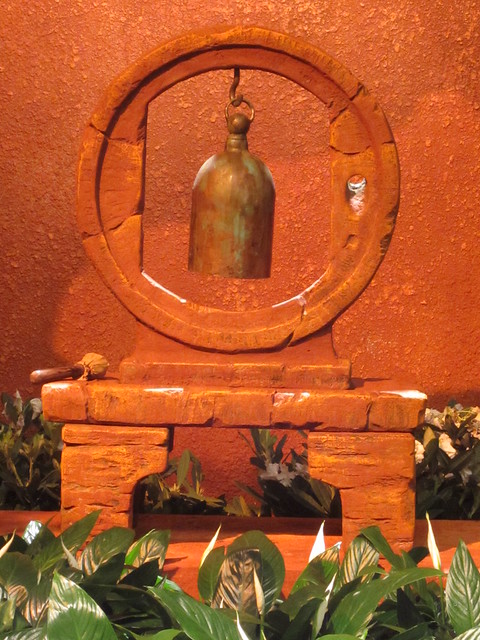
About 2 1/2 miles from here, there is a church with a bell tower. At noon and 6 p.m., if the wind is coming from the south, I can hear the bells. It always makes me take a moment to focus on the bells and the beautiful music they create.
I don't do much beyond that, but that simple gesture is often times enough of a reminder for me to stop and focus - however briefly - on the beauty of sound and all that around me.
• When I hear reports of war, famine, and other disasters, I vow to remember all those who are suffering in my prayers.
There has been so much disturbing news in the paper recently. The images are so graphic and make me stop to reflect about the pain that so many people are enduring on a daily basis throughout the world. I have stopped watching the news at night specifically for this reason. It's just too much for me to take in and process.
Practice of the Day
The Hopi Indians of Arizona believe that our daily rituals and prayers literally keep this world spinning on its axis. For me, feeding the seagulls is one of those everyday prayers.
— Brenda Peterson quoted in American Nature Writing 1994 edited by John A. Murray
To Practice This Thought:
Identify one activity you do every day that can be regarded as a devotional act to sustain the world.
I thought about this and there are several things that I do each day that I could regard as a devotional act to sustain the world. The one, though, that is most consistent is recycling. Every day I am recycling paper; packaging from items I used to cook and bake meals for my family; and/or creating something from an item that could have been tossed.
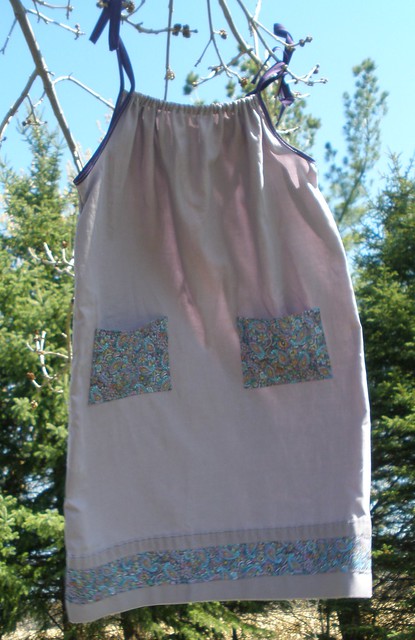
As I look at the dress above that I sewed, I think about the girl who received it. Perhaps she didn't have many clothes, and the dress brought her spirits up on the day it was given to her. She could hold and collect things in the two pockets that were made from fabric that was sitting in one of my fabric bins. The decorative fabric band, also, was made from that same fabric that was just in my room waiting to be used for something.
The pillowcase...that fabric...even the thread - all could have been tossed in a landfill. Instead, I repurposed it into something useful that a child could wear. I need to continue to do things like this - not only to use up what I have on hand, but to help others who I will never see face-to-face in my life, yet are deserving of help to make their lives easier.
Spiritual Exercises
Each week make an effort to simplify your life as an affirmation of your commitment to beauty. Give away or discard one excess possession.
I like this idea and need to start getting in the habit of doing this practice. The timing for this spiritual practice came when I was out of town for several days and trying to get a lot done with 4-H in preparation for a club meeting and two wildlife project bowl meetings. I'm hoping that in March I can retroactively look at this spiritual exercise and make it a regular habit throughout 2015.
Discussion Questions, Storytelling, Sharing
• David Steindl-Rast points out the importance of finding cues to prayer. He tells of two sisters who had a clock that struck every 15 minutes. With each stroke of the clock, one would say, "Remember God's presence," and the other would add, "Let us always be grateful." Talk in your group about what kinds of things spark your prayers.
I contacted a clock repair shop on February 17th to fix our mantel-size grandfather clock. The repair shop makes house calls, and I'm going to get the clock fixed. I miss hearing the rhythmic sound of the clock ticking. It's a sound that was very familiar when I was growing up between the cuckoo clock and grandfather clock with the ticking as well as chimes and cuckoo noises throughout the day and night.
• What benefits have you derived from worshiping in a community? What parts of the service are most satisfying to you?
The benefits for me have been being around like-minded people who enjoy listening to the same inspirational readings, talks, and music during a service. I particularly enjoy the music within any service - instrumental and vocal.
Household, Group, and Community Projects
• Find ways to expand the devotional activities in your household. Use a variety of graces at meals. Incorporate blessing prayers into such activities as leaving for school, going to the grocery store, or washing the car.
I didn't have a chance to do this during the past two weeks, but I like these ideas. So, I'm going to keep this idea as future reference.
Spiritual Practice: Devotion
Enhances: Self-discipline
Balances/Counters: Lack of commitment
Prayer beads.
Taken on October 12, 2012.
The Basic Practice
The Spiritual Practices website noted that "the world's religions demonstrate an amazing variety of ways to practice devotion. To name just a few: Sufis dance. Buddhists chant. Catholics pray with a rosary. Protestants sing hymns. Orthodox Christians meditate on icons. Hindus gather to receive blessings in temples. Jews wrap themselves in a prayer shawl. Native Americans bring up the sun. Muslims make a pilgrimage."
It is suggested to begin by cultivating one's own garden of devotion. The Spiritual Practices website said, "Pick as many seeds to plant as you desire. Water them with love. Be vigilant in your caretaking. Add new plants to the garden for variety. And be happy knowing that this garden" pleases not only yourself, but the world.
Why This Practice May Be For You
Devotion is not something that is done once a week, only on religious holidays, or in response to a particular event in one's life. Special devotions may be called for at those times, but as a spiritual practice, it needs to be part of one's daily routine.
Devotion helps build self-discipline. Being constant in one's prayers prepares a person for other disciplines needed in life. On the other hand, if a person lacks commitment and doesn't tend to follow through in the long run, a devotional life will suffer as well. This practice needs to be done regularly.
Quotes
For the person who is religiously or spiritually inclined,
work even becomes a vehicle for devotion,
a way of utilizing one's gifts and talents to serve others.
— Marsha Sinetar in Do What You Love, the Money Will Follow
Taken at Panola Valley Gardens
on May 21, 2012.
Her garden is work because it is of devotion,
undertaken with passion and conviction,
because it absorbs her,
because it is a task or unrelenting quest which cannot be satisfied.
— Donald Hall in Life Work
I read and wrote a review about Chanting from the Heart - Buddhist Ceremonies and Daily Practices by Thich Nhat Hanh.
The book has a variety of verses, chants, ceremonies, and discourses used regularly by the monks, nuns, and laypeople of a Buddhist monastery and lay practice center in southeastern France. It was established in 1982 by Thich Nhat Hanh and his community.
The other book I read and wrote a review about that focused on devotion was The Mystic Hours - A Daybook of Interspiritual Wisdom and Devotion by Wayne Teasdale. I f The Mystic Hours.
Films
Baraka is an non-narrative film that delivers a collection of snapshots from the global family album. It shows many devotional activities practiced at sacred sites, in homes, and in communities around the world. I ordered this movie, didn't have time to watch it so I had to return it to the library, and then re-ordered it. My goal is to watch it some time in March.
There were two other films that were recommended that I want to watch, but are unavailable through the library system. Perhaps someday I'll be able to find them. The Spiritual Practices website recommended:
- Brother Sun, Sister Moon saying it is "a gorgeous piece of filmmaking by Franco Zeffirelli. [It] is an inspiring and edifying portrait of St. Francis's spiritual practice of devotion and his humble life of service.
• Therese "is a stylized screen portrait of Saint Therese of Lisieux (1873-1897), later to be known as the Little Flower of Jesus, conveys the purity and simplicity of this saint's devotional life."
Music
A wide variety of sacred music is attracting a worldwide audience - including Gregorian chants, and Hindu and Buddhist meditation music.
B'ismillah: Highlights from the Fez Festival of World Sacred Music, Volume I contains Pakistani chants, Egyptian odes, flamenco-style Christian songs, and Sufi dance music. Hamdulillah: Highlights from the Fez Festival of World Sacred Music, Volume II showcases spiritual songs from Iran, medieval Muslim and Andalusian songs, Moroccan Jewish traditional music, and Islamic songs of Central Asia.
Neither of the above-mentioned CDs are available through the local library or MNLINK system of libraries through the state. So, instead I watched a YouTube video that showed excerpts from the opening concert of the Fez Festival of World Sacred Music.There was a combination of singing, drumming, and dance.
The other video I watched is Moments from the Fez Festival of World Sacred Music. The first part includes an introduction by Fez Festival organizers and participants. One person said, "One feels so comfortable when they hear music that they love." Another said, "The only important things is the moment where we are." Another person (Omar al Kyayyam) said, "Be happy for this moment. This moment is your life."
I watched the Whirling Dervishes. I've never seen anything like that before. The men kept twirling around for about four minutes. The amazing thing was that they never lost their balance or fell off the narrow stage.
Daily Cue, Reminder, Vow, Blessing
Taken on April 5, 2013, at
the flower show in downtown Minneapolis.
• The sound of a bell, a church chime, or the stroke of a clock is a cue for me to pray.
About 2 1/2 miles from here, there is a church with a bell tower. At noon and 6 p.m., if the wind is coming from the south, I can hear the bells. It always makes me take a moment to focus on the bells and the beautiful music they create.
I don't do much beyond that, but that simple gesture is often times enough of a reminder for me to stop and focus - however briefly - on the beauty of sound and all that around me.
• When I hear reports of war, famine, and other disasters, I vow to remember all those who are suffering in my prayers.
There has been so much disturbing news in the paper recently. The images are so graphic and make me stop to reflect about the pain that so many people are enduring on a daily basis throughout the world. I have stopped watching the news at night specifically for this reason. It's just too much for me to take in and process.
Practice of the Day
Prayer flags at Pipestone National Monument
(a national park) in Pipestone, Minnesota.
Taken on June 8, 2012.
The Hopi Indians of Arizona believe that our daily rituals and prayers literally keep this world spinning on its axis. For me, feeding the seagulls is one of those everyday prayers.
— Brenda Peterson quoted in American Nature Writing 1994 edited by John A. Murray
To Practice This Thought:
Made a pillowcase dress that was sent to Africa
on April 9, 2010.
Identify one activity you do every day that can be regarded as a devotional act to sustain the world.
I thought about this and there are several things that I do each day that I could regard as a devotional act to sustain the world. The one, though, that is most consistent is recycling. Every day I am recycling paper; packaging from items I used to cook and bake meals for my family; and/or creating something from an item that could have been tossed.
As I look at the dress above that I sewed, I think about the girl who received it. Perhaps she didn't have many clothes, and the dress brought her spirits up on the day it was given to her. She could hold and collect things in the two pockets that were made from fabric that was sitting in one of my fabric bins. The decorative fabric band, also, was made from that same fabric that was just in my room waiting to be used for something.
The pillowcase...that fabric...even the thread - all could have been tossed in a landfill. Instead, I repurposed it into something useful that a child could wear. I need to continue to do things like this - not only to use up what I have on hand, but to help others who I will never see face-to-face in my life, yet are deserving of help to make their lives easier.
Spiritual Exercises
Each week make an effort to simplify your life as an affirmation of your commitment to beauty. Give away or discard one excess possession.
I like this idea and need to start getting in the habit of doing this practice. The timing for this spiritual practice came when I was out of town for several days and trying to get a lot done with 4-H in preparation for a club meeting and two wildlife project bowl meetings. I'm hoping that in March I can retroactively look at this spiritual exercise and make it a regular habit throughout 2015.
Discussion Questions, Storytelling, Sharing
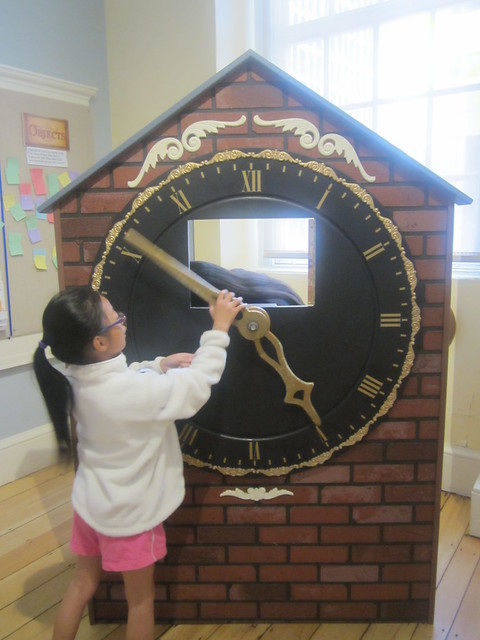
Olivia was playing with a clock while Sophia was playing behind it
on our trip to the New England states.
This was taken on September 9, 2011.
• David Steindl-Rast points out the importance of finding cues to prayer. He tells of two sisters who had a clock that struck every 15 minutes. With each stroke of the clock, one would say, "Remember God's presence," and the other would add, "Let us always be grateful." Talk in your group about what kinds of things spark your prayers.
I contacted a clock repair shop on February 17th to fix our mantel-size grandfather clock. The repair shop makes house calls, and I'm going to get the clock fixed. I miss hearing the rhythmic sound of the clock ticking. It's a sound that was very familiar when I was growing up between the cuckoo clock and grandfather clock with the ticking as well as chimes and cuckoo noises throughout the day and night.
• What benefits have you derived from worshiping in a community? What parts of the service are most satisfying to you?
The benefits for me have been being around like-minded people who enjoy listening to the same inspirational readings, talks, and music during a service. I particularly enjoy the music within any service - instrumental and vocal.
Household, Group, and Community Projects
• Find ways to expand the devotional activities in your household. Use a variety of graces at meals. Incorporate blessing prayers into such activities as leaving for school, going to the grocery store, or washing the car.
I didn't have a chance to do this during the past two weeks, but I like these ideas. So, I'm going to keep this idea as future reference.
Labels:
4-H,
gardening,
geography,
music,
recycle,
Spiritual Practices from A to Z,
Unitarian Universalism,
vacation
Sunday, February 22, 2015
The Mystic Hours - Read 52 Books in 52 Weeks - Week 8
For the 8th week of the Read 52 Books in 52 Weeks challenge, I read The Mystic Hours - A Daybook of Interspiritual Wisdom and Devotion by Wayne Teasdale.
This book actually took me more than a week to read because it is a daily reflection book - so there's one page per day of the year in the book. Each page has a quote and a reflection; with the former being from various faiths. It is a diverse book in terms of beliefs and reflections.
These are some things I want to remember:
- The greatest accomplishment in life is to be who or what you are. (Abbot Thomas Keating)
- Look within to identify our true self and work throughout the year to express it.
- The choice is between nonviolene and nonexistence. (Martin Luther King, Jr.)
- Reason, common sense, and the enduring wisdom of our great religions call us to the realization of our responsibility to embrace this course if we want to survive as a species in a larger community of species. Nonviolence summons us to the clear recognition that we are a fragile human family in a fragile world. In a very real sense, our choice is really between inner growth and destruction.
- Our attachments hold us back from experiencing true happiness. Freeing ourselves from the bondage of attachment requires a mind trained in the pursuit of liberation, a mind able to let go of all that hinders.
- We have to prepare the house by living a committed spiritual life, putting aside time each day for prayer, and most of all practicing compassion and love.
- My religion is kindness...I'd rather be kind than right...You can always be kind. (Tanzin Gyatso, the 14th Dalai Lama)
- Kindness....is the bond connecting all beings in the great web of interdependence in which we all participate and by which we are sustained.
- When we are living in harmony with our nature then we cannot resist being kind, loving, passionate, and merciful.
- If we have no peace, it is because we have forgotten that we belong to each other. (Mother Teresa)
- Only when we remember our inescapable relatedness to one another will peace become a reality.
- Cultivate joy as you would a dear friendship.
- If you would be happy all your life, plant a garden. (Chinese proverb)
- It is often the simple things in life that greatly enrich us and teach us things about ourselves we never knew, but they also open up for us aspects of reality that are necessary for our happiness. Let us not fritter life away in a kind of work and passive entertainment. Rather let us learn the value of contemplation in the power of the simple.
- The mind is like a parachute - it only works when it's open. (Lily Tomlin)
- Genuine growth is only possible if we are open and listening. A closed mind is a recipe for stagnation and mediocrity. People are always threatened by change, especially if it requires them to stretch beyond feelings of security and assumptions about happiness. An open mind and an open heart are indispensable to achieving real maturity, and, even more important, becoming an agent in the happiness of others. Let us strive to keep our minds and hearts open, the openness that education engenders and spirituality develops.
- True greatness is found in the humble disposition. It is an acceptance of reality balanced with an openness to positive change.
- Creativity leads beyond the routine safety of the known. The creative spirit is never satisfied with what we know - or think we know - with past achievements, or the comforts that lull us into a mechanical living of life. Creativity involves stretching beyond our current understanding, attitudes, capacities, and opinions. Through creativity, culture continues to evolve on the back of innovation.
- The creative mind is never content with our current assumptions unless they are founded on deep truth.
- It is not death that is the tragedy of life....[but] what you let die when you are alive. (Robert Muller)
- When they are young, most people have a genuine desire to serve the world, to selflessly contribute to humanity's future and to be future of all sentient beings. Yet many become disillusioned with age and give up on their earlier desire. They settle for something less, like simply achieving the American dream. That dream isn't bad; it's just not enough to realize our potential as spiritual beings.
- A dream that I dream alone is only a dream, but a dream that we dream together is reality. (Raul Seixas).
- Great societal changes...require vision and a movement.
- When we have a worthy dream, an inspired vision, we cannot keep it to ourselves; we must share it with others if it is to catch the popular imagination and eventually become imbedded in others' collective hopes, becoming the dream of the people.
- Music inspires, opening minds and moving hearts. Great music appeals to our emotions, stirs up feelings, aspirations, and possibilities.
- Let us be aware of music's potential to lead us and inspire us. Let us allow music to carry our deepest intention.
- The highest wisdom is kindness. (Berakot)
- Kindness will eventually transform the entire existence of an individual, having reverberations in the community and the world. Let us allow ourselves to be refashioned by the effective and beautiful quality of kindness.
- When we become truly established in other-centeredness, where we put the well-being of the community above our own self-interest, then we somehow also speak and act for the Divine.
- Zen Buddhism infuses that country's ancient culture, whoever is so grounded in right motivation and behavior thinks, speaks, and acts in the light of the ancestors.
- All we need to know is present in the world; it is written in the nature of the earth. Let us dedicate ourselves to discovering that natural wisdom present in the world so that we can spread this awareness and change the course of the world.
- Courage does not ignore danger, nor does it negate fear; it concentrates on what must be done and on the hope of something better.
- Go placidly amid the noise and haste, and remember what peace there may be in silence.
- It is always the secure who are humble. (G.K. Chesterton)
- The humble are secure precisely because they are humble, and the secure are secure because they have this humility of heart....the security...comes from wisdom.
- It is the easiest thing in the world for a person to deceive himself. (Benjamin Franklin)
- We deceive ourselves when we ruthlessly seek our wants or use other people to obtain them. We lie to ourselves to shield our conscience from the truth. When we deceive ourselves, we are hurting ourselves the most. The cure is pure honesty and humility. True humility never tolerates self-deception.
- Seek the company of the wise, to associate with people who have a similar conviction, who are looking in the same direction. One virtue implies others: A generous soul may also be courageous, kin, compassionate, loving, and patient.
- The purpose each one of us has is not merely a mission external to us, but has a lot to do with unfolding and developing our gifts, especially who we are in our capacity for mercy, kindness, and love, the cultivation of which is an essential part of the task of life.
- Until humankind extends its circle of compassion to all living things, it will not itself find peace. (Albert Schweitzer)
- There is no possibility of a mature spiritual life without humility. Nor is it possible to be a successful human being without it. Humility is also, most fundamentally, a relationship of truth with ourselves.
- We acknowledge our mistakes, not years from now, but when they are made. We must be willing to own up to these mistakes before others and not simply ourselves.
- In compassion, kindness, and love, we discern what is needed and we respond. We are a good listener to some, a provider of strength to others, a fierce advocate and prophet to still others.
- No person was ever honored for what he received. Honor has been the reward for what he gave. (Calvin Coolidge)
- Individual happiness by itself, alone is an illusion. It's superficial and doesn't last. When we work for the happiness of others, or as the poet Ralph Waldo Emerson says, pour it on others, we become happy in the process. What we give out returns to us, and if we are constantly contributing to the welfare, joy, and happiness of others, we will receive these blessings in return.
- The first step in personhood is to allow ourselves to be loved. (John Main)
- When we accept love from others, we open ourselves to the possibility to genuine happiness, which arises in us as we find ourselves giving love in return. Being loved increases our own capacities to love - to be merciful, kind compassionate, and sensitive - all capacities that lead to true happiness. Love opens up the whole spectrum of human greatness: other-centeredness, self-sacrifice, heroic virtue, joy, and deeds of extraordinary generosity.
- You cannot do a kindness too soon, for you never know how soon it will be too late. (Anonymous)
- We don't know if we have a tomorrow here in this world: we have no guarantees. But we do have the present moment, the now, and that's where we can choose to be kind, to respond to a loving, compassionate way.
- As soon as the waves have stopped and the lake has become quiet, we see its bottom. So with the mind when it is calm, we see what our nature is.
- Giving of ourselves to help others works in two ways: it benefits the recipient and it benefits the giver.
- Teaches open the door. You enter yourself.
- A person's true wealth is the good he does in this world. (Muhammad)
- None of the material wealth of this world lasts. The only things that follow us into eternity are our good works.
- The only reason for material wealth is to share it with the less fortunate, not to hoard it for oneself. This is our glory as spiritual beings: to assuage the sufferings of others, to others, to offer what we have to those in need.
- The end and aim of all education is the development of character. (Francis W. Parker)
- The medieval Christian ideal of learning also focused on the education of the whole peson: body, soul, and spirit.
- The Tibetan tradition places great emphasis on the good heart.
- We simply pay too much attention to facts and skills and not enough to fostering responsibility, ethics, charity, and kindness.
- Our relationship with the natural world is not primarily stewardship. It's primarily rapport, admiration, interaction with, and listening to. (Thomas Berry)
- The soul is the sense of something higher than ourselves, something that stirs in us thoughts, hopes, and aspirations which go out to the world of goodness, truth, and beauty. (Albert Schweitzer)
- When we look at the extent of cosmic time, our lives are as brief as fleas. The brevity of life should alert us to the purpose of our existence: to grow in compassion, kindness, love, and sensitivity. Time is short and there is so much to learn, to be, and to do. Impermanence frames the field of our growth. Focus on what is necessary and leave all else behind.
- The positive side of frustration and discontent is the beginning of discovering your dream. It is a sign that the deeper aspects of who you are need to find a vehicle to actualization in your life. Whether the frustration you feel is related to a talent you have that lacks an outlet, a vision you have of where you want to be, or some creative project you can't quite get started on, you have to listen to your discontent because it is. A gift we give ourselves gives us to move us forward in realizing our dream.
- Humor bonds us with others: it builds intimacy, trust, and a positive attitude.
- A sense of humor is one of the surest signs of balance and perspective in ordinary life - a sign that someone understands that life is meant to be enjoyed and that we can find something funny even in our deepest foibles, mistakes, and misfortunes.
- At the end of life, when someone has lived a life with consciousness and they look back on it, the questions are simple: "Did I live fully?" and, more than anything else, "Did I love well?" (Jack Kornfield)
- To live life with awareness is to live each moment with real sensitivity and receptivity to others, their sufferings and need. To live fully is to be aware of the opportunities to be compassionate and loving toward others. To love well is to love unselfishly and to strive to be ever more inclusive, extending one's care even to those with whom we would not ordinarily associate. It is to be spontaneously open and receptive to those we meet who may need us in some way.
- Our lives begin to end the day we become silent about things that matter. (Martin Luther King, Jr.)
- To bring the four energies together in the moment - physical, intellectual, spiritual, and emotional - is the fundamental artistic act. This is where the joy arises. (Dick Richards)
- Just as a tree, a bush, or a flower cannot live without roots, we cannot live without being firmly established in our souls. The soul should also be nourished and cared for, just as a gardener nurtures the growth and well-being of his garden. Prayer, meditation, kindness, and love are ways to nourish the soul, the root of our being.
- Compassion for yourself translates into compassion for others. (Suki Jay Munsell)
- Every time we suffer, we grow. (Ram Dass)
- Suffering has a way of opening our hearts and putting us in touch with our compassionate nature. Suffering teaches us to love and to be kind, compassionate, and sensitive to the struggles of others. It is the greatest means of enlarging our perspective.
- Constantly rushing discourages authentic behavior. It is the opposite of compassion, kindness, love, and sensitiviyt, and more important, it is the enemy of being present, both to the moment and to others. To be truly present, we have to take our time, whether we are looking at the task at hand, which we can then do with good intention and efficiency, or listening to the people around us, who we can respond to authentically and appropriately. When we're in our hurried state, we are unable to attend to spiritual practice. Allow yourself to slow down and be present to others and to the miracle of the present moment.
- You always carry within yourself the very thing that you need for the fulfillment of your life purpose. (Malidoma Some)
- Each person has a mission, a work they must contribute to the whole. It appears vaguely at first, a nagging dissatisfaction or an inkling of desire for greater things, but within a disciplined inner journey, the process of becoming honest with ourselves, we can come to realize our life purpose.
- We cannot do great things, only little things with great love. (Mother Teresa)
- She knew that great opportunities are rare and that the little opportunities that come our way every day provide the occasions for us to grow in love by transcending ourselves.
- Your trials did not come to punish you, but to awaken you. (Paramahansa Yogananda)
- Challenges bring us to our sense about our lives. They can serve as vehicles of realization, helping us to understand why we are here and how necessary the spiritual journey is for us. They awaken us to the serious purpose of life and inspire us not to waste this opportunity on a halfhearted existence.
15 Creative Goals in 2015
I've been thinking about what I want to learn and do in terms of my creative goals in 2015. Although almost two months have already passed, there's still ten months ahead to incorporate more creative time in my life.
During 2015, I want to:
1. Learn how to do fused glass.
2. Do glass blowing.
3. How to build a portable brick oven so I can create homemade pizzas and breads in it during the summer.
4. Finish all the WIP (works in progress) in the bin.
5. Go through all the fabric bins and donate what I no longer like or want.
6. Use the bag of felted wool to make a project (or two).
7. Learn 3 new crocheting stitches.
8. Make a pair of socks using the sock loom.
9. Learn to knit and make something useful.
10. Use some of Dad's clothes and make legacy gifts to give to Mom, Mary, Jim, and me.
11. Do two upcycled crafts that use jeans.
12. Make six handmade cards using inspiration from other DIY cards.
13. Make three homemade bath products.
14. Paint and install a barn quilt.
15. Make something for the next door neighbor's daughter who is expecting her first child this spring, and who has a baby shower in March. Did this on March 1st. I made two baby bassinets from diapers and a washcloth bouquet.
During 2015, I want to:
1. Learn how to do fused glass.
2. Do glass blowing.
3. How to build a portable brick oven so I can create homemade pizzas and breads in it during the summer.
4. Finish all the WIP (works in progress) in the bin.
5. Go through all the fabric bins and donate what I no longer like or want.
6. Use the bag of felted wool to make a project (or two).
7. Learn 3 new crocheting stitches.
8. Make a pair of socks using the sock loom.
9. Learn to knit and make something useful.
10. Use some of Dad's clothes and make legacy gifts to give to Mom, Mary, Jim, and me.
11. Do two upcycled crafts that use jeans.
12. Make six handmade cards using inspiration from other DIY cards.
13. Make three homemade bath products.
14. Paint and install a barn quilt.
15. Make something for the next door neighbor's daughter who is expecting her first child this spring, and who has a baby shower in March. Did this on March 1st. I made two baby bassinets from diapers and a washcloth bouquet.
Labels:
aromatherapy,
art,
art education,
barn quilt,
card making,
cooking,
creativity,
crochet,
felting,
goal setting,
knitting,
legacy gifts,
memories,
needlefelted,
quilt making
Monday, February 16, 2015
Spiritual Practices A to Z: Compassion
This is the third focus of the "Spiritual Practices A to Z" challenge that I'm doing that is based on the spiritual practices that are shared on the Spirituality & Practice website. So far I have focused on Attention and Beauty. For the past two weeks, I focused on the spiritual practice of Compassion.
The Basic Practice
Compassion is a feeling deep within ourselves and a way of acting — being affected by the suffering of others and moving on their behalf. Buddha and Jesus are the two most well-known exemplars of compassion, and it is the central ethical virtue in the two religions that developed from their teachings.
As the Spiritual Practices website said, "The spiritual practice of compassion is often likened to opening the heart. First, allow yourself to be feel the suffering in the world, including your own. Don't turn away from pain; move toward it with caring. Go into situations where people are hurting. Identify with your neighbors in their distress. Then expand the circle of your compassion to include other creatures, nature, and the inanimate world."
Why This Practice May Be For You
The practice of compassion increases our capacity to care. It reinforces empathy, sympathy, and charity.
However, when you move toward others with compassion, you are likely to encounter some common attitudes that want you to close your heart again. The usual suspects are judgment and all its associated "isms": ageism, classism, racism, sexism, and nationalism.
On a personal level, your compassion is sabotaged by feelings of ill will toward others: malice and spite. These feelings, and others arising out of personal pain and emotional wounds, are actually symptoms indicating that you need to have compassion for yourself.
The Jain religion in India teaches that because all life is essentially interrelated and interconnected, all living beings should be considered sacred and be respected. This belief forms the basis of the doctrine of ahimsa, which has been translated into English variously as "reverence for life," "nonviolence," and "dynamic compassion."
— Nathaniel Altman in Sacred Trees
When we were volunteering at Northwoods Humane Society on February 13th, we noticed Jet who was in her kennel at the very back pressed up against the wall. She appeared frightened and very timid. Brenda (the executive director) had to carry her out and gently push her into the room where we were sitting.
Within five minutes of listening to harp music and being petted, Jet was feeling more relaxed. She even ate two bowls of soft food. Her expression and demeanor changed from one of fear and anxiety to one of happiness and relaxation.
She was moved to a quieter area at Northwoods after her time in the room with us and seemed to be doing significantly better. Her ears were up, she looked alert, and she was so much more engaged and happy. She's going to make a family who adopts her very happy.
We are beginning to learn that each animal has a life and a place and a role in this world. If we place compassion and care in the middle of all our dealings with the animal world and honor and respect their lives, our attitudes will change.
— Jane Goodall in The Ten Trusts
What do you want to achieve? The Dalai Lama responded, "To be happy. My practice helps me lead a useful life. If I can give some short moment of happiness to others, then I feel that my life has achieved some purpose. This gives me deep mental satisfaction — this feeling always comes if you serve others. So when I help others, I feel happy. For me, the most important thing is human compassion, a sense of caring for one another."
— His Holiness the Dalai Lama quoted in The Big Questions by Lama Surya Das
Every time I hold a bowl of rice, I know how fortunate I am. I know that forty thousand children die every day because of the lack of food and that many people are lonely, without friends or family. I visualize them and feel deep compassion. You don't need to be in a monastery to practice this. You can practice at home at your dinner table. Eating mindfully is a wonderful way to nourish compassion and it encourages us to do something to help those who are hungry and lonely.
— Thich Nhat Hanh in Living Buddha, Living Christ
Books
I checked out two books from the library during the last two weeks: The Rhythm of Compassion - Caring for Self, Connecting with Society and How to Be Compassionate: A Handbook for Creating Inner Peace and a Happier World.
The first book I began reading, The Rhythm of Compassion - Caring for Self, Connecting with Society by Gail Straub, has taken me the entire two weeks to read. The book compares the relationship between soul and society to the in-breath and the out-breath of meditation practice.
She presents stories of individuals who have struggled to maintain balance while caring for self and caring for the world as well as questions that prompt the reader to reflect on their inner life and who they are; and their life of service.
The most critical part is finding a central image that influences how we see our personal life, identifying the legacies we've inherited from our parents, and exposing where we belong and where we hide.
The author discusses four qualities of mature compassion — a quiet mind, an open heart, presence, and radical simplicity. We can become more compassionate by making a place for imagination, discipline, and support in our lives.
However, our helping is tainted when "the ego wants to fix, to make things perfect, to reorder someone else's life, to do something to maintain the illusion of control."
There are so many insights into this book about my own life and focus on helping others. I am taking my time with it to fully reflect on it, and think about ways to be both more compassionate to myself as I try to be with others through volunteering and service.
The second book that I checked out is How to Be Compassionate: A Handbook for Creating Inner Peace and a Happier World by His Holiness The Dalai Lama. I have not had a chance to read it yet, but it is focused on the Tibetan techniques for how to transform one's mind and heart. The book is supposed to have a "soul-stirring, enlightening array of material gleaned from science, religion, theology, psychology, and [The Dalai Lama's] own adventures of living a compassionate life."
Films
There's a movie called Damien that's a one-man drama focusing on the suffering servanthood ministry of Father Damien, a priest who put his life on the line for lepers isolated on Molokai island in Hawaii. This movie was unavailable through any Minnesota library, so I ordered a book instead about Father Damien.
Music
Benjamin Britten's War Requiem was first performed at the 1962 dedication of the new Coventry Cathedral built next to the ruins of the cathedral destroyed during World War II.
In this choral work, Britten alternates the language of the mass with tenor and baritone solos taken from the antiwar poetry of Wilfred Owen, who died on the battlefield in World War I. Compassion is a constant companion of this powerful music.
The YouTube video I found is 91 minutes. It is an impressive work of art that includes a full orchestra and choir.
According to Wikipedia, "The traditional Latin texts are interspersed, in telling juxtaposition, with settings of poems by Wilfred Owen, written in World War I. The work is scored for soprano, tenor and baritone soloists, chorus, boys' choir, organ, and two orchestras (a full orchestra and a chamber orchestra). The chamber orchestra accompanies the intimate settings of the English poetry, while soprano, choirs and orchestra are used for the Latin sections; all forces are combined in the conclusion."
Art
Two of Pablo Picasso's most famous paintings evoke compassion. Guernica, painted in 1937 for the Spanish Pavilion at the Paris World's Fair, reflects the artist's visceral response to the destruction caused by the Spanish Civil War.
Picasso created this piece in response to the bombing of Guernica, a Basque Country village in northern Spain, by German and Italian warplanes at the behest of the Spanish Nationalist forces on April 26, 1937, during the Spanish Civil War.
According to Wikipedia, "Guernica is a statement against fascism, showing the tragedies of war and the suffering it inflicts upon individuals, particularly innocent civilians. This work has gained a monumental status, becoming a perpetual reminder of the tragedies of war, an anti-war symbol, and an embodiment of peace. Upon completion, Guernica was displayed around the world in a brief tour, becoming famous and widely acclaimed. This tour helped bring the Spanish Civil War to the world's attention."
Weeping Woman, from the same year, is considered to be a postscript to Guernica.
The Weeping Woman series, according to Wikipedia, "...is regarded as a thematic continuation of the tragedy depicted in Picasso's epic painting Guernica. In focusing on the image of a woman crying, the artist was no longer painting the effects of the Spanish Civil War directly, but rather referring to a singular universal image of suffering."
Daily Cue, Reminder, Vow, Blessing
Seeing someone in pain is my cue to practice compassion.
When I was volunteering at the nursing home on February 13th, there were several people who were having difficult afternoons because of their challenges with dementia. All were part of the Music & Memory program, so I helped the CNAs get the iPods with the personalized music and the headphones and put them on the seniors. Listening to the music helps reduce stress and anxiety as well as some of the behaviors that appear because of dementia (e.g., yelling out).
I am so thankful that I was trained to do the Music & Memory program, and that we are able to bring the gift of music to seniors.
Practice of the Day
If you see on the evening news a person who moves you by his distress, just breathe it in and breathe out to him love and strength.
— Andrew Harvey in The Direct Path
To Practice This Thought: Send love to a stranger you notice is in need.
Spiritual Exercise
Create a Compassion Collage. I didn't do this since I didn't have magazines that I could cut up, but do want to do this in the future. Basically, the activity is to gather pictures of people, places, and things for which you feel compassion. You may take photos yourself, cut them out of magazines and newspapers, copy them from books, or find them in the direct mail appeals from service organizations.
Look for strong pictures to which you have an emotional response, no matter how painful. Include examples of the suffering of animals, nature, and things.
Add words or symbols to represent others areas of concern — "Earthquake" to remind you to feel compassion for victims of natural disasters, "Prison" for political prisoners and those who have committed crimes, or "Garbage" to note the suffering caused by wasteful consumption - for example.
Leave one area of your collage blank for what has not yet touched your compassionate heart. Keep your collage in a place where you can contemplate it at least once every day. One or more images may become the focus of prayer or meditation.
Hand Collage - One of the activities that I did see during the two-week time period focused on Compassion was one that was done at the 4-H BLU conference on February 7-8, 2015. The youth were in small groups and each traced her/his hand onto a piece of white paper.
Inside their hands they put things that they liked to do with others. From the overlapping hands, you could see how the youth were different from one another - yet could come together, support one another, and make a difference in the world.
Journal Exercises
• Identify an area where you need to be compassionate to yourself. Write about how you will go about this.
Interestingly, this issue came up at the beginning of the month when I was journaling and before I had read about this exercise. I wrote about how the upcoming several months - particularly the next few weeks - already feel like they are out of balance with a lot of volunteering and not enough time at home.
One of the challenges that I'm going to need to address is how to balance my time - homeschooling, volunteering, and caring for my family - so that I don't burn out and/or am not effective.
• Make a list of "missed opportunities" to show compassion to poor, sick, lonely, alienated, or hurting beings. Look for any patterns in your behavior or inaction. Identify an obstacle or rationalization that has kept you from being more compassionate.
This is something that I wrote in my journal about.
Discussion Questions, Storytelling, Sharing
The following are two things to reflect upon not only during this two-week time period, but throughout the year:
• Share an example of a situation when your willingness to be compassionate was tested. What do you usually do when you meet someone in need of help? What kinds of questions do you ask yourself? What conditions do you set?
• Tell a story about a moral mentor you have known-someone who inspired you with his or her compassionate activity.
Household, Group, and Community Projects
• Go on a fast. If you are inexperienced in this practice, begin with a one-day fast. Eat only fruits or vegetables and drink at least eight glasses of water. Or skip a meal a day for one week. Use the time you would have spent preparing and eating food for quiet reflection on the experience of being hungry. Feel compassion for the millions of people around the world who do not have enough to eat.
I didn't do this, but want to remember that this may be an action to take at some point in the future.
• Volunteer to serve meals at a soup kitchen, to carry meals to shut-ins, to read to people in the hospital, or to do any other activity that puts you close to suffering.
On February 13th, Sophia, Olivia, and I volunteered at Northwoods Humane Society to provide music therapy and extra attention to dogs and cats who were experiencing higher-than-normal levels of anxiety or stress, or needed some one-on-one time with people.
That afternoon, we spent time with about 15 seniors and helped them frost and decorate cookies for Valentine's Day. For many of them, they needed help remembering how to use a knife and put frosting on a cookie, and what to do with sprinkles. It was pretty sobering to see that such a basic activity was so challenging for many of the them.
I also had the opportunity to put the Music & Memory headphones on seniors who had dementia or Alzheimer's Disease who were having difficulty that afternoon.
On February 14th, Olivia and I visited my mom who is considered a shut-in. She was thrilled to have us spend time with her and eat lunch that I had prepared that morning for her. We had a nice conversation and time together.
Sophia helping Darlene frost and decorate cookies
for Valentine's Day at the nursing home.
(Taken on February 13, 2015)
Spiritual Practice: Compassion
Enhances: Caring
Balances/Counters: Judgment, Pain
The Basic Practice
Compassion is a feeling deep within ourselves and a way of acting — being affected by the suffering of others and moving on their behalf. Buddha and Jesus are the two most well-known exemplars of compassion, and it is the central ethical virtue in the two religions that developed from their teachings.
Olivia helping Annabelle at the Valentine's Day
cookie decorating activity at
the nursing home on February 13, 2015.
As the Spiritual Practices website said, "The spiritual practice of compassion is often likened to opening the heart. First, allow yourself to be feel the suffering in the world, including your own. Don't turn away from pain; move toward it with caring. Go into situations where people are hurting. Identify with your neighbors in their distress. Then expand the circle of your compassion to include other creatures, nature, and the inanimate world."
Sophia tuning her harp in preparation for
our time at Northwoods Humane Society.
We are starting to do music therapy for the animals
who are waiting to be adopted there
which has been very rewarding.
This is Bridgett listening to Sophia.
(February 13, 2015.)
Why This Practice May Be For You
The practice of compassion increases our capacity to care. It reinforces empathy, sympathy, and charity.
On May 12, 2011, over 30 volunteers from
Keller Williams in Maple Grove came to
my parents home to help them with outdoor work
as well as making their home safe indoors.
This was for their annual Red Day (volunteer day).
The volunteers had such great attitudes and
worked through the pouring rain.
My parents are so happy - and thankful - that they were chosen to
receive all the help and improvements to their home.
Why were they selected?
Keller Williams was looking for families
who have made a difference in the community.
My dad was in the very advanced stages of Alzheimer's Disease, and
my mom had significant mobility and other health issues.
However, when you move toward others with compassion, you are likely to encounter some common attitudes that want you to close your heart again. The usual suspects are judgment and all its associated "isms": ageism, classism, racism, sexism, and nationalism.
On a personal level, your compassion is sabotaged by feelings of ill will toward others: malice and spite. These feelings, and others arising out of personal pain and emotional wounds, are actually symptoms indicating that you need to have compassion for yourself.
Quotes
Compassion is a foundation for sharing our aliveness and
building a more humane world.
— Martin Lowenthal in Opening the Heart of Compassion

Olivia filling a sock with toiletries and
other personal care items that will be
donated to a person experiencing homelessness.
(Taken on February 5, 2015.)
Olivia filling a sock with toiletries and
other personal care items that will be
donated to a person experiencing homelessness.
(Taken on February 5, 2015.)
Like a mother who protects her child,
her only child,
with her own life,
one should cultivate a heart of unlimited love and
compassion towards all living beings.
— The Buddha quoted in The Mystic Vision
edited by Andrew Harvey and Anne Baring
Olivia and I brought lunch to my mother on Valentine's Day.
I made tuna noodle salad with eggs and
chopped all the vegetables very small so she could eat them
(she has lost most of her lower teeth).
We had fresh strawberries and mandarin oranges,
rosemary crackers, and chocolate cookies.
She has a container of potted tulips that
will grow over the next few weeks.
(Taken on February 14, 2015.)
The Jain religion in India teaches that because all life is essentially interrelated and interconnected, all living beings should be considered sacred and be respected. This belief forms the basis of the doctrine of ahimsa, which has been translated into English variously as "reverence for life," "nonviolence," and "dynamic compassion."
— Nathaniel Altman in Sacred Trees
When we were volunteering at Northwoods Humane Society on February 13th, we noticed Jet who was in her kennel at the very back pressed up against the wall. She appeared frightened and very timid. Brenda (the executive director) had to carry her out and gently push her into the room where we were sitting.
Within five minutes of listening to harp music and being petted, Jet was feeling more relaxed. She even ate two bowls of soft food. Her expression and demeanor changed from one of fear and anxiety to one of happiness and relaxation.
She was moved to a quieter area at Northwoods after her time in the room with us and seemed to be doing significantly better. Her ears were up, she looked alert, and she was so much more engaged and happy. She's going to make a family who adopts her very happy.
Compassion is the intention to see each human being
as no better or worse than yourself,
neither more nor less important, and
as fundamentally similar to yourself.
— Timothy Miller in How to Want What You Have
Because my mom has significant vision issues (she's blind in both eyes),
we bought her a Valentine's Day card
that hopefully she could see.
Sure enough, when she took the card out of the envelope,
she said, "I can see it!"
Her smile was heart-warming for me to see.
Olivia read her the message, and
I noticed as she was reading it my mom had her hand on her heart.
She had tears in her eyes as Olivia read to her.
(Taken on February 14, 2015.)
To grow old is to pass from passion to compassion.
— Albert Camus quoted in Letters to a Young Doubter by William Sloane Coffin
We are beginning to learn that each animal has a life and a place and a role in this world. If we place compassion and care in the middle of all our dealings with the animal world and honor and respect their lives, our attitudes will change.
— Jane Goodall in The Ten Trusts
On the day that Bailey was adopted from the
Minnesota Hooved Animal Rescue Foundation (August 13th),
we have welcomed and tried to provide comfort to her.
She was not use to eating grass (she was in a dry lot and ate baled hay),
so she needed to be slowly transitioned to
being able to eat fresh grass.
During the first week after she was adopted,
the vet came out to do an overall check on her.
He noticed that she was blind in her right eye, and
had some pigment issue with the left eye.
This has required compassionate care as
we helped her learn her new environment,
meet a new equine friend who was adopted on the same day, and
helped her trust us.
(Taken on August 13, 2009)
What do you want to achieve? The Dalai Lama responded, "To be happy. My practice helps me lead a useful life. If I can give some short moment of happiness to others, then I feel that my life has achieved some purpose. This gives me deep mental satisfaction — this feeling always comes if you serve others. So when I help others, I feel happy. For me, the most important thing is human compassion, a sense of caring for one another."
— His Holiness the Dalai Lama quoted in The Big Questions by Lama Surya Das
Sophia packaging up boxes of books that
we shipped to Lesotho, Africa, to establish a library in a primary school.
(Taken on December 7, 2012.)
All beings wish for happiness, so extend your compassion to all.
— The Buddha quoted in Buddhist Wisdom by David Crosweller
Olivia helping to fold and organize clothes for
a clothing giveaway at a local church.
(Taken on May 19, 2011.)
Every time I hold a bowl of rice, I know how fortunate I am. I know that forty thousand children die every day because of the lack of food and that many people are lonely, without friends or family. I visualize them and feel deep compassion. You don't need to be in a monastery to practice this. You can practice at home at your dinner table. Eating mindfully is a wonderful way to nourish compassion and it encourages us to do something to help those who are hungry and lonely.
— Thich Nhat Hanh in Living Buddha, Living Christ
Olivia and Sophia donating food to the food shelf.
(Taken on July 31, 2012.)
Books
I checked out two books from the library during the last two weeks: The Rhythm of Compassion - Caring for Self, Connecting with Society and How to Be Compassionate: A Handbook for Creating Inner Peace and a Happier World.
The first book I began reading, The Rhythm of Compassion - Caring for Self, Connecting with Society by Gail Straub, has taken me the entire two weeks to read. The book compares the relationship between soul and society to the in-breath and the out-breath of meditation practice.
She presents stories of individuals who have struggled to maintain balance while caring for self and caring for the world as well as questions that prompt the reader to reflect on their inner life and who they are; and their life of service.
Sophia, Olivia, and I helped make meat and cheese sandwiches
that were donated to a program that
served those who were experiencing homelessness.
(Taken on September 23, 2012.)
The most critical part is finding a central image that influences how we see our personal life, identifying the legacies we've inherited from our parents, and exposing where we belong and where we hide.
The author discusses four qualities of mature compassion — a quiet mind, an open heart, presence, and radical simplicity. We can become more compassionate by making a place for imagination, discipline, and support in our lives.
I am petting Bridget as she listens to harp music.
We are volunteering once at month
at Northwoods Humane Society.
(Taken on February 13, 2015.)
However, our helping is tainted when "the ego wants to fix, to make things perfect, to reorder someone else's life, to do something to maintain the illusion of control."
There are so many insights into this book about my own life and focus on helping others. I am taking my time with it to fully reflect on it, and think about ways to be both more compassionate to myself as I try to be with others through volunteering and service.
The second book that I checked out is How to Be Compassionate: A Handbook for Creating Inner Peace and a Happier World by His Holiness The Dalai Lama. I have not had a chance to read it yet, but it is focused on the Tibetan techniques for how to transform one's mind and heart. The book is supposed to have a "soul-stirring, enlightening array of material gleaned from science, religion, theology, psychology, and [The Dalai Lama's] own adventures of living a compassionate life."
Sophia with Nora - one of the dogs that
came into the room when she was playing the harp.
Olivia and I each spent time with Nora.
(Taken on February 13, 2015.)
There's a movie called Damien that's a one-man drama focusing on the suffering servanthood ministry of Father Damien, a priest who put his life on the line for lepers isolated on Molokai island in Hawaii. This movie was unavailable through any Minnesota library, so I ordered a book instead about Father Damien.
Music
Benjamin Britten's War Requiem was first performed at the 1962 dedication of the new Coventry Cathedral built next to the ruins of the cathedral destroyed during World War II.
Winston Churchill visiting the ruins of
the Coventry Cathedral in 941.
In this choral work, Britten alternates the language of the mass with tenor and baritone solos taken from the antiwar poetry of Wilfred Owen, who died on the battlefield in World War I. Compassion is a constant companion of this powerful music.
Wilfred Owen.
The YouTube video I found is 91 minutes. It is an impressive work of art that includes a full orchestra and choir.
According to Wikipedia, "The traditional Latin texts are interspersed, in telling juxtaposition, with settings of poems by Wilfred Owen, written in World War I. The work is scored for soprano, tenor and baritone soloists, chorus, boys' choir, organ, and two orchestras (a full orchestra and a chamber orchestra). The chamber orchestra accompanies the intimate settings of the English poetry, while soprano, choirs and orchestra are used for the Latin sections; all forces are combined in the conclusion."
Art
Two of Pablo Picasso's most famous paintings evoke compassion. Guernica, painted in 1937 for the Spanish Pavilion at the Paris World's Fair, reflects the artist's visceral response to the destruction caused by the Spanish Civil War.
Picasso created this piece in response to the bombing of Guernica, a Basque Country village in northern Spain, by German and Italian warplanes at the behest of the Spanish Nationalist forces on April 26, 1937, during the Spanish Civil War.
According to Wikipedia, "Guernica is a statement against fascism, showing the tragedies of war and the suffering it inflicts upon individuals, particularly innocent civilians. This work has gained a monumental status, becoming a perpetual reminder of the tragedies of war, an anti-war symbol, and an embodiment of peace. Upon completion, Guernica was displayed around the world in a brief tour, becoming famous and widely acclaimed. This tour helped bring the Spanish Civil War to the world's attention."
Weeping Woman, from the same year, is considered to be a postscript to Guernica.
The Weeping Woman series, according to Wikipedia, "...is regarded as a thematic continuation of the tragedy depicted in Picasso's epic painting Guernica. In focusing on the image of a woman crying, the artist was no longer painting the effects of the Spanish Civil War directly, but rather referring to a singular universal image of suffering."
Daily Cue, Reminder, Vow, Blessing
Seeing someone in pain is my cue to practice compassion.
When I was volunteering at the nursing home on February 13th, there were several people who were having difficult afternoons because of their challenges with dementia. All were part of the Music & Memory program, so I helped the CNAs get the iPods with the personalized music and the headphones and put them on the seniors. Listening to the music helps reduce stress and anxiety as well as some of the behaviors that appear because of dementia (e.g., yelling out).
Music has the power to reduce stress and anxiety; and
create the feeling of happiness in those with
dementia and Alzheimer's Disease.
(Taken on January 23, 2015.)
I am so thankful that I was trained to do the Music & Memory program, and that we are able to bring the gift of music to seniors.
Practice of the Day
If you see on the evening news a person who moves you by his distress, just breathe it in and breathe out to him love and strength.
— Andrew Harvey in The Direct Path
To Practice This Thought: Send love to a stranger you notice is in need.
Spiritual Exercise
Create a Compassion Collage. I didn't do this since I didn't have magazines that I could cut up, but do want to do this in the future. Basically, the activity is to gather pictures of people, places, and things for which you feel compassion. You may take photos yourself, cut them out of magazines and newspapers, copy them from books, or find them in the direct mail appeals from service organizations.
Look for strong pictures to which you have an emotional response, no matter how painful. Include examples of the suffering of animals, nature, and things.
Add words or symbols to represent others areas of concern — "Earthquake" to remind you to feel compassion for victims of natural disasters, "Prison" for political prisoners and those who have committed crimes, or "Garbage" to note the suffering caused by wasteful consumption - for example.
Leave one area of your collage blank for what has not yet touched your compassionate heart. Keep your collage in a place where you can contemplate it at least once every day. One or more images may become the focus of prayer or meditation.
Hand Collage - One of the activities that I did see during the two-week time period focused on Compassion was one that was done at the 4-H BLU conference on February 7-8, 2015. The youth were in small groups and each traced her/his hand onto a piece of white paper.
Inside their hands they put things that they liked to do with others. From the overlapping hands, you could see how the youth were different from one another - yet could come together, support one another, and make a difference in the world.
Above: Sophia and Olivia in their small groups
working on the hand tracings.
Below: The hand tracings of Sophia's group.
Some of the positive and inspiring messages that
the youth wrote at the 4-H BLU conference
on February 7-8, 2015.
• Identify an area where you need to be compassionate to yourself. Write about how you will go about this.
Interestingly, this issue came up at the beginning of the month when I was journaling and before I had read about this exercise. I wrote about how the upcoming several months - particularly the next few weeks - already feel like they are out of balance with a lot of volunteering and not enough time at home.
One of the challenges that I'm going to need to address is how to balance my time - homeschooling, volunteering, and caring for my family - so that I don't burn out and/or am not effective.
• Make a list of "missed opportunities" to show compassion to poor, sick, lonely, alienated, or hurting beings. Look for any patterns in your behavior or inaction. Identify an obstacle or rationalization that has kept you from being more compassionate.
This is something that I wrote in my journal about.
Discussion Questions, Storytelling, Sharing
The following are two things to reflect upon not only during this two-week time period, but throughout the year:
• Share an example of a situation when your willingness to be compassionate was tested. What do you usually do when you meet someone in need of help? What kinds of questions do you ask yourself? What conditions do you set?
• Tell a story about a moral mentor you have known-someone who inspired you with his or her compassionate activity.
Household, Group, and Community Projects
At the 4-H BLU conference, each youth wrote her/his name
on a piece of paper that was tri-folded. On the inside,
they wrote things that they are proud about themselves.
On the outside from they wrote their name.
On the back center, other youth in the small group
wrote positive qualities about the person.
It was a way to build self-esteem and acceptance, and
show compassion to one another through
supportive words and comments.
• Go on a fast. If you are inexperienced in this practice, begin with a one-day fast. Eat only fruits or vegetables and drink at least eight glasses of water. Or skip a meal a day for one week. Use the time you would have spent preparing and eating food for quiet reflection on the experience of being hungry. Feel compassion for the millions of people around the world who do not have enough to eat.
I didn't do this, but want to remember that this may be an action to take at some point in the future.
Olivia petting Nora while Sophia played the harp
at Northwoods Humane Society.
Nora loved all the extra attention and music.
(Taken on February 13, 2015.)
• Volunteer to serve meals at a soup kitchen, to carry meals to shut-ins, to read to people in the hospital, or to do any other activity that puts you close to suffering.
On February 13th, Sophia, Olivia, and I volunteered at Northwoods Humane Society to provide music therapy and extra attention to dogs and cats who were experiencing higher-than-normal levels of anxiety or stress, or needed some one-on-one time with people.
That afternoon, we spent time with about 15 seniors and helped them frost and decorate cookies for Valentine's Day. For many of them, they needed help remembering how to use a knife and put frosting on a cookie, and what to do with sprinkles. It was pretty sobering to see that such a basic activity was so challenging for many of the them.
I also had the opportunity to put the Music & Memory headphones on seniors who had dementia or Alzheimer's Disease who were having difficulty that afternoon.
On February 14th, Olivia and I visited my mom who is considered a shut-in. She was thrilled to have us spend time with her and eat lunch that I had prepared that morning for her. We had a nice conversation and time together.
Sophia, Olivia, and I gave Valentine's Day cards
to the seniors. Vernon was so excited to receive one, and
had his tucked in his pocket so he could bring it
back to his room at the nursing home.
(Taken on February 13, 2015.)
Labels:
4-H,
Alzheimer's Disease,
animals,
art,
books,
community service,
donate,
donation,
food,
history,
holiday,
horses,
journaling,
music,
Music & Memory,
pets,
Spiritual Practices from A to Z,
therapy,
volunteer
Subscribe to:
Posts (Atom)