Saturday, March 8, 2014

Spring - LEGO Quest #10

Spring is the transition period between winter and summer. It is seen as a time of growth, renewal and new life for both plants and animals.

A spring scene with a river lined with rocks; emerging flowers;
a tree; and a person cooking outdoors over a campfire.


The axis of the Earth is increasing its tilt towards the sun, which warms the Earth and causes new plant growth.

For this week's LEGO Quest challenge, the focus is on spring and what it means. The goal is to create something out of LEGO that is a reminder of spring.

Olivia created a spring scene with a river lined with rocks, green grass, emerging plants, a tree, and a person cooking outdoors over a campfire.


Although there's still snow on the ground here, there are signs that spring is coming with the warmer temperatures. Finally we are seeing nights that are above zero which is a relief.

Before long we will be able to cook outdoors as well - whether it's a campfire or a grill. I think Olivia is looking forward to being able to make hot dogs and s'mores again...and maybe even go on a camping trip where we have to cook outdoors.

Thursday, March 6, 2014

Four to the Pole! - Read 52 Books in 52 Weeks - Week 11

After going dogsledding and ice climbing during the last week in February with Olivia and Sophia, I wanted to read Four to the Pole! by Nancy Loewen and Ann Bancroft for this week's Read 52 Books in 52 Weeks challenge.


The trip with Olivia and Sophia came about as a result of a grant from the Ann Bancroft Foundation that Olivia received in November. It has been a dream of hers to do both of these winter sports. I also had an interest in dogsledding for many years, but had never thought about ice climbing until Olivia mentioned it. So, reading Four to the Pole! was an interesting follow-up to the trip.

The book describes through journal entries and narrative passages the journey that four women took from the coast of Antarctica to the South Pole. The journey 67-day, 660-mile trip would be the first time that women reached the South Pole on foot.


The book describes the challenges that the women endured: frigid temperatures, strong winds, physical injuries, and emotional and mental struggles. They did this while skiing and dragging heavy sleds.

The insight shared through the journal entries that the women shared provided a more intimate view of the struggles that each went through to reach the South Pole.

Likewise, the narrative portion of the book noted some of the challenges that the expedition had with fundraising and corporate sponsorship as the major obstacles to being able to do the expedition at the level that they had hoped to do.

Although dogsledding wasn't part of this expedition that Ann Bancroft went on (she went on a dogsledding expedition with Will Steger and Paul Schurke to the North Pole in the 1980s), the experience I had with Olivia and Sophia with our own trip gave a perspective and understanding that I wouldn't have had if I read it, say, a couple of months ago.

Looking at the list of supplies that were needed for the expedition - collectively and individually - was a reminder of the excessive (but necessary) amount of clothing needed to stay warm during bitterly-cold weather.

As I looked at the temperatures that they skied in during the trip to Antarctica, the range was -12 to -25. The wind was mentioned more than once as being very strong, able to knock over snow walls their built when they set up camp, and potentially create white-out conditions.

When we were dogsledding with Positive Energy Outdoors on the lake, the temperature was about 5 degrees above zero. However, the wind was about 25-30 mph out of the northwest, so it felt more like -20 or -25 below zero. Frostbite on exposed skin under these conditions can occur in 10 to 25 minutes. Needless to say, it was extremely cold. I cannot even begin to imagine skiing and camping outdoors in weather like that. These four women endured conditions that were beyond what I can even fathom.

Olivia (in the dogsled), Sophia, and 
Blake (co-owner of Positive Energy Outdoors)
with their team facing our team of dogs 
(Steph - the co-owner of P.E.O. and my team).

It was also interesting to see the different items for climbing: shovels, saws, ice ax, ice hammer, lead rope, ice screws, pulley, and crampons. Had we not gone ice climbing, I wouldn't have the knowledge or understanding how each of these items are used and how essential they are to climbing.

Me at the top of the frozen waterfall at
Gooseberry State Park in Two Harbors, Minnesota.


I thoroughly enjoyed Four to the Pole! for many reasons: because it was inspiring to read about women who have challenged themselves to realize their dreams; and I learned a lot about a continent I didn't know much about. This is a book that I would highly recommend to both youth and adults who want to learn more about an all-female expedition to Antarctica.

Monday, March 3, 2014

Reflection - P52 and 52 Week Photo Challenge 2014 - Week 10

The sun was so bright today that its reflection in the puddle on the driveway was just a circle of almost blindingly-white light. 


The light was so strong that it was impossible to look directly at it - even in the puddle. What a welcome sight after months of frigidly-cold weather and rather dull sunlight.

This is a sure sign that spring is right around the corner. I'm ready...as are most people in Minnesota who have endured a rather brutal winter. (The average temperature from December 1st through February 28th was 9.8 degrees at the Minneapolis-St. Paul International Airport. That's the coldest meteorological winter since 1978-79 and the ninth-coldest in records going back to 1871.)

Posted on: 

Sunday, March 2, 2014

Artist/Picture Study - Pablo Picasso

Pablo Picasso is perhaps the most famous of all 20th century artists. During his lifetime, he created a large number of works of art - from paintings and sculptures, to ceramics and lithographs. His passion to experiment and his fearless use of different styles led to innovations that had a great impact on contemporary artists and made his name throughout the world.


Picasso said, "When I was a child, my mother said to me, 'If you become a soldier, you'll be a general. If a monk, you'll end up as the Pope!' Instead, I became a painter and wound up as Picasso."

Picasso's first major oil painting The First Communion was completed when he was 15, and was exhibited in Barcelona in the spring of 1896. He chose to paint a scene familiar to every Catholic person, a child's first holy communion. However, he broke with tradition by showing the events before it - a hint, perhaps, of things to come.

In 1900, Picasso traveled to Paris with his friend Carlos Casagemas. Casagemas killed himself in 1901; and Picasso was deeply affected by his friend's suicide. Over the next four years, many of his pictures were dominated by the color blue - his so-called "Blue Period."

Later in his life, Picasso experimented with Cubism. Cubist artists used photographs, newspaper cuttings, and other objects to stick onto their canvases - a technique called collage.  Sometimes the cuttings were relevant to the picture's meaning and other times they were used just for their textural qualities. The overall goal was to show objects in their most simplified form.

In the late 1940s and early 1950s, Picasso created many sculptures. One of the ones he did was Baboon with Young. This sculpture is at the Minneapolis Institute of Arts (MIA) and Sophia, Olivia, my mom, and I had the opportunity not only to see this sculpture, but to touch it on a "touch tour" that we did in Spring 2013.

Having an opportunity to touch 
Picasso's Baboon with Young
at the Minneapolis Institute of Arts.

Since my mom is legally blind, the MIA offers "touch tours" where visitors with visual impairments and their guests can touch different sculptures and textural pieces at the museum.

For doing a picture and artist study about Pablo Picasso, Sophia and Olivia looked at six pictures of works that he had created. They were able to see a small sampling of the range of styles and media that Picasso explored.


*~*~*~*~*~*~*~*~*~*


Two Girls Reading (1934)

Sophia remembered:
=> In the picture, there is a background of a goldish color and a  wooden table.
=>On the table, there are a few papers or a book. Looking at the book or papers are two girls.
=> The girls look like someone cut them up and then painted them different color and glued them together in weird shapes.
=> For example, the older one/sibling/sister has a diamond-shaped head, green skin, brown hair, a gold dress; and is standing next to a girl that has a head shaped like - oh, I don't know - that's blue and white with lilac-colored hair. She was wearing a red dress.
=> She is leaning on the older girl's shoulder...I think she is because her head is so misshapen that you don't know where it starts and stops.
=> Both of their eyes are turned down.
=> Neither of them are smiling.
=> The girls with the blue skin has both hands folded next to the book that they are readings.
=> The older girl with the green skin has one arm around the older girl's neck. The hand that's around her neck is - of course - green and has six fingers.

Olivia remembered:
=> There are two women who have unusual skin color.
=> One of the women has red hair, and the other one has purple hair.
=> The woman with purple hair has a sad expression.
=> The other woman looks like she is trying to comfort her.
=> The woman with red hair has a yellowish-orangeish-golden color shirt.
=> The other woman has a red shirt with white cuffs and collar.
=> On the table, there's a newspaper or book that has writing on it.
=> The background is a darkish-yellow-orange-golden color.
=> At the bottom of the picture on the right there are some words that I cannot read.

*~*~*~*~*~*~*~*~*~*


Maya with Doll (1938)

Sophia remembered:
=> In the picture, there was a young girl sitting on the floor with her right leg in front of her and her left leg crossed over her.
=> She is wearing a dark blue dress that has white slightly puffy sleeves. They are slightly frilly at the end. She also has a white frilly collar. It has red buttons with little holes in the center, but not exact. You can see three, but the one in the center is moved more to the left so it is uneven.
=> She is wearing knee-high socks that are different colors in between red, gold, and brown.
=> She is wearing black shoes and you can see the sole of her left shoe which is yellow.
=> She is holding a doll in her arms. It is wearing a dark blue sailor suit and a hat that you would see on someone who is graduating (a black one).
=> The doll has a blue mouth and eyes.
=> She also has red suspenders painted on her dress so it looks like she would have trousers underneath if you didn't see the dress.
=> The girl, Maya, has one hand underneath the doll's neck as if to prop it up.
=> The girl has green hair with a little bit of yellow and white which is pulled into two braids with blue and red bows at the end.
=> The most disturbing thing about her is her face because her right eye is lower than her left eye; and her mouth and nose are moved to the right of her face even though she is looking straight ahead so it looks like she has this weird, disfigured face.
=> Her face is pale, but in spots there is blue so she looks kind of icy.
=> She has bright purple eyes and she is sitting on a dark brown floor with white walls that are tinged with an icy blue at the edges.
=> She is not smiling and her mouth seems longer than a normal persons' mouth.

Olivia remembered:
=> There is a girl and she has kind of lime green hair.
=> Her eyes are violet or purple.
=> She is wearing a dark blue dress that has puffy stuff that makes the dress stick out - crinoline.
=> She has straps on her dress that are orange and red put together.
=> She has socks on that go up to her knees, but a little lower than her knees. They have stripes on them.
=> She has black shoes.
=> She has a blueish spot - like a streak - under her right eye that goes down a little ways.
=> On the top of her head, you can see a green spot that is kind of big...and also on her chin.
=> Her skin is white.
=> Her fingernails are green.
=> In her arms she has a doll that has black hair. In one spot, it looks olive green.
=> She has a square hat that has a knob thing on top of it...or dot things...whatever you want to call it.
=> She has dark purple sailor's outfit. She has orangeish-reddish stripes on it.

*~*~*~*~*~*~*~*~*~*


First Communion (1896)

Sophia remembered:
=> In the picture, there is a room; and the ceiling is checkered and in the far corner there is a doorway.
=> Everything is dark except for an altar that has two candles that are lit. There are two more candles in the candleabra, but they are not lit.
=> Next to the candleabra, on either side, are vases are bright flowers. To the right of the candleabra, there is a young man. He has short, cropped black hair, a red robe with a white lace coat that was open.
=> The man is putting a vase of flowers on the altar.
=> Two steps down the altar on the floor there is a kneeler that is very fancy because it is covered in red velvet.
=> Kneeling on it, is a girl dressed in a white dress with long sleeves, white gloves, and white veil with white flowers on top.
=> In her hands, she was holding a prayer book. She appears to be looking at it.
=> To the left of her is a man who is wearing a dark blue suit with a white color and a white shirt underneath.
=> He has a certain expression and is looking at the base of the altar.
=> Slightly behind him is a woman who is dressed all in black, has black hair, and has a slightly hooked nose.

Olivia remembered:
=> There are four people in a room that is rather dark.
=> One of the people is dressed all in white and she is kneeling on a red chair with a book in her hands that she looks to be reading out of.
=> Two of the people are wearing all dark navy or black clothing.
=> Another person is standing by the altar that has candles and flowers on it and the person standing by it is wearing a red gown with a kind of a shawl that you can see through. He is putting out flowers in a vase.
=> Above the one who is dressed in white, there looks like there is a candle that is hanging from a ceiling.
=> The roof appears to be made out of glass.
=> The room appears to be a church room or a sanctuary.
=> There is a carpet that has flowers on it.
=> There is a woman behind the man who has a rather grim expression.
=> The man is standing by the girl who is dressed all in white and is staring at the altar.

*~*~*~*~*~*~*~*~*~*


Baboon with Young (1951)

Sophia remembered:
=> In the picture there is a bronze monkey standing on a square white pedestal in a room with ocean-blue walls.
=> The monkey is standing with her knees slightly bent. On her rounded stomach is a baby. I guess the baby is a monkey because it has a tail. The baby is clinging rather tightly to the mother.
=> The mother monkey has her hands kind of holding the baby.
=> The mother's tail is rather long and is curved at the end so it helps the statue stand and keep it from falling over.
=> The mother monkey has rather large ears, which is to be expected.
=> The strangest part is that in between the ears is a car.
=> The monkey's eyes are where the windshield should be.
=> The front of the car is the monkey's snout.
=> The baby monkey has a round head and no nears to speak of.

Olivia remembered:
=> In the picture there was a monkey with a baby monkey...or a baboon with a baby monkey.
=> The mother is holding the baby how you would hold a baby child.
=> The mother monkey's head is made from a car.
=> The mother monkey's ears are big.
=> The monkey's tail is long and it is curled at the end...kind of like a spiral.
=> The baby's ahead is a round head and his arms are stretched out and to the front.
=> The mother has big feet and toes; and her feet are kind of on a bronze plate.
=> The background is a blue that looks like fabric or cloth.
=>The monkey is on a pedestal.

*~*~*~*~*~*~*~*~*~*


Bottle, Glass, and Violin (1912)

Sophia remembered:
=> In the center of the picture there are letters that spell "Journal" in bold newspaper print.
=> To the side of that half-drawn in charcoal and half in newspaper is what appears to be a violin.
=> The bottom part of it is drawn in charcoal and the top part is drawn on newspaper.
=> On the other side is a cutout of what appears to be a bottle. Drawn with charcoal is the cork.
=> The newspaper that he used looks aged and brown.
=> Sometimes the charcoal is slightly smudged...otherwise everything is very sharp.

Olivia remembered:
=> There is a newspaper piece that is cut out that says "Journal."
=> The other piece of newspaper that has been cut out is the shape of a bottle. The spout is drawn onto it.
=> There is a drawn-out picture of a violin or cello.
=> The drawings are done in charcoal.
=> I saw a circle and another shape that I don't know what it is called.
=> Brown, black and white are the colors that are used in it.
=> The brown parts are the newspaper.
=> The black is the lines that he drew.

*~*~*~*~*~*~*~*~*~*


The Old Jew with a Boy (1903)

Sophia remembered:
=> There are two people sitting in an alleyway. The first one is a boy who has a dark beret or cap on and a dark blanket wrapped around his shoulders and legs. It is open in the front to reveal a white scarf that wraps around the boy's hands which is holding what appears to be a potato that he is eating.
=> His face appears to be neither happy or sad. His eyes are distant and far away - like he is thinking of other things.
=> To the left of him is an old man who he is slightly leaning against. The old man is wearing tattered pants that are almost up to his knee and a long-sleeve blue shirt.
=> The man has one leg underneath him and one leg stretched out.
=> His feet look old and bony.
=> One hand is slightly behind him to hold him up.
=> He has a blue piece of cloth tied around his head like a bandanna.
=> His face is a dirty brown, and his bear is the same color except with a hint of white.
=> The old man appears to have his eyes closed as if in thought.
=> You can't see much of his mouth because it is hidden by his beard, but he appears to be slightly frowning.
=> The whole picture looks blue with splashes of color that aren't very bright.

Olivia remembered:
=> There are two people - one is a boy and one is an old man.
=> The old man has his eyes closed and he looks kind of sad.
=> The boy has his eyes open and he is holding a piece of food that he is eating.
=> The boy is wrapped in a blanket and at the end of the blanket it appears to be dusty.
=> The man's feet have white lines on them so it appears that the artist is showing the man's bones a little bit.
=> They appear to be in an alleyway or a place where it is dark.
=> The boy has a hat on his head; and the man has something wrapped around his head.
=> You can see a little bit of the man's left hand.
=> His pants look kind of torn.
=> His beard is kind of a white color.
=> The man is wearing a shirt.
=> The whole entire picture is blue and kind of a white color.

Earth Knows My Name - Read 52 Books in 52 Weeks - Week 10

The book for this week's Read 52 Books in 52 Weeks challenge is a non-fiction one that I read because of its timeliness about the subject matter - spring and gardening. The Earth Knows My Name - Food, Culture, and Sustainability in the Gardens of Ethnic Americans by Patricia Klindienst is about the world of farming and gardening from immigrants' viewpoints.


In choosing this book, I had hoped for a greater percentage of it relating to food and gardening. However, each chapter - which focuses on a different person - spends more time sharing the person's life story than it does about the gardening and agricultural aspect of their lives.

Nonetheless, the stories are quite fascinating...some tragic and heart-breaking while others tell of hope and anticipation of immigrating to the United States. A common theme is summarized by one of the people featured in the book: "First you lose your costume. Then you lose your language. The last thing you lose is your food."

It is these three distinct phrases: "the shock, the intense pressure to conform, and the losses that have shaped the lives of generations of immigrants to America" that many of these immigrants' stories revolve around.

Artistry and Beauty

One of the stories in The Earth Knows My Name focused on a man who was imprisoned for a crime he didn't commit. Yet he passed the time as contentedly as he could when he imagined himself in a garden with "grassy paths and meadows beyond" He wrote of singing birds, grass leaves reflecting the sky, sun, moon, and stars; and "a ' rainbow cloud' of pollinators [that] would rise up with each step."

The book said, "Even in his extreme circumstance - he was allowed only one hour a day to walk outside - [he] relished the aesthetic and sensual satisfactions of a garden ..... To walk the garden's paths, even in memory, surrounded by clouds of insects, singing birds, and drifts of wildflowers, restores to this man stripped of his freedom - a man in exile, stateless, soon to be robbed of his very life."

A Native American farmer mentioned how they use open-pollinated, heirloom varieties of seeds that they receive from Native Seeds/SEARCH. "They provide the palette, and we, the farmers, we're the artists. We paint the land."

Another person describes wanting to live in a rural area on a farm and then creating a beautiful place to live: "I came here because I wanted to have a way to live in beauty."

An immigrant from India transformed her yard into a thriving garden that produces fruit, vegetables, and herbs. It also is designed to attract pollinators. She explains, "This part of the garden is for my bees. I'm trying to plant as many flowers as possible to invite them. The hummingbirds love this part too."

Pretty Flower
Flower on South Padre Island.
(Taken on April 30, 2010)

Gardening and Farming as an Economic Necessity

Besides providing emotional benefits, some of the people spoke of the necessity of gardening to provide food for a family. As one person said, "If you didn't have a garden, you didn't eat as well."

What was intriguing was that back in the 1950s in one farming community, a person said, "Some [people] had cows. Some had chickens, some had pigs. Not everybody had all of those things. But it was a farming community, so you didn't need to - you could barter for whatever you needed."

Pig in Mud
A pig at a local Community Supported Agriculture farm.
(Taken on June 2, 2012.)

I like that idea of bartering and sharing what you have for what you need. Not only does it build a sense of community, it helps people afford to live - especially if they are struggling financially.

Another farmer who was giving a tour of his garden had "reached the end of the path. On this end of the garden shed, [he] had placed an old sink under the downspout 'to collect the rain.' Nothing is wasted here - not light, not soil, not rain, food, time, or work."

This is a great philosophy to have, and one that I need to more carefully consider. For the past two summers, we have had drought-like conditions. Conserving whatever water is available (especially from rain) is something that makes a lot of sense, especially when we are dependent on well water.

Passing Down Traditions

A gardener, when asked what was going through his mind when he planted his garden said, "I'm paying homage to my parents, very consciously, in the garden. You know, our parents die, but they're always with us."

I couldn't agree more. When I look at a particular tree that was planted here at the farm by my Dad and brother; and perennials that my Dad shared with me, it reminds me of him. My parents had blue flax that used to grow in my grandma's garden. My mom always felt a special connection to her through the beautiful flowers each summer.

An African-American farmer said, "The seeds of the original African American gardens - okra, yams, peanuts, watermelons, pigeon peas, and other African foods that [I] still grow - came with the slave trade and were cultivated in the slaves' small allotment gardens - 'provision gardens,' as they are known."

These gardens were essential to slave owners because of the "economic burden of providing for the slaves .... [They also] discouraged runaways, because, as masters noted, slaves tended to become deeply attached to their gardens and their animals."

Regarding seed saving, "Sixty years ago it was common to save seeds; they were a part of every harvest. Now people buy books to learn how- and why - it is crucial to preserve them."

Bean Seeds Starting to Sprout
Bean seeds starting to sprout.
(Taken on March 4, 2011)

Seed saving isn't something I've done before, but it would be a good skill to learn this summer. It would be nice to be able to pass down seeds to Sophia and Olivia for them to use in their own gardens when they are on their own as adults.

Food as Being Central to Culture

Another person talked about how food in Europe is central to their culture. "They eat in big groups, multi-generational groups....That's how food should be - it should be part of your relationships with people, especially your family."

In one of the chapters, there is a delightful image of an outdoor meal: "There are great wooden bowls of green salad and ceramic bowls filled with red, white, gold, blue, and purple roasted potatoes. There is fresh bread - baguettes, rounds, and loaves - and white goat cheese, bowls of beans and plates of sliced tomatoes, a platter mounded with steaming corn. There are berry pies, bowls of fresh berries, cakes, and cookies."

Caraway Rye Bread
Caraway rye bread that we made.
(May 11, 2010)

The description continued, "Nearby, tables and chairs are set out on the grass around a beehive oven shaped like a great frog with its mouth open wide. [There is a] wood fire and [two women] are making fresh pizza with tomatoes and basil grown in the field."

I always longingly look at beautifully-decorated outdoor tables filled with food fresh from the garden. Perhaps that is something that I should aim to do when there isn't snow on the ground.

Pressure to Develop

One of the signs at an organic farm on the west coast summed up what many farmers are experiencing throughout the country. Even here in Minnesota in our small, rural community, this is an issue:

"Pressures to develop farmland like this are great. New farmers can't afford to buy land at development prices to grow vegetables, yet older farmers have no retirement income other than their land, and they can't afford to sell it at a price the young farmers can pay. So how can we, as members of a community, keep farms like this alive, providing us with food for both body and soul?"

View Looking West

View from our neighbor's balcony looking west 
towards the back part of our farm.
The pine trees mark the east side of our property.
About 350 feet beyond that to the west starts the neighbor's farm.
(Taken on March 8, 2012)

Gardening and a Sense of Community

Something that was mentioned that made me pause to reflect was the statement: "We use the phrase, 'We are what we eat,' but I also think we are where we eat. That's the thing that people miss. This need to be of a place, to be of a community."

One farmer said, "My dream is...to save the beauty in world by getting people to eat from where they live."

There was a town in Italy that was described that I thought captured the spirit of community: "The women spin the yarn and do their own weaving. They made all their own clothes. They made their own shoes. Very fancy shoes. There was nothing we didn't make. Remember, the town had no money. So you basically did everything yourself. There was a communal bakery, a communal mill. And you brought the grain to the mill, and they would grind it for you and you'd bring it home in a sack, the flour."

Inside the Windmill

Inside the windmill at Pella, Iowa.
They still grind wheat into flour.
(Taken on April 29, 2009)

He continued, "When you made your bread, if you didn't have a baking oven, a masonry one, outside or inside your house, you'd bring it to a communal bakery. There was one in town. That's where women used to go and bake bread and visit and talk."

Back at the farms in Italy, "At lunchtime, someone would come out with food - bread and cheese - and they'd all sit down."

Currently, I'm a board member of the local farmers market. Trying to create a sense of community is a goal of mine. Besides purchasing food at the market, there has to be some sort of draw - some connection that people can make with one another. Having a wood-fired oven for bread baking and pizza making would be a great start to making this happen.

Summary

The Earth Knows My Name was different than I expected, yet it was interesting to read the stories of different immigrants and how - when the human community had failed them - the community of the land did not. The garden "is where they affirm a sense of who they are and where they come from."

There are many inspiring ideas about how to create that sense of connection - with the land and with one another - from the stories shared in this book. I'm hoping that this summer will be the start to trying to implement some of these ideas - both at our farm and with the local farmers market with which I am involved.

Saturday, March 1, 2014

Dogsledding

In August 2012, I created a bucket list that had many different things that I wanted to do in my lifetime. One of the things on the list was to mush a dogsled.

Mushing a dogsled team at Wintergreen.
This was one of many beautiful trails we were on.

One of the first things we learned was that it takes a considerable amount of clothing and gear to go dogsledding. Each of us had multiple layers of clothes on to stay warm.

Olivia with all her clothes for dogsledding.

This was essential given that the temperatures were in the single digits and the windchill was even colder than that.

Sophia with her clothes for dogsledding.

On Monday and Tuesday (Feburary 24th and 25th), I had the opportunity to do that at two different places: Ely and Duluth.

In Ely, Sophia, Olivia, and I went dogsledding through Wintergreen Dogsled Lodge. The lodge is co-owned by Paul and Sue Schurke. Paul went with Ann Bancroft, Will Steger, and other explorers to the North Pole in 1986.

Sophia and Olivia with Paul Schurke and Greg (our guide)
and our two dogsled teams.

Paul greeted us as we arrived at Wintergreen, helped hook up the dogs, and accompanied us for part of the ride since it was our first trip.

There were about 60 Canadian Inuit Dogs at Wintergreen. This breed, according to Wintergreen's website, is considered to be the "Sherman Tank" of the mushing world. The breed evolved with the Arctic cultures which employed them as draft animals.

Sophia with her two-dog sled team.

As the Wintergreen website said, "[The dogs] truly are athletes. An Inuit dog will pull at least twice its weight in payload at a pace of 4-6 mph for hours at a time. Their thick double coats and tough demeanor allow them to thrive in extreme conditions. In fact, the colder it is the harder they pull."

Olivia and I shared a sled with four dogs since she did not want to be on her own. Sophia had her own sled with two dogs.

We followed a guide who was on cross-country skis.

Our four-dog team of dogs.
I'm making them wait while Greg skis off on the trail.

The dogs maintained a steady, controlled pace since we were limited by how fast the guide could ski. At times, we would stop and let him ski ahead so we could give the dogs the opportunity to run a bit faster.

The sleds were designed specifically for Wintergreen and had a platform to stand on. The brake system was behind the platform and gave the musher the opportunity to control how quickly or slowly the sled should go.

Wintergreen was an excellent introduction to dogsledding; and provided the knowledge and confidence to move to the next level at Positive Energy Outdoors.

On Monday afternoon, after we finished dogsledding in Ely, we drove to Duluth. On Tuesday morning, we went dogsledding through Positive Energy Outdoors.

The experience began with a kennel tour, where we met a lot of the Alaskan huskies. Some of the dogs had a bit of greyhound mixed into them, so they appeared quite different from the Canadian Inuit Dogs that we saw at Wintergreen the day before.

One of the sled dogs.

We learned about the sleds that we were going to use and how they differed from the ones at Wintergreen.

Two braking systems were between the two runners.

These sleds had runners (versus a platform), two different braking systems (one that was similar to the one at Wintergreen and then another one that was used to gradually slow down or add drag to the sled), and a snow anchor.

Steph showing the snow anchor and 
explaining how to use it.

We had the opportunity to bring down the dogs to the line, put harnesses on them, and hook up the team.

The girls bringing down a dog to the line.

Positive Energy Outdoors used belts that we wore around our waists. Attached to them was a rope and clip that attached to the dog's collar. Bringing some of the 17 dogs that we used on the two teams was an eye-opening experience: they were incredibly strong and powerful! In some cases, it took both Sophia and Olivia to bring down just ONE dog.

Harnesses set out for each of the dogs.

It was interesting to see all the work that is involved with getting ready to go on a ride.

Almost ready to go.
We are hooking up each dog to the sled now.

At Positive Energy Outdoors, we were able to both be riders in the sleds as well as mushers.

Sophia with Blake (the guide) mushing their dog sled team.

We went on trails and onto Island Lake where we went through marshes, bays, and the lake itself where the wind was quite strong.

Our two teams of dogs 
(17 dogs were used between the two sleds).

We felt like we were in the Arctic with the cold temperature and biting wind.

The dogsled teams facing one another in the middle of the lake.

When we returned to the kennel area, we watched how they received treats.

Eager dogs waiting for a frozen meat treat.

Then we brought them back to their individual homes after unhooking their harnesses.

Olivia putting the harness on a dog.

Both experiences were wonderful, and they complemented each other in terms of what we were able to do and see.

Maximum Height - LEGO Quest #9

This week's challenge on LEGO Quest is called "maximum height." The website said that it should be a vertical structure, that is standing alone, without anything supporting it."

The LEGO Quest website said that "sometimes structures built for height need to be wider than just one LEGO brick. You might think about how easily it would fall over if it was really thin, and how stable it is when you use a wider base.

"The idea is to have fun, this is not a contest, just build as high as you can, with the bricks that you have."


With that description in mind, Olivia built a tall house. It's the tallest one that she has ever made - most are about half that height.


The back of the house has different areas to relax - a garden area with trees, a pool, fountain, and places to enjoy eating outdoors.


She had fun with this house design, and it definitely challenged her to build in a way that she doesn't normally construct homes.

Entertaining Kids on Long Driving Trips

Recently we went on a driving trip to Ely and Duluth, Minnesota. Ely was about five hours north of where we live; and Duluth is about two hours northeast of here.

The last part of the driving trip to Ely was 61 miles, 
but it took close to two hours to drive because of the ice- and snow-covered road


Because the trip to Ely was going to be long, I had remembered that I had pinned an idea for making road trips easier with children.

Olivia ready to go on the trip to Ely.


The pin on Pinterest led to 320 Sycamore which had some great ideas for passing time in the car.

One of the first tips was to gather items to put into the "store" a few months before the trip. In my case, simply going to the grocery store and secondhand store a few days before the trip was sufficient.

I purchased healthy snacks (e.g., all-natural fruit strips, all-natural fruit snacks, crackers, trail mix, water) as well as some treats that I normally wouldn't have around the house for the girls (e.g., cheese in a can, Twinkies, root beer).

Some of the food treats. 
The granola bars were a surprisingly big hit with both the girls.


Also, the secondhand store had a sale on magazines and books - originally 50 cents each, they were only only 25 cents each the day I visited. This was quite a savings from the $4.99 cover price of some magazines at the local big-box retailer.

Some of the magazines and books that the girls 
could choose from to pass the time.


Something that was mentioned on 320 Sycamore that I didn't do, but may be more appropriate for younger children, is to "...give everything a point value and [the children] can buy things with their points when you open the store. Our store was open around 10 and 2 every day. They started every day with 10 points and then could earn a point every hour they were good in the car. Of course you can add bonus points if you want, or points can be taken away for naughtiness."

Since Sophia and Olivia are older (13 and 11 years old respectively), I wasn't dealing with rewarding good behavior or punishing bad behavior. Come to think about it, I've never had any issues with difficult behavior in the car when we've traveled. They are always so grateful and happy to be going on a trip. The excitement of seeing and doing new things is the prevalent feeling.

The road near our home. 
This was an indicator of what was to come on the drive up north.


At any rate, on the way to Ely (the longest part of the trip), I told them that they could visit the "store" every hour on the hour. They enjoyed the treats, but weren't as interested in the books or magazines since they had some things of their own to pass the time:

- books from the library that they chose before the trip.

- iPod or mp3 player that had a variety of music that was downloaded prior to the trip.

- Waze - which is an app on my iPhone. It has a GPS component which was very helpful since we were traveling to an area that we didn't know. Also, road conditions are noted on the app which helped determine which roads were safer to travel due to the snow/ice storm we had two days before we left on the trip.

Highway 35 headed north to Ely. 
A large percentage of the highway was covered with icy patches.


Sophia enjoyed watching the progress we were making on the trip on Waze, and was helpful in typing locations and/or information I needed into Waze as I was driving.

On Highway 1 leading to Ely. 
The entire road was like this or worse. 
It was a challenging drive...yet beautiful
as we looked at the snow-covered pine trees.


(According to the app: "Waze is the world's largest community-based traffic and navigation app. Join other drivers in your area who share real-time traffic and road info, saving everyone time and gas money on their daily commute.")

Sophia taking a break from being in charge of Waze and the GPS function.
She snapped a few pictures of herself with the iPhone.


Using this app gave Sophia some hands-on experience with map-reading, navigation, and geography. Even though this was vacation, there was still an element of real-life learning and homeschooling which I like to see.

Another way that we benefited from this idea was that the bag with all the food treats came into the hotel room each night. There were a couple of nights where the girls wanted microwave popcorn or wanted a snack in the early evening, so it was nice to have a selection of food to choose from versus ordering room service or buying unhealthy food from the vending machine.

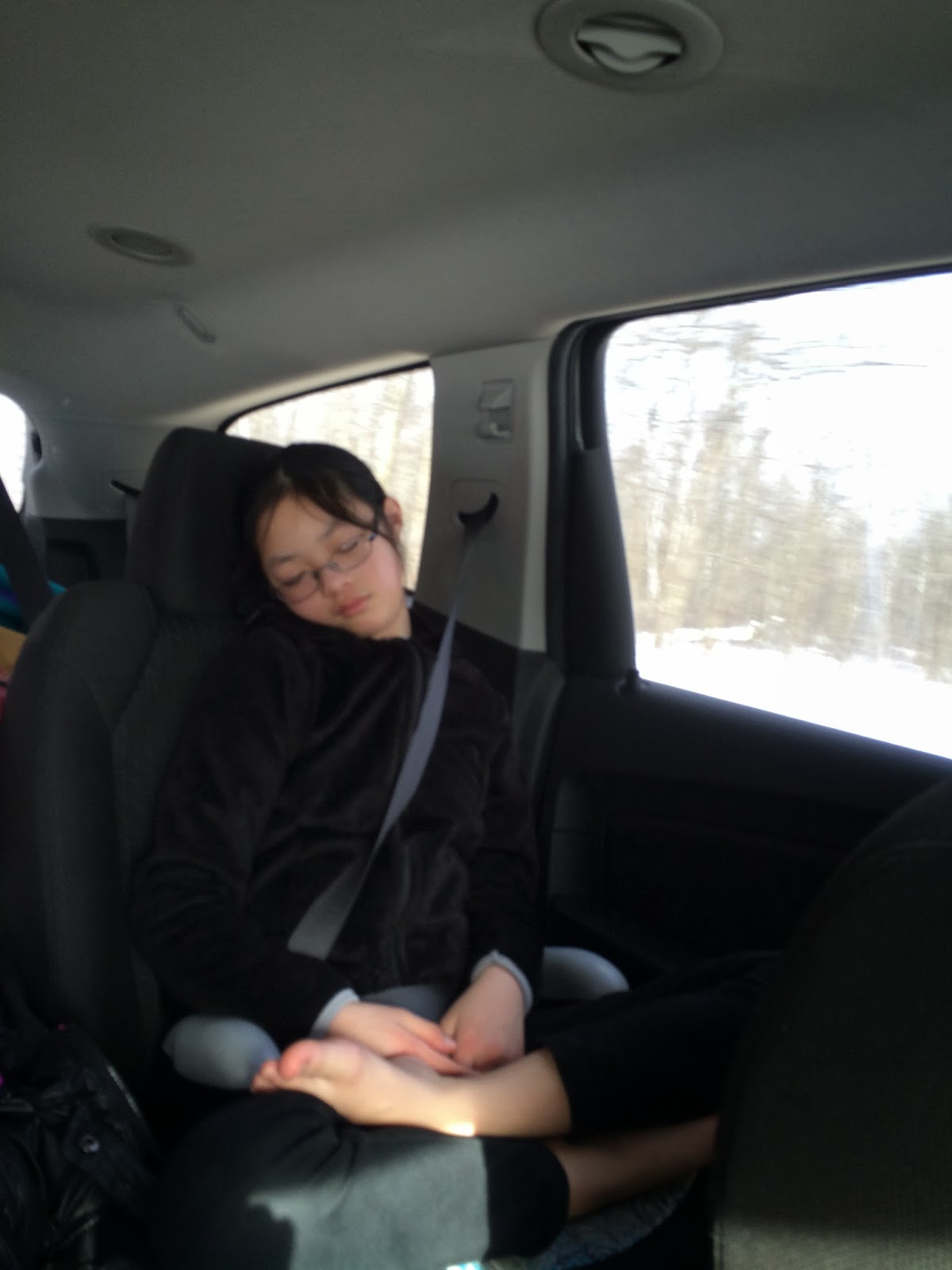
Sometimes, on part of the driving trip, the girls were simply too tired to do anything except sleep.

Olivia sleeping in the back seat. 
She was exhausted by the end of the trip.


I guess that can be expected after two days of dogsledding and a day of ice climbing!