During the past week I read Water for Elephants by Sara Gruen for the Read 52 Books in 52 Weeks challenge. Water for Elephants was another book that I had on my list that was one Oprah's Book Club books.
As with the other book, I was not disappointed with this one. Once I read the prologue, I was hooked. There was no way that I could not finish reading this book.
The story revolves around Jacob Jankowski, a 93 year old man who is residing in an assisted living facility, who once worked on circuses for almost seven years. He never discussed his life in the circus for 70 years until a circus came to town to set up across the street from the facility. One of the residents claimed he had worked in the circus and brought water to the elephants. This set Jacob off because he knew it wasn't true, and it began the unfolding of a story that took place during his youth.
Jacob, an Ivy League dropout who had been studying to become a veterinarian, was orphaned and penniless when he jumped a freight train in the dark, and in that instant, he transformed his future. By morning, he was working as a veterinarian with the Flying Squadron of the Benzini Brothers Most Spectacular Show on Earth. By evening, he fell in love with one of the performers who was married to one of the show's animal trainer who was a paranoid schizophrenic.
The story takes place during the uncertainty and chaotic time of the Depression and Prohibition. It's a time when the circus is a refuge of sequins and a dream world for children and adults alike. Behind the glamour and excitement, though, lies a darker world, where both animals and men are dispensable.
Conceptually I have an understanding about Prohibition. However, I did not realize that there was a risk when drinking homemade alcohol. One of the workers named Camel was having trouble standing and walking. Eventually, he realized he was becoming paralyzed. One of the other workers, Walter, explained to Jacob that Camel had "jake leg." It was also called jake walk or limber leg.
Basically, someone made a big batch of Jamaica ginger extract (or jake) and put plasticizers (cresol compound) in it. They did it "to get around the regulations that require that Jamaica ginger extract be rendered unpalatable so it won't be used as an alcoholic beverage."
The Jamaica ginger extract went out all over the country and when someone drank it they would be paralyzed. It started anytime within two weeks of drinking the alcohol. Apparently tens of thousands of people were paralyzed as a result of drinking it.
Jacob realizes how fortunate - and close - he was to ending up like Camel: Camel had offered him some "brackish liquid...on the first day on the show" but he had refused.
The most difficult part of this book for me was how the animals were treated - especially the elephant. Hearing how they were fed and punished made my stomach turn in some parts of the book. I cannot even begin to imagine the cruelty the animals that became part of the circus had to endure. What a miserable life.
The other part was how the workers and some of the performers were thought of by those in the circus' management and upper-level workers. I had never heard of "red-lighting" before - how workers were thrown off the circus trains while they were moving in the night if it was determined that the person was of no value to the circus any longer.
Water for Elephants gave a glimpse into a world that no longer exists in terms of the human oddities show. I do remember when I was younger seeing one of these types of shows at the Minnesota State Fair. This would have been in the 1970s and early 1980s. Apparently back in the Depression, there was a wider variety of people who had unusual physical characteristics.
The narrator’s transition from the young circus veterinarian, to the elderly, cantankerous nursing home resident is a well-crafted, bi-lateral view. Whether in his twenties admiring beautiful, equestrian performer, Marlena and caring for the animals he loved so dearly or in his nineties mulling over where to have breakfast and the indignities of old age, the quick wit comes through loud and clear.
One thing that Jacob said in the nursing home was something that reminded me of my mother and thoughts that she has echoed at different times during recent years. "My platitudes don't hold their interest and I can hardly blame them for that. My real stories are all out of date. So what if I can speak firsthand about the Spanish flu, the advent of the automobile, world wars, cold wars, guerrilla wars, and Sputnik - that's all ancient history now. But what else do I have to offer? Nothing happens to me anymore. That's the reality of getting old, and i guess that's really the crux of the matter. I'm not ready to be old yet. But I shouldn't complain..."
He also said that he no longer liked looking in a mirror. One day, as he was brushing his hair, he said he froze "...at the sight of my old hand on my old head. I lean close and open my eyes very wide, trying to see beyond the sagging flesh. It's not good. Even when I look straight into the milky blue eyes, I can't find myself anymore. When did I stop being me?
It's interesting because I've often had similar thoughts as I've aged - about not recognizing the person looking at me in the mirror. Often times, like Jacob, I avoid looking in the mirror. My reflection is not the person I remember I am.
Water for Elephants had such a range of every conceivable emotion. It was beautifully written and very engrossing. It is a story that pulls ones into a captivating world, where fact and fiction combine. The characters are so clearly described that they can easily be pictured. This book was an honest, moving glimpse into a world filled with excitement, cruelty, adventure, and challenges...and one that I will remember for a very long time.
Sunday, November 9, 2014
Water for Elephants - Read 52 Books in 52 Weeks - Week 46
Friday, November 7, 2014
Woodpeckers and Wintering Birds - Outdoor Hour Challenge
This week we talked about woodpeckers and wintering birds. We do see quite a few types of woodpeckers at our feeders as well as in the trees on our farm. In addition, black-capped chickadees, nuthatches, dark-eyed juncos, blue jays, finches, sparrows, and cardinals are also commonly-seen birds in Minnesota.
For this nature study, we concentrated on woodpeckers. The All About Birds website had some interesting information about downy and pileated woodpeckers which is noted below.
Size & Shape
Downy woodpeckers are small versions of the classic woodpecker. They have a straight, chisel-like bill, blocky head, wide shoulders, and straight-backed posture as they lean away from tree limbs and onto their tail feathers. The bill looks smaller for the bird’s size than in other woodpeckers.
Color Pattern
Downy woodpeckers give a checkered black-and-white impression. The black upper-parts are checked with white on the wings, the head is boldly striped, and the back has a broad white stripe down the center.
Males have a small red patch on the back of the head. The outer tail feathers are typically white with a few black spots.
Behavior
Downy woodpeckers move more acrobatically than larger woodpeckers. Their rising-and-falling flight style is distinctive of many woodpeckers. In spring and summer, Downy Woodpeckers make lots of noise, both with their shrill whinnying call and by drumming on trees.
Habitat
You’ll find downy woodpeckers in open woodlands, particularly among deciduous trees, and brushy or weedy edges. They’re also like to be in backyards, orchards, city parks, and vacant lots.
Food
Downy woodpeckers mostly eat insects, including beetle larvae that live inside wood or tree bark as well as ants and caterpillars. They eat pest insects including: tent caterpillars, corn earworm, apple borers, and bark beetles. About a quarter of their diet consists of plant material, particularly grains, acorns, and berries.
Downy woodpeckers are common feeder birds, eating suet and black oil sunflower seeds and occasionally drinking from hummingbird feeders.
Nesting
A clutch typically has between 3–8 eggs, with one brood per season. The incubation period is 12 days and nestling period is 18-21 days. The eggs are completely white.
Nest Description
Both male and female downy woodpeckers excavate the nest hole, a job that can take between 1 to 3 weeks. Entrance holes are round and about 1-1.5 inches across. Cavities are 6-12 inches deep and widen toward the bottom to make room for eggs and the incubating bird. The cavity is lined only with wood chips.
Nest Placement Cavity
Downy woodpeckers nest in dead trees or in dead parts of live trees. They typically choose a small stub (averaging around 7 inches in diameter) that leans away from the vertical, and place the entrance hole on the underside.
Nest trees are often deciduous and the wood is more than likely infected with a fungus that softens the wood, making excavating easier.
Sounds
To hear what a downy woodpecker sounds like, click here: Calls
Backyard Tips
Downy woodpeckers enjoy visiting backyard bird feeders. They prefer suet feeders, but are also fond of black oil sunflower seeds, millet, peanuts, and chunky peanut butter. Occasionally, downy woodpeckers will drink from oriole and hummingbird feeders as well.
Interesting Facts
In winter Downy woodpeckers are frequent members of mixed species flocks. Advantages of flocking include: (1) having to spend less time watching out for predators and (2) better luck finding food from having other birds around.
Male and female Downy woodpeckers divide up where they look for food in winter. Males prefer to feed on small branches and weed stems while females prefer larger branches and trunks.
Downy woodpeckers eat food that larger woodpeckers cannot reach, such as insects living on or in the stems of weeds. You may see them hammering at goldenrod galls to extract the fly larvae inside.
Woodpeckers don’t sing songs, but they drum loudly against pieces of wood or metal to achieve the same effect. People sometimes think this drumming is part of the woodpeckers' feeding habits, but it isn’t. In fact, feeding birds make very little noise even when they’re digging into wood.
The nest holes these birds make offer crucial shelter to many species including swifts, owls, ducks, bats, and pine martens.
Size & Shape
The pileated woodpecker is one of the biggest, most striking forest birds on the continent. Nearly the size of a crow, it has black with bold white stripes down its long neck and a flaming-red triangular crest that sweeps off the back of the head.
The bill is long and chisel-like, about the length of the head. In flight, the wings are broad and the bird can seem crowlike.
Color Pattern
Pileated woodpeckers are mostly black with white stripes on the face and neck; and have a flaming-red crest. Males have a red stripe on the cheek. In flight, the bird reveals extensive white underwings and small white crescents on the upper side, at the bases of the primaries.
Behavior
Pileated woodpeckers drill distinctive rectangular-shaped holes in rotten wood to get at carpenter ants (their main prey) and other insects. They are loud birds with whinnying calls. They also drum on dead trees in a deep, slow, rolling pattern, and even the heavy chopping sound of foraging carries well. Their flight undulates like other woodpeckers, which helps separate them from a crow’s straight flight path.
Food
In addition to carpenter ants, pileated woodpeckers also eat other types of ants, termites, woodboring beetle larvae, and other insects such as flies, caterpillars, cockroaches, spruce budworm, and grasshoppers. They also eat nuts and wild fruits, including hackberry, sassafrass, greenbrier, blackberries, poison ivy, holly, dogwood, sumac berries, persimmon, and elderberry.
In some diet studies, ants constituted 40 percent of a pileated woodpecker's diet, and up to 97 percent in some individuals. Occasionally, pileated woodpeckers visit backyard bird feeders for seeds or suet.
Habitat
Pileated woodpeckers are forest birds that require large, standing dead trees and downed wood. Forests can be evergreen, deciduous, or mixed. In the East (including Minnesota) they live in both old and young forests and may even be seen in partially-wooded suburbs and backyards.
Interesting Facts
The pileated woodpecker digs characteristically rectangular holes in trees to find ants. These excavations can be so broad and deep that they can cause small trees to break in half.
A pileated woodpecker pair stays together in its territory all year round. It will defend the territory in all seasons, but will tolerate new arrivals during the winter.
Nesting
The clutch size is 3–5 eggs; and one brood per season is common. The incubation period is 15-18 days, and the nesting period is 24-28 days. The eggs are white.
Nest Description
The male begins excavating then nest cavity and does most of the work, but the female contributes, particularly as the hole nears completion. The entrance hole is oblong rather than the circular shape of most woodpecker holes.
For the finishing touches, the bird climbs all the way into the hole and chips away at it from the inside. Periodically the adult picks up several chips at a time in its bill and tosses them from the cavity entrance.
Pileated woodpeckers do not line their nests with any material except for leftover wood chips. The nest construction can take between 3-6 weeks, and nests are rarely reused in later years. Cavity depth can range from 10-24 inches.
Nest Placement
Nest trees are typically dead and within a mature or old stand of coniferous or deciduous trees, but may also be in dead trees in younger forests or even in cities. Dead trees are a valuable resource as nest sites or shelter for birds and other animals, and pileated woodpeckers battle for ownership with European starlings, wood ducks, red-headed woodpeckers, red-bellied woodpeckers, Eastern bluebirds, and great crested flycatchers. Occasionally bats and swifts share roost cavities with pileated woodpeckers.
Sounds
To hear what a pileated woodpeckers sound like, click here: Sound.
*~*~*~*~*~*~*~*~*~*
In addition to learning about woodpeckers, we studied a bit about birds' feet as noted on pages 40-42 of The Handbook of Nature Study. We also visited a website that looked at different types of bird feet.
Outdoor Time:
This week during our outdoor time, we actually spent time watching the birds that came to the feeder so we could get a better look at their feet.
After doing that, we went outdoors to see what birds we could observe.
Woodpeckers that We've Observed in the Past
Nature Journal Entry
The girls each did a nature journal entry. Olivia used pictures she found from the internet as starting points for her journal page.
Sophia researched different facts and drew pictures to illustrate what she learned.
It's interesting to see the different styles of journaling take shape as the girls get older.
For this nature study, we concentrated on woodpeckers. The All About Birds website had some interesting information about downy and pileated woodpeckers which is noted below.
DOWNY WOODPECKERS
Size & Shape
Downy woodpeckers are small versions of the classic woodpecker. They have a straight, chisel-like bill, blocky head, wide shoulders, and straight-backed posture as they lean away from tree limbs and onto their tail feathers. The bill looks smaller for the bird’s size than in other woodpeckers.
Color Pattern
Downy woodpeckers give a checkered black-and-white impression. The black upper-parts are checked with white on the wings, the head is boldly striped, and the back has a broad white stripe down the center.
Males have a small red patch on the back of the head. The outer tail feathers are typically white with a few black spots.
Behavior
Downy woodpeckers move more acrobatically than larger woodpeckers. Their rising-and-falling flight style is distinctive of many woodpeckers. In spring and summer, Downy Woodpeckers make lots of noise, both with their shrill whinnying call and by drumming on trees.
Habitat
You’ll find downy woodpeckers in open woodlands, particularly among deciduous trees, and brushy or weedy edges. They’re also like to be in backyards, orchards, city parks, and vacant lots.
Food
Downy woodpeckers mostly eat insects, including beetle larvae that live inside wood or tree bark as well as ants and caterpillars. They eat pest insects including: tent caterpillars, corn earworm, apple borers, and bark beetles. About a quarter of their diet consists of plant material, particularly grains, acorns, and berries.
Downy woodpeckers are common feeder birds, eating suet and black oil sunflower seeds and occasionally drinking from hummingbird feeders.
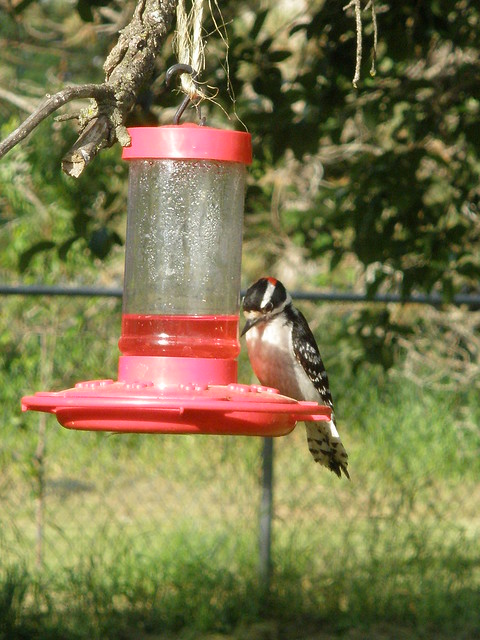
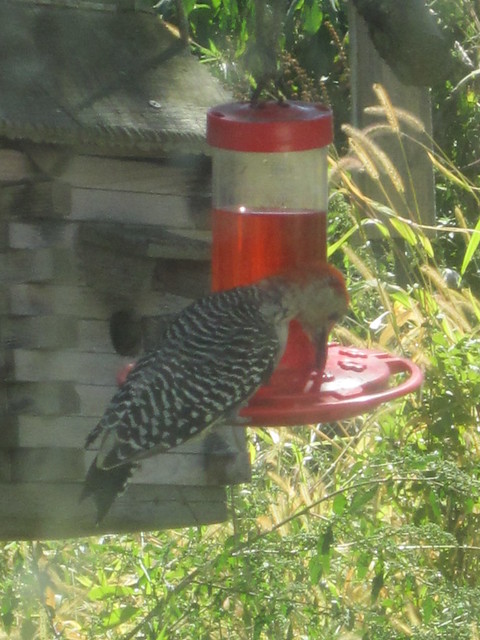
This woodpecker visited our hummingbird feeder
daily during the early summer.
June 8, 2011
Nesting
A clutch typically has between 3–8 eggs, with one brood per season. The incubation period is 12 days and nestling period is 18-21 days. The eggs are completely white.
Nest Description
Both male and female downy woodpeckers excavate the nest hole, a job that can take between 1 to 3 weeks. Entrance holes are round and about 1-1.5 inches across. Cavities are 6-12 inches deep and widen toward the bottom to make room for eggs and the incubating bird. The cavity is lined only with wood chips.
Nest Placement Cavity
Downy woodpeckers nest in dead trees or in dead parts of live trees. They typically choose a small stub (averaging around 7 inches in diameter) that leans away from the vertical, and place the entrance hole on the underside.
Nest trees are often deciduous and the wood is more than likely infected with a fungus that softens the wood, making excavating easier.
Sounds
To hear what a downy woodpecker sounds like, click here: Calls
Backyard Tips
Downy woodpeckers enjoy visiting backyard bird feeders. They prefer suet feeders, but are also fond of black oil sunflower seeds, millet, peanuts, and chunky peanut butter. Occasionally, downy woodpeckers will drink from oriole and hummingbird feeders as well.
Interesting Facts
In winter Downy woodpeckers are frequent members of mixed species flocks. Advantages of flocking include: (1) having to spend less time watching out for predators and (2) better luck finding food from having other birds around.
Male and female Downy woodpeckers divide up where they look for food in winter. Males prefer to feed on small branches and weed stems while females prefer larger branches and trunks.
Downy woodpeckers eat food that larger woodpeckers cannot reach, such as insects living on or in the stems of weeds. You may see them hammering at goldenrod galls to extract the fly larvae inside.
Woodpeckers don’t sing songs, but they drum loudly against pieces of wood or metal to achieve the same effect. People sometimes think this drumming is part of the woodpeckers' feeding habits, but it isn’t. In fact, feeding birds make very little noise even when they’re digging into wood.
PILEATED WOODPECKER
The nest holes these birds make offer crucial shelter to many species including swifts, owls, ducks, bats, and pine martens.
Size & Shape
The pileated woodpecker is one of the biggest, most striking forest birds on the continent. Nearly the size of a crow, it has black with bold white stripes down its long neck and a flaming-red triangular crest that sweeps off the back of the head.
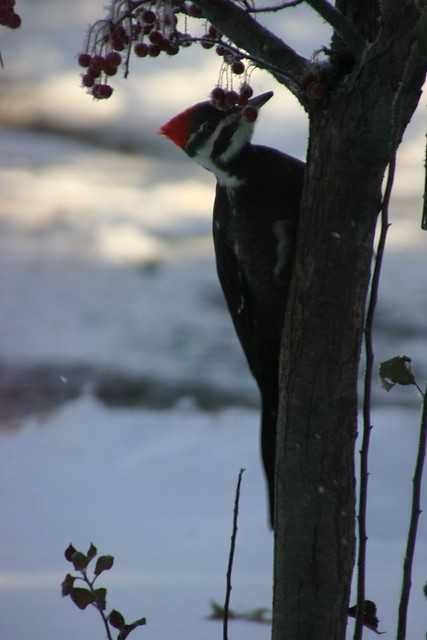
Pileated woodpecker on our plum tree.
December 12, 2007.
The bill is long and chisel-like, about the length of the head. In flight, the wings are broad and the bird can seem crowlike.
Color Pattern
Pileated woodpeckers are mostly black with white stripes on the face and neck; and have a flaming-red crest. Males have a red stripe on the cheek. In flight, the bird reveals extensive white underwings and small white crescents on the upper side, at the bases of the primaries.
Within an hour of putting out new feeders,
this woodpecker and others found it.
This one is on our pear tree.
November 11, 2007.
Behavior
Pileated woodpeckers drill distinctive rectangular-shaped holes in rotten wood to get at carpenter ants (their main prey) and other insects. They are loud birds with whinnying calls. They also drum on dead trees in a deep, slow, rolling pattern, and even the heavy chopping sound of foraging carries well. Their flight undulates like other woodpeckers, which helps separate them from a crow’s straight flight path.
Food
In addition to carpenter ants, pileated woodpeckers also eat other types of ants, termites, woodboring beetle larvae, and other insects such as flies, caterpillars, cockroaches, spruce budworm, and grasshoppers. They also eat nuts and wild fruits, including hackberry, sassafrass, greenbrier, blackberries, poison ivy, holly, dogwood, sumac berries, persimmon, and elderberry.
In some diet studies, ants constituted 40 percent of a pileated woodpecker's diet, and up to 97 percent in some individuals. Occasionally, pileated woodpeckers visit backyard bird feeders for seeds or suet.
Habitat
Pileated woodpeckers are forest birds that require large, standing dead trees and downed wood. Forests can be evergreen, deciduous, or mixed. In the East (including Minnesota) they live in both old and young forests and may even be seen in partially-wooded suburbs and backyards.
Interesting Facts
The pileated woodpecker digs characteristically rectangular holes in trees to find ants. These excavations can be so broad and deep that they can cause small trees to break in half.
A pileated woodpecker pair stays together in its territory all year round. It will defend the territory in all seasons, but will tolerate new arrivals during the winter.
Nesting
The clutch size is 3–5 eggs; and one brood per season is common. The incubation period is 15-18 days, and the nesting period is 24-28 days. The eggs are white.
Nest Description
The male begins excavating then nest cavity and does most of the work, but the female contributes, particularly as the hole nears completion. The entrance hole is oblong rather than the circular shape of most woodpecker holes.
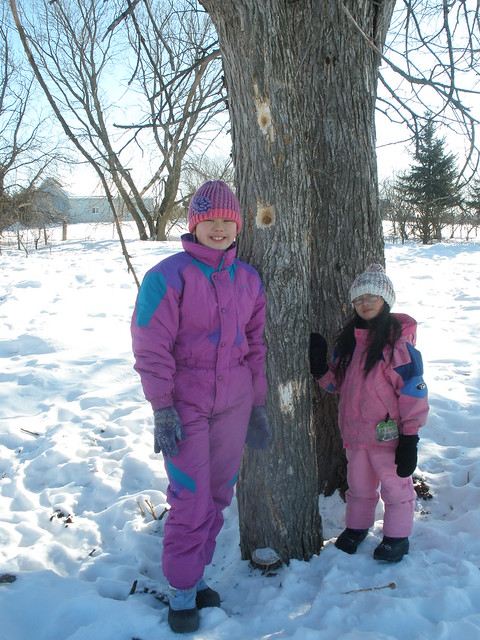
The girls outside braving the 0 degree weather.
They are standing next to woodpecker's holes in the tree.
February 8, 2011
For the finishing touches, the bird climbs all the way into the hole and chips away at it from the inside. Periodically the adult picks up several chips at a time in its bill and tosses them from the cavity entrance.
Pileated woodpeckers do not line their nests with any material except for leftover wood chips. The nest construction can take between 3-6 weeks, and nests are rarely reused in later years. Cavity depth can range from 10-24 inches.
Nest Placement
Nest trees are typically dead and within a mature or old stand of coniferous or deciduous trees, but may also be in dead trees in younger forests or even in cities. Dead trees are a valuable resource as nest sites or shelter for birds and other animals, and pileated woodpeckers battle for ownership with European starlings, wood ducks, red-headed woodpeckers, red-bellied woodpeckers, Eastern bluebirds, and great crested flycatchers. Occasionally bats and swifts share roost cavities with pileated woodpeckers.
Sounds
To hear what a pileated woodpeckers sound like, click here: Sound.
*~*~*~*~*~*~*~*~*~*
In addition to learning about woodpeckers, we studied a bit about birds' feet as noted on pages 40-42 of The Handbook of Nature Study. We also visited a website that looked at different types of bird feet.
“The feet of birds are shaped so as to assist the bird to get its food as well as for locomotion.”
~ The Handbook of Nature Study, page 41 ~
This week during our outdoor time, we actually spent time watching the birds that came to the feeder so we could get a better look at their feet.
After doing that, we went outdoors to see what birds we could observe.
Woodpeckers that We've Observed in the Past
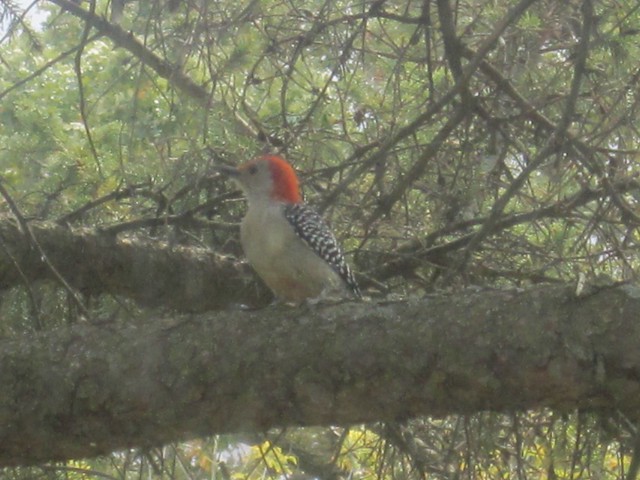
Red-bellied woodpecker in the pine tree.
September 21, 2012.
Red-bellied woodpecker drinking nectar
from the hummingbird feeder.
For at least a few weeks, this bird would visit the feeder daily
(sometimes more than once a day.)
It would always announce its arrival with a loud call.
It was such a joy to see it each day.
September 14, 2012.
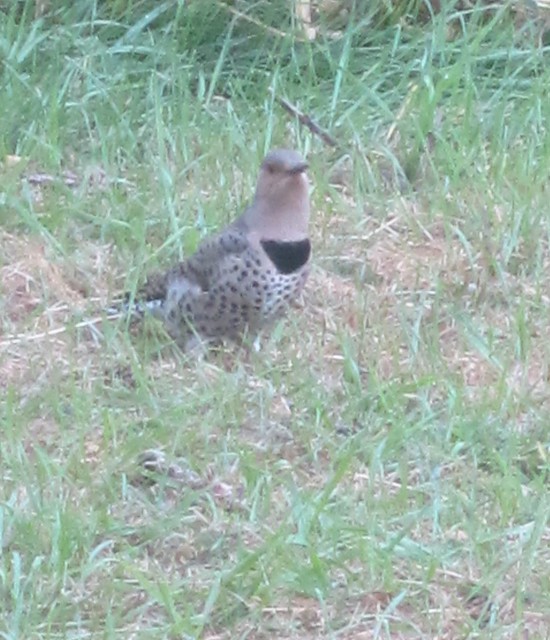
This was a northern flicker that was in the backyard.
September 21, 2012.
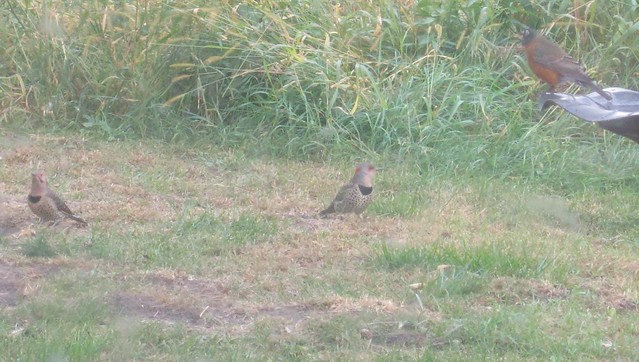
These two northern flickers were hanging out with
a robin that was on the bird bath.
September 21, 2012.
Nature Journal Entry
The girls each did a nature journal entry. Olivia used pictures she found from the internet as starting points for her journal page.
Sophia researched different facts and drew pictures to illustrate what she learned.
It's interesting to see the different styles of journaling take shape as the girls get older.
We used the Outdoor Hour Challenge Autumn Series - Woodpeckers as inspiration.
Labels:
birds,
charlotte mason,
homeschooling,
journaling,
nature,
science,
summer,
unschooling,
waldorf,
wildlife
Monday, November 3, 2014
Where the Heart Is - Read 52 Books in 52 Weeks - Week 45
This week for the Read 52 books in 52 Weeks challenge, I read Where the Heart Is by Billie Letts. This book is on Oprah's Book Club list, so I was interested in reading it for that reason.
Like many of the books this year that I've read, this would not have been one that I would have thought about reading unless I was doing the challenge. However, I'm happy I did. The story - although filled with some very sobering and difficult situations - somehow keeps the focus on the positive elements of life. Many of the characters face struggles - either ones due to poor choices they have made or ones that have been thrust upon them - yet plod forward and persevere.
As the main character, Novalee Nation, says, "...Our lives can change with every breath we take...Let go of what's gone....and hold on...to what [you've] got....We've all got meanness in us...but...we have some good in us, too. And the only thing worth living for is the good. That's why we've got to make sure we pass it on."
Where the Heart Is begins with the story about Novalee, a seventeen-year-old girl who is seven months pregnant who was heading for California with her boyfriend, Willy Jack. He drops her off at the Wal-Mart in Oklahoma to use the restroom, and continues on the journey without her.
So, Novalee finds herself stranded at the Wal-Mart with just $7.77 in change. Somehow she manages to live in the store and not be discovered for a couple months.
It is during this time that people come into Novalee's life; and they become her true friends and new family. These people support Novalee and her already strong spirit. They are down-to-earth, deeply caring people who are willing to help a homeless, jobless girl.
From a kind, generous older lady named Sister Thelma Husband to eccentric librarian named Forney Hull who loves Novalee more than she loves herself, they are all there to support Novalee.
About two months after her arrival in Oklahoma, she has her baby one night at the store. Her friend, Forney, happens to see her there, breaks the window of the store, and helps deliver the baby. Needless to say, she receives much publicity and financial support.
When she's in the hospital, her mother (who abandoned her when she was a young girl), shows up and convinces Novalee that they will begin their life over. Novalee trusts her mother, and gives her all the money she received hoping that her mother follows through on the promise to get a home where they all can live...a place that Novalee has dreamed of her whole life.
Novalee has dreamed her whole life of living in a house since she has always lived on a home on wheels. She keeps a journal full of magazine pictures of houses; and she looks through them, she imagines her dream house and how it is furnished. Truly, she wants to make sure that her baby grows up in the best environment that she can create.
Of course, the mother simply takes the money and disappears again, leaving Novalee with no money and no place to live. Sister Thelma just happens to show up and offers to let Novalee and her baby live with her husband and her in their trailer home.
Soon, Novalee takes charge of her future by working and bringing in money to support herself and daughter. Through her friendship with Moses Whitecotton, she develops skills in photography. She builds on the information he shares with her by reading many books and magazines from the library where Forney works. She visits photography exhibitions and takes many photographs to build her skills.
Although she is not educated when she arrives in Oklahoma, by the end of the story she is enrolled in college and is supporting herself through her photography skills.
Where the Heart Is also follows Willy Jack's life and the string of bad decisions he makes. His journey is a sharp and negative contrast to Novalee's life, filled with alcohol, prison time, failed singing career, and an encounter with a train that amputates both his legs. In the end, his journey tries to lead him back to Novalee to apologize to her and let her know that he lied about something that meant a lot to her.
She ends up finding out about Willy Jack by reading a newspaper article; and - in her compassionate and quiet, unassuming manner - meets him at a hospital where he was transported to after being a victim of a robbery. He talks about lies and their impact one one's life.
As Willy Jack said, "Why does anyone lie? 'Cause we're scared or crazy, maybe just 'cause we're mean. I guess there's a million reasons to lie, and I might've told that many....but none like that. I guess there's always that one lie we never get over....Maybe you never told a lie so big it can eat away a part of you. But if you ever do...and if you get lucky...you might get a a chance to set it right. Just one chance to change it. Then it's gone. And it never comes again."
His apology to her - and what he said about lying - makes Novalee reconsider what she said to a dear friend who she loved, but said she didn't care for him.
Towards the end of the story, Novalee follows through on where her heart is; and the book finishes on a positive note which I liked. After all the early poor decisions, hard work, and determination to build a respectable life - Novalee succeeds. She may not be the richest and most powerful person in her mid-20s, but within her world she attained much more than she expected, positively impacted the lives of many people, and realized dreams that she would never have imagined when she was 17 years old.
Like many of the books this year that I've read, this would not have been one that I would have thought about reading unless I was doing the challenge. However, I'm happy I did. The story - although filled with some very sobering and difficult situations - somehow keeps the focus on the positive elements of life. Many of the characters face struggles - either ones due to poor choices they have made or ones that have been thrust upon them - yet plod forward and persevere.
As the main character, Novalee Nation, says, "...Our lives can change with every breath we take...Let go of what's gone....and hold on...to what [you've] got....We've all got meanness in us...but...we have some good in us, too. And the only thing worth living for is the good. That's why we've got to make sure we pass it on."
Where the Heart Is begins with the story about Novalee, a seventeen-year-old girl who is seven months pregnant who was heading for California with her boyfriend, Willy Jack. He drops her off at the Wal-Mart in Oklahoma to use the restroom, and continues on the journey without her.
So, Novalee finds herself stranded at the Wal-Mart with just $7.77 in change. Somehow she manages to live in the store and not be discovered for a couple months.
It is during this time that people come into Novalee's life; and they become her true friends and new family. These people support Novalee and her already strong spirit. They are down-to-earth, deeply caring people who are willing to help a homeless, jobless girl.
From a kind, generous older lady named Sister Thelma Husband to eccentric librarian named Forney Hull who loves Novalee more than she loves herself, they are all there to support Novalee.
About two months after her arrival in Oklahoma, she has her baby one night at the store. Her friend, Forney, happens to see her there, breaks the window of the store, and helps deliver the baby. Needless to say, she receives much publicity and financial support.
When she's in the hospital, her mother (who abandoned her when she was a young girl), shows up and convinces Novalee that they will begin their life over. Novalee trusts her mother, and gives her all the money she received hoping that her mother follows through on the promise to get a home where they all can live...a place that Novalee has dreamed of her whole life.
Novalee has dreamed her whole life of living in a house since she has always lived on a home on wheels. She keeps a journal full of magazine pictures of houses; and she looks through them, she imagines her dream house and how it is furnished. Truly, she wants to make sure that her baby grows up in the best environment that she can create.
Of course, the mother simply takes the money and disappears again, leaving Novalee with no money and no place to live. Sister Thelma just happens to show up and offers to let Novalee and her baby live with her husband and her in their trailer home.
Soon, Novalee takes charge of her future by working and bringing in money to support herself and daughter. Through her friendship with Moses Whitecotton, she develops skills in photography. She builds on the information he shares with her by reading many books and magazines from the library where Forney works. She visits photography exhibitions and takes many photographs to build her skills.
Although she is not educated when she arrives in Oklahoma, by the end of the story she is enrolled in college and is supporting herself through her photography skills.
Where the Heart Is also follows Willy Jack's life and the string of bad decisions he makes. His journey is a sharp and negative contrast to Novalee's life, filled with alcohol, prison time, failed singing career, and an encounter with a train that amputates both his legs. In the end, his journey tries to lead him back to Novalee to apologize to her and let her know that he lied about something that meant a lot to her.
She ends up finding out about Willy Jack by reading a newspaper article; and - in her compassionate and quiet, unassuming manner - meets him at a hospital where he was transported to after being a victim of a robbery. He talks about lies and their impact one one's life.
As Willy Jack said, "Why does anyone lie? 'Cause we're scared or crazy, maybe just 'cause we're mean. I guess there's a million reasons to lie, and I might've told that many....but none like that. I guess there's always that one lie we never get over....Maybe you never told a lie so big it can eat away a part of you. But if you ever do...and if you get lucky...you might get a a chance to set it right. Just one chance to change it. Then it's gone. And it never comes again."
His apology to her - and what he said about lying - makes Novalee reconsider what she said to a dear friend who she loved, but said she didn't care for him.
Towards the end of the story, Novalee follows through on where her heart is; and the book finishes on a positive note which I liked. After all the early poor decisions, hard work, and determination to build a respectable life - Novalee succeeds. She may not be the richest and most powerful person in her mid-20s, but within her world she attained much more than she expected, positively impacted the lives of many people, and realized dreams that she would never have imagined when she was 17 years old.
Home gives you something no other place can...
your history...
home is where your history begins.
Labels:
52 Books in 52 Weeks,
books,
read,
reading
Saturday, November 1, 2014
Tulips, Crocuses, and Daffodils - Outdoor Hour Challenge
This past week's focus for the Outdoor Hour Challenge is on tulips, crocuses, and daffodils.
One of my favorite bulbs is the tulip. It reminds me of a trip that Sophia, Olivia, and I took with my dad and mom about 5 1/2 years ago to Pella, Iowa. They have a big tulip festival there, and we went about a week before it happened so that we could enjoy the beautiful tulips without the crowds of people.
We read about tulips in the Handbook of Nature Study since we had some tulip bulbs that we were going to plant. Some things we wanted to remember about tulips include:
=> Tulips came from the Orient to Europe in the sixteenth century. One hundred years later, the Netherlands were buying and selling tulip bulbs at an almost manic level. Rare varieties of tulips were going for $1,800...per bulb!
=> In the red varieties, there is a six-pointed star at the heart of the flower, usually yellow or yellow-margined.
Next, we read about crocuses in the Handbook of Nature Study. Some interesting facts about crocuses:
=> The crocus has a corm instead of a bulb. A corm is a solid, thickened, underground stem, and is not in layers, like the onion. The roots come off the lower side of the corm
=> The leaves number from two to eight, depending on the variety.
=> The petals and sepals are similar in color. The three sepals are on the outside and their texture is coarser than that of the three protected petals.
=> Crocus blossoms have varied colors: white, yellow, orange, and purple (striped or feather-veined).
=> The crocus multiples by its corms.
=> Crocuses need to be replanted every two or three years.
=> Crocuses can be planted in flower beds or in the grass. The flowers bloom and mature before the grass needs to be mowed.
Although we didn't plant daffodils, we still read about them in the Handbook of Nature Study. Some key facts to remember:
=> There are six segments of the perianth - three bright-colored sepals and three inner petals. These sepals and petals are different shapes and look like a corona or crown.
=> The bulbs should be planted in September or early October, about four to six inches apart.
Nature Journals:
Each of the girls did an entry in their nature journal about tulips, crocuses, and daffodils.
Outdoor Hour Time:
For this week's nature journal focus, we spent time outdoors planting bulbs that will bloom in the spring. It was a great way to bring learning about flowers alive.
Sophia, Olivia, and I planted 70 crocus corms under the four big pine trees in the front yard. (I have always called them bulbs, but they are technically called "corms." Honestly, I don't see us using that term. They'll still always be "bulbs" to us.)
Looking at the trees now, I can envision the beautiful purple, yellow, and white flowers emerging in the spring after a cold, snow-filled winter. It will be a welcome sight!
Thankfully, the ground was still relatively easy to dig into. It hadn't completely frozen yet.
The soil under the pine trees is relatively "fluffy" since so many pine needles have fallen into it over the years.
Under each tree there are about 17 bulbs. Seeing the bulbs in a bag and then seeing them spread out under the tree made me realize that we could have easily planted four times as many bulbs to give a fuller and more colorful look under the trees.
At least this is a good starting point in terms of a long-term vision. Each year we can add more bulbs under the trees.
Under the pine tree that's adjacent to the house on the northwest side, Olivia and I planted orange and yellow tulips with purple flowers.
The fairy house door is on the pine tree, and the tulips and purple flowers now will surround it in the spring - like a miniature, colorful front yard with the secret little door hidden among the colorful flowers.
This winter we can spend some time thinking about ways we can enhance that space and make a bigger fairy garden.
Because the sun was setting and it was getting dark, we decided to wait to plant the remaining tulips until Tuesday morning. I planted the tulips by the door of the mudroom (our main entry to the house) to add some color to that area. It will be nice to have some color there since we are at that entryway a lot with letting the dogs out; and going in and out of the home.
Then I planted two different types of bulbs next to the driveway. If all goes well over the summer, we should be enjoying tulips in the back and muscari in the front. The flower garden is visible from several rooms in the home, so it will be nice to see the bright colors after a relatively colorless winter.
In about 150 days, we should see our front yard transformed by colorful flowers! What will be nice is that we can also cut some of these flowers and bring them indoors to enjoy their color and fragrance.
Perhaps later in November we will plant bulbs to force indoors. We've done this before and it always a joy to see the flowers growing and emerging indoors. We try to pick fragrant flowers, so the scent reminds us of spring time.
Note: We used Winter Series #10 - Early Spring Bulbs for inspiration.
One of my favorite bulbs is the tulip. It reminds me of a trip that Sophia, Olivia, and I took with my dad and mom about 5 1/2 years ago to Pella, Iowa. They have a big tulip festival there, and we went about a week before it happened so that we could enjoy the beautiful tulips without the crowds of people.
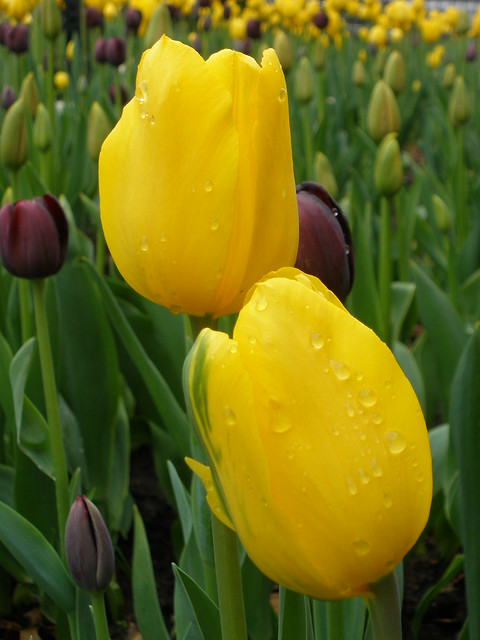
Beautiful yellow tulips after a rainfall.
(Taken on April 29, 2009.)
We read about tulips in the Handbook of Nature Study since we had some tulip bulbs that we were going to plant. Some things we wanted to remember about tulips include:
=> Tulips came from the Orient to Europe in the sixteenth century. One hundred years later, the Netherlands were buying and selling tulip bulbs at an almost manic level. Rare varieties of tulips were going for $1,800...per bulb!
=> In the red varieties, there is a six-pointed star at the heart of the flower, usually yellow or yellow-margined.
This was a tulip that hadn't opened yet.
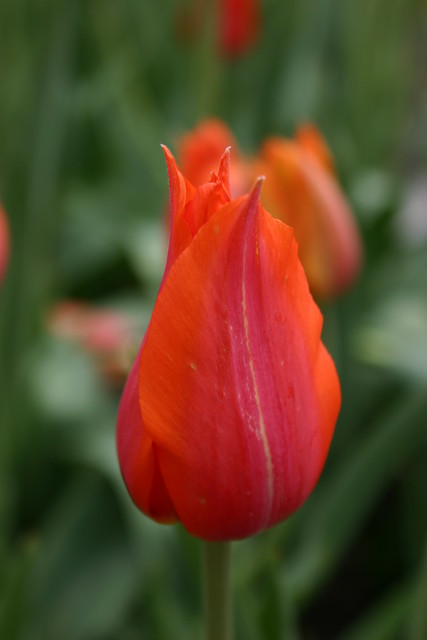
(Taken on May 1, 2009.)
=> In the heart of each bulb is a flower bud, sheltered by the fleshy leaf-layers around it, which furnish it food in the spring.
=> The true roots are below the bulb.
=> Tulips will grow in almost any soil as long it it is well-drained so that the roots don't rot.
=> Make sure that the bulb is upright and doesn't fall over on its side.
=> Bulbs can be planted in September and October. The more root growth the bulbs have before the ground freezes the better. (Note: We planted the bulbs perhaps a bit too late since the ground froze within days after we planted the bulbs.)
Everywhere we looked in Pella, Iowa, there were beds of beautiful tulips.
(Taken on April 30, 2009.)
=> Blossoms should be cut as soon as the flowers wither so that the plant's energy can go back into the bulb.
Next, we read about crocuses in the Handbook of Nature Study. Some interesting facts about crocuses:
=> The crocus has a corm instead of a bulb. A corm is a solid, thickened, underground stem, and is not in layers, like the onion. The roots come off the lower side of the corm
=> The leaves number from two to eight, depending on the variety.
=> The petals and sepals are similar in color. The three sepals are on the outside and their texture is coarser than that of the three protected petals.
=> Crocus blossoms have varied colors: white, yellow, orange, and purple (striped or feather-veined).
=> The crocus multiples by its corms.
=> Crocuses need to be replanted every two or three years.
=> Crocuses can be planted in flower beds or in the grass. The flowers bloom and mature before the grass needs to be mowed.
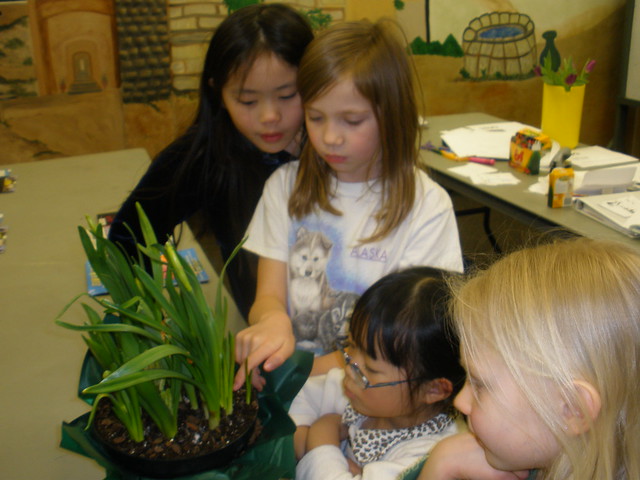
The girls with some friends at the homeschool co-op looking at spring bulbs.
(February 16, 2009)
=> There are six segments of the perianth - three bright-colored sepals and three inner petals. These sepals and petals are different shapes and look like a corona or crown.
=> There is one flower on a stalk in the daffodils, compared with jonquils or paper-white narcissus that have two or more flowers on the same stalk.
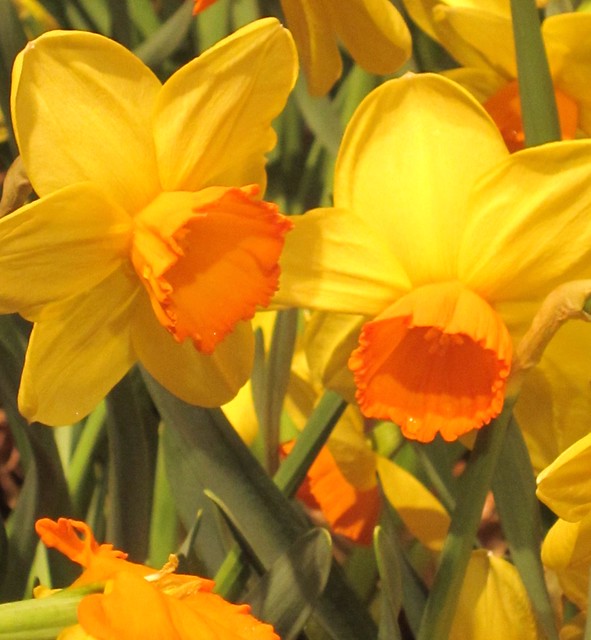
Daffodils at an indoor flower show
(Taken on April 5, 2013.)
=> As soon as the surface of the ground is frozen in the winter, the beds should be covered with four to six inches in depth with straw mixed with stable manure. (Note: We did not do this when we planted the crocus, tulip, and hyacinth bulbs this year. It will be interesting to see if this step is needed for the other bulbs, or is something that we would do in the future when we plant daffodils.)
=> New bulbs are formed on the sides of the old one.
=> The leaves of the plant should be allowed to stand as long as they will after the flowers disappear so they will furnish the bulbs with plenty of food for storage.
=> The seeds shouldn't be allowed to ripen because it takes too much energy away from the bulb.
=> The flowers should be cut as they are opening.
Nature Journals:
Each of the girls did an entry in their nature journal about tulips, crocuses, and daffodils.
Outdoor Hour Time:
For this week's nature journal focus, we spent time outdoors planting bulbs that will bloom in the spring. It was a great way to bring learning about flowers alive.
Sophia, Olivia, and I planted 70 crocus corms under the four big pine trees in the front yard. (I have always called them bulbs, but they are technically called "corms." Honestly, I don't see us using that term. They'll still always be "bulbs" to us.)
Olivia putting a crocus corm into the soil.
Looking at the trees now, I can envision the beautiful purple, yellow, and white flowers emerging in the spring after a cold, snow-filled winter. It will be a welcome sight!
Sophia working under one of the pine trees.
Thankfully, the ground was still relatively easy to dig into. It hadn't completely frozen yet.
Sophia planting one of 17 crocus corms under the pine trees.
The soil under the pine trees is relatively "fluffy" since so many pine needles have fallen into it over the years.
Olivia looks so small compared to the pine tree.
Under each tree there are about 17 bulbs. Seeing the bulbs in a bag and then seeing them spread out under the tree made me realize that we could have easily planted four times as many bulbs to give a fuller and more colorful look under the trees.
This is a crocus corm.
There's another one in the background.
The one in front is the way that you plant it in the ground.
The one in the back shows the flat underside that
faces the ground when it is planted.
At least this is a good starting point in terms of a long-term vision. Each year we can add more bulbs under the trees.
Sophia creating a nice space for the crocus' roots to grow.
Under the pine tree that's adjacent to the house on the northwest side, Olivia and I planted orange and yellow tulips with purple flowers.
Two of the bulbs we planted by the pine tree
near the fairy house door.
The fairy house door is on the pine tree, and the tulips and purple flowers now will surround it in the spring - like a miniature, colorful front yard with the secret little door hidden among the colorful flowers.
This winter we can spend some time thinking about ways we can enhance that space and make a bigger fairy garden.
This was a smaller area in which to work,
so the tulips will be closer together.
As we were planting the bulbs, Olivia came across one that was already starting to shoot out another section. She wondered if it was still okay to plant. It is. Hopefully we'll see two flowers instead of one in the garden.
Hopefully we'll have a bonus flower in the spring.
Because the sun was setting and it was getting dark, we decided to wait to plant the remaining tulips until Tuesday morning. I planted the tulips by the door of the mudroom (our main entry to the house) to add some color to that area. It will be nice to have some color there since we are at that entryway a lot with letting the dogs out; and going in and out of the home.
Then I planted two different types of bulbs next to the driveway. If all goes well over the summer, we should be enjoying tulips in the back and muscari in the front. The flower garden is visible from several rooms in the home, so it will be nice to see the bright colors after a relatively colorless winter.
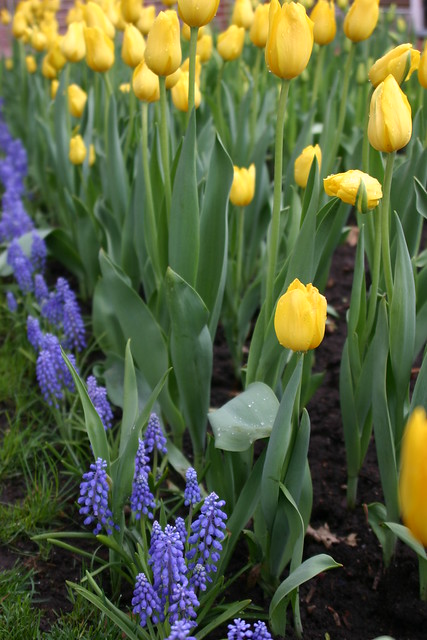
Purple muscari in front of yellow tulips.
(Taken on April 30, 2009.)
In about 150 days, we should see our front yard transformed by colorful flowers! What will be nice is that we can also cut some of these flowers and bring them indoors to enjoy their color and fragrance.
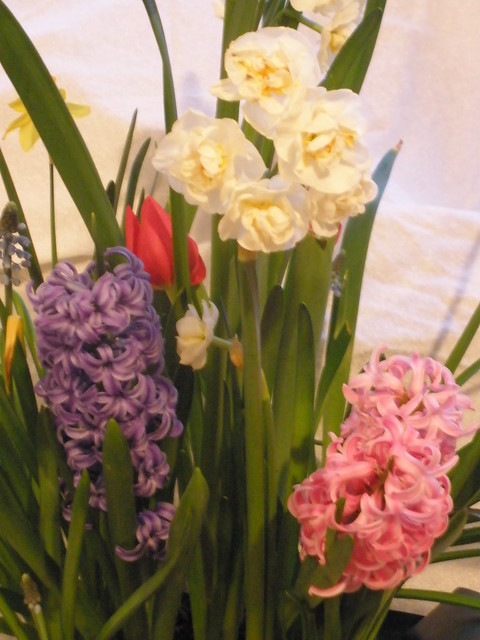
An indoor garden filled with a variety of fragrant, spring flowers.
(Taken on February 26, 2009.)
Perhaps later in November we will plant bulbs to force indoors. We've done this before and it always a joy to see the flowers growing and emerging indoors. We try to pick fragrant flowers, so the scent reminds us of spring time.
Note: We used Winter Series #10 - Early Spring Bulbs for inspiration.
Friday, October 31, 2014
Countdown to Halloween 2014
We have been doing a Countdown to Halloween now for a few years. This year, however, we did as many activities each day as we have in past. It seems like as the years go by with homeschooling, there are more things that need to get done academically, leaving less room for fun activities like we did when the girls were younger.
Nonetheless, we did so several things and had theme days (on some of the days leading up to Halloween from October 21st to October 31st).
The first day we focused on mummies. We've done the mummy dogs a couple times now and the girls really like them.
They're just hot dogs wrapped in crescent roll dough and baked until the crescent roll is golden brown.
The next day we focused on spiders since the girls were eyeing the miniature chocolate donuts I had bought earlier in the week.
For the spiders, we used one donut, some vanilla frosting for the eyes, and then broke pretzels into curved shapes to put into the sides of the donut.
It was easier to put little holes where the ends of the pretzels needed to go into the donut. In that way, the pretzel wouldn't break.
I think the donut spiders have to be one of the girls' favorite breakfasts during the Halloween season.
On another day, we focused on monsters. We made monster tacos again this year since we all like tacos.
A hard shell taco, taco meat, fixings, two olives, and a sliver of tomato is all we needed for each taco monster.
We're not huge hard-shell taco fans, so after we ate one taco - anyone who wanted another one just crumbled the taco shells into bits and put the meat and toppings on top. It's easier to eat that way.
On October 24th, we spent some time at the nursing home where we volunteer. We helped the seniors decorate bags for treats that they were going to fill and give to a group of preschoolers who would be visiting them in costume on Halloween.
The ladies enjoyed being creative and attaching stickers to the fronts of the bags.
Afterwards, we helped with a root beer social in the dining room while the seniors listened to music. It was a nice way to spend the afternoon.
Another day, we focused on ghosts. The girls were asking when "ghost day" would be because they knew we would have Boo-nilla shakes.
Sophia found a delicious recipes for a vanilla shake online, so we used that this year. Before pouring the shake into the glass, we "painted" eyes and a mouth onto the side of the glasses. When the shake is carefully poured into the glass, the eyes and mouth stay in place.
We enjoyed the shakes and look forward to having them again next year.
On Saturday, the humane society where we adopted Cooper and Aspen from, had a Pet Fest. After looking for ideas for costumes, we decided on The Big Bad Wolf dressed as Grandma for Cooper, and Little Red Riding Hood for Aspen.
We spent several days before the event putting the costumes on them. They were always so excited to wear the costumes...so much so that we were worried that they wouldn't be able to wear them at the Pet Fest.
At the event, we managed to get Cooper into his nightgown. The bonnet with the black fur ears to hold it in place stayed on his head for probably a good five minutes and then we just gave up. It kept falling off, and honestly was more trouble than it was worth. Oh well...
Aspen tolerated her costume, but she was pretty nervous at the event. There was a lot of activity, people, and pets there. Her cape stayed on, but kept going to the side. The hood did not stay on because her ears are upright.
Inside at Pet Fest there were games. A Golden Retriever did the tennis ball game before Cooper and loved it. Cooper, on the other hand, couldn't focus or wasn't motivated to retrieve the balls from the water.
Same thing with Aspen. Even though they like toys at home and like to play fetch, the tennis balls in the water confused them.
Sophia ended up playing a few games. The rubber-band gun was one of her favorite games.
We had a bit to eat and some pop to drink; did the costume contest; and looked at the vendors' tables. Chuck & Don's gave us a big bag of treats and a tennis ball which was nice.
The next evening, the girls made witches' hats with crackers, cheese in a can, and Bugles.
The only time I will buy cheese-in-a-can is for the witch theme day. Otherwise, it doesn't come into the house. Oh...unless one of the girls sneaks it into the grocery cart and I don't see it. But, other than that...this is a treat for them.
Sophia and Olivia each had about a half dozen of the witch hats.
They're simple to make, and the girls both enjoy them.
For the owl theme day, we made a fruit owl. The owl's body is half a pineapple. The wings are apple slices, the feet are limes, the eyes and beak are oranges with blueberry centers, and the outline is strawberries and cherries.
The girls were happy with how the owl turned out. The fruit was delicious too.
On vampire day, we made homemade pizzas. Sophia and Olivia were hungry, so they just wanted to make pizza the normal way. Olivia made hers with pepperoni and cheese.
Sophia had some pepperoni, vegetables, and cheese.
Because it was vampire day, I took a bit of time and made a vampire-shaped pizza.
We weren't sure what the pizza would look like after it was baked, so we took a before and after picture.
After we ate pizza, we made caramel apples for dessert.
I had sliced apples, and the girls added melted caramel, chocolate chips, and chopped peanuts on top.
The more caramel, the better.
We even added sprinkles for some color and Halloween spirit.
On the candy corn theme day, we made a healthy snack. The bottom layer of the fruit salad is pineapple. The next layer is mandarin oranges; and then whipped cream covers the fruit salad.
On the pumpkin theme day, which we've done quite a bit in the past on, we simply went to a local pumpkin patch. Our pumpkins didn't produce anything this year which was frustrating.
The pumpkin patch we went to was picked over, but the owner said if we could find anything in the field we could have it for free.
The girls ran throughout the field looking for pumpkins.
We ended up finding about a half dozen pumpkins which surprised us.
Although we didn't carve them this year (neither of the girls wanted to do that), we did put them out by the gate so that is the first thing we see.
On Halloween, we volunteered to help at the nursing home. When we arrived, we saw Annabelle and her daughter dressed as the Good Witch (Glenda) from the Wizard of Oz and her daughter as the Wicked Witch of the West.
There was a costume contest which the girl participated in.
I sat with John and tabulated all the voting sheets that the seniors filled out. They were supposed to vote for one person whose costume they liked. Some of the seniors understood this, while others voted for lots of different people. Apparently they really liked the costumes.
Everyone who was in costume had their picture taken together.
Around dinner time, the girls got into their costumes again. Olivia was a princess.
She found a dress that fit her perfectly at a fraction of the cost of a costume which was great! She and Sophia thought it looked like a shorter version of Belle's dress from Beauty and the Beast.
Sophia went as a vampire complete with the makeup and pointy teeth.
It seems like such a long time since Sophia dressed as princesses and Olivia dressed as a lion and giraffe. Time goes by so quickly.
We went to the fire station which sponsored - along with Lions and a local church - dinner. There were hot dogs, chips, cookies, and hot chocolate.
There were games that the girls played before we headed out.
Our first stop was the cafe which was transformed into a haunted house.
Some of the decorations danced and sang.
After that we went to the senior cottages, another nearby town, and then back to homes in our neighborhood.
All in all, we had a great Halloween season.
Subscribe to:
Posts (Atom)