Tuesday, January 19, 2021

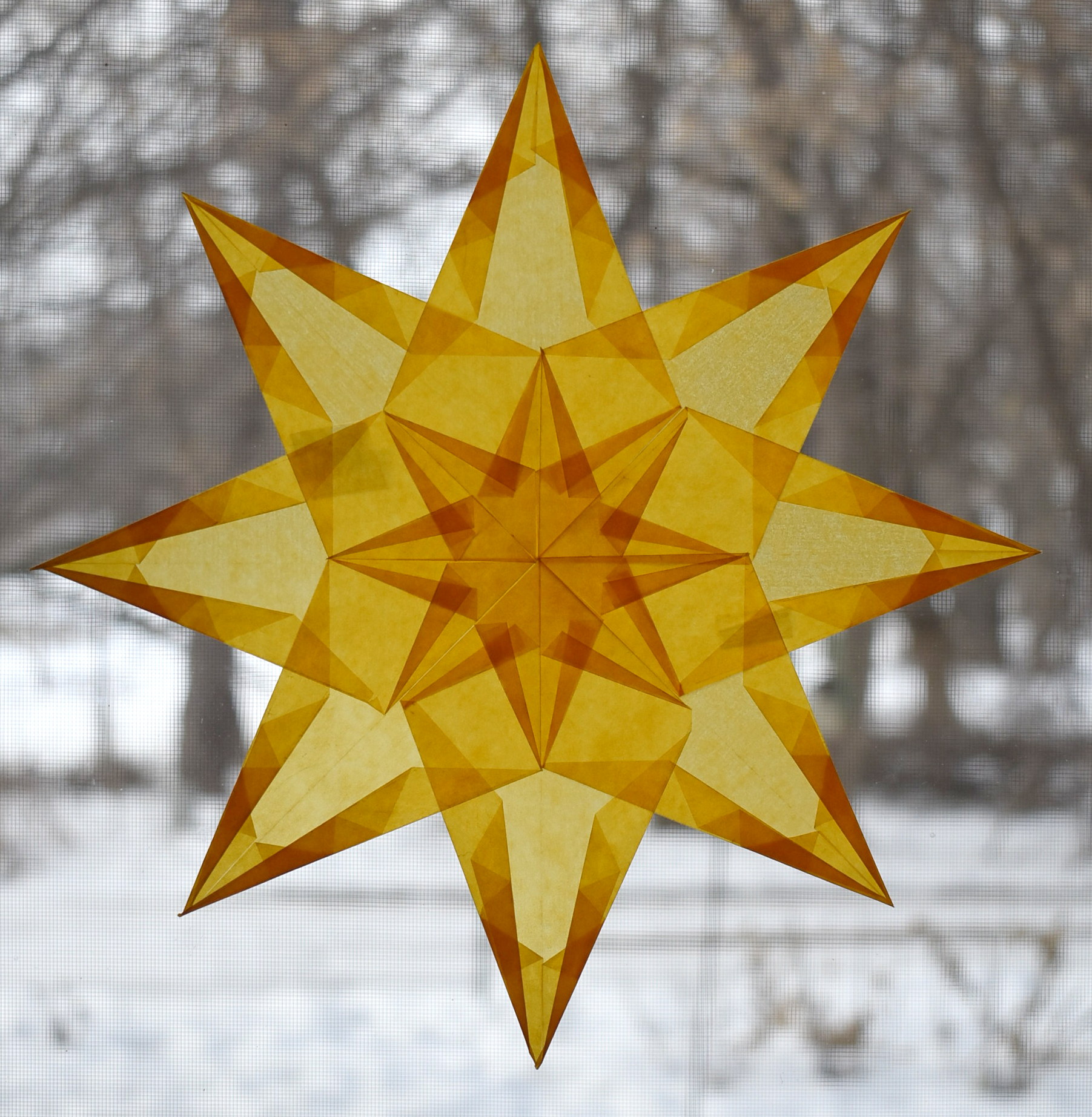
Window Star for Olivia's Golden Birthday

Olivia had her golden birthday on the 18th. It's hard to believe she is an adult. I thought I'd make some gold window stars to decorate the windows to celebrate this special day. I've never done a display of all gold stars. It was a nice backdrop to meals and opening presents on her birthday.

I found a new pattern on Pinterest that I tried for one of the window stars: 


For the paper size, I used 3"x5". This is how it turned out: 

I'm happy with it and would make this pattern again. 

Tuesday, January 12, 2021

The Wisdom of Sundays - Book Review and Notes

This week I read The Wisdom of Sundays - Life-Changing Insights from Super Soul Conversations by Oprah Winfrey. I had mixed feelings about the book. There were some people who had things that resonated with me while with others, there was nothing to which I could relate. The majority of the book fell into the latter category.


Essentially The Wisdom of Sundays is a series of conversations that Oprah had with leaders in “great thought.” Some of these were guests who were on her show, Super Soul Sunday. Other guests were ones she knew had been on their own spiritual journey and, as Oprah said, their “wise words have led me to knowing for sure that we are all spiritual beings having a human experience.” 

Not related to the content of the book, I found that the typeface was challenging to read - especially the italics for some reason. So, that made me skim over some parts since it took too much effort to try to read the book. 

That being said, the following are quotes or passages that I found valuable

- Your spirit is the part of you that is seeking meaning and purpose. That's one way someone can relate to that. Another way to understand spirit is that it's the part of you that is drawn to hope, that will not give in to despair. The part of you that has to believe in goodness that has to believe in something more. (Caroline Myss)

- For many years, I suffered from what I call a "disease to please." I worried that if I ever said no to something, people were going to think I wasn't nice, or they might think I was selfish and ask, "Why wouldn't she do that for me?"I made the shift to listen to the truth of who I really was, telling me what I really wanted. Before you agree to do anything that might add even the smallest amount of stress to your life, ask yourself, What is my truest intention? When the intention is right, and the answer is yes, your entire body will feel it. (Oprah)

- When you find yourself in a new situation, a new circumstance, a new life experience, everything that requires healing is going to rush to the surface. And if you don't take a minute to breathe, to gather yourself, to pray, you will do what you've always done. (Iyanla Vanzant)

New situation - how to raise rabbits after t
he den was found by one of our dogs. 

- If you've been faking your way through life, ignoring your inner compass, the wake-up call can be harsh: job loss, the end of a relationship, money problems, disruption in any form. Your real purpose on Earth is to become more of who you really are - to live to the highest degree what is pure, what is honest, what is natural, what feels like the real you. (Oprah)

- I can use the best of my talent and ability and influence to enhance the kingdom of God on Earth, which I believe comprises peace and freedom and the alleviation of suffering, human rights...When I was president, we never dropped a bomb, we never fired a missile, we never shot a bullet. (President Jimmy Carter)

-I believe that everyone has a God-size hole inside of them that we try to fill with shopping or with a relationship or food or sex or drugs. But it's not out there. It's in here. It's an internal connection. And that's what a spiritual practice, listening to your intuition, having a creative expression, being of service is all about. That is how you sustainably fill up your God-size hole. Otherwise, it's like a drop that's disconnected from the ocean. You just wither and die. (Mastin Kipp)

- You will forgive because you love yourself so much that you don't want to keep hurting yourself for whatever happened. Whatever happened is done and cannot be changed. And we have to accept that and keep going with our life. (Don Miguel Ruiz)

- There is not one experience, no matter how devastating, no matter how torturous it may appear to have been, there is nothing that's ever wasted. Everything that is happening to you is being drawn into your life as a means to help you evolve into who you were really meant to be on Earth. It's not the thing that matters, it's what that thing opens within you. (Oprah)

- Any hint of discomfort or agitation that could lead to confrontation, rejections, or anyone being upset would cause me to eat. (Oprah)

- My life changed when I started writing down five things I was grateful for each day. (Oprah)


- Follow your bliss. Pay attention to those moments when you're lit up, when time just flies by. When you're in that field of joyful expression, which is generally in contribution and being in service of some kind. Some sense of connection in your life. (Gary Zukav)

- When I really wanted something, I always got it. Positive and negative. Because the Universe does not think. You have this subconscious mind that sometimes is attracting tragedy. Attracting bad things. Because you want to be a victim. Because to be a victim is to justify a lot of frustrations and failures in your life. The Universe is helping you. You want to be successful. The Universe is helping you. (Paulo Coelho)

- My belief is that the whole purpose of life is to gain mastery - master our emotions, our finances, our relationships, our consciousness- through meditation, things like that. And it's not about the stuff. All the stuff can be taken away. People lose their fortunes. They lose their reputation. Beautiful spouses die or leave you. But who you become in the process can never be taken away. Never. You are mastering through the process of overcoming these obstacles that you face in life. (Jack Canfield)

- We are busier than any other generation we have seen in the last three to four hundred years. We are so busy. And we think because we're busy, we're effective. But I want you to challenge your schedule for a minute and ask yourself, are you really being effective, or is your life cluttered with all kinds of stuff that demands you, and drains you, and taxes you, and stops you from being your highest and best self? And are you substituting busyness and all the chaos that goes along with busyness for being effective? (Bishop T.D. Jakes)

- The only limit to your success is your own imagination. Whatever you can imagine is possible. (Shonda Rhimes)

- You are fulfilled when you get up in the morning. So many times we get up in the morning, we're depressed. We're down. We're angry. We're frustrated. But when you can wake up saying, "I'm glad to be alive. There is purpose to this day." To me, that is success. And I would argue that once you have that internal success, then externally it's just a manifestation of what happens internally in the best possible way. (DeVon Franklin)

- When you love someone, the best thing you can offer him or her is your presence. How can you love if you are not there? You offer him or her your true presence. You are not preoccupied with the past, or the future, your projects. You are for your beloved one. (Thich Nhat Hanh)

- Love is when you choose to be at your best when the other person is not at their best. (Pastor Wintley Phipps)


- The triggers for happiness are similar worldwide. It's a deep social connection. The breadth and depth and the meaning in our relationships is one of the greatest predictors of long-term levels of happiness we have. Only 10% of our long-term levels of happiness are based upon the external world. 90% of our long-term happiness is how the brain processes the world we find ourselves in. (Shawn Achor)


Sunday, January 10, 2021

Nature's Best Hope - Book Review

 During the first week of January, I read Nature's Best Hope by Douglas Tallamy. This is an excellent book filled with so much information about the birds and insects, and what people can do to improve the environment. The subtitle of the book is "A New Approach to Conservation that Starts in Your Yard" - and that is exactly what the book does. It provides such a vast array of ideas from which to choose. 

Some of the ideas we've already implemented during the past Summer when Olivia did her 4-H OWLS project.  However, there are still ways that we can build upon what we did and further improve the lives of birds and insects as well as other wildlife.

Some of the key points made in the book that I want to remember and share are:

- In 1903, with the state of Arizona on the verge of mining the Grand Canyon, President Theodore Roosevelt stood on the canyon's lip, gazed out over its unique magnificence, and uttered the five words that would save it: "Leave it as it is." 

- 95% of the country has been logged, tilled, drained, grazed, paved, or otherwise developed.

 - We have purposely imported thousands of species of plants, insects, and diseases from other lands, which have decimated many native plant communities on which local food webs depend. 

- We have carved the natural world into tiny remnants, each too small and too isolated to support the variety of species required to sustain the ecosystems that support us. 

- It is tempting to garden only for beauty, without regard to the many ecological roles our landscapes must perform. 

- For a typical homeowner east of the Mississippi, 80% of the plants in your yard are species that evolved in Asia, Europe, or South America - species that are unable to support the complex food webs necessary to sustain ecosystem function in your area. 

- President Richard Nixon understood the limits to the amount of abuse our natural resources could endure. In his 1970 State of the Union address, he said, "We can no longer afford to consider air and water common property, free to be abused by anyone without regard to the consequences. Instead, we should begin now to treat them as scarce resources, which we are no more free to contaminate than we are free to throw garbage into our neighbor's yard." 

- We must stop segregating ourselves from nature and learn to live as a part of it.

- If conservation is to happen, it must happen largely on private property, but not just on farms and raches; it must include all types of private property.

- There are few of us who cannot improve our relationship with the land we own. 

- The first serious efforts to protect natural areas from overexploitation were enacted some 500 years ago by European aristocracy as a means of protecting their favorite pastime: hunting. 

- Conservation by populor demand did not take root in Europe until the 1800s, when British artists started to change the subjects of their paintings from human forms and religious events to the beauty of the natural world. 

- Yellowstone National Park was the first national park in the world.

- In 1966, Congress passed the Endangered Species Act.

- Young box turtles spend much of their time underground.

- The built landscapes between habitat fragments must be ecologically enriched to the point where they can sustainably support entire lifecycles of local biodiversity. 

- 40% of the chemicals used by the lawn-care industry are banned in other countries. 

- 40-60% of fertilizer applied to lawns ends up in surface and groundwater, where it kills aquatic organisms and contaminates drinking water. 

- Land ownership is not just about privilege. It's about responsibility. (Roy Dennis)

- Because our gardens are usually in full public view, they are a form of communication.

- Thomas Jefferson featured plants from China and Europe whenever he could, because his landscape was a a symbol of his status. 

- If you are seeking peaceful solitude in a natural setting, a yard with plantings that create outdoor rooms is ideal.

- A cardinal in your yard is not justa cardinal in your yard: it is your cardinal. As such wild creates can no longer dpend on while natural plants to sustain them, you must assume responsibility for the well-being of your cardinal, your blue jay, and your AMerican toad. 

- One of the biggest benefits of Homegrown National Park (the natural areas that you create on your property) is providing our future earth stewards with the convenient option of entering the natural world 365 days of the year right at home. 

- Homegrown National Park will teach us, and our children, to value the natural world rather than destroy it. 

- Insects that attempt to eat milkweed leaves soon find their mouthparts glues permanently shut by the sticky sap. Monarchs, however, have found a simple but amazing way to defeat this defense: they block the flow of sap to milkweed leaves. 

- Friedrich Wilhelm Heinrich Alexander von Humboldt in 1804 stated that human activities would change the earth's climate if they continued unabated.

- The community of insectivores that relied on caterpillars for food were seriously diminished when introduced plants replaced native plants.

- Chickadees are able to assess the quality of the landscape before they deide whether or not to set up house. In yards with introduced plants, chickadees lay 1.5 fewer eggs than nests in yards dominated by natives. In these same yards, there were 1.2 fewer chicks produced and the chicks matured at a slower rate of 1.5 days compared to nests located in yards with lots of native plants. These changes cumulatively are making a huge and negative impact on the chickadee population. 

- A chickadee must find thousands of caterpillars to rear one clutch of young.

- Birds do eat berries produced by introduced plants. Nearly all of our invasive shrubs produce their berries in the fall; and both migrating and overwintering birds depend on fall berries for the fats that they need either to fuel their migration or to build fat reserves for the long winter months if they don't migrate. 

- Berries from introduced Eurasian plants such as autumn olive, glossy buckthorn, bush and Japanese honeysuckle, and multiflora rose container very little fat, typically less than 1 percent, while berries from natives such as Virginia creeper, wax myrtle, arrowwood, viburnum, spicebush, poison ivy, and gray dogwood are loaded with valuable fat, often nearly 50 percent by weight.

- Introduced plants are high in sugar at the time of year when our birds need to consume berries high in fat.

- When fall migrants stop to rest and eat in a habitat loaded with invasive shrubs, they do not stay long. Instead, they linger in habitats with plenty of the spicebush and arrowwood viburnum berries they need to fuel their migration.

- It takes 200 aphids to equal the weight of one medium-sized caterpillar. Caterpillars are also more nutritious than most other insects. They are high in protein and fats.

- A typical nestling eats a full meal 30-40 times a day. That means a parent (or couple) raising five chicks must bring food to the nest about 150 times a day. 

- Some genera, such as Quercus (oak), Prunus (cherry), and Salix (willow), host hundreds of caterpillar species.

- For most caterpillar species, only two of these life stages, the egg and larval stages, are completed on the host plant. 

- Monarch caterpillars almost never form their chrysalises on milkweed.

- When outdoor lights are on, insect visits (e.g., moths) declined 62%. A solution is to have the lights turn on only when you, or an intruder, are out and about in your yard.

- There are nearly 4,000 species of native bees in North America.

- Half of the Midwest's native bee species have disappeared from their historic ranges in the last century.

- There should be a continuous sequence of flowering plants in our landscape to help the bees. Although having more than one species of flowering plant blooming at once is desirable and gives bees nutritional options, a landscape that goes through a 2-3 weeks period with no blooms is deadly to bees. 

- Goldenrod nectar is an important source of energy for migrating monarchs. Its seeds feed a number of wintering sparrows, juncos, and finches, and birds use them to line their nests in the spring. Its stems provide housing for native bees during both summer and winter and support four species of gallers (insects that create galls) as well as several stem-boring caterpillars.

- Fall-blooming asters provide essential forage for migrating monarches, even well after goldenrod blooms end. 

- Diverse plant communities will generate diverse animal communities wherever they are.

- A silver maple has the potential to produce 287 species of caterpillars.

- Plant trees in groups of thre or more on ten-foot centers to result in a root matrix that would keep them locked in place through thick and thin. The trees must be planted young, so their roots can interlock as they grow. 

- Pocket prairies can be as small as 3'x7' and still provide pollen and nectar for flower visitors as well as nectar and host plants for monarchs. 

- Install a bubbler to attract a variety of birds.

- Reduce your lawn by half. Think of a lawn as an area rug, not wall-to-wall carpet.

- Remove invasive species.

- Plant keystone genera - native oaks, cherries, willows, birches, cottonwoods, elms, goldenrods, asters, and sunflowers. 

- Be generous with your plantings. Plant groves of trees at the same density that they would occur naturally in a forest. 

- Install window well covers to prevent toads, frogs, voles, and other small creatures from becoming trapped in window wells.

- Set your mower height no lower than three inches. 

- Replace the lawn under trees with well-planted beds replete with groundcovers. Large decorative rocks also provide pupation sites. A fallen log or old stump is even better to add to the bed.

Further books to read:

- A Sand County Almanac

Sites to explore:

- www.nwf.org/NativePlantFinder

- https://www.audubon.org/native-plants

Creamy Skinny Pasta Casserole

During January, I have been trying to use up what we have in the freezer and refrigerator. Not only has this saved a lot of money, but it has challenged me to look for new recipes to use this food. 

Today, I was looking for something that would use frozen ground chicken. I found Creamy Skinny Pasta Casserole by Taste of Home. As a bonus, there were five other items in the recipe that I had on hand that I could use. 

The recipe took about 30 minutes to prep and bake, and Taste of Home says there's about six servings. I would say there's more like 8-9 servings.


Ingredients 

12 ounces uncooked whole wheat penne pasta (I used regular pasta)
1 pound lean ground chicken 
1 small onion, finely chopped 
1 teaspoon garlic powder, divided 
1 teaspoon Italian seasoning (I used a combination of oregano, marjoram, and rosemary, and about 2 teaspoons)
1/2 teaspoon salt 
1/4 teaspoon pepper 
1 can (14-1/2 ounces) diced tomatoes, undrained (I used 2 cans)
3 ounces reduced-fat cream cheese 
1/2 cup reduced-fat sour cream 
1 cup shredded part-skim mozzarella cheese, divided 
Optional: Minced fresh parsley and crushed red pepper flakes (I did the red pepper flakes, but not parsley)

Directions 

Preheat oven to 400°. Cook pasta according to package directions for al dente. Drain, reserving 1/3 cup pasta water; return all to the pot. 

Meanwhile, in a large skillet, cook and crumble chicken with onion, 1/2 teaspoon garlic powder and remaining seasonings over medium-high heat until no longer pink, 5-7 minutes. Stir in tomatoes; bring to a boil. 

Add to pasta; toss to combine. Transfer to a 13x9-in. baking dish coated with cooking spray. 

Mix cream cheese, sour cream, 1/2 cup mozzarella cheese and remaining garlic powder. Drop mixture by tablespoonfuls over pasta. Sprinkle with remaining mozzarella cheese. 

Bake, uncovered, until cheese is melted, 8-10 minutes. If desired, sprinkle with parsley and pepper flakes.

Saturday, January 9, 2021

Remembering Lucy + The Heaven of All Animals

One of our cats, Lucy, died last month on St. Nicholas Day, December 6th. 

He was 15 years old. 

We only have one cat left, Meenie. 

2020 was not a good year for us in terms of pet loss. 

In addition to Lucy, Eenie died in April. 

He, too, was old - 16 years old. 

Both Lucy and Eenie were "Super Seniors" - cats who reach the age of 15 years old.


Having lived at our farm for 25 years, 15 of them with Lucy, there are reminders of him everywhere I look.


He probably sat on every piece of furniture we have in the house.


He was an easy-going cat who got along well with all the pets throughout his life.


He loved catnip - especially fresh catnip from the garden that we would dry in the dehydrator.


The cats would enjoy their special treats. This is when we had five cats (four of which are shown).


Lucy and Montague were close friends. When Montague came back from being groomed, he was so happy to see him. Lucy rubbed his head on Montague's to welcome him back.


Whenever I typed, the pets would surround me. Often times, they would be right where my arms were, making it slightly difficult to type.


Lucy was a good sport about the girls taking photos of him. He was a patient cat.


He also wanted to be right next to us when we ate. Towards the end of his life, he got bolder and tried to take our food if we weren't paying attention.


He was a part of holiday celebrations and always got a special treat in his stocking at Christmas. 


I loved seeing how the dogs would get along with the cats.


As I was thinking about Lucy, I looked at the books at the library and found some that dealt with pet loss. There was one that was a children's book that I thought may be helpful for Olivia, since it was she who found Lucy when he had collapsed in the next room from where she was sitting. She came in to get me - panicked - and then we went back to see what was going on. Olivia pulled Lucy out from behind the nightstand, where he had collapsed (we think he had a heart attack). 

Although he had a faint heartbeat, it was clear he was on the brink of death. We pet him as he was dying and told him he was a good boy. 

So, this book is one that I thought she'd like to see. Perhaps it could provide some comfort to her. I know it did for me. 

The Heaven of Animals by Nancy Tillman provides a message of comfort that helps people through the process of grieving and healing.

The illustrations are lovely and some brought tears to my eyes as I thought of the many pets that we have had over the years who are no longer with us - dogs, cats, a horse, sheep, chickens, turkeys, fish, and a hedgehog. 

I love the photos of animals coexisting who would never be next to one another on Earth - buffalo with a macaw, a cat, and a dog; or the boat with a child-angel, dog, giraffe, cat, and gorilla. 


Below are some of the images and text from the book that I particularly enjoyed. I also loved the cover of the book, pictured above.

When dogs get to heaven they're welcomed by name, and angels know every dog's favorite game.

When kitties arrive on their soft kitty paws

they are even more lovely to look at because

when they bathe up in heaven, their fur is so fine -

they stretch out their toes and just let themselves shine.


Horses in heaven are never alone, and grass is much sweeter than grass here at home. 

Whenever they want to, horses can snack; as soon as they nibble, grass grows itself back.


Sometimes a horse just wants to have fun,

so he and his friends kick their hooves up and run.

When it is thundering high in the sky,

horses in heaven are galloping by.


Heaven changes everything. 

But the love that you have for your animal friends is always the same - that love never ends. 

It makes itself known in all kinds of ways. 

It floats all around them, or settles and stays. 

And when angels whisper in animal ears, it is your voice that each animal hears.

You'll grow older; I will, too. 

That's what people always do.

But when you meet your friends again,

they'll see you as they saw you then

And you'll find they always knew

how much they were loved...

and how much they loved you.

Thursday, January 7, 2021

The Next Person You Meet in Heaven - Book Review

 Back in 2003, I read The Five People You Meet in Heaven by Mitch Albom. I recently read The Next Person You Meet in Heaven which I enjoyed. 

This is the sequel to that first book which focused on a man named Eddie who died saving a young girl named Annie when an amusement park ride broke. Although he felt his life was meaningless on earth, he learned from five people in heaven how much his - and every life - matters. 

In the sequel, Annie is whisked into her own journey to Heaven after her wedding day. She and her husband, who are involved in a hot air balloon crash, are taken to the hospital. She tried to keep him alive by donating an organ, but ended up dying. She wanted desperately to know if she saved her husband because of the transplant. 

The book alternates between chapters titled "Annie Makes a Mistake" which looks at her life retrospectively and because Annie felt that her whole life she'd been making mistakes. The other chapters are ones that carry the reader through her present-day life. 

The first person she meets is her doctor who treated her after the accident. He explained that "the five people you meet first are chosen for a reason. They affected you in some way on earth. Maybe you knew them. Maybe you didn't."

Annie questioned if she didn't know them, how could they affect her. The doctor explained that "our" time is lined to others' times. "We come from one. We return to one. That's how a connected universe makes sense."

The other thing the doctor explained when she said that she didn't picture heaven the way it was when she arrived was that "you get to pick your eternal setting." For the doctor, trains haunted him because of an accident he was in. In heaven there is "nothing to fear...so I chose to flip my human existence. Now I ride this train wherever I please."

The second "person" she met in Heaven was her dog, Cleo. However, Cleo presented herself as a woman because she "thought this form would be easier." She was there to teach Annie something and said that "each soul you meet in heaven does the same."

The lesson that Cleo was to teach Annie was focused on loneliness. Annie suffered from it, especially in her younger years. Cleo said that "loneliness itself does not exist. It has no form. It is merely a shadow that falls over us. And just as shadows die when light changes, that sad feeling can depart once we see the truth...[and that is] that the end of loneliness is when someone needs you. And the world is so full of need." 

Cleo's heaven was filled with grim-faced people, children on crutches, adults in wheelchairs, soldiers in dirt-stained uniforms, widowed women in veils....all in need of comfort in some way. There were tons of dogs who would run to the people with their tails wagging. They licked the people and the people would embrace the dogs and begin to smile. For Cleo, she wanted to feel the joy when people came home. Souls reuniting with something define.

Annie asked Cleo, just like she did the doctor, if Paulo (her husband) lived. Annie said, "I'm all right with dying as long as Paulo lived. Just tell me my death wasn't wasted." To which Cleo replied, "No act done of someone else is ever wasted."

This book had parts in it that reduced me to tears...just like the first book. One section was when Cleo changed forms back to being a dog and Annie was able to see her beloved dog again. "Annie's mind was flooded with memories...she felt a joy she had not known in years."

If that wasn't enough, the third person Annie meets in Heaven is her mom. This was another challenging chapter for me to read because I thought of my own parents and how much I miss them. The chapter with her mother said that "children begin by needing their parents. Over time, they reject them. Eventually, they become them." 

An important part of her time with her mother in Heaven was learning about the sacrifices that her mother made. When Annie was growing up, her mother kept a lot of secrets to keep Annie safe. As the author said, "All children keep secrets. All parents do the same. We mold the version we want others to believe, boosting the disguise and tucking away the truth." 

The other part was learning about what happened the day that she almost died, but was saved by Eddie. Because of the situation leading up to the accident, Annie's mother realized that when her daughter most needed her, she was with a man she didn't even care about. She became overly protective after the accident. Her mother said, "We don't realize who else we punish while we're punishing ourselves." 

The fourth person she met was Eddie - who saved her life when she was a little girl. She was able to learn his life history. They realized that both felt like they made too many mistakes in their lives. Eddie said, "I thought my whoel life was a mistake. Things kept happening to me, lousy things, until I finally gave up trying." 

When Eddie got to Heaven he learned that the job he thought was below him - working in an amusement park as a maintenance man - was actually exactly where he needed to be. Although Annie was sorry about being in the wrong place and causing his life, he said, "I needed to save you. It let me make up for the life I took. That's how salvation works. The wrongs we do open doors to do right." 

He also explained to Annie that he met five people when he arrived in Heaven and he was one of five for someone else...and that someone else was Annie. "You meet five people, then you're one of five for someone else. That's how heaven connects everybody."

Then it was time to meet the fifth person. When I read who it was, my heart sank. It was Paulo. 

"Loss is as old as life itself. But for all our evolution, we are yet to accept it." Annie realized that she didn't save Paulo's life and then reflected on the many losses she had experienced in her life. She felt like she failed again. And then...just as she was thinking that they would be together, she was headed back to Earth and Paulo was in Heaven to stay. 

The book concluded with what happened in Annie's life for a few years after returning...including having a child. Annie knew that she would comfort her daughter with the knowledge that "whatever her fears or losses, heaven held the answers to all her earthly questions, beginning with five people who were waiting for her, as they wait for us all, under the eyes of God and in the true meaning of that most precious word. Home."

Monday, January 4, 2021

Chicken Burrito Bowl

Sophia found a recipe a while back for Chicken Burrito Bowls that was on BuzzFeed Tasty. We have made it a couple times now and have enjoyed it. It is a flexible recipe that can be adapted to one's eating preferences. The recipe below serves 4-6 people. 


Ingredients

2–3 boneless skinless chicken breasts (I also used thighs one time, but chicken breasts taste better in this recipe)
3 bell peppers, any color, sliced
1 large red onion, sliced (I also have used a plain, yellow onion)
2 tablespoons olive oil
1 tablespoon taco seasoning (add more if you want more flavor)
Salt and pepper
1 jar salsa (split - use some for baking and the other for each serving once it is assembled)
3 cups cooked brown rice, divided (I used white rice)
1 can black beans, drained and rinsed (also could use kidney beans)
1 can corn
1 cup shredded cheddar cheese
1 lime, sliced into wedges
Fresh cilantro to garnish

Directions 

Preheat oven to 400˚F. Line a baking sheet with foil. Place the chicken, peppers, and onions on the baking sheet and drizzle with oil. Sprinkle the taco seasoning evenly over both sides of the chicken breasts. Salt and pepper the peppers and onions, tossing to coat. 

Top each chicken breast with a generous pour of salsa. Bake in a preheated oven for 25 minutes. Rest chicken for 10 minutes, before slicing into strips. 

Add a base of brown rice to 4 food storage containers. Top each with a scoop of black beans, corn, additional salsa, cheddar cheese, cooked peppers and onions, and sliced chicken. Garnish with fresh cilantro and a lime wedge. Store in the refrigerator (and enjoy any extras immediately). Can be kept refrigerated for up to 4 days. 

Monday, December 14, 2020

Slow Cooker Chicken Tacos - Whole 30 and Paleo

Last week, I made Slow Cooker Chicken Tacos. The recipe was from a pin on Pinterest that led to The Real Food Dietitians. I doubled the recipe since the package of chicken came was two pounds. I'm glad I did. It was an easy recipe to make and tastes great! 


We used tortillas. However, the Real Food Dietitians said it could also be served in a lettuce wrap or on a bed of greens. We topped the meat with onions, yellow peppers, fresh tomatoes, and salsa that we got at the local farmers market this summer. Fresh cilantro and some sliced avocado would taste good on the chicken tacos as well.

The Slow Cooker Chicken Tacos take about 10 minutes to prep and cook for four hours.

Ingredients

1-1 1/4 lb. chicken breast or thighs
1/2 cup organic or homemade salsa
1/4 cup water
1 tsp. ground cumin
1 tsp. chili powder
½ tsp. garlic powder
1/2 tsp. ground coriander (optional)
1/8 tsp. cayenne pepper (more for more heat)
1/4 tsp. sea salt
1/4 tsp. black pepper
Salad greens or bibb lettuce
Fresh cilantro
Toppings: Fresh chopped veggies of choice, olives, avocado, fresh salsa, lime wedge, etc.

Directions

Place all ingredients except the toppings and salad greens/lettuce in a slow cooker and cook on high for 4-5 hours. Remove chicken and shred with 2 forks (Note: I did this right in the slow cooker). Return to slow cooker and cook on low for an additional 30 minutes. (Note: I cooked the chicken for 4 hours and then kept it on warm until dinner). 


Serve chicken taco meat in a lettuce wrap or on a bed of greens, top with cilantro and desired toppings.

Thursday, December 10, 2020

Christmas Cookies and Treats

I was going through drafts of posts on my blog and came across one for Christmas Cookies and Treats. When I opened the document, I realized I had almost finished it except putting the fudge recipe in it. I don't know which fudge recipe I used, so I'm just posting with two recipes for Peppermint Shortbread Cookies and Mint Chocolate Cookies. 

The Peppermint Shortbread Cookies is a recipe from a friend who I knew for many years. We happened to be visiting her and her daughters one day when she was making these cookies. She shared the recipe and we've been making them at Christmas ever since.

Peppermint Shortbread Cookies

The shortbread cookies are the ones 
with the crushed candy canes on top.

Ingredients:

Cookies
1 cup softened butter
1/2 cup sugar
1 teaspoon vanilla
2 cups flour
1/4 cup cornstarch

Frosting
1 cup confectioners (powdered) sugar
2 tablespoons milk
Peppermint extract
Crushed candy canes or peppermint candy

Directions:

Mix butter, sugar, and vanilla with an electric mixer. Gradually blend in flour and cornstarch.

The mixture will be crumbly, so it is best to squeeze the dough by hand at this point.

Form into 1-inch balls and press down slightly on the cookie sheet. Bake at 300 degrees for 25-30 minutes or until the undersides begin to brown.

Cool 5 minutes, drizzle with frosting and sprinkle with crushed candy.

*~*~*~*~*~*~*~*

I saw a pin on Pinterest for Mint Chocolate Cookies that led to a blog. The cookies, when they come out of the oven, are soft and delicious. They turn into crisp cookies once they cool. I wish they would stay soft. They taste better that way, and it's the way I prefer them. Although I like the mint flavor, I would not make these cookies again.

The Mint Chocolate Cookies are the green cookies 
in the center of the plate.

Mint Chocolate Cookies

Ingredients:

2 3/4 cup flour
1 tsp baking soda
1/2 tsp baking powder
1/2 tsp salt
1 cup unsalted butter (at room temperature)
1 1/2 cup sugar
1 egg
1 tsp mint extract
15-20 drops green food coloring
1 bag of Andes Mints (chopped) or Andes Baking Chips

Directions:

Preheat oven to 375 degrees. Sift the dry ingredients (flour, baking soda, baking powder, and salt) together and set aside. Solicit your kids to unwrap the Andes Mints. A. was more than happy to unwrap them (knowing full well, he would be sneaking some).

In a large bowl, cream together the butter and sugar until smooth. Beat in egg and mint extract. Gradually blend in the dry ingredients. Add green food coloring and mix until evenly colored. Last, but not least, fold in the chopped Andes mints. Doesn't it look just like the ice cream?

Roll rounded teaspoonfuls of dough into balls (you may need to shape with your hands), flatten, and place onto ungreased cookie sheets.

Bake for 8-10 minutes. Let stand on cookie sheet for 2 minutes before moving them to wire racks to cool.

*~*~*~*~*~*~*~*~*~*~*~*

I had a fudge recipe for many years that I wanted to try. It called for nuts, but I didn't put them in the recipe since no one in our family likes nuts in fudge. This recipe made a very large amount of fudge - way more than what we needed. It could easily be halved or quartered and put in a smaller pan.