Wednesday, June 24, 2015

Creating a Barn Quilt Trail + "Log Cabin" Barn Quilt

Back in April, Olivia received a grant from Disney's Friends for Change to create a barn quilt trail in Washington County.

She held an informational and planning meeting on April 19th.


Three families from the Soaring Eagles 4-H Club as well as the president of the Friends of Scandia Parks and Trails met to discuss the project and a timeline.


By early May, we were purchasing MDO signboard, 2x2s and 2x4s.


Thankfully, we had a volunteer who helped transport these large pieces of plywood and lumber since we didn't have a vehicle large enough. He also did all the cutting of the pieces which was invaluable.


We began priming all the wood on May 9th.


The more exciting part of creating the barn quilts was picking out the colors and painting with them.


There were so many choices that it was difficult to make a decision sometimes.
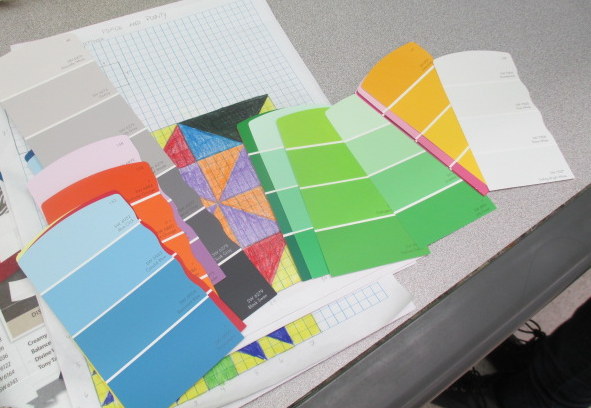

Each of the seven barn quilt patterns were graphed out using different measurements. They were either done on 6-inch, 8-inch, or 12-inch scales.


The first barn quilt we worked on, Log Cabin, was done on a 6-inch scale. This meant that we had to figure out the design first on graph paper with each block representing a 6-inch square.

Then we transferred the design to the large sheets of primed signboard. We used string that was taped down on both sides and a three-foot ruler to make the lines.


Early in the project, Olivia was interviewed by Mary Divine of the St. Paul Pioneer Press.


She did a phone interview with her first on May 5th and then a face-to-face interview on May 12th. Mary was able to observe Olivia, Sophia, and other volunteers while they worked on the Log Cabin barn quilt.


One of the challenges was keeping all the paint colors straight - especially the yellows which are very close in shade.


This project was a great intergenerational activity. For this barn quilt, there were volunteers who ranged in age from 8-86 years old.


It also was a great way to learn from people who had skills that we didn't have - like woodworking.


The Washington County Barn Quilt Trail had a photographer who came out on a very cold day - 45 degrees! - to photograph Olivia and Sophia at work. We couldn't paint that day because it was so cold, so we ended up sanding wood filler where we had screwed the framework into the barn quilt.


Our hands were so cold!


The next time we painted - just a few days later - it was at least 20 degrees warmer. It made such a difference to be painting in nice weather.


Each of the sections that needed to be painted had to be taped off. The tape remained on the barn quilt until at least three - sometimes up to six - coats of paint were applied and dried.


On the last day of doing "Log Cabin," we screwed together the two big pieces of wood. The wood was either slightly off and/or had warped during the few weeks we had been working on it. So, we had to quickly fill a rather large gap with wood filler, sand it, and paint it before installing it later that afternoon.


While the paint was drying, Olivia and Dan measured the barn to find the center of it.


Around 6:00 p.m., more volunteers came to lift the 100+ pound barn quilt up and onto the 2x4 that would stay in place until the six-inch lag bolts were holding the barn quilt to the barn.


We were all a bit nervous as the barn quilt made its way up since it was so heavy and awkward. Everyone had worked so hard on it that we didn't want to see it fall to the ground.


Not to worry. It finally was in place and resting on the 2x4.


The six-inch lag bolts were put through the quilt and into the barn's huge beams.


Everyone was so happy with how it looked when it was up. It was about 7:30 p.m. by the time it was done - 1 1/2 hours after the process was started.


A couple days later, we went back on a sunny day to look at the barn quilt. It stands out and complements Gammelgarden Museum quite well. The colors tie into the buildings which make the barn quilt all that much more special and relevant to the museum.


This was a fun barn quilt to begin with. It was complicated, but not overly so compared to some other ones that we did with this project.


Olivia (the creator of the Barn Quilt Trail) and Lynne (the director of Gammelgarden) are both very pleased with how the Log Cabin barn quilt turned out, and are excited that it was done in time for Gammelgarden's opening event on the Sunday of Memorial Day weekend.

Sunday, June 21, 2015

Nature Photo of the Week - Week 25

The theme for this week's photo is "Birth." This is a drone bee (a male) emerging from a cell.


The bees had created a double layer of cells in the beehive to fix a frame-spacing error on our part. We didn't realize that the bees were so precise in amount of space they like between the frames in the hive. The spacing was off no more than a half an inch, but that made all the difference in the world to the bees.

As inexperienced beekeepers, we are learning how amazing and industrious these creatures are each time we visit them.

At any rate, we had to remove these cells from the hive, properly space the frames, and give the bees another opportunity to build onto the frame.

After we closed the hive, we were able to watch these drones emerge from their cells. It reminded me of when we had chickens and watched the little chicks peck their way from their eggs.

It's a slow process in the sense of the pace in which we live our lives. Yet, in reality, these baby bees know exactly what to do in a relatively short period of time.

Once they emerged, they walked around a bit and then began looking for food. Interestingly, there was honey in some of the cells that was leaking out. The drones found it and we could watch them eat it.

We placed the honeycomb near a container garden that is filled with flowers that attract bees. We're not sure if they went to the flowers since we had to move on with our day, but at least they were very near two food sources right after they emerged.

Sunday, June 14, 2015

Nature Photo of the Week - Week 24

This week the peonies started blooming. They are so fragrant and remind me of peonies my grandma used to grow along the side of her home and in her flower garden in the backyard.

One of the themes for the Nature Photo of the Week is "Fragrant" - so this seemed like a fitting photograph to choose.


Each of the peonies had ants in them. When I was younger, I didn't like the ants crawling over the flowers - especially after the flowers had been picked and were inside in a vase on the table.

I was told that the ants helped the petals open. According to the Heartland Peony Society, though, peonies don't rely on ants for the flowers to open. The Society said, "Some people think ants are required to open the flowers, but this does not to appear to be true .... Peonies produce small amounts of nectar and other ant attractants to encourage ants to help in opening the dense double flower buds found in many peonies." So, it looks like they are beneficial, but not necessary to the flowers opening.

Interestingly, the Society noted that, "Ants may be found covering certain varieties and avoiding others, this is totally normal." They also recommended not trying "to get rid of the ants on your peonies. This is a natural and temporary activity. Once the buds have opened the ants will disappear - also normal."


I also was interested in the meaning and symbolism of peonies. According to Teleflora, "With a recorded history that dates back thousands of years, it’s not surprising that even the mythology surrounding the origin of the peony has multiple versions.

"One legend has it that the peony is named after Paeon, a physician to the gods, who received the flower on Mount Olympus from the mother of Apollo. And another tells the story of that same physician who was 'saved' from the fate of dying as other mortals by being turned into the flower we know today as the peony."

The peony is the traditional floral symbol of China, the state flower of Indiana, and the 12th wedding anniversary flower. They are known as the flower of honor and riches. Teleflora noted, "With their lush, full, rounded bloom, peonies embody romance and prosperity and are regarded as an omen of good fortune and a happy marriage."

Another thing I was curious about was if peonies were edible. According to What's Cooking America, "In China the fallen petals are parboiled and sweetened as a tea-time delicacy. Peony water was used for drinking in the middle ages. Add peony petals to your summer salad or try floating in punches and lemonades."

Each week, new things are blooming and the landscape is changing. I've enjoyed spending more time outside and am looking forward to taking more photos of nature this week. I'll see which ones fit with the themes remaining for the year.

Tuesday, June 9, 2015

Nature Photo of the Week (Weeks 13-23)

One of my goals for 2015 is to take 52 pictures using the Nature Photo of the Week Prompt List. Rather than post each week, I am doing a group posting for 11 weeks.

Ideally I would have been taking one photo per week since my last posting at the end of March when I returned from a wonderful trip to three southern states (Louisiana, Mississippi, and Arkansas) where I was able to go on many nature walks.

However, it hasn't worked out that way. Instead, I went back on nature photos that I took from April through this past weekend, and picked about two dozen photos that I liked. From those pictures, I chose 11 of them that matched the prompts.

Feather: There were two wood ducks in the backyard at my mom's home in April. The feathers on these ducks are brilliant, and the picture doesn't do them justice since it is taken through a screen and window. Had I opened the door leading to the deck and backyard, they would have flown off.

My dad used to have a wood duck house next to the lake and each year there would be a new family of ducks that would use the house. They truly are beautiful, vibrantly-colored birds that are a joy to watch.


First day of...: Beekeeping. Sophia received a scholarship from the Minnesota Hobby Beekeepers Association to establish a hive. In April, she built a hive from a kit they provided, and then received a container of bees with a queen. We're excited to see how the bees do during their first year, and to watch the process of establishing a hive from scratch.


View: This is the view I had while walking on one of the trails at William O'Brien State Park. This one is along the St. Croix River. It's such a peaceful and quiet part of the trail. The trees provided a nice canopy along this section of the walk.


Refreshing: This spring the tulip and hyacinth bulbs came up along the driveway. After the snow and cold of winter, it was refreshing and uplifting to see a garden filled with shades of purple and magenta along with crisp white.


Stream or creek: Our 4-H club visited Koi Acres. This was the stone pathway that we crossed to get to the pond that had some of the koi.


Fish: At Koi Acres, there is a natural swimming pool/pond that has koi in it. These are big fish who were friendly and inquisitive. Each had unique markings and colors. Even in the drizzling rain, I could have spent hours just watching the fish swim in the pond.


Hidden: This heron was hiding among the tall grass at the pond at Gammelgarden to the left of the picture. All of a sudden, as we were painting the barn quilts (for part of the Barn Quilt Trail project) that afternoon, we noticed the heron slowly walking along the shoreline. It made its way out of the grasses and into this open area to turn slightly back from where it had walked. The heron stood there for a long time before continuing on its walk along the edge of the pond.


Just do it!: On the afternoon of June 5th, there was a big snapping turtle trying to cross a busy highway in the country. A woman stopped and was crossing the road to get the turtle to the other side.

We passed where she was and found a place to safely turn around so we could offer her our shovel. We stopped as did another family, and collectively each of us helped in some way to get this turtle back to a safe area and far from the road. I wondered how old it was and if it had ever come in contact with humans before.


Early: Early in the season, I enjoy watching how seeds emerge. These are beans that are about a week old. On some of them, you can still see the casing of the seed while others have pushed it away to  reveal the new, young leaves. Within 60 days, we should be enjoying fresh beans from the garden.


Little things: Among the huge hostas and ferns under the pine trees in the front yard are delicate bleeding hearts and columbine. Below is wild columbine that we found on the side of the road more than a decade ago. It would have been mowed by the county and no one or thing would have benefited from it.

When Olivia and I were out taking a look at the front gardens, we noticed a big bumblebee going from flower to flower on the columbine plant. It made me happy that this plant is helping the bees!


Fragile: This White Admiral butterfly was in the driveway on June 7th when we were painting barn quilts (again). The butterfly would fly around a bit, and then land on the rain-soaked sand and gravel on the driveway. Interestingly, this butterfly typically isn't spotted in our county in Minnesota. Rather, it is found to the west and north of us - mainly in the northeastern part of the state.


Now that the weather is much warmer; and things are growing and blooming, I'm hoping to spend even more time outside to notice and observe the changes each week in the plants, flowers, and world around me.

Sunday, June 7, 2015

Take-Out, Fake-Out: Beef & Broccoli {Crockpot}

Last year I was doing 101 Days of Summer Fun, and the theme for Mondays was Make It Monday. I made "Take-Out, Fake-Out: Beef & Broccoli" that everyone enjoyed. However, I forgot to take a picture.

So, I thought I'd make it again this summer while we were working on the Barn Quilt Trail project. The recipe is from a pin that I saw on Pinterest that led to Table for Two. It's a perfect Chinese-inspired main entree for four people that can be made in a slow cooker.

Beef & Broccoli that I made on June 7th

The ingredients include:

1 pound boneless, beef chuck roast, sliced into thin strips (this is put in the crockpot raw - do not precook or brown the meat)
1 cup beef consumme or beef broth
½ cup low sodium soy sauce
⅓ cup dark brown sugar
1 tablespoon sesame oil
3 garlic cloves, minced
2 tablespoons cornstarch
4 tablespoons sauce (from the crockpot after dish is cooked)
Fresh or frozen broccoli florets (as many as desired, I used about 2 cups)
White rice, cooked

The instructions are very easy:

In the insert of the crockpot, stir together the beef consume, soy sauce, dark brown sugar, sesame oil, and minced garlic.

Place your slices of beef in the liquid and stir to coat.

Turn the crockpot on low and cook for 6 hours.

After this time period, whisk together the cornstarch and cooking liquid in a small bowl to create a slurry. Pour the mixture into the crockpot and stir to mix. Add the broccoli florets. Cook on low for an additional 30 minutes to thicken the sauce, and defrost and cook the broccoli.

Serve over white rice. Enjoy!

Adding other vegetables - like snow peas - might be 
something that we would enjoy as well.

Tuesday, May 26, 2015

Top 10 Spring/Summer Chores: #7 - Plant Seeds and Transplants

Each year, there are things that we need to do in the spring and early summer. These are both chores that make getting through these seasons much easier; and things that will help the wildlife and/or flora.

1. Spring cleaning and purging - inside the home as well as outdoor (hobby shed, barn, and tractor shed).

2. Muck out the barn.

3. Repair the mailbox and post after having it damaged by the snow plow.

4. Tune up/service the lawn tractor.

5. Repair and/or replace the pasture fence.

6. Prepare the garden beds - create new ones and build new raised beds.

7. Plant seeds and transplants.


Flowers, vegetables, and herbs ready to be transplanted.

8. Build a chicken coop and introduce chicks to their new home.

9. Make repairs to any buildings damaged during the winter; and then paint them.

10. Start splitting and stacking wood.

*~*~*~*~*~*~*

This week, I'm focusing on planting seeds and transplants. Through our 4-H Club, we received ten Garden-in-a-Box kits. Three of the kits were given to families to manage at their own homes, and seven were kept at our farm to use as demonstration gardens, be used to harvest and share produce for those who participate in the summer gardening program; and to donate the surplus produce to the food shelf (our goal is 30 pounds).

Loading 35 bags of dirt into a pick-up before realizing that we didn't have enough vehicles with a significant amount of carrying capacity to carry 75 more bags of dirt.
Thus, we rented a U-Haul to transport 110 bags - or 2.2 tons - of soil to the farm.

The raised beds are different from the ones I've used in the past.

Friends/fellow 4-H parents help set up the 3'x4' bags for raised beds.

These are heavy-duty bags that "pop up" into a 3'x4' garden.

Each garden required 11 bags of soil. 
Once the 440 pounds of soil was put in the gardens,
they weren't going anywhere. 

We added 11 bags of soil (or 440 pounds) and two cups of fertilizer.

Olivia and Sophia work with fellow 4-Hers to set up the gardens.

It was so easy to set up the gardens compared to building raised beds from wood.

Bailey and Hoss supervise the work of 4-Hers.

The hardest work was behind us once the gardens were established.


About six days later, we put the transplants in the gardens. (It's amazing how quickly six days can go by.)

Olivia transplanting a tomato plant.

We are using the posts as a temporary way to mark off 12"x12" squares. We have 7 plants per raised bed or 49 plants total.

We placed different transplants into each section depending on their height. The plants that will grow the tallest are in the back row (the north side) and the shortest plants are in the front row (the south side). In this way, all the plants will receive the maximum amount of sunlight.

The plants are all in the garden and ready to start growing.

We have five spaces per garden (35 spaces total) to fill with other transplants or seeds. Some of the seeds we have and others we still need to purchase. We also need to purchase a few more transplants for this gardens as well as others that we want to establish this year. Our goal is to have everything in planted by end of the first week of June.


This past Sunday, we put down newspapers and then bark chips on top of that. It finishes of the gardens nicely. We still need to trim around the gardens and cut back some of the wild black raspberries that are growing on the north side of the 4 raised beds.

It will be interesting to see if our challenges with weeding are not as great as in past years since we are not planning to add any compost from our farm to the raised beds. We will be planting other gardens in which we do use compost from our farm (from the horses), and will see if there is a difference in terms of the number of weeds.

Other than that, it is such a sense of satisfaction to have gardens again. In a couple of months we should be enjoying fresh vegetables!

Sunday, May 17, 2015

Finding Deep Joy - Read 52 Books in 52 Weeks - Week 20

For the 20th week in the Read 52 Books in 52 Weeks challenge, I read Finding Deep Joy by Robert Ellwood. This is a book that is part of the "Joy" focus in the Spiritual Practices A to Z that I'm also doing this year.


Some of the things that I found interesting in Finding Deep Joy were:
- Joy lies hidden deep down at the heart of all things - boulders, trees, dolphins, zebras, and ourselves.
- Joy can be tapped in such a way that we can recognize its presence everywhere.
- When this deep joy comes, it is just there, independent of outer events....It is a pure joy of being that can well up in the most ordinary settings...even in a hospital bed or a prison cell.
- Joy is not only your right, your heritage; joy is you at the deepest level, and your joy is one with the infinite, timeless joy of the unbound universe.
- Yet so often we block joy. We get caught up in our routines, our little fears and goals. We merely skim the surface of little puddles of joy as we run by.
- After going through a great personal joy or sorrow - falling in love or losing a loved one - you come to a point where you just don't feel it so strongly anymore. You may even feel emotionally numb.
- Questing for happiness in the world of things turns our gaze away from the genuine wellsprings of deep joy, which have little to do with possessions, excitement, entertainment, or fun - though deep joy enhances all innocent pleasure.
- We ought to be able to know joy in each moment, in each person we meet, or each object we see, however transitory the event, unprepossessing the person, or trivial the object to the casual eye.
- Love or compassion is the supreme ethical value simply because it expresses the unity of the universe. Its opposite, hatred, which wants to alienate and separate and distance people and things, is at cross-purposes with the true nature of the universe and can never ultimately prevail.
- Compassion is simply expressing in action the interrelatedness of all life, all being; the person who talks about cosmic oneness but does not express it in compassion has not begun to understand it.
- Joy represents a state of equilibrium, one that is tension free.
- What the joyous person has is a radiance, a smiling serenity accented by a twinkle. That person may be of any religion or none.
- You should abstain from harming others, falsehood, theft, and greed; you should observe purity, contentment, study, and religious devotion....When you set foot on the spiritual path to deep joy, you must give up all that is untrue to yourself and all that harms others, all that caters to the self-centered appetites and passions, and all forms of excess, while taking on a simple lifestyle, an even-tempered frame of mind, and emphasizing higher things.
- The ill effects of negative thoughts, words, and deeds that might be no great sin for an ordinary person will be much greater for one seriously engaged in any spiritual path....That is because the higher your aspirations - or sometimes attainments - the greater the inner schism created by departures from them. The farther apart the poles of aspiration an behavior, the greater the chance that the whole system will fly off kilter and degenerate into chaos.
- It is said that you can break a bad habit or establish a good habit by carefully not doing the former and doing the latter for one month. Try it: do not overeat, drink, smoke, or whatever the compulsion is, for one month. Then do what you set yourself to do for a month - meditation, regular exercise, good eating, whatever. See if the negative dependency has not lost its power and the good become well established.
- So far as the rest of your life is concerned, the key is to live in a manner that is congruent with your spiritual practice.
- Your lifestyle and surroundings should be calming, tend toward joy, and foster a sense of living for more than sensual and material  gratification.
- If you want to find and keep joy, it helps to live in reasonable simplicity, neither in abject poverty nor choked with material goods.
- If you move toward simplicity - living in a clean and neat but unostentatious home, earning an honest living and spending within your means, eating wholesome food and keeping regular hours, you will set the physical conditions for joy.
- Living moderately and simply does not mean stifling creativity...No human activity is closer to the wellsprings of deep joy than creativity. Cultivate it in your own way. If you enjoy cooking, prepare your wholesome food as creatively as possible. Ornament your house with art or furnishings made by yourself or your friends. Spend part of your free time writing or painting. It doesn't matter so much what you do, but find something creative that you like and feel good at, and spend time with it.
- It is important to have a collection of books on topics consonant with your spiritual quest, the sort you return to time and time again for inspiration. Related pictures and symbols might be on the walls.
- You must not try to push anyone else in the household....into a lifestyle they have not freely chosen. If they choose to live less simply than you or around different values, you must accept this cheerfully and not let it become a source of contention, just as they must accept your way. All this is part of the love and wise moderation of the path to joy.
- Take time out to cultivate deep joy....In times of great suffering, poverty, sorrow, or anxiety - above all, of sadness - it is even more important.
- No obligations imposed by troubles are so great that they preclude all recourse to deep joy, even if for only a few minutes saved for prayer or meditation.
- In real engagement with life, the seeds of joy are always there, for engagement means looking outward rather than toward the self.
- Live here and now, in the present moment. Remember that deep joy is now; pain is mostly past and future.
- Past and future are not real. They are only constructions of mind. True, the mind may use certain memories as building blocks to reconstruct the past and to fashion the future. Still, what we are in the present really determines how we read past and future. If we are anxious and depressed, we will tend to drag up unpleasant and crazy-making memories from the storehouse of the past and build a future out of the darkest present trends in our lives. If we are full of deep joy in the present, we will make a past out of happy memories or of crises from which we emerged triumphant. We will look forward to a future in which everything that is now going well only grows in power.
- Clean up the present moment, fill it with joy, and let its sunshine dissipate the clouds of past and future. This does not mean that nay bad thing that objectively did happen or will happen is magically made nonexistent. But their power to hurt will be gone. They will just be there, but impotent.
- Don't worry about ten years or even ten minutes from now. Stay in touch with deep joy here an now, in the present, one second at a time. Nothing can destroy it so quickly as not allowing yourself even the present second of joy! Grief, heavy problems, and physical pain are real, but they depend on tight bondage to the past and future for their reality.
- Difficulties are opportunities.
- The bad times can aid you in learning compassion.
- It is the nature of compassion and caring to do all that is humanly possible to change the situation so that happiness rather than suffering is what is shared.
- Joy is ours by right and we are empowered to take charge of our lives.

In spring, hundreds of flowers; in autumn, a harvest moon;
In summer, a refreshing breeze; in winter, snow will accompany you.
If useless things do not hang in your mind,
Any season is good for you.
- The Gateless Gate (Zen text)

There were suggestions of things to do:
- Think back over your life and record the moments when you have felt the most joy. Perhaps they have to do with the smell of autumn...or the satisfaction of having helped someone. Consider keeping a journal for this purpose.
- Pain, disappointment, suffering, and death are realities in everyone's life. Thing about your own greatest heartaches and hardships. What can you affirm of value beyond these painful experiences? What can you affirm of value in them?
- Whatever your present circumstances, list 10 things for which you are grateful today.
- Find an image of (or simply visualize) your favorite saint. Look deeply into his or her eyes until you catch a little of that saint's joy - real sanctity is caught, not taught!

Sunday, May 10, 2015

Simple Living - Read 52 Books in 52 Weeks - Week 19

For the 19th week of the Read 52 Books in 52 Weeks challenge, I read Simple Living by Jose Hobday.


- Simple living is about freedom.
- Choose space rather than clutter, to choose open and generous living rather than a secure and sheltered way.
- Freedom to choose less rather than more. It's about choosing time for people and ideas and self-growth rather than for maintenance and guarding and possessing and cleaning.
- it is about poetry and dance, song and art, music and grace. It is about optimism and humor, gratitude and appreciation.
- It is a relaxed grasp on money, things, and even friends.
- Simplicity cherishes ideas and relationships.
- It doesn't cling nor try to possess things or people or relationships. Simplicity frees us within, but it frees others, too. People don't have to compliment our clothing or admire our collections. They aren't distracted from what's real.
- It makes us welcome among the wealthy and the poor alike. The poor are not offended by our dress and the rich are not threatened. This applies to clothing, housing, and transportation.
- Attending to simple living yields unsuspected abundance, joy, and freedom.
- Having things that are meaningful to us contributes to simple living.
- We have to know what matters in this life.
- The native tradition is always to seek harmony. If you have many needs and desires, harmony is not possible.
- The best way to sell ourselves is through what we believe in through our values and principles.
- Don't listen to what they say, look at how they live. That's where their beliefs are.
- Simple living requires us to take a good look at our consumer mentality, our spending mentality, and our misunderstood right to squander the gifts and good of this world for a few so that many are deprived and suffer.
- We learn to appreciate what we have.
- We gain not only material space but inner room for things that are new and exciting. We gain an uncluttered spot for something lovely and beautiful. We gain time. We have more room in our soul. Our soul feels clean and empty, swept out - uncluttered and unfettered.
- Our spirit yearns for more quality....It requires more love in our actions.
-  There's a depth, a quality, an inner smile that goes with being really present, because the ultimate wonder is that we are present to ourselves.
- Parenthood is difficult...because discipline is required - of patience, of waiting, of understanding requires extraordinary love and attention, consciousness, care, and time.
- What food do I need each day to keep me healthy?
- As we look at our basic clothing needs, we ask, "What do I really need?"
- The spiritual task is to discern between real needs and the extras. We don't need the extras.
- If you have all of your needs met, all of your helps met, most of your preferences met, and most of your luxuries met, you are not living a gospel life. You are blind to the real world, especially to the poor.

Sunday, May 3, 2015

Where Women Create - Read 52 Books in 52 Weeks - Week 18

During 2015, I'm doing two challenges: Read 52 Books in 52 Weeks and Spiritual Practices from A to Z. The latter challenge is what is guiding my reading choices for the year.

The spiritual practice I am currently focusing on is "Imagination." I found a book at the library called Where Women Create - Inspiring Work Spaces of Extraordinary Women by Jo Packham.


This was more of a browsing book versus reading book, although there is plenty of text throughout it. I just found that was looking at the pictures and concentrating on the more visual elements of the book than the written words.

The overall feeling, though, as I completed the book was "clutter" and "chaos." I'm sure there's an organizational system in each of the artist's work space. However, for me, the majority of the spaces had so much stuff. It was just too much. I would find it difficult to concentrate and be inspired with so many distractions around me.

Everywhere in the work spaces was something. There was often no open space on walls, in closets, in drawers - anywhere. That would drive me crazy.

One artist did have a floor that I liked. It was hand-painted and had big square blocks on it. The outlines (maybe 1" wide borders) were a sage green. In one corner, a diagonal line was drawn and then divided in half so there were two small triangles. One of the blocks was painted purple, and then the two small triangles were red and turquoise separated by a gold line/border. The other square was painted red and the two small triangles were gold and purple separated by a turquoise line/border.

What I did take away from the book were some helpful tips:

- To launch your imaginary voyage, carve out a private space and time, even if it's only an hour sketching.
- Give yourself time to straighten up at the end of a session so you can start the next time without being too overwhelmed.

There were some good quotes too:

- Live simply so that others may simply life. (Anonymous)
- The future belongs to those who believe in the beauty of their dreams. (Eleanor Roosevelt)
- What things are true, what things are honest, what things are just, what things are pure, what things are lovely, what things are of good report; if there be any virtue, and if there be any praise, think on these things. (Philippians 4:8)
- Not merely an absence of noise, real silence begins when a reasonable being withdraws from the noise in order to find peace and order in his inner sanctuary. (Peter Manard)
- Use it up, wear it out, make it do, or do without. (Old New England Proverb)