Tuesday, September 23, 2014

Cucumber Mint Sugar Scrub

Some time ago, I pinned a recipe on Pinterest for Cucumber Mint Sugar Scrub. Now that cucumbers and mint are readily available at the farmers market, I thought I'd try it.

The pin links to Bella Limento and is an easy-to-make scrub that uses only four ingredients:

1 large cucumber
2 tablespoons fresh mint leaves
2 1/2 cups granulated sugar (I used 3 1/2 cups of sugar)
4 tablespoons extra virgin olive oil

To make the sugar scrub, first place the peeled cucumber and mint into a blender. (I used our Vita-Mix Mixer.) Puree.

Into a medium bowl add: sugar, the puree, and olive oil. Stir until combined.

The original recipe said that if you prefer the mixture more firm to add additional sugar. So, I added another cup of sugar.

The mixture is still on liquidy-side, but it was a consistency that was fine to use.


I tried it on both Sophia and me. Below is what the scrub looks like on Sophia's arm before I rubbed it in.


Once the scrub is rubbed in, the skin turns a light shade of red.


Although the oil is probably absorbed into the skin, the rest of the ingredients stay above the skin.


When we were done, we rinsed off our arms and hands. Both of us felt like our skin was much smoother.

There is still quite a bit of the Cucumber Mint Sugar Scrub left in the refrigerator. We both want to use it again - perhaps on legs and feet next - so we can see if there's a difference just like we felt on our arms.

Canning Pickled Banana Peppers

This year I tried something new with canning: pickling peppers. The recipe is from Canning Homemade! and uses a variety of peppers.

I used banana and red peppers and put both types in two pint jars in layers. I'm not sure what the flavor will taste like since they need to sit for a while (kind of like canning homemade pickles).


What I do know is that the texture is much softer than I anticipated. Once the peppers are placed under the broiler so the skin can be peeled, the texture is significantly changed. So, these pickled banana peppers may be better on sandwiches where crunchiness isn't desired.

The recipe calls for 7 pounds of peppers. I had about half that amount on hand and it made two pints. There was quite a bit of brine (vinegar, water, salt, sugar, and garlic leftover) because of having less peppers to pickle.

Pickled Banana Peppers

Ingredients:

4 lbs Hungarian, banana, chile, or jalapeno peppers
3 lbs sweet red and green peppers mixed
5 cups vinegar 5% acidity
1 cup water
4 t. kosher salt (or pickling salt)
2 T. sugar
2 cloves garlic

Directions:

Caution: Wear rubber gloves and do not touch your face while handling or cutting hot peppers. Wash your hands thoroughly with soap and water before touching your face.

Wash peppers and then quarter them.

Blanch in boiling water or blister skins on tough skinned hot peppers by placing peppers under the broiler for 6 to 8 minutes until skins blister.

After blistering skins, place peppers in a pan and cover with a damp cloth. You can also put them in a zip loc or paper bag. Cool for several minutes and then peel off the skins.

Flatten the small peppers and quarter the large peppers.

Fill hot jars with peppers, leaving ½ inch headspace.

Combine and heat other ingredients to boiling and simmer 10 minutes. Remove garlic. Add hot pickling solution over peppers, leaving ½ inch headspace. Remove air bubbles and adjust headspace, if needed.

Wipe rims and then place hot lids and rings on them. Process in a water bath for 10 minutes at a full boil.


I'm not sure if I would make this recipe again. I was hoping for a crunchier pepper. However, I'll have to see what the taste is like in a few weeks. 

This has been one of many new recipes that I've tried this year with canning. It is a major project I'm doing in expanding my canning skills by trying different recipes and new processes (including learning how to use a pressure canner). 

As part of project-based homeschooling (one of the many philosophies I've incorporated into our homeschooling curriculum), I believe it's important to model that this philosophy extends well into adulthood. Doing projects isn't something simply reserved for children. Even as adults we should be challenging ourselves to learn new things and expand our skills.

Monday, September 22, 2014

Roasted Garlic Pasta Sauce

After shopping at the Minneapolis Farmers Market on Saturday morning, I had a variety of fresh produce and herbs that I was excited to can. One of the recipes I've been wanting to try was Roasted Garlic Pasta Sauce from Canning Homemade.


Although there are a couple of pasta sauces at the store that taste good, there's nothing like making your own pasta sauce (which also can be used for pizza sauce) that are made with organic ingredients and don't have added preservatives and chemicals.

The recipe for the Roasted Garlic Pasta Sauce is adapted from Better Homes and Garden Canning Magazine

Ingredients:

6 bulbs of garlic (I used 4 bulbs)
3 T. olive oil
4 medium red, yellow and/or green bell peppers, halved and seeded (I used red and green bell peppers)
12 pounds peeled tomatoes (I didn't peel the tomatoes since I was running them through the Vita-Mix mixer)
3 T. packed brown sugar
2 T. kosher salt
1 T. balsamic vinegar
1 t. ground pepper
2 cups snipped basil leaves (there was no basil available at the market, so I had to skip this, unfortunately)
1 cup assorted fresh oregano, thyme, or flat leave parsley (I used rosemary and parsley)
(I also added some dried thyme and Italian seasoning)
6 T. bottled lemon juice

Preheat the oven to 400 degrees. While it is preheating, peel away the dry outer layer of the garlic bulbs. Cut top off and leave bulbs intact. Place cut side up on a small baking dish and drizzle with one tablespoon of oil.

Arrange peppers cut side down on a foil-lined baking sheet. Brush with remaining 2 tablespoons of oil. (I ended up pouring some oil onto the foil and then dragging the peppers through the foil so they were covered.)

Roast garlic and peppers for 40 -50 minutes or until the pepper skins are charred or the garlic cloves are soft. Cool garlic until cool enough to handle.

Pull up foil to enclose the peppers. (Didn't see this step as I was reading the instructions. That could explain why some of the peppers weren't as easy to peel as I anticipated.) Let peppers stand for 15 to 20 minutes or cool enough to handle. Peel off skin and discard. Set aside peppers.

Remove garlic by squeezing the bottom of the bulbs. Place garlic cloves in a food processor and add cut peeled tomatoes into chunks. Add some of the chunks to the garlic in the food processor. Cover and process till chopped. (I skipped these steps since I was going to use the Vita-Mix Mixer after all the ingredients had boiled on the stove.) Transfer garlic and tomatoes to a 7-8 quart stainless steel heavy pot. Repeat chopping the remaining tomatoes in batches in the food processor. Add all the tomatoes to the pot.

Add brown sugar, salt, vinegar, and black pepper to the tomato mixture. Bring to low boil and boil steady for 50 minutes stirring often. Add chopped roasted peppers to tomato mixture. Low boil for 10 to 20 minutes more or until mixture reduced to 11 cups and reaches desired consistency stirring occasionally. Remove from heat stir in basil and assorted herbs. (For some reason, the sauce did not get to a very thick consistency like I would find with the grocery store pasta sauces.)

My thought is that I could add all or a portion of a small can of tomato paste when I'm using one of the canned jars of Roasted Garlic Pasta Sauce.

Spoon 1 tablespoon of bottled lemon juice into each of the hot sterilized pint jars. Ladle hot sauce into jars with lemon juice leaving a ½” headspace. Wipe jar rims, adjust lids. Process jars for 35 minutes in a water bath at a full boil.


Makes 6 pints. (I made 12 pints from this recipe.)

Sunday, September 21, 2014

The Time Keeper - Read 52 Books in 52 Weeks - Week 39

This week for the 39th week of the Read 52 Books in 52 Weeks challenge, I chose to read The Time Keeper by Mitch Albom. I've read many of his books and each one is equally as thought-provoking as the others.


This one focuses on a man named Dor (also known as Father Time) who invented the first clock as a way to measure time. Since then, people have measured time in increasingly smaller amounts. As the book said:

Try to imagine a life without timekeeping. You probably can't. 

You know the month, the year, the day of the week. There is a clock on your wall or the dashboard of your car. You have a schedule, a calendar, a time for dinner or a movie. 

Yet all around you, timekeeping is ignored. Birds are not late. A dog does not check its watch. Deer do not fret over passing birthdays. 

Man alone measures time. And, because of this, man alone suffers a paralyzing fear that no other creates endures. A fear of time running out.

So, because Dor impacted humans with the burden of timekeeping, he is banished to a cave for centuries and forced to listen to the voices of people who come after him who are begging for more days, weeks, or years...essentially asking for more time.

After listening to the voices for hundreds of years, his spirit is nearly broken. At this point, he is given conditional freedom: with a magical hourglass he is to go into the present world and teach two people the true meaning of time.

One person he chooses is a teenage girl named Sarah who is about to commit suicide after being rejected by a boy whom she thought liked her. In reality, he posted on Facebook that he was simply being nice to her. After reading all the mean-spirited comments from his friends, Sarah's self-esteem (which was already low) seemed to plummet to deeper levels. She could only envision one way to end the miserable and humiliating situation she was in. Sarah felt "worthless and hollow."

The other person he picked was a wealthy, old businessman named Victor who is facing multiple health issues and a prognosis of two months of life. His goal is to live forever by exploring cryogenics (freezing a dead body and waiting for science to advance so the body could be unfrozen and brought back to life to cure it).

In order for Dor to save himself, he must save Sarah and Victor. In that process, he affords them each a look at the impact of their decisions if they would happen the way each anticipated. For both Sarah and Victor, the outcome is vastly different than how they envisioned their choices.

Sarah and Victor have the opportunity to go back to the moment in with Dor met them and choose what they wanted to do. The remainder of The Time Keeper looks at how their decisions affected not only themselves but others.

Ultimately, Dor and Victor learn a valuable lesson:

"With endless time, nothing is special. 
With no loss or sacrifice, we can't appreciate what we have."

The Time Keeper is an excellent book that I would highly recommend. It is one to reflect upon and consider the choices one makes in life - especially as they relate to time - and the impact they have on others.

Sunday, September 14, 2014

Son - Read 52 Books in 52 Weeks - Week 38

For the 38th week of the Read 52 Books in 52 Weeks challenge, I read Son by Lois Lowry. Son is the final book in The Giver quartet. Many years ago I read The Giver and then earlier this year I read Gathering Blue as part of this challenge.

In between Gathering Blue and Son is the third book in the quartet: Messenger. I haven't read that one yet.


At any rate, Son is about a teenager (Claire) who had a son in a future "utopian" world. Although it is designed to have removed all the negative and challenging features of the real world, it ends up being more dystopian.

Claire was assigned the role of "Birthmother" - a lesser role in her society an one that simply views the young woman as being a "Vessel" who produces a "Product." Each Vessel is only allowed to produce three Products at which time they are re-assigned to another role in the community.

At age 14, Claire struggled to give birth to her son. Because of the challenges with childbirth, she was immediately re-assigned to work in the fish hatchery. While she was there she feels a sense of longing...of grief...of loss for the son she was never allowed to see and hold.

Conveniently, all the "Products" were raised in a building not far from the fish hatchery. Claire decides to visit there one day and ends up volunteering to help the staff. She is finally able to see her son, hold him, and spend time with him.

All the "Products" are assigned family units who will raise them. All the babies - except one - are suitable for this assignment except one: Claire's son. He is retained so that he can overcome his challenges and not be as disruptive to his future family unit.

Ultimately, it is determined that he isn't able to be placed. For that reason, he will go to "Elsewhere" (which is just another word for being killed).

A worker who feels a special connection to Claire's son ends up taking him so he doesn't go to Elsewhere. Claire, then, feels she needs to go as well.

She ends up, though, in a village where she is welcomed by the community members as one of their own. There she is loved and accepted for who she is, and free to do what she wants to do. With the help of another community member, she becomes stronger with the goal of leaving the community to search for her son.

In the process of leaving, she is warned that she will encounter a spirit of evil that takes the form of a person - the "Trademaster." Trademaster provides what people want at an expense that they cannot fully comprehend when the trade is made.

Claire does encounter Trademaster and makes a significant trade in order to see her son. In turn, her son ends up facing Trademaster to put an end to the evil that has affected many people...including his mother.

Like the other books that I've read by Lois Lowry, Son was a throught-provoking, engaging story. I have always been impressed by Lowry's writing and how she can pull a reader into a story so much that it is difficult to put the book down.

Friday, September 12, 2014

Ants - Outdoor Hour Challenge

For this week's Outdoor Hour Challenge, we focused on ants. First, I shared some information from the Handbook of Nature Study about insects in general and ants specifically. (This was from pages 294-300 for the insects in general and 369-373 for information about ants.)

We found the part about ants who battle with one another quite fascinating. We had no idea that ants could be so aggressive towards one another. The description is engaging and we could picture the ants in battle.

As the author said, "There is a great variation in military skill as well as in courage shown by different species of ants; the species most skilled in warfare march to battle in a solid column and when they meet the enemy the battle resolves itself into duels, although there is no code of ant honor which declares that one must fight the enemy single-handed."

We also learned the difference between an ant egg (very small, oblong, and the size of a pinpoint), the larvae (translucent, like grains with one end pointed), and pupae (yellowish, covered with a parchment-like sac and resembles grains of wheat).

There are often two different sizes of ants within the same species. The large ones are called majors and the smaller ones minors.

We also used two books from the library: Creepy Creatures: Ants by Valerie Bodden and All About Ants by Sue Whiting.

Some interesting facts:
=> Most ants are black, brown, yellow, or red.
=> The smallest ants are the size of the grain of sand. The biggest ants are as long as your thumb.
=> There are about 15,000 kinds of ants.
=> If an ant is in danger it will give off a specific pheromone, alerting the other ants in the colony to be on guard.
=> An ant's nest has different rooms that are used for different things (e.g., nurseries, for the queen, food, sleeping). These oval-shaped rooms are called "chambers."
=> Most individual ants only live 45-60 days, but an ant colony can survive up to 30 years.

After we did some reading, the girls worked on their nature journals and we watched a four-minute and 52-second video on YouTube about ants making tunnels at 900 times the speed of life. It was fascinating to watch how they construct the tunnels - a world that is unseen to us.

Then we spent some of our outdoor time looking for ants. We looked on the driveway (which is gravel), in the pasture on dirt spots that the horses roll on, under rocks, and on trees.

We thought for sure that we would find ants on fallen trees, especially ones that had rotted, and had moss and mushrooms growing on them.


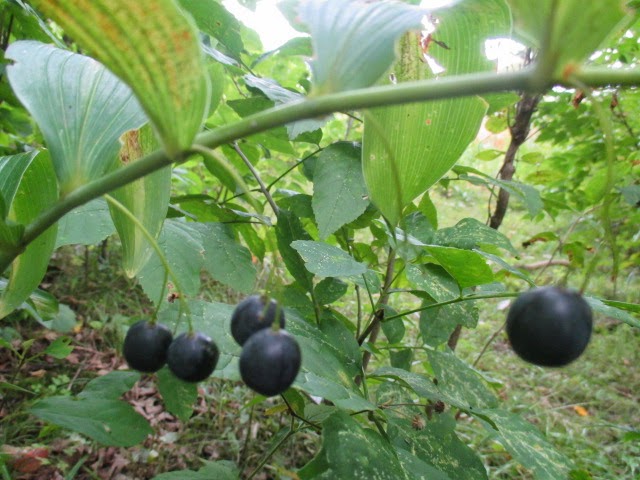
While we were near one fallen log in the wooded section of the west pasture, we found some type of fruit. We have no idea what it was so we didn't taste it.


We spotted some type of insect. It was like a grasshopper or cricket, except it had a black "tail" which none of us had seen before. When we came inside, we looked up the words "grasshopper," "cricket," and "tail." The images that came up and most closely matched what we saw in the pasture were of the Field Cricket.

In our case, it was a female Field Cricket. (The male doesn't have the "tail" or ovipositor, a spike-like appendage, about 0.75 inches long, on the hind end of the abdomen between two cerci. The  ovipositor allows the female to bury her fertilized eggs into the ground for protection and development.)


Last week, the acorns had not fallen from the oak tree yet. This week, we spotted a few on the ground as well as evidence that they are being nibbled on by some little creatures.


Sophia found a big woolly bear caterpillar. Initially it curled up when she picked it up, but when she gently blew warm air on it, it uncurled itself and began traveling on her hands.


Despite all the these interesting discoveries, we were surprised that we found only two ants on tree bark of the big oak tree in the west pasture.

We headed to the backyard and found that mushrooms seem to be growing in abundance. There are big white ones.


When some of them are picked, the interior is a tannish-brown color with lots of little "pores" - for a lack of a better word.


When I came in, I was curious to know what the big white mushrooms were. From what I can tell, they may be Calvatia gigantea, commonly known as the Giant puffball.

According to Wikipedia, the Giant Puffball is a mushroom commonly found in meadows, fields, and deciduous forests worldwide usually in late summer and autumn. All true puffballs are considered edible when immature, but can cause digestive upset if the spores have begun to form, as indicated by the color of the flesh being not pure white (first yellow, then brown).

Immature gilled species still contained within their universal veil can be lookalikes for puffballs. To distinguish puffballs from poisonous fungi, they must be cut open; edible puffballs will have a solid white interior.

As a side note, as I was finishing up this post, I put the above photograph on the Minnesota Mushroom Forum. Within minutes, I received confirmation that it is, indeed, the Giant Puffball; and that it is edible if the flesh is white and firm.

We also spotted this fascinating-looking mushroom that was growing new one of the new trees that we planted this spring.


Although the picture isn't too clear, I spotted a Daddy Long-legs resting on the wood pole of the arbor. (It's on the left-hand side of the picture.)


Sophia and Olivia were playing on the swings and I was determined to find some ants for them to observe. I finally did! Of all places, they were on the cover of the hot tub.

There were a couple of ants just walking around.


They were walking among the pine needles that had fallen from the pine tree next to the hot tub.

The girls came up from the swings and took a look at the very few ants that we could spot. We moved the pine needles and tried to find more ants.


Then, interestingly, there was one ant that seemed to have a purpose. It was carrying a wing of another insect. It was holding the wing upright - like a flag - and made its way quite quickly across the cover. It was very determined to bring this wing somewhere despite the obstacles in its way.


We noticed that all of the ants on the hot tub cover were about the same size.


They were much smaller than the two we saw on the oak tree; and were lighter in color. The ones on the oak tree were black (but not carpenter ants).

We used the original ant study on the Outdoor Hour Challenge as well as the newer version.

     Carnival of Homeschooling

Sunday, September 7, 2014

Taco Ring after the Taco Daze Parade

We went to the Taco Daze Parade on Saturday afternoon. The theme this year was the Roaring 20s. Some of the people and horses were dressed up and decorated to reflect the theme, while others were familiar sites from past years.

The Lions always have a big float at the parade and are one of the first floats to start the event.


About midway in the parade, the gnome appears:


It's a Swedish community, so the parade wouldn't be the same without the gnome.

Towards the end of the parade is what we look forward to: the horses. One group was decorated with a patriotic theme.


Another set of horses had the 1920s theme with pretty feathers and decorations around their faces and on their manes.

Every year that we see the miniature horses and carts, we think that it would be good to get a cart so that Hoss can go out on walks and explore the area a bit. Bailey would probably like to go too, but would need a larger cart.


When we came home, I made a taco ring. This recipe appeared on my Facebook feed a couple of times, and I've been wanting to try it since. Taco Daze seemed like a great day to try this recipe.


Ingredients

2 crescent roll tubes
1 pound ground beef
1 packet of taco seasoning
1 1/2 cups grated cheddar cheese (divided)
Shredded lettuce
1 or 2 diced tomatoes depending on size
1/2 small can sliced olives
Guacamole
Sour Cream

Directions 

Separate the crescent pastry and lay out in a circle, pointed ends out on a foil lined pizza pan, sprayed very lightly with cooking spray. Use some of the leftover crescent rolls to to make the center a bit thicker as this will hold the meat.

Brown meat in a frying pan until no longer pink. Drain fat and add taco seasoning as directed on package, reducing the water to a scant 1/3 cup. Drain excess liquid from meat.

Spread meat mixture in a circle inside the crescent rolls, then sprinkle 1 cup of the cheese over the meat.

Pull crescent roll points over meat and cheese and tuck in.

Bake at 350 degrees until pastry is golden brown (about 30 minutes).

Add remaining 1/2 cup of cheese, chopped lettuce, tomato, black olives, and jalapenos (if using), into the middle of the ring, then add a few dollops of sour cream if desired, before serving.

As a side note, the ring I made puffed up quite a bit. I think you need to make the center ring quite large in order to have a space for lettuce, tomatoes, and cheese.


Regardless, everyone enjoyed the taco ring and wants to have it again. Although this will (most likely) become an annual tradition, I may just have to make this recipe more often since it's so easy and delicious!

Blue Jay - Outdoor Hour Challenge

Two years ago, we studied blue jays and blue birds. We're starting out our nature studies for the 2014-15 homeschool year with this familiar bird again. 

First, we read about bird beaks on pages 39-40 of the Handbook of Nature Study. Although the focus is on chicken beaks and duck bills, it gave an overview some of the different purposes of beaks/bills.

Then each of the girls listened to facts that I had found on All About Birds about blue jays - a familiar bird here at the farm that has blue, white, and black plumage, a pretty crest, and noisy calls.

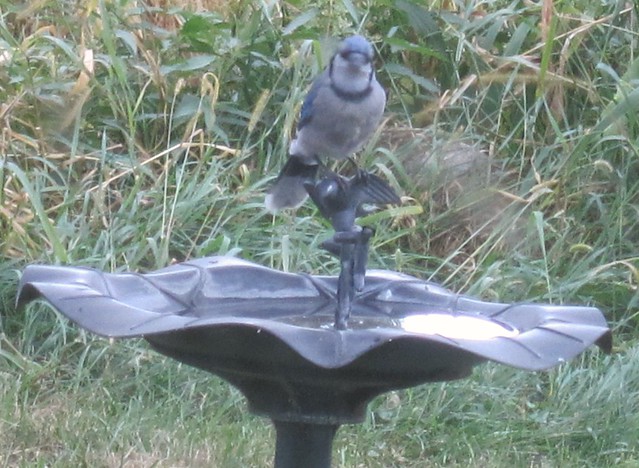
Blue Jay on Bird Bath
Blue jay on our bird bath.

There were many interesting things we learned about blue jays from All About Birds. For example:

=> Their fondness for acorns is credited with helping spread oak trees after the last glacial period.
=> Some blue jays migrate while others stay in their range. Others will alternate years that they migrate (migrating one year, not migrating the next).
=> Blue jays are known to take and eat eggs and nestlings of other birds. However, most of their diet was composed of insects and nuts.
=> Blue jays lower their crests when they are feeding peacefully with family and flock members or tending to nestlings.
=> The pigment in Blue Jay feathers is melanin, which is brown. The blue color is caused by scattering light through modified cells on the surface of the feather barbs.
=> Blue jays are found in all kinds of forests but especially near oak trees; and they’re more abundant near forest edges than in deep forest. (This probably explains why they like our farm since we have many mature oak trees.)

Sophia's nature journal entry.

Size wise, blue jays are about 9.8–11.8 inches. Their wingspan is 13.4-16.9 inches. They weigh 2.5-3.5 ounces. As a comparison, nine pennies equals approximately 2.5 ounces.

In terms of eggs, a female will have between 2-7 in her clutch; and will have a single brood each spring. The blue or light brown with brownish spotted eggs are about 1- 1/3 inches in length and .7-.9 inches in width.

The incubation period is 17–18 days and the nesting period is about the same (17-21 days).

Olivia's nature journal entry.

Blue jays carry food in their throat and upper esophagus—an area called a “gular pouch.” They may store 2-3 acorns in the pouch, another one in their mouth, and one more in the tip of the bill. In this way they can carry off five acorns at a time to store for later feeding. Six birds with radio transmitters each cached 3,000-5,000 acorns one autumn. That's an amazingly large number of acorns!

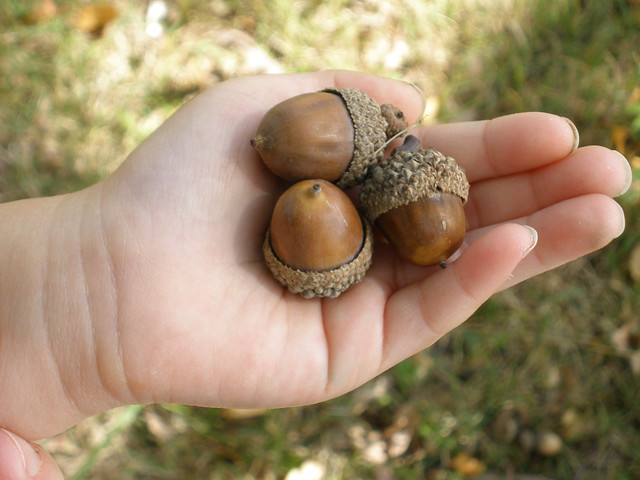
Acorns in a Hand
Sophia holding some acorns back in October 2008.
We found a few acorns when we outside, but it will be another month
until the majority of the acorns fall off the trees.

Once Sophia and Olivia worked in their nature journals, we headed outside. It was a nice day after a string of rainy days. While we were listening for blue jays, I had Sophia and Olivia go on a "micro-hike" in which they each had a four-foot piece of yarn that was put on different sections of the grass.


The goal was to explore - at a micro level - the activity that can often be overlooked. Despite being in the same part of the yard, each section had very different items.

Some of the things that Sophia noticed were various groupings of mushrooms and different types of grasses and weeds.


Some of the things that Olivia noticed were: grass, clever leaves, dead grass, dirt, bark, bugs, dead pine needles, "c-shaped thingies," and weeds.


While the girls were observing life at the ground level, I looked around and observed life at the ground to two-foot level.

There was a sunflower that was near the birdfeeder. One of the seeds must have fallen to the ground and germinated.


The hydrangeas are green. They were white back in July, so it looks like before long they will be in their dried state. I leave these up during the winter because they provide a nice landing and sitting spot for the birds.


We've been having lots of problems with moles this year in the back and front yards. This is one of many holes that are in our yard - along with a lot of tunnels.


These little wildlflowers grow each year.


The Black-eyed Susans were adding color to the landscape.


The pear tree even has some pears this years despite an odd spring that went from a first snowy week in May to almost 80 degrees a few weeks later. A severe rainstorm knocked down a lot of blooms so I wasn't sure we'd even get any fruit. This year the fruit seems a bit mis-shapen and damaged. Yet, the flavor is delicious...though the fruit is still on the crisp side.


We collected some things that caught our eyes - such as a feather:


a pretty leaf that's already changing its color:


and a milkweed pod with seeds so tightly packed in the pod still - overlapping one another in a beautiful pattern.


Pretty soon the seeds in other pods will be ready to burst open their homes and set forth on journeys throughout the pastures and yards.

We made our way to the west  pasture, and the girls noticed the tremendous number of box elder bugs this year. If you walk past them and don't disturb them, it's not that bad. However, if you get too near and disturb them, Sophia said that they'll all fly up. Clearly, we didn't want that to happen. We avoided them.


As we entered the pasture, the horses noticed us and started to walk towards us.


There are milkweed plants all over the pasture - something that wasn't present when we moved here back in 1995. It's nice to see that our efforts to spreading the seeds throughout our farm are paying off. Hopefully the monarchs are finding enough to eat here.


The goldenrod is in full bloom. The monarchs - on their migration south - visit the goldenrod as do the bees for nourishment.


We spent some time under the oak tree in the west pasture looking for acorns. It's still a bit too early, but we found five - the same amount that a blue jay can hold in its throat and beak.

We enjoyed watching Bailey and Hoss gallop through the pasture.


As we were there, we heard a very shrill call. Was it a blue jay? We know they can imitate hawks. (We also found out they can imitate humans!) We didn't see anything, so we walked through different parts of the pasture.

Hoss was showing off - rolling in dirt like a dog, running at top speed and kicking up his legs; while Bailey walked along with us. Before long, she couldn't resist: she had to run with Hoss. She sped through the pasture - also kicking her legs up and having a great time. She put on quite a show.


The only bird we saw while we were out in the pasture was a large raptor.


When we heard another  shrill call we looked up. We're not sure exactly what type it was - maybe a falcon or a hawk. At any rate, it soared in the air directly above us showing its impressive wingspan.

That was, ironically, the only bird we saw the entire time that we were outdoors.

I printed page 38 of Cornell's Classroom Feeder Watch coloring book that had an image of a blue jay and some questions. The girls worked on these after they they had completed their nature journal page and we spent some time outdoors.