Showing posts with label Handbook of Nature Study. Show all posts

Monday, February 14, 2022

Skunk - Outdoor Hour Challenge

The girls and I used to do the Outdoor Hour Challenge when they were younger. With this being the last year of homeschooling Olivia, I wanted to do some remaining nature studies that we had not had the opportunity to do yet. This week, we focused on skunks. 


Watch excerpts from a Nature program about skunks: PBS Nature Skunk. This is a 30-second preview to the program. After that we watched "Skunk Spray Chemistry" which we found fascinating. We learned that:
- A skunk spray ingredient has an interesting characteristic. It will ignite and is highly flammable. 
- The spray has a thiol in it which is a sulfur-based compound that is found in garlic and onions. 
- In high concentrations, the compound will cause people to vomit. 

Look at photos from a field trip to Fawn de Rosa where there was a skunk

We talked about the field trip, and being able to see and touch the skunk up close.


Olivia was clearly intrigued by the little skunk.


It was such a great experience to be able to touch a skunk - something we would never have been able to do elsewhere.

September 26, 2015

Read pages 245-247 in the Handbook of Nature Study. 

Some of the interesting facts from this book include:
- A fully grown skunk is about two feet long; and its body is covered with long, shining, rather coarse hair. 
- The tail is very large and bushy.
- The fur is sometimes entirely black, but most often has a white patch on the back of the neck, with two stripes extending down the back and along the sides to the tail. The face also has a white stripe.
- Its front legs and very much shorter than its hind legs, which gives it a very peculiar gait.
- Its forefeet are armed with long, strong claws, with which it digs its burrow.
- Sometimes it makes its home in an abandoned woodchuck's hole or under a barn.
- The skunk is very neat about its own nest.
- It belongs to the same family as the mink and weasel, which also give off a disagreeable odor when angry. 
- The odor from the spray can be smelled for half a mile downwind.
- Because this discharge is so disagreeable to all other creatures, the skunk's intelligence has not become so highly developed as has that of some animals. It has not been obliged to rely upon its cunning to escape its enemies and has therefore never developed either fear or cleverness.
- The skunk's food consists largely of fruits and berries, insects, mice, snakes, frogs, and other small animals. It also destroys the eggs and young of birds that nest upon the ground. 
- When skunks burrow beneath barns, they completely rid the place of mice. 

Look at the New Hampshire PBS NatureWorks information about skunks. This handout had a lot of good information that Olivia cut and paste into her nature journal.

Read Stories 22 (An Independent Family) in The Burgess Animal Book for Children. Some facts that were integrated into the story are:
- Weasels, minks, otters, and badgers are all related to skunks.
- The "scent gun" is never used unless a skunk feels it is in danger.
- Skunks eat beetles, grubs, grasshoppers, crickets, mice, and frogs. 
- Skunks don't go into the winter chamber of their home until after the first snowfall.
- They have between 6-10 babies each year.
- The mother skunk is the only one around when the babies are born. However, the father rejoins them when they start walking. 
- In the southwest United States, there is a hognose skunk.
- When skunks are angry, they will growl and stamp the ground with their front paws.
- Owls don't mind the skunk's scent, so they are are an enemy of the skunk. 

During 10-15 minutes of outdoor time, keep an eye out for signs of mammals - such as animal tracks. Take photos or make a mental note of how they looked. 

In Minnesota, we typically do not see skunks. Every once in a while we smell if a skunk has been hit on the road. However, it is very rare. In the past 26 years that we have lived at our farm, I think I've smelled a skunk under five times - mostly on the county roads near us. Only one of those times did I smell the skunk (or skunks) on our farm and the smell lingered for days. We had no idea where the skunk (or skunks) was living or hiding. 

Olivia with a stuffed skunk/taxidermy at Lake Shetek State Park.
June 9, 2012

Create a page in a nature study book about what was learned about skunks. 

Olivia did a nature study on March 22, 2013. Her nature journal page is here:


Her new nature journal page that was done in February 2022, is here: 


Olivia used the notebooking page (the first image) from Notebooking Fairy. 

Additional resources for this challenge:

Sunday, February 13, 2022

Raccoons - Outdoor Hour Challenge

This week, Olivia and I focused on studying raccoons for our nature study. We used some of the ideas from the Outdoor Hour Challenge that were posted back in 2009, but never did at that time. We also added some of our own activities.


Watch videos about raccoons.

We watched this one - Raccoons: Amazing Animals. Raccoons are opportunistic omnivores. They have very sensitive paws. There are seven species of raccoons, and most live between 2-5 years. That's such a short life!

We also watched this one - Raccoon demonstrates problem-solving skills. Rascal, the raccoon, shows how it can remember how to open a variety of locks to get through three compartments to receive treats and eventually leave the plexiglass tunnel. 

We also watched Raccoon Nation and some of the short clips from the episode. The "First Night Out" one was interesting as a mother and her young raccoons went out and about. As dawn approaches, they need to find a hiding spot for the day. We learned that raccoons can collapse their backs to fit into smaller quarters. 

Also on Raccoon Nation was "Filming Raccoons is Hard" which shows the difficulties of getting videos and pictures of raccoons at night. 

Read from the Handbook of Nature Study.

“None other of our little brothers of the forest has such a mischievous countenance as the coon. The black patch across the face and surrounding the eyes like large goggles, and the black line extending from the long, inquisitive nose directly up the forehead give the coon’s face an anxious expression; and the keenness of the big, beady, black eyes and the alert, “sassy” looking, broadly triangular ears, convince one that the anxiety depicted in the face is anxiety lest something that should not be done be left undone; and I am sure that anyone who has had experience with pet coons will aver that their acts do not belie their looks.”
                                                        -Handbook of Nature Study, pages 247-248


Read pages 247-250 in the Handbook of Nature Study about the raccoon. 

“The raccoon lives in hollow trees or caves along the banks of streams. It sleeps during the day and seeks its food at night. It sleeps during the winter.”


Do supplemental reading in The Burgess Animal Book for Children by reading Story 31. 

This story is called Bobby Coon and integrates facts about raccoons into the story. We learned some facts about raccoons including:
- they are nocturnal animals. 
- they are wasteful eaters, especially when it comes to corn in cornfields.
- they are related to the bear family. 
- the hindfoot shows the whole foot - including the heel and toes. It resembles a bear's footprint, but on a smaller scale.
- they eat eggs, young chickens, anything with flesh, fish, frogs, fruit, nuts, and insects.
- they like to wash their food before eating it.
- they give birth to more than one baby at a time.
- after the first snowfall, they typically hibernate in hollow trees.
- they can climb trees and move from treetop to treetop, if they are close together.
- they are most closely related to animal that is known by many different names: the Bassaris, the Civet Cat, the Coon Cat, or Cacomixtile. This animal lives in the far Southwest or the mountains of the West. This is what they look like: 


Neither Olivia nor I had ever heard of the Bassaris, so reading this children's story was worthwhile. We learned something new.

Learn some facts about raccoons on the Adirondack Ecological Center's website.

The AEC has interesting facts about raccoons that we enjoyed reading.


Spend 10-15 minutes outdoors on a nature walk. 

Raccoons hibernate in the winter so there will be little chance of actually observing one this week. Instead, look for any animal tracks in the snow or mud. Keep your eyes out for any mammal that comes your way this week.


We didn't do the nature walk because we knew that there would be no raccoons. It's easier for us to see them on the trail cam. 

This is Olivia's nature journal page: 


Thursday, February 3, 2022

3-2-1 January 2022

3 things that made you happy in January

One thing that made me happy was seeing a variety of birds at our bird feeders during January. The female and male cardinals make periodic visits. There are multiple pairs which is nice to see.


Saw a purple finch that stood out in the tree.


The pheasants have been running around the front yard and - this morning - even the backyard! They are so big compared to the other birds we regularly see. 


I'm seeing a lot of dark-eyed juncos - a migratory bird from Canada. This is a female - she's more gray than black.


A second thing that made me happy was that Olivia recorded two audition pieces for applying for a music scholarship. She has worked hard on preparing to play these pieces since September. It was a huge relief for her to be able to play, record, and submit these pieces; and to have this part of her scholarship request completed. 


The third thing that made me happy was going a nature hike around our farm with Olivia. We started doing nature studies again to complete some that I had on my list of ones I wanted her to do before she graduates. Here she is walking ahead of me towards the southwest pasture and little forest.


In the little forest, we noticed the bark on these trees was rubbed down in about the same spot. It's not that high off the ground, so we questioned what it would be.


2 things you're looking forward to in February

The first thing I'm looking forward to in February is having a weekend where I don't have to go anywhere! On February 5th-6th, I can stay at home and don't have to go out in the cold. I can get caught up with doing things I've wanted to do - including making a quilt. A couple years ago, I purchased a quilt kit and I'm finally getting around to it. Working on the quilt this weekend will hopefully get me closer to finishing it by the end of the month. 

The second thing I'm looking forward to in February is getting a facial and massage on the last day of the month. I received some gift cards to a local salon for Christmas, and am excited to have 90 minutes to relax and take care of myself.

1 thing from January that you'd rather forget

The extremely cold temperatures during January felt especially brutal this year for some reason. 


There were so many days that the temperature and/or windchill dropped below -15 at night. Sometimes, even during the day, it never got above zero. The frost forms on the doors and windows in the mudroom. It's pretty...yet a good indicator of how cold it is here. 

Friday, January 28, 2022

Enjoying Winter and the Natural World - Outdoor Hour Challenge

This week's challenge includes a variety of different activities that focus on enjoying winter and the natural world. We also explored ways that we could enjoy the outdoors when it was too cold and it was better to be inside.

We have been having many days and nights with double-digit below zero temperatures or "feels like" temperatures. Needless to say, it's not pleasant weather to be outside in. However, we did have a break in Wednesday's weather with it being in the mid-20s. So, Olivia and I went outside to gather some snow for experiments and went on a walk around part of our farm.

We did a couple of different experiments with snow:

Filtering Snow

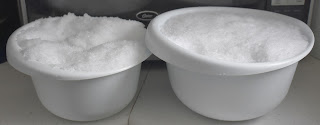
We gathered some snow in two clean mixing bowls and brought them inside the house to melt. 


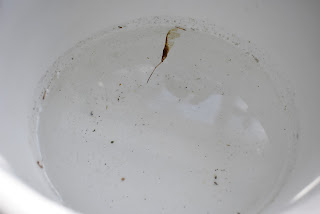
After the snow melted, we looked at the items that were left in the water. 


There was a lot of dirt - more so than we anticipated - both particles and a film of dirt on the bowl and on the surface of the water. There was a box elder seed pod in my bowl. We also saw a lot of small pieces of vegetation in the melted snow.

We noticed that my bowl of water - which also had ice in it - had more dirt and debris in it than Olivia's bowl which was all light, fluffy snow. 


We could have taken this a step further by filtering the water through a coffee filter and then using a hand lens to examine the particles left in the filter. However, we were satisfied with what we were seeing by just observing the water. 

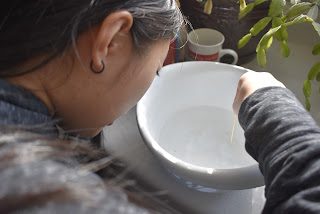
One thing that Olivia noticed was that her bowl of water had quite a few bubbles in the bottom of the bowl. Taking a toothpick, she moved the bubbles around. They would float to the top of bowl. They were trapped air or air pockets! 


After we were done observing the contents in the bowl and popping air bubbles, we measured the water from the melted snow. Each bowl had 3 cups of water. 


Although one bowl was bigger than the other, the smaller bowl had ice which would have had a higher water content than snow.

Snow Produces Water

We filled a two-cup measuring cup with fresh snow and let it melt. 


It resulted in 2/3 cup of water.

I looked up how much water a deer needs to survive during the winter. For every 100 pounds, a deer needs to consume 6 cups of water. We figured out that 12 cups of snow equals 4 cups of water. So, a deer would need to eat 18 cups of snow to equal 6 cups of water...and that's just one day! Without reliable water sources during the winter, deer would have to really look for snow to get enough water. 

Snowflakes 

Next, we talked a bit about snowflakes. We realized that we had done a snowflake nature study back on December 19, 2013. This was Sophia's nature journal entry:


This was Olivia's nature journal entry: 


“Water in its various changing forms, liquid, gas, and solid,
 is an example of another overlooked miracle - 
so common that we fail to see the miraculous in it.”
~ The Handbook of Nature Study, page 808 ~

I read about the geometry of a snowflake - page 809 - of The Handbook of Nature Study. A six-rayed snowflake has angles of 60 degrees. If a snowflake only has three rays, the angles between the rays are 120 degrees. 

What also is fascinating about snowflakes is their symmetry. In The Handbook of Nature Study it says, "If one ray of the six is ornamented with additional crystals the other five are decorated likewise."

Also of interest is where the snowflakes form. Those that form in the higher clouds where it is cooler, will be more solid in form and "the spaces in the angles being built out to the tips of the rays." 

Snow crystals that are "formed in the lower currents of air, and therefore in warmer regions, on the other hand, show their six rays marvelously ornamented. The reason why the snow crystals are so much more beautiful and perfect than the crystals of hoar frost or ice, is that they are formed from water vapor, and grow feeling in the regions of the upper area."

Mr. W.A. Bentley, who we read about when the girls were younger, identified nearly 5,000 distinct snowflake designs! 

Bird Watching

When Sophia and Olivia were younger, they would count how many birds they would see at the feeder during a set period of time. It was interesting to track which ones frequented the feeder more often.

On Wednesday, January 26th, we looked at the tracks that the birds are making by our home where the feeders are located. There are several more highly-visited feeder areas including this one by the dining room. There's 1 suet feeder, an open feeder on the ground, a round seed feeder in the tree and another one on the post, an open feeder near the propane tank, and an area to put seeds on top of the roosting box.


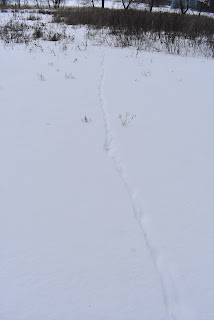
Another thing that Olivia noticed in the pasture were pheasant tracks. They are very distinctive because not only can you see the feet, but the tail leaves a trail as well.


On Thursday, January 27th, when we started observing birds around 1:30 p.m. (5 minutes per feeding station), there were NO birds that came to any of the feeding areas. It was the strangest thing. About 10 minutes later, the birds came back and were feeding at them. 


The dining room feeder (partially pictured above with the platform feeder) was so busy with activity that I couldn't keep up with counting the birds! Roughly, in five minutes, there were: 

- 19 dark-eyed juncos
- 6 American tree sparrows
- 4 black-capped chickadees


I then did bird watching at the backyard feeders. At those three stations, there are 3 suet feeders, a hanging round seed feeder from a post, a column seed feeder, 2 finch feeders, and an open tray feeder with a cover. I saw the following birds in a five-minute time period:

- 14 dark-eyed juncos (male and female)
- 2 nuthatches
- 2 black-capped chickadees
- 1 American tree sparrow

The female dark-eyed juncos are gray and white and super cute. They are all fluffed up to keep warm on these cold days. 


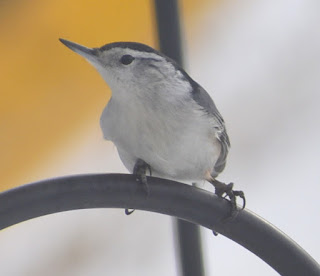
The nuthatch alternates between feeding at the suet feeder and searching the pine tree for food.


The American tree sparrow has a cute brown cap and two bright-white wing bars. It also has a stripe leading from the corner of its eye towards its neck.  


Brief Time Outside and Finding Winter Colors

We spent some time outside even though it was cold to see some things that had changed since the fall when we were regularly going out to explore the land.

Even though initially Sophia and Olivia felt the landscape was rather bland with only shades of brown and dull green, there ended up to be much more color and texture than we anticipated.

“There is enough to see outside in winter to satisfy any poet.
 In fact, winter may be even better because 
there aren’t so many things going on in nature 
that they crowd each other out.
It’s easier to notice what’s there.”
~ Charlotte Mason volume 1, page 86 ~

I was curious if we could find most of the colors of the rainbow - plus the neutral colors - during our time outside on January 26th. Here's how we did:

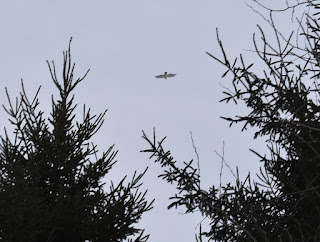
Green - pine trees. The pine trees don't look green, but they are. I happened to look up and see a hawk flying overhead. Was surprised that when I took the picture that the hawk was in between the tops of the pine trees. 


Brown - weeds and dead pine needles; pine cone; and cattails. This cattail was on the back part of the property, to the north of the mini-pine tree forest. The pine cones were under some trees that are in the west pasture. There were lots of rabbit tracks under the trees and around the pine cones. 


Looking at the birds, I saw many American Tree Sparrows. 


White - snow. These are some tracks in the snow that are leading to a branch that is partially-buried. The tracks went to the side of the branch where there was some shelter from the weather.


Gray 

The gray squirrels are prolific this year. They like the corn that I put out. The goal is to keep them away from the more expensive birdseed. In concept, it works...in real life, not so much.


Black

While bird watching, I saw many black-capped chickadees and dark-eyed juncos. The male juncos have the darker coloring - more of a black than the gray-colored females. The black-capped chickadees, like the one below, always seem to be the first birds to find the new birdseed when I fill the feeders.


The colors we didn't find were red, orange, yellow, blue, indigo, and purple - all the vibrant colors we would see in the Spring, Summer, and Fall. That being said, on other days we will see red on male cardinals, orange on the beaks of female cardinals, and blue in the sky and on blue jays. Sunrises and sunsets would show any of the colors we didn't see also. 

That wraps up our nature study about winter, snow, snowflakes, birds, and colors during the winter.

Sunday, April 15, 2018

Red-Winged Blackbird - Outdoor Hour Challenge

Using the Handbook of Nature Study, I did a study about the red-winged blackbirds since we are seeing quite a few here migrating back to Minnesota.


Inside Preparation Work:

1. Read the Handbook of Nature Study pages 117-119 about the red-winged blackbird. I found the following information interesting:
  • Some of the earliest visitors in the Spring.
  • They have a bright red and pale yellow stripe on each wing.
  • Male red-winged blackbirds arrive three weeks before the female blackbirds.
  • The female blackbird is speckled with brown, black, whitish bluff, and orange. 
  • Females do most of the nest building. The tail is used as a steering organ.
2. Read in the Handbook of Nature Study the section on bird’s eyes and ears on page 38. I found the following facts interesting:
  • Birds have a clear film lid that moves from the outside corner of the eye to the center.
  • The ears are holes in the heads covered with feathers. 
Outdoor Hour Time:

I spent time filling up bird feeders in the front- and backyards - especially during the snowstorm that dropped 18 inches of snow in three days.


I shoveled pathways out to the feeders so that the birds, squirrels, and rabbits could use them. It was a little easier to run and hope on pathways than it is on stop of snow. It also provided a windblock for these tiny animals and birds.

Throughout then entire snowstorm, there were bird at the feeder - sometimes small flocks and other times gatherings of up 25 birds. I've never seen that many birds at a feeder at once.

After the snowstorm and as things warmed up, the red-winged blackbirds went back to the pond where they typically can be found during the Spring and Summer.


It was such a fascinating time watching theses birds eat and sustain their strength for this three-day snowstorm.

Additional Information:

Below is information about red-winged blackbirds that I found on All About Birds:

Size and Shape
A stocky, broad-shouldered blackbird with a slender, conical bill, and a medium-length tail. Red-winged Blackbirds often show a hump-backed silhouette while perched; males often sit with tail slightly flared.

Color Pattern
Male Red-winged Blackbirds are hard to mistake. They're an even glossy black with red-and-yellow shoulder badges. Females are crisply streaked and dark brownish overall, paler on the breast and often show a whitish eyebrow.

Behavior
Male Red-winged Blackbirds do everything they can to get noticed, sitting on high perches and belting out their conk-la-ree! song all day long. Females stay lower, skulking through vegetation for food and quietly weaving together their remarkable nests. In winter Red-winged Blackbirds gather in huge flocks to eat grains with other blackbird species and starlings.

Habitat
Look for Red-winged Blackbirds in fresh and saltwater marshes, along watercourses, water hazards on golf courses, and wet roadsides, as well as drier meadows and old fields. In winter, you can find them at crop fields, feedlots, and pastures.

Interesting Facts
Male Red-winged Blackbirds fiercely defend their territories during the breeding season, spending more than a quarter of daylight hours in territory defense. He chases other males out of the territory and attacks nest predators, sometimes going after much larger animals, including horses and people.

Red-winged Blackbirds roost in flocks in all months of the year. In summer, small numbers roost in the wetlands where the birds breed. Winter flocks can be congregations of several million birds, including other blackbird species and starlings. Each morning the roosts spread out, traveling as far as 50 miles to feed, then re-forming at night.

Habitat

Red-winged Blackbirds spend the breeding season in wet places like fresh or saltwater marshes and rice paddies. You may also find them breeding in drier places like sedge meadows, alfalfa fields, and fallow fields. Occasionally, Red-winged Blackbirds nest in wooded areas along waterways. In fall and winter, they congregate in agricultural fields, feedlots, pastures, and grassland.

Food

Red-winged Blackbirds eat mainly insects in the summer and seeds, including corn and wheat, in the winter. Sometimes they feed by probing at the bases of aquatic plants with their slender bills, prying them open to get at insects hidden inside. In fall and winter, they eat weedy seeds such as ragweed and cocklebur as well as native sunflowers and waste grains.

Nesting

Clutch Size
2–4 eggs

Number of Broods
1-2 broods

Egg Length
0.9–1.1 in

Egg Width
0.6–0.7 in

Incubation Period
11–13 days

Nestling Period
11–14 days

Egg

Pale blue-green to gray with black or brown markings.

Condition at Hatching
Blind, naked with scant buffy or grayish down, and poorly coordinated.

Nest Description

Females build the nests by winding stringy plant material around several close, upright stems and weaving in a platform of coarse, wet vegetation. Around and over this she adds more wet leaves and decayed wood, plastering the inside with mud to make a cup. Finally, she lines the cup with fine, dry grasses.

One nest picked apart by a naturalist in the 1930s had been made by weaving together 34 strips of willow bark and 142 cattail leaves, some 2 feet long. When finished the nest is 4 to 7 inches across and 3 to 7 inches deep.

Nest Placement

Red-winged Blackbirds build their nests low among vertical shoots of marsh vegetation, shrubs, or trees. Females choose the nest site with some input from the male. Typically, she puts the nest near the ground (or water surface in a marsh), in dense, grass-like vegetation such as cattails, bulrushes, and sedges in wetlands; goldenrod, blackberry, or willow and alder trees in uplands; and wheat, barley, alfalfa, and rice plants.


Behavior

Male Red-winged Blackbirds spend much of the breeding season sitting on a high perch over their territories and singing their hearts out. Females tend to slink through reeds and grasses collecting food or nest material. Both males and females defend nests from intruders and predators. Red-winged Blackbirds nest in loose groups in part because appropriate marshy habitat is scarce. Typically five or more (up to 15) females have to crowd their nests into any one male’s territory.

In fall and winter, Red-winged Blackbirds flock with other blackbirds, grackles, cowbirds, and starlings, feeding on open ground and roosting in flocks of thousands or millions of birds. Red-winged Blackbirds are strong, agile fliers.

Songs and Calls

The male Red-winged Blackbird’s conk-la-ree! is a classic sound of wetlands across the continent. The 1-second song starts with an abrupt note that turns into a musical trill. Males often sing from a high perch while leaning forward, drooping their wings, spreading their tail feathers, and fluffing their bright shoulder patches to show them off. Females give a very different song in response to a singing male, a series of three to five short chit or check notes.

The typical call of a Red-winged Blackbird is a distinctive, matter-of-fact check that’s fairly easy to recognize. Males and females make these calls all year round, in flight and while feeding, when confronting rivals and to raise an alarm. They also give a more intense alarm call, a fast, scolding chak chak chak.