Showing posts with label sashiko. Show all posts

Wednesday, May 31, 2017

Wednesday Hodgepodge - May 31, 2017


1. What makes you feel accomplished? Explain.

When I was working at various non-profits, I would feel a sense of accomplishment if the proposal I sent to a foundation or corporation was funded; and the organization would receive a needed grant to do a project.

As a mother, it is seeing both Sophia and Olivia happy, laughing, and bringing joy to others. I love seeing them in awe of nature and the world around them.

Olivia and Sophia watching a monarch butterfly
that they raised fly away.
(Taken on August 23, 2008.)

Sometimes, feeling accomplished is doing simple things that I can see are completed: mowing the lawn, planting more perennials, or cleaning the house.

One of the blueflag irises growing by the pond in the pasture.
(Iris versicolor aka Harlequin Blueflag)

2. If you had your own talk show, who would your first three guests be? Tell us why.

For some reason, I find this question challenging. The people who I truly want to talk with are ones who have died - my parents and grandparents. It's the questions that are left unasked and unanswered; or to hear their perspective and insight on different issues that I'd rather talk about.

My parents with Sophia and Olivia in Pella, Iowa.
(Taken on April 29, 2009.)

That being said, if I did have a talk show, my guests wouldn't be world leaders, celebrities, or athletes. Rather, they would be everyday people who have a story to share - something inspiring that no one would know about just  looking at the person; perhaps a lesson they learned and want to impart to others; or people who are content with their lives and want to talk about how they have created that inner happiness and sense of fulfillment.

3. Do you have a great burger recipe? What's in it? What do you like on a hamburger and where is your favorite spot to order one out?

Burgers aren't anything fancy here: just some salt and pepper. Sometimes I'll add garlic and onion powder; and/or ketchup and mustard. Beyond that - if I start monkeying around with adding too many ingredients - I'll have some family members who won't be interested in eating dinner.

If I'm eating a hamburger, I like to have ketchup, mustard, lots of pepper, pickle slices, and onion slices on it.

I don't have a favorite spot to order one out. I like hamburgers well-done with no pink in the middle. Often times, burgers in restaurants don't get their meat done to that level and I can't stomach eating raw meat.

4. What's the biggest anxiety producing thing you do on a regular basis?

Get involved in doing something that takes a lot of my time and interest; and then not allow enough time to get things done that should get done. It's a time management issue.

Doing something I enjoy - like needlework - is a good way for me
to lose track of time.

5. This is the last Hodgepodge of May. Tell us about your summer plans.

I read an article online about how parents only have 18 summers with their children and to make the most of them....to not let them slip by without creating memories to draw upon when the children no longer are living at home.

Making dinner over a campfire at
Lake Shetek State Park.
(Taken on June 9, 2012.)

Also, when going through my homeschooling files and getting rid of things I no longer needed, I came across an article about doing an A to Z Summer as a family. The magazine (a local one) listed specific places to go for each letter of the alphabet. Essentially, it was 26 different activities to do during the summer: about 9 per month (June, July, and August).

I created a list of ideas for an A to Z Summer that we'll be doing starting tomorrow. There are many things that we have never done as a family, and I'm looking forward to doing them.

In addition to these things, we will be doing some other activities as well: homeschooling, 4-H Camp in June, going to Arizona (Sophia won a trip to a leadership camp and Olivia wants to see the Grand Canyon), competing in two county fairs (one for 4-H and one for open class), and competing in the Minnesota State Fair.

Sophia and Olivia  competing at the Minnesota State Fair in August 2016.
They were representing the 4-H club for the Community Pride project.
They earned a blue ribbon. 

Sophia also will be preparing for starting PSEO classes by attending an information day at the college where she will be taking classes through, doing a two-week online college course, and starting two PSEO courses in mid-August.

She will be playing her harp at the Farmers Market and at a local church during the summer.


She will finish work on her harp CD that will be available in about three weeks. With that comes the development of a website and blog.

6. Insert your own random thought here.

Tomorrow is the last 4-H club meeting of the year. I'm not sure what the upcoming year is going to look like for 4-H as both the girls are going to be in high school; and are at a different place in their educational and social needs than many of the youth who are in the club.

Olivia making a presentation about Greece
during our 4-H club's second annual
Festival of Nations in May 2017.

We started the club in Fall 2014 with the hopes that there would be more older youth than what we have. Currently, Sophia and Olivia are the oldest ones in the club. About half of the club is children who are 7 years old and younger. The other half are between the ages of 8-13 years old (the bulk of whom are 8-11 years old).

Sophia (in purple jacket on the right) leading a parachute game
in April 2017 at a 4-H meeting.

We are putting together the digital scrapbook for the club and - although there are a lot of activities that we did during the past year that were fun and educational - they also aren't all consistent with the girls' curriculum. They both enjoy getting together with other homeschooled youth to learn and play - it's just a major time commitment for our family.

I'm not sure, at this point, what to do.

Monday, July 30, 2012

Creative Work I've Done

Today's question for the Summer Blog Challenge asks: "Are you an artist? Show some artwork or doodling you've done."

I enjoy being able to do a variety of crafts and things that allow me to express myself. The images below show a variety of things that I like to do and have made over the past several years: embroidery, quilting, snow sculpture, baking, nature journaling, needlefelting, origami, paper folding, quilting, coloring, doodling, photography, paper cutting, quilling, cake decorating, homeschooling/teaching, and playing the piano. 

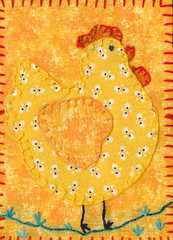
ATC Traded - Embroidered Henny Penny Taking a Stroll
Hand-embroidered and appliqued artist trading card.
July 26, 2008

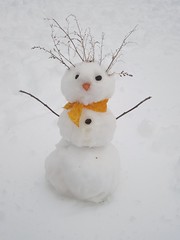
My Snowman
Snowman I made on Leap Day.
February 29, 2012

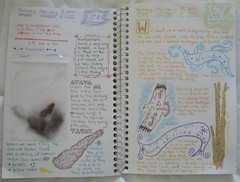
My Nature Journal
A couple of pages from my nature journal.
February 15, 2011

Take a Stitch Tuesday Journal
A two-page spread from my 
Take a Stitch Tuesday embroidery journal. 
Each week I put a personal reflection, 
list of five items for which I'm grateful, 
a collage of images that represents the week, and 
embroidery samples that show the new stitch I learned that week.
February 26, 2012

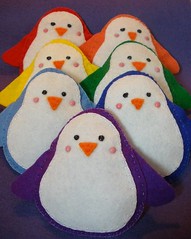
Rainbow Penguins - Learn the Color Wheel and Natural Play Toys
Hand-embroidered penguins that I made
to help my daughters learn their colors.
December 14, 2008

Mosaic of Needlefelted Alphabet ATCs and ACEOs - Tactile Art and Learning for Children
Needle-felted letters (each one 2 1/2" x 3 1/2") 
that I made when my daughters were learning the alphabet.
June 12, 2008

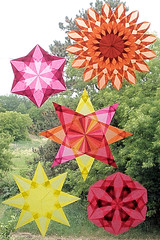
Summer Solstice Star Collection
Origami window stars.
June 7, 2009

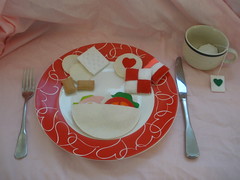
Valentine's Day Meal - Felt Pita Sandwich Crackers, Cookies, and Tea
Hand-embroidered felt food.
Some of the items are from patterns, and
others are ones that I made up based on 
food I had in the kitchen.
February 1, 2009

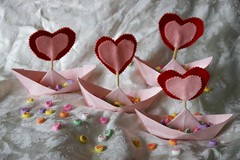
Origami and Felt Valentine's Day Boats
Origami boats with felt sails 
filled with candy hearts.
February 12, 2008

Close Up of Journal Quilt
One of the monthly journal quilts I made.
Each month I created one based on what happened that month.
Every component in the mini quilt represents something.
They are each about 9" x 12".
April 9, 2010

August Journal Quilt without Border
This is another example of a journal quilt I made.
It is also about 9"x12".
August 24, 2010

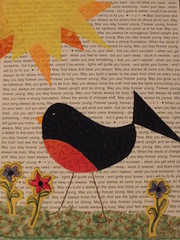
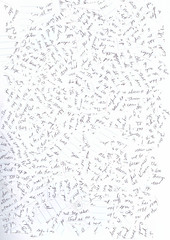
Inspire the Artist Within You - Cut Up Secret Journal Entry
"Secret journal page."
I wrote a page in my journal, cut it up, and 
glued it onto another page.
March 9, 2009

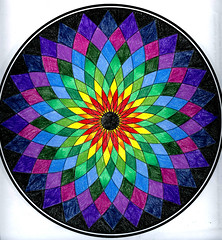
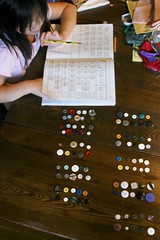
Rainbow Mandala
I have a book with blank mandalas that I color
using Prismacolor Colored Pencils.
May 23, 2008

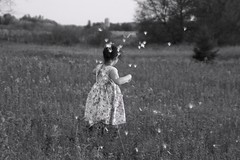
Floating Milkweed
Photo I took of Sophia when she was 6 years old.
She's pulling milkweed seeds from her pockets and releasing them.
The seeds are floating away in the wind.
September 29, 2007

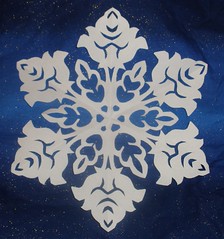
"My Favorite Things"/Sound of Music Swap - Raindrops on Roses
Paper cutting with roses at the end of each point.
January 1, 2009

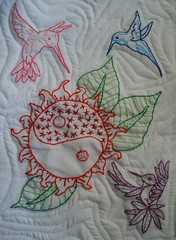
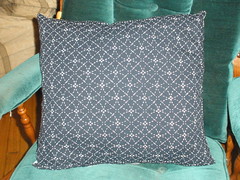
Sashiko Pillow
Sashiko pillow I embroidered and sewed.
July 17, 2010

Counting by 5s and 10s
Homeschooling/teaching requires some creative thinking when
new concepts are taught. 
In the picture above, Sophia was learning 
jump counting (counting by 5s and 10s).
September 25, 2007

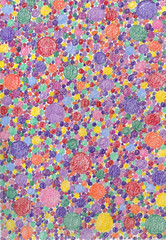
Inspire the Artist Within You - Small Circles
Page of  circles I did with
Prismacolor Colored Pencils.
March 7, 2009

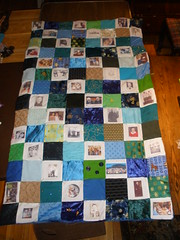
Finished Sensory and Memory Quilt (for my Dad's Christmas Gift)
Sensory and memory quilt that I made for my dad.
Each plain square of fabric is a different texture.
The white squares have pictures that my dad and 
I picked out shortly after he was diagnosed with 
\mid-stage Alzheimer's Disease.
They each had special meaning to him.
He slept with the quilt each night from Christmas time 2009 
until his death on January 5, 2012.
December 21, 2009

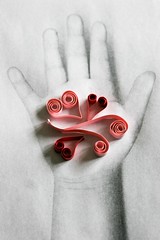
Quilling on Olivia's Hand
Olivia's photocopied hand with
quilling I did glued on top of the image.
February 16, 2008

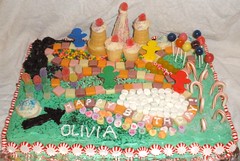
Olivia's 8th Birthday Cake
Candyland cake I made for Olivia's 8th birthday.
She saw the image in Taste of Home magazine, and 
asked if I would make it for her.
This is the cake I decorated.
January 18, 2011

Couching Stitch on Felt
I learned how to do the couching stitch, and
used some wool yarn, cotton floss, and wool felt.
This was part of the Take a Stitch challenge that 
started on January 1, 2012, and goes until December 31, 2012.
March 5, 2012

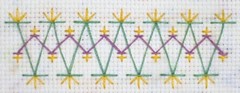
Chevron Stitch in Spring Colors
This is another stitch I learned (the green and purple parts).
The other elements I added to make it 
more reflective of my style.
February 8, 2012

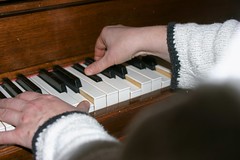
Me Playing the Piano
Sophia took this picture of me playing the piano.
The shadow in the lower right part is 
Olivia standing next to me.
I took lessons for ten years when I was growing up.
Although I don't play as much as I would like to now,
I still can sit down and play some songs which is nice.
January 31, 2008

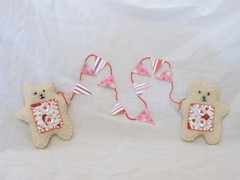
Wool Felt Bears & Bunting
Two hand-embroidered bears made from 
a wool blanket that I machine felted.
They are holding a paper flag bunting.
They're small bears - they fit in the palm of a person's hand.
January 30, 2011

That's a sampling of the things I like to do. Am an artist? I don't term myself one. I just enjoy doing the things I have shown, and look forward to the times when I can do them. 

Thursday, April 19, 2012

P52 - Things that Grow - Week 16

Growth through change.
Growth through loss.
Growth through challenges.
Growth in nature.

Growth -- some of it inevitable….some painful, yet necessary…and some welcome.

I’ve seen all of these in my life during the past couple of years, especially during the last 3 ½ months.

Chaos in the world brings uneasiness, but
it also allows the opportunity for creativity and growth.
~ Tom Barrett

Part of dealing with watching the progression of Alzheimer’s Disease in my father and dealing with the continual losses on a monthly…weekly…and then, ultimately, daily basis, I began using art as a way to express my feelings, document my life, and the effect caregiving had on it.

I have made monthly journal quilts (small 9” x 12” quilts that were accompanied by several-page journal entries); wrote poetry; made full-size quilts; blogged on a regular basis; took photographs; and embroidered.

These were all ways to creatively express myself, learn new skills, and grow despite the chaos in a changing world – the caregiving world – around me.

I think that our fundamental belief is that for us
growth is a way of life and
we have to grow at all times.
~ Mukesh Ambani

As my father was in the active dying process from late-November 2011 until the first week of January 2012, I still believe he was teaching me despite his ability to actively communicate with words or open his eyes.

I chose to be at his bedside from January 1st through January 5th (when he died). Being able to be with him, help care for him, ensure that he was receiving the medicines he needed, and giving people the opportunity to say “goodbye” to him all were emotionally challenging.

But I grew.
I was touched.
I learned.

He showed me – through the many visitors he had – the impact that he made by giving of himself. Of listening. Of genuinely caring for others.

Seeds of faith are always within us;
sometimes it takes a crisis to nourish and encourage their growth.
~ Susan Taylor

Because my father was a deacon, his funeral was attended by many deacons and their wives as well as priests. Hearing their wonderful voices in unison as they sang the songs provided healing comfort when I needed it.

Although I knew my father’s faith was strong, in going through his offices at home during the past few months, I have found countless Bible verses that were handwritten, homilies, and resources that showed how strong faith can be, and how it truly was such an integral part of who he was and what he believed.

He began his life in one religion and changed to another as a teenager. Within his chosen religion and throughout his entire adulthood, he continually chose to grow, learn, and inspire others on many different levels.

Education is growth.
Education is not a preparation for life;
education is life itself.
~ John Dewey

During the past week, I attended the annual homeschool conference. Most of the workshops I attended focused on special education and children who have special educational needs.

Being able to gain new ideas and methods of teaching along with thousands of other parents who are experiencing similar challenges with their children was invigorating and inspiring.

There are some basic changes to the way of teaching as well as feeding my daughters that may have a significant impact on their learning.  Truly, I am excited to make these changes and see the growth in their learning.

I am incredibly thankful to the workshop presenters who shared their knowledge so as a parent (and teacher) I can help my daughters learn and grow.

The garden is growth and change; and
that means loss as well as
constant new treasures to make up for a few disasters.
~ Mary Sarton

As the month progresses, the weather continues to be unpredictable – one week it is warm and in the 60s and 70s. The next, there are mornings with a light snowfall or frost. There have been calm days and days with extreme wind.

Yet, the bushes and trees are in full bloom and have sustained these setbacks – these challenges that the weather has put forth. They have held onto their blossoms and flowers. They have welcomed the bees and butterflies as they have drank nectar and spread the pollen.


The crabapple tree – with its beautiful pink flowers – provides a fragrant canopy over the walkway from the driveway to the door. Its other half – which fell over in an ice storm in November 2010 – has grown new shoots from the fallen trunk. Tiny white flowers are gracing the ends of the branches.

Then I look over at the garden – overgrown already with weeds and grasses. Yet within the mess, signs of sustenance – chives, rhubarb, lettuce, raspberries, and strawberries – all have begun to emerge.

*~*~*~*~*~*~*~*

So, despite the changes, loss, and challenges that – at times – seemed too overwhelming, it was (and is) important to focus on positive growth.

:: Recognizing good changes in myself, my daughters, and others.
:: Taking the time to be grateful for things and people I can often take for granted.
:: Making a commitment each month to give and serve others (especially those in need), animals, and the environment.
:: Using photography, embroidery, writing, and journaling to make it through an emotionally-difficult year.

project 52 p52 weekly photo challenge my3boybarians.com

Saturday, March 10, 2012

Take a Stitch Tuesday - Running Stitch - Week 10

This week for Take a Stitch Tuesday (TAST), the featured stitch is the running stitch. According to Wikipedia, the "running stitch or straight stitch is the basic stitch in hand-sewing and embroidery, on which all other forms of sewing are based.

"The stitch is worked by passing the needle in and out of the fabric. Running stitches may be of varying length, but typically more thread is visible on the top of the sewing than on the underside."


What could be a rather dull stitch can actually be presented in many different ways by simply varying the stitch length and using a variety of colors of embroidery floss.


Throughout the world there are many forms of the running stitch.  For example, kogin is a traditional embroidery from the northern part of japan.

Originally kogin was used as a form of darning or reinforcing work clothes. The patterns became more beautiful and were known for their intricate designs. Kogin is most commonly done with white thread on an indigo blue background.

From Min Gei Kan: Japanese Kogin
Meiji Period, 19th Century

On Needleprint it said that "...Kogin [is] a form of sashiko. It was developed in the Aomori Prefecture which is in the Tohoku region. In the early 1700s, farmers were prohibited from using cotton for work clothes; only linen was allowed.

"In order to keep warm (this area is buried in deep snow in winter), the women darned threads between the gaps of rough linen cloth to make it stronger and warmer. Later, the darning took on decorative patterns and the women would present their best Kogin works as festive wear. The Kogin patterns symbolized nature such as the dragonfly, nuts, butterflies, etc."

One of the samples I did this week. Under the purple embroidery floss are
green lines to mark where to stitch.

Sashiko patterns are typically traced onto the right side of the ground fabric and then stitched with 5-8 small, even stitches per inch along the pattern lines.

Sashiko Pillow Close Up
One of the sashiko patterns I embroidered in 2010.
This one was made into a pillow.

Traditional sashiko patterns are done with white thread on indigo ground fabric but modern sashiko is now done with multi-colored thread on various types of ground, including silk.

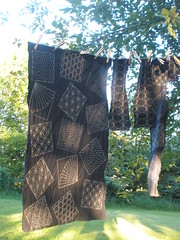
Sashiko Fabric is Stitched
After I finished doing all the stitching on the sashiko fabric,
I washed each piece of fabric to remove the gold marks.
I dried it on the clothesline and then ironed the fabric.
What remains are the white stitches on indigo fabric.

Kogin embroidery is done on evenweave fabric and is stitched as an over/under darning pattern. In order to create the pattern, the horizontal stitches vary in length.

It doesn't show up well in the photo,
but there are two lighter shades of blue (Light - L; and Medium - M) and
a darker shade of blue (D).
So, the pattern is: L, M, D, M, L, M, D, M, L.

Traditional kogin embroidery was also done with white thread on indigo ground but modern kogin embroidery can be done with any thread you choose on any ground you choose.

This pattern is from a kogin pattern book.
The difference is that I used three strands of embroidery floss
on 11-count Aida cloth. The original pattern used
a tighter-weave of blue fabric with
thicker white thread/floss which (I thought) looked a lot better.

Another part of the world also has a type of embroidery that uses the running stitch. On Wikipedia, it says that "Kantha is a type of embroidery popular in Bangladesh and in West Bengal, India. The use of kantha is popular in kantha sarais traditionally worn by women in Bengal, but any garment or cloth with kantha embroidery, predominantly having a border of decorative running stitch motifs, may be called a kantha garment."


Kantha stitching is also used to make simple quilts, commonly known as nakshi kantha. Women in Bengal typically use old saris and cloth and layer them with kantha stitch to make a light blanket, throw, or bedspread, especially for children.

Kantha is similar to the decorative running stitch of Japanese sashiko quilting. Kantha originated from the way in which Bengali housewives mended old clothes by taking out a strand of thread from the colorful border of their saris and making simple designs with them.

For this week's TAST, I did the running stitch on Aida cloth as well as pre-printed cloth that had green lines. These lines did not wash out of the fabric like the lines on traditional sashiko fabric. I wrote a short journal entry, did a list of things for which I am grateful, and included the stitch name.

My embroidery journal entry and samples for the week.

I also added a couple of images from greeting cards that were in my dad's office since I'm still going through his files and two offices at home (one for his persona/business use and one for being a Deacon).

It's been a long process so far - with lots of work ahead - but it has been a helpful thing to do in the grieving process. The quote is one that I found in his items and truly reflects the way that he lived his life - to the fullest and positively affecting literally thousands of people.

I shall pass through this world but once,
Any good, therefore, that I can do or
Any kindness that I can show
To any human being
Let me do it now.
Let me not defer it or neglect it,
For I shall not pass this way again.
~~ Steven Grellet ~~