Friday, April 19, 2013

Q is for Quilting with Paper and Paint - A to Z April Challenge

Both Sophia and Olivia have sewn quite a few quilts during their young lives. Their beds and closets have the quilts that they can use now and when they are older.

Not only do they show their sewing skills, but they contain memories of time we spent together selecting the fabric (sometimes on vacations which help recall those memories as well); cutting the pieces; sewing the fabric together to create quilt tops; and then sewing all the components together (quilt top, batting, and quilt bottom).

Rather than sew more quilts, we decided to create paper quilts based on a pin on Pinterest that I saw. The pin led to Painted Paper on Flickr and showed how colored paper could be transformed into beautiful designs that look like quilts.

Sophia's paper quilt.

This creative activity also ties into math in that it is a great lesson about symmetry and fractions.

The first step was to select the colors of paper for the background and shapes.

Olivia chose bright blue for her background paper.
She is folding the paper into quarters here.

The background paper is folded into fourths.

Sophia folding her paper into fourths.

The other colors are cut into shapes squares and circles of various sizes.

Olivia and Sophia cutting the circles 
out of colorful paper.

Then, the squares and circles are folded in half or fourths to create smaller shapes - like triangles, semi-circles, and pie-shaped pieces.

Next comes the fun part. The girls symmetrically arranged the shapes onto the background paper.

Olivia arranging and gluing shapes in place.

Once they were satisfied with their designs, they glued the pieces in place.

Sophia arranging her pieces in each quadrant.

The paper quilt projects was easy and fun to do.

Olivia with her finished paper quilt.

It is one that could easily be done many times in the future with different results each time.

Thursday, April 18, 2013

Blog Angels - Half-way Update

Over on Craftbotic, there is a Blog Angels program. This is a great way to connect with other bloggers and create a sense of community spirit.

So far, I have done the following things for the person's blog I chose to be angel for during April:
- followed my Blog Angel's blog, Facebook page, and some Pinterest boards.
- Commented on each blog post she has written.
- Pinned some of pins she has on her Pinterest boards.

I've been inspired by her crafting, organizational projects, and cooking. But that's all I can say...I don't want to reveal too much at this point. At the end of the month, I will share who I have been helping and encouraging.

CraftboticBlogAngel

P is for Photography - A to Z April Challenge

Sophia and Olivia both have digital cameras and are enthusiastic photographers. As we move towards the summer and think more about 4-H projects for the county fair, I wanted to give them some ideas about how to create a themed project versus single picture to enter.

There are a few ways to display pictures that are in a collection:
=> on a single sheet of colored tag board;
=> in a variety of frames that are attached to one another; or 
=> in a book.

I gave them several ideas as starting points:

=> Alphabetically capture the people, places, and/or things around your home, backyard/pastures/farm, street, neighborhood, or town. (Both of the girls are going to do this project.)

Sophia photographing the piano in a different way.

=> A to Z of Me. This would be best done in a book format. One idea would be to combine photography and art as was done on the An A to Z of Me blog.

=> Favorite things and people.

Sophia wanting to capture Lucy 
while he was sitting still.

=> Day in my life. Capture what happens in a typical day - from waking up, eating meals, homeschooling, playing, to taking care of pets. It could include exciting as well as mundane things (e.g., the socks you wore, the view from the window). This could be done by activity or in 15-minute or 30-minute increments throughout the day. (Olivia wants to do this.)

Olivia photographing Lucy.

=> Month in my life. Similar to the "Day in my Life" concept, except choosing one photograph per day or one month. The final collection would include 28, 30, or 31 pictures depending on the number of days in the month. (Or 29 pictures, if it's February of Leap Year.)

=> Seasons in Nature. Take one picture per month to capture the changing seasons. These 12 pictures could be made into a calendar.

=> Take a self portrait every day for a month, every month for a year, or every year for set period of time. The subtle changes that happen over a time period can be captured and looked back upon when one is older.  (Sophia is going to do this on her half-birthday and birthday each year.)

After presenting these ideas, both of the girls began to think of things they could photograph.  I'm excited to see how their projects turn out.

Wednesday, April 17, 2013

O is for Occupational Therapy - A to Z April Challenge

Both Sophia and Olivia have Sensory Processing Disorder (SPD) or Sensory Integration Disorder (SID). Although there is some overlap with issues within SPD/SID (e.g., vision/eyesight), each one has different aspects that are unique to them (Olivia has challenges with hearing/auditory processing, tactile/touch, taste/oral sensitivity; and Sophia deals with issues related to proprioception/movement).

Although Sophia and Olivia have different needs in terms of SPD/SID, they both seem to positively respond to occupational therapy (OT) activities related to proprioception/movement.

What is proprioception? Basically, there are small receptors within our muscles and tendons that detect the amount of stretch that occurs in muscle fibers and tendons. This allows a person to sense the movements of her/his body parts without having to look at where they are located.

Any activity that provides positive feedback to the muscles and joints of the body promote coordinated movement. Repetitive movement enables people to know where their legs and arms are in space. There are very good benefits to using proprioceptive activities to organize all of the senses in the treatment of SPD/SID.

Below are some examples of fun OT activities that the girls enjoy doing:

Playing on the playground, and using the monkey bars, ladder, or fireman pole.


Sophia and Olivia swinging on the swingset
at the homeschool co-op.

Pulling a sled or pushing a wheelbarrow filled with toys or other items.

Biking.

Hiking or walking, especially up hill.


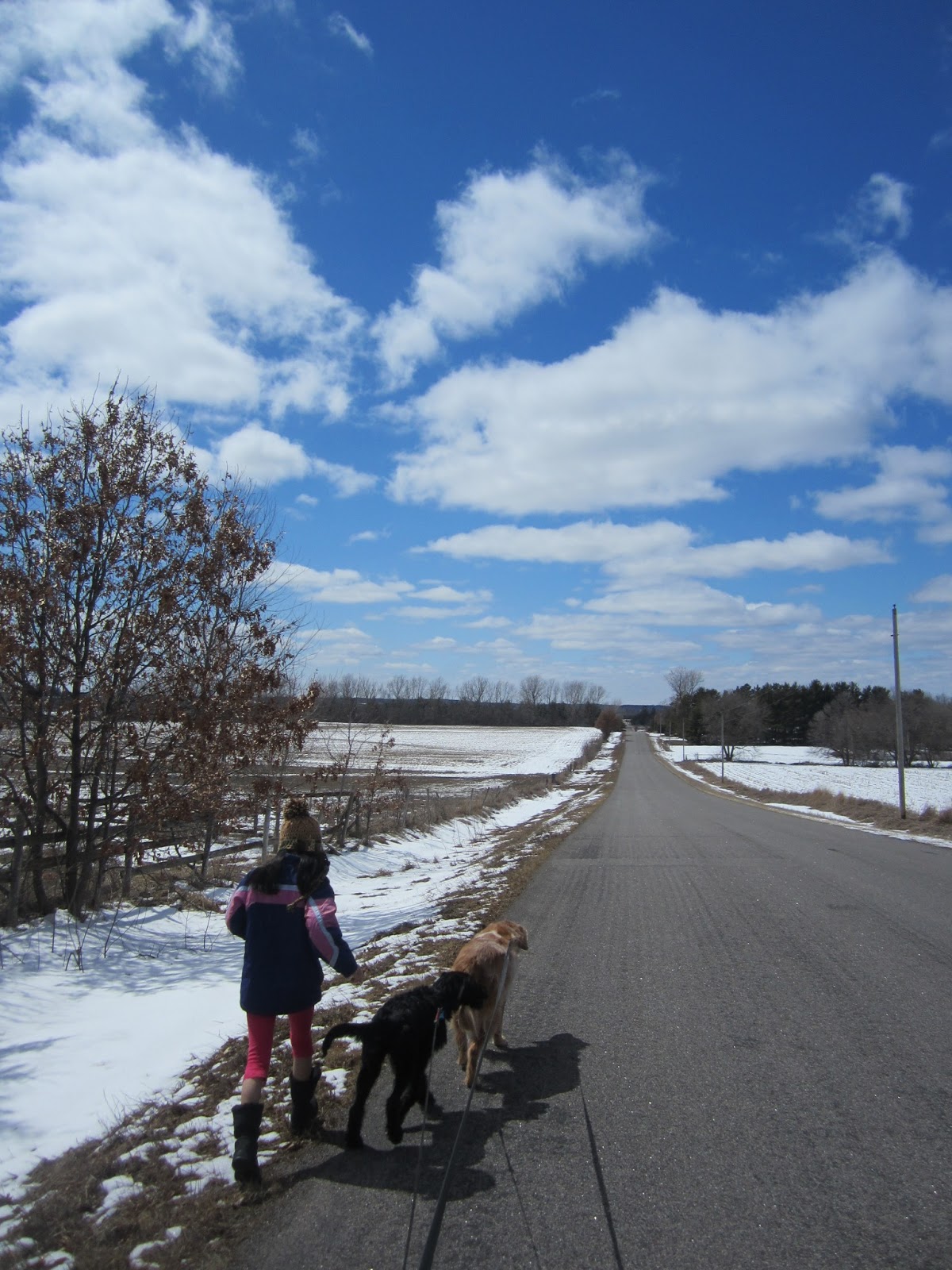
Olivia going on a walk with the dogs
on a "warm" 40 degree day in April.

Jumping on a trampoline or jump rope.

Another area that we work on is Vestibular/Balance. To give a person a sense of balance, there are small structures within the inner ear called the semicircular canals. These act similar to a carpenter's level in that they tell a person when s/he is upright or tilted.

Some fun and easy OT activities that help with vestibular/balance include:

Playing on the playground equipment - particularly on the swings, hanging bars, ladder, and floating bridge.


Still swinging...

Rocking in a rocking chair.

Swinging in a hammock.

Jumping on a trampoline or with a jump rope.


Sophia was jumping so fast 
I couldn't get a picture that wasn't blurry.

Walking through an uneven terrain or obstacle course (stepping over step stools, boxes, bubble wrap, pillows, cushions).

Rolling down a grassy hill.

Walking or running up and down ramps.


Olivia and Sophia on a ramp at the
homeschool co-op.


Sitting and bouncing on a large exercise ball.

Standing on balance boards.


Going up and down stairways or curbs.


Olivia walking down the stairs with 
Cooper close behind her.

Being able to integrate OT activities into our daily and weekly homeschooling schedule helps both Sophia and Olivia with SPD/SID issues while making learning all that much more enjoyable.

Tuesday, April 16, 2013

N is for Nature - A to Z April Challenge

Nature has been a valuable and integral part of homeschooling since the girls were in preschool. One of our favorite activities related to nature is caring for the birds at our farm by having a variety of homes and feeders for them; and watching the birds enjoy and use what we provide.

Although we have many birdhouses here, we did not have bluebird houses. So, last month, Sophia, Olivia, and I built bluebird houses at a local state park.

The girls working on their bluebird houses.

This month, we stained each of the birdhouses so that they will last longer.

Sophia staining her bluebird house.

We are going to put the bluebird houses on the east-facing and north-facing fences.

Olivia staining her bluebird house.

We also need to clean out all the birdhouses so that they are ready for the birds to use this spring. The weather during the past week has included snow, rain, and sleet so it hasn't been ideal for working outside. Hopefully within the next week the weather will improve so we can work on the birdhouses.

It's been so rewarding to see new families of birds each spring and summer use the homes we have here. We have enjoyed seeing the parent-birds introduce their children-birds to the feeders; and watch them fly around our farm, and rest and take shelter in the trees.

Nature will always play an important part of homeschooling for our family. The birds and other wildlife we regularly see here will always provide wonderful memories and happiness that will sustain us throughout our lives.

Monday, April 15, 2013

M is for Music - A to Z April Challenge

An important part of our homeschooling curriculum is music. In addition to composer studies in which we learn about six composers and six of their works (per composer) over a 36-week period, Sophia and Olivia also have learned to read and play music.

Sophia has played the piano since September 2010. She was 9 1/2 years old when she began learning to play the piano.

Sophia Playing the Piano for Nana
Sophia playing the piano for her grandma.


Once she could read the notes as well as understand note values and counting, she began playing the harp in June 2011. She was about 10 1/2 years old when she began learning to play the harp.

Sophia playing the harp.

Although she wanted to learn the violin shortly after that, I wanted her to have at least a full year of harp lessons. So, in November 2012 she began playing the violin. She was one month shy of her 12th birthday.

Sophia practicing the violin.

Olivia has played the piano since June 2011. She was 8 years old when she began learning to play the piano.

Olivia playing the piano.

She tried percussion in June 2012 - starting with the glockenspiel - however, the sound ended up being too loud for her. With sensory issues, as the months went by, she became more reluctant to play the instrument. With this one being the first out of 23 instruments she would have had to learn how to play within the percussion field, it was better she stopped learning percussion than having the experience be miserable.

So, Olivia is focusing her efforts exclusively on the piano which has provided her with an opportunity to concentrate her practicing on one instrument and gain more skill and comfort with playing.

What does the 2013-2014 school year hold for both the girls in terms of music? At this point, Sophia is deciding whether to learn another instrument (trombone or percussion) and/or continue piano since she now knows how to read music. Olivia is still thinking of continuing piano, but isn't sure whether she will be adding another instrument so she can play in orchestra or band.

Regardless, music will always play a critical role in our homeschooling curriculum. Living in a home filled with music is wonderful...and truly a gift that will last a lifetime.


Saturday, April 13, 2013

L is for Latin - A to Z April Challenge

One of the subjects for our homeschooling curriculum is Latin and Greek Root Words. We use English from the Roots Up - Help for Reading, Writing, Spelling, and S.A.T. Scores by Joegil K. Lundquist. There are two volumes of this book; and we are using the first volume.


In Volume 1, there are 100 Latin and Greek root words which are appropriate for elementary through high school students to learn.

Set of cards with root words. 
The cards outlined in red are Latin root words; and
the cards outlined in green are Greek root words.


In addition to the book, there is a set of 3"x5" cards with the root word on one side and various words using the root word on the reverse. Each word also is defined in case a student does not know its meaning.

The back side of one of the Latin root word cards.


What I like about English from the Roots Up is that there are ideas for extending the lessons instead of mere memorization. For example, the teacher notes for the Latin root word aqua (which means water)  includes the following ideas and information:

How about a trip to the aquarium? 

Aqueduct - notice the "e" in aqueduct? It is commonly misspelled since we expect it to be spelled with an "a" like its root, aqua. The Romans were great engineers, and since they needed clean, healthy water in their cities, they built magnificent bridges over land and valleys so cool mountain water could flow by gravity down to the fountains and storage cisterns of the town. Aqueducts can still be seen today. 

Aquarius - There is a series of entertaining stories about the constellations and how they got their names. The Egyptians believed that Aquarius, the water carrier, caused the annual floods of the Nile River. The zodiac sign, Aquarius, comes from the hieroglyph for "running water."

Aqueous humor - This part of the eye is easy to find on a cross-section drawing of the eyeball. A small introduction to anatomy may be in order here.

Aquifer - Notice the "i" in this spelling. Some layers underground are solid rock. Others are porous, carry water, and are called aquifers.

Combining hands-on activities in a variety of subjects - such as science, history, and geography - can make learning root words and expanding one's vocabulary much more engaging. I'm looking forward to working our way through both volumes of English from the Roots Up, and hope that Sophia and Olivia feel the same way too.

Friday, April 12, 2013

K is for Kindness through Animal Assisted Therapy - A to Z April Challenge

This morning Sophia, Olivia, and I spent some time at a local nursing home with our cat Eenie.

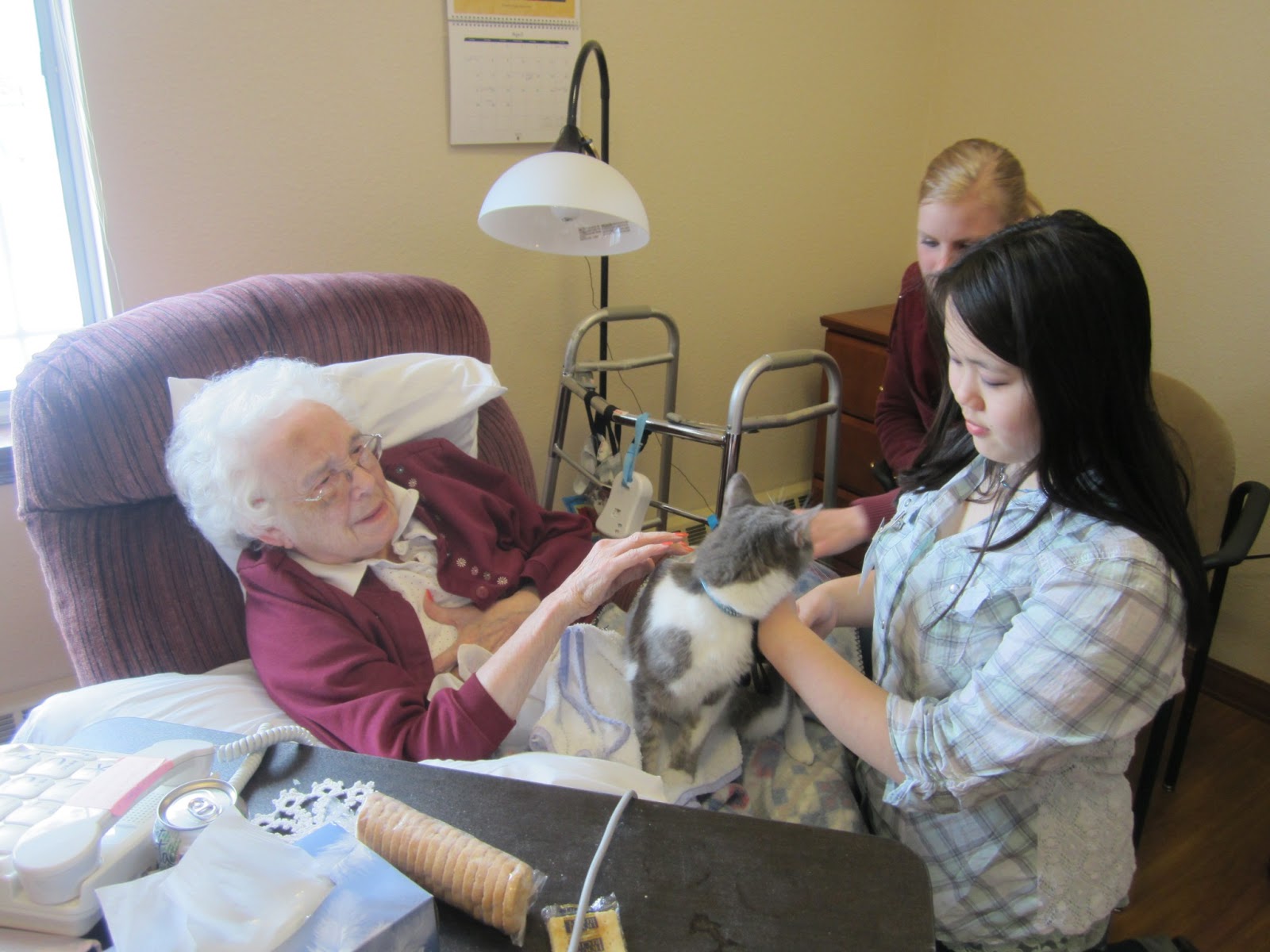
A resident enjoyed a visit with Eenie and Sophia.

Eenie had visited residents at St. Therese (a nursing home) during October-November 2011 when my Dad was a resident there because of the progression of Alzheimer's Disease.

My Dad enjoyed seeing Eenie when we would bring him on visits to the nursing home; and we also would bring Eenie around to see other residents in both the Palliative/Hospice and Alzheimer's Disease/Dementia units if my Dad fell asleep or after our visit was done.

Olivia and Sophia with Eenie.
They were trying to help him get comfortable walking in a hallway
at the nursing home before visiting residents.

We were curious to see how Eenie would do at another nursing home, and with meeting a variety of new people.

Eenie sat on almost every resident's lap that we visited.
With some residents, he chose to sit in a nearby chair or
next to their bed. It was almost as if he knew
where the best place to sit and keep people company.

Having pets visit people in nursing homes is not new. In fact, animal assisted therapy was first reported back in the late 18th century at York Retreat in England. In that case, animals were used with people who were mentally ill.

Patients at York Retreat would wander the grounds which contained a population of small domestic animals. The animals were believed to be effective tools for socialization.

In 1860, the Bethlem Hospital in England followed the same trend and added animals to the ward, greatly influencing the morale of the patients.

Currently, according to Wikipedia, "animal assisted therapy draws on the bond between animals and humans in order to help improve and maintain an individual’s function and is being used to assist in the process of enhancing the individual’s quality of life in nursing homes."

One resident lit up when she saw that we had a cat.
Her face radiated happiness when she was able 
to talk with and pet Eenie.

Wikipedia continued, "The goal of using animals...is to improve the person’s social, emotional, and cognitive functioning and reduce passivity." It has been noted that when people are transferred to a nursing home, they often can become agitated, depressed, passive, withdrawn, and inactive because of the loss of loved ones and/or lack of regular visitors.

Supporters of animal assisted therapy believe that animals can be helpful in motivating residents at nursing homes to be active physically and mentally, keeping their bodies healthy and minds sharp.

This gentleman who normally has difficulty expressing himself
due to a limited vocabulary (because of a medical condition)
was able to say, "We had two cats" when asked if he had any cats.
He continued trying to share his thoughts and talk with us
while he petted Eenie who sat in his lap and walked between his legs.
He had never tried to converse with us before when we visited him.
It was as if Eenie opened a door to his mind, and 
allowed him to recall important memories.

For people who have dementia, hands-on interactions with animals - most typically cats and dogs -  are the most important aspect. Animal assisted therapy, like we were able to do with Eenie, provides people with opportunities to have close physical contact with a cat's warm bodies, feel his heartbeat, touch his soft fur, notice his big eyes, and giving hugs.

Residents shared stories with us about their lives 
prior to being at the nursing home.
We heard about living on a farm with work horses, cows, pigs,
chickens, dogs, and cats from this resident.

This was such a wonderful way to spend part of our morning; and I know that the residents were very happy to have had the opportunity to spent time with Eenie (as well as Sophia, Olivia, and me). 

Homeschooling gives us the opportunity to spend time volunteering and doing animal assisted therapy. It also gives the Sophia and Olivia practice on developing positive character traits...like kindness.

Thursday, April 11, 2013

J is for Journaling - A to Z April Challenge

One of the goals for this homeschool year was to do journaling. I had hoped to start at the beginning of the year, and have Sophia and Olivia do a page or two per week. However, other subjects took priority over this activity so we are just starting now.

On Grace is Overrated, there is an engaging journal that is 50 pages that can be used by children and adults alike. Each of the pages has a variety of different questions and prompts for people to complete. The black-and-white pages can be colored in with markers, color pencils, or crayons.

The cover of the journal both girls 
are writing and coloring.

Today, Sophia and Olivia started working on their journals. Olivia was very excited about being able to color the pages. I printed them all in black and white - so there's a lot of room for creativity in terms of color and pattern choice.

Olivia coloring a page in her journal.

We read through the first page of questions together, and both the girls were thinking of answers.

The first page of the journal.

The questions are easy to answer - especially the lightening round ones - which makes it fun to write and keep a journal.

Sophia working on her journal.

By having the girls keep a journal during their fourth and sixth grade years, my hope is that they will continue to write and keep journals throughout their high school years and adult life.

Wednesday, April 10, 2013

I is for Interior Design (and Injections) - A to Z April Challenge

Today's alphabetical activity for homeschooling focused on interior design. Olivia has been checking out House Beautiful and other interior decorating magazines for the past six months from the library, so I thought we'd take a look at interior design today.

As a side note, Sophia did not participate in this activity because she had to have three injections for allergies today...a purely coincidental alphabetical activity for Sophia. A side effect to the injections is being very tired, and she needed to rest during the afternoon.

This was the first of a series of weekly shots that Sophia will be having for the next six months. The entire allergy program runs for about three years. Hopefully this will improve her quality of life and eliminate the allergies she has to over 15 things.

Back to interior design. Olivia's first activity was to think about each room in the home. She wrote the name of the room and put two boxes next to the name. In the first box is the color that the room currently is painted. In the second box is the color she would like to re-paint it if she could re-do the home.


About half of the room colors she liked and wouldn't change. The other room colors she changed to pink, peach, blue, brown, and green.
 
The next activity looked at warm and cool colors on the color wheel. Then the last two questions focused on colors that make a room look larger and colors that make a room look smaller.


She learned that the lighter colors and white will make a room appear larger; while the darker shades of color will make it feel smaller.

The final activity used a sample floor plan for a two-story home.  She colored rooms and spaces that had a social function red (e.g., family room, living room, porches); work areas yellow (e.g., laundry room, kitchen, hallways); and quiet areas blue (e.g., bedrooms, bathrooms).

The first floor is on the left side, and 
the second floor is on the right side.

It was interesting to see how the various functions (social, work, and quiet) are grouped within a house plan. It would be interesting to see if this is typical of most homes.

Olivia enjoyed doing activities related to interior design and would like to do more things about this topic in the future.