Tuesday, March 24, 2015

Progress on 2015's Nature Goals

Now that one-quarter of 2015 has almost passed, I wanted to check in on my nature goals that I set for myself.

1. Visit three new national wildlife refuges in Louisiana, Mississippi, and/or Arkansas. ACCOMPLISHED!

- Delta National National Wildlife Refuge in Venice, Louisiana.This NWR is near the very end of the Mississippi River.


The river is very wide at this point and has clearly picked up a lot of sediment along the way.


There is a bench and some informational placards to describe the significance of the area. This actual location did not have a lot of visible wildlife.


However, there's another nearby road that leads to the southeastern most point of Louisiana and that had significantly more birds and waterfowl that were visible from the road. I pulled over many times (as did others) to watch the wildlife - or, in the case of local people, do some fishing.

- Bayou Sauvage National Wildlife Refuge in Lacombe, Louisiana. This NWR spans a large amount of space and can best be seen by driving through it on a couple of paved roads. There is a small stop that has a wooden boardwalk/pathway that leads into the bayou.


The sounds of ducks and birds swimming in the water and hiding in the reeds is constant.


There was some vegetation that I had never seen before - like the tree pictured below with brown seed pods. The pods were dry and would rattle. I'm not sure what type of tree it is and could not find it on the internet.


Perhaps my favorite part of the walk was coming across this little tree frog that was nestled in a reed. The reed looked like bamboo, so I wanted to take a closer look. I was pleasantly surprised when I looked inside it and spotted this little green face looking back at me.


- Yazoo National Wildlife Refuge in Hollandale, Mississippi.This NWR wasn't on my list of places to see, yet it was on my way to Greenville, Mississippi where I was spending the night. I thought I'd take a brief detour to see it, and am happy that I did.


Although it was a bit early in the season, there was a monarch waystation at the NWR. It is an enclosed area with a few benches, trees, and variety of plants. The plants - or where they will be - are all marked with signs. There was a little area with water for the butterflies and other wildlife that visit the garden.


Along one of the roads, there was an area of slough. In the Little House books, Laura Ingalls Wilder mentions areas that were slough, but I had no point of reference since I had never slough before. Now, having visited Yazoo NWR, I know to what she was referring.


There is quite a diversity of landscape within the NWR. The picture above is right across from a wooded area pictured below.


2. Visit three new national historic parks in Louisiana, Mississippi, and/or Arkansas. ACCOMPLISHED!

I was able to see three historical parks, sites, or parkways while in Louisiana and Mississippi:

- Audubon State Historic Site in St. Francisville, Louisiana. This was on my must-see list and, thankfully, I arrived in time to go on a house tour and see the grounds.


The Oakley Plantation is where John James Audubon lived for four months. Yet, during that brief time he painted 32 of his bird pictures here.


The grounds had pathways that led through open and wooded areas.


There were old buildings where people were demonstrating what life was like back in the 1800s.


The displays showed items typical of that time period as well.


The main pathway leading from the interpretive center to house was once a carriage road.


Leading to and from the house, the paved road for cars goes under beautiful old trees.


- Natchez Trace Parkway in Natchez, Mississippi. I didn't take many pictures of the parkway since much of it looked like the photograph below. Although the entire parkway is 444 miles long, I was only on it for a small segment.


Nonetheless, it was a beautiful drive and I enjoyed the break from driving on the freeway.

According to the National Park Sevice, "The Natchez Trace Parkway forms an almost continuous greenway, or transect, from the southern Appalachian foothills of Tennessee to the loess soil bluffs of the lower Mississippi River.

"Over its length it crosses four ecosystem provinces, eight major watersheds, and twelve physiographic regions. Forest types range generally from oak-beech in the far south, to oak-pine mixes covering the vast middle section, to oak-hickory dominating in the north.

"Habitats represented within the park are diverse and include: streams, lakes, swamps, riparian woodlands, bottomland hardwood forests, upland hardwood forests, pine and mixed hardwood forests, prairie, fallow fields, and agricultural croplands."

If I ever have the chance, it would be interesting to drive the entire Natchez Trace Parkway.

- Vicksburg National Military Park in Vicksburg, Mississippi.It was raining on the day I visited this park, but I still left the car at some spots and explored different historical points and monuments.


It is a 16-mile, self-guided car tour through the park which is quite large - much larger than I thought. The road passes by many monuments that are tributes to soldiers who fought and/or lost their lives in the battle at Vicksburg.


The land was rolling in parts and forested in others, with deep trenches in many parts.


There were beautiful, pink blossoms on trees. This picture below doesn't do justice to how vibrant the blossoms were against the dark tree bark.


I was surprised at how much diversity there was in the land in terms of hills and ravines. For some reason, I pictured battlefields more level. The images I always saw in textbooks were of flat battlefields - nothing like what is pictured below.


The visits to these historical parks provided a completely different and much more engaging view of American history. I'm so happy that I went to each one of them.

3. Visit six new state parks in Minnesota as a family, and take the dogs with us as we explore new trails (St. Croix, Afton, Fort Snelling, Minnesota Valley, Frontenac, and Forestville/Mystery Cave).

I have not done this yet.

4. Visit two new national wildlife refuges in Minnesota (Sherburne and Upper Mississippi) as a family, and take the dogs with us as we explore new trails.

I have not done this yet.

5. Identify and journal three new birds. IN PROGRESS

On my trip to Louisiana, Mississippi, and Arkansas I saw four birds that I have never seen before:

- Boat-tailed Grackle in Venice, Louisiana.


- Northern Mockingbird in Vicksburg, Mississippi.


- Black Vulture in between Vicksburg and Greenville, Mississippi. I didn't get a picture of this type of bird because I was driving. There were about a half dozen of the black vultures in the median.

I also saw a vulture on the side of the road driving from Vicksburg back to New Orleans. Since there were no cars behind me, I stopped on the side of the road. The vulture just looked at me - much like the bird pictured below - and didn't move from the carrion. It was not going to give up its meal.


- Double-crested Cormorant at Lake Chicot, Arkansas as well as in northeastern Louisiana.


I have photographed the birds, but not completed entries in my nature journal because I want to include pictures of them.

6. Identify and journal three new types of wildlife. IN PROGRESS.

On my trip to Louisiana, Mississippi, and Arkansas I saw three new types of wildlife that I have never seen before. I have photographed them and want to include pictures of some of them in my nature journal. So journaling will have to wait until I return to Minnesota.

- Nine-banded Armadillo in Greenville, Mississippi. (Unfortunately, the armadillo was road kill, but I was able to it up close.) Rather than show what I saw, I found a picture of a living armadillo.


- Brown Anole in St. Francisville, Mississippi.


- Eastern Carpenter Bee in St. Francisville, Mississippi. The bees that were visiting these flowers were huge - way beyond anything I have ever seen. They were focused on flying from flower to flower and didn't seem aggressive or bothered that I was so close to them. It gave me plenty of time to enjoy seeing a bee that does not live in Minnesota.


7. Take 12 hikes throughout the year. IN PROGRESS.

- Hiked briefly at Leroy Percy State Park on Saturday, March 21st. The rutted, muddy road that is pictured below was next to the sign for the state park.

As I drove for probably a good mile on it, sure the car would get stuck the mud, I turned around when I came to a gate to the right hand side indicating this road was not the road to the park, but rather would be the next road over.


No one was at the welcome gate or at the visitors center, so I drove around a bit to see if there were any trails. I didn't see any which is quite different from state parks in Minnesota.

I ended up driving to a section where there were cabins and parking at one where no one was staying. The cabins all were along this river that was clearly flooded.


The ground around the river was very saturated.


Many of the trees were submerged in a couple of feet of water. Since it was raining, I didn't spend too much time outside. It was, nonetheless, nice to get out of the car and walk around a bit.

- Took an extraordinarily brief walk through Winterville Mounds State Park on Sunday, March 22nd. Due to the torrential rain and super-saturated grounds, it was not conducive to a pleasurable hike. Yet, I wanted to go to this park because of its historical significance.


The mounds were build by prehistoric Native Americans and the mounds range in height from between 1-2 stories tall.


There were no large animals used for work at the time, so the mounds were all built by hand. The Native Americans took buckets of soil, brought them to the mound, stomped it down, and then repeated the process. 

- Hiked at Lake Chicot State Park on Sunday, March 22nd. The lake is 22 miles long and 1 mile wide. Is is shaped almost like a crescent moon or the letter "c."


The trail that they had at this state park was partially submerged in areas due to all the rain that this area of the state has been receiving.


Eventually, I came to a path that someone made using logs. The first and middle parts were rather secure in the mud. However, the last few logs still had some movement in them, thus the intention of keeping one's shoes dry did not work.


Despite the water-logged path, it was well worth the time spent. All around were countless birds singing - many of which I had never heard before. Periodically, the red-winged blackbird would chime in - a familiar - and welcomed sound in the spring in Minnesota!

8. Visit 6 nature centers at the state parks and wildlife refuges. IN PROGRESS.

None of the wildlife refuges that I visited in Louisiana and Mississippi had nature centers. Rather, they had outdoors displays with information about wildlife typical to the area.

Lake Chicot State Park in Arkansas had a nature center that I visited and learned quite a bit at about the largest lake in Arkansas, some of the wildlife in the area, and the historical significance of the area.

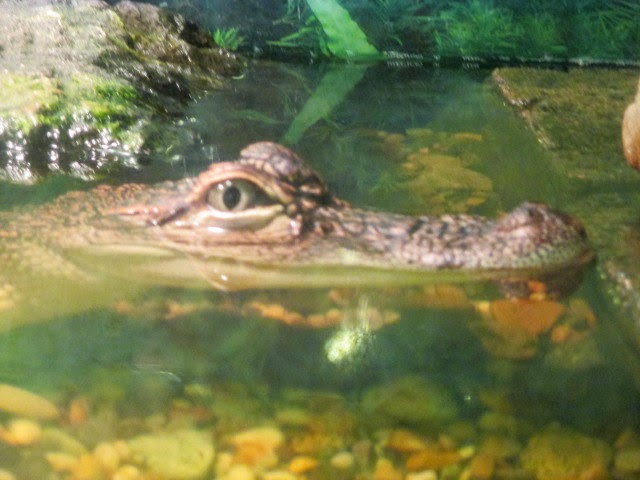
Saw an alligator, though it made me sad that it was in such a small aquarium.

There was a display on the wall with different patches of fur. You could touch the fur and then try to figure out which animal it belonged to using the images on the wall to help.


There was information a bout the Mississippi Flyway - something that the 4-H Wildlife Project Bowl team I am coaching has been learning about over the past few months.


9. Post a nature photo each week based on the Nature Photo of the Week Prompt List. IN PROGRESS.

I wrote about the first 12 weeks of the challenge HERE.

10. Do nature studies at least three out of four weeks of each month (36 entries) both online and in my journal.

Not doing so well on this goal.

11. Try 2 new outdoor sports.

I will be waiting until warmer weather to try some sports.

12. Have 6 picnics when the weather is pleasant and we aren't battling with mosquitoes.

Still waiting for consistently warm weather.

13. Go camping twice during the year at new state parks.

In a few months it will be warm enough to go camping.

14. Learn 3 new outdoor skills and/or hobbies.

Nothing new learned here yet. I'm waiting for late-spring and summer to work on this goal.

15. Attend 4 workshops, classes, or activities at state parks.

Programming for the spring and summer has been posted, and I have classes and activities on my calendar now including nordic walking, outdoor cooking, and archery.

Sunday, March 22, 2015

Forgiveness, the Passionate Journey - Read 52 Books in 52 Weeks - Week 12

For the twelfth week of the Read 52 Books in 52 Weeks challenge, I read Forgiveness, the Passionate Journey - Nine Steps of Forgiving through Jesus' Beatitudes by Flora Slosson Wuellner. The author uses the Beatitudes as a way of framing the nature of forgiveness.


Some of the highlights from the book include:
- Forgiveness is a major release: a release from the prison and burden of the past. This release does not mean release from responsibility for what what done. Nor does release necessarily mean release from paying a penalty in this world. It means release from the chains of resentment and guilt that hold us back from...freedom [and a] new beginning.
- Mourning includes more than anger and sorrow. Mourning can include a feeling of vulnerability after we have been hurt. We feel like a target. Now that such a hurt has happened, we wonder if it will happen again. We feel unprotected in a hurtful, dangerous world, wondering whom we can trust.
- Shame is often a response to being wounded...We may feel humiliated, somehow rendered unclean and unworthy when we have been abused. It is a well-documented fact that victims of abuse....often do not name or report abuse because they feel shame and embarrassment that such a thing has happened to them. They may feel they have brought it on themselves and are unworthy of help.
- Healthy forgiveness is usually impossible if these feelings are pushed past too quickly in the name of forgiveness. Such feelings do not go away until they are healed.
- In situations that are not...critical, we may well need a time of emotional distancing. We may need to stop meeting or talking with the other person for a while, taking the space and time we need before we interact again.
- Even when dealing with hurts that are truly trivial, it is wise to create an inner safe space, an inner distances, if only for a few moments to face what has happened and what we feel about it. We can go into another room, take a walk, gaze at a tree or plant, take a few breaths at an open window, close our eyes for a few minutes.
- Meek: not self-effacing, passive, or submissive. He knew his worth, and he knew that his intentions had been good. But he listened, he was open to change, and he responded to this experience out off an inner power rather than force.
- In this wounded and wounding world we will always be in some less-than-perfect relationships.
- Abusiveness is an addiction to power exerted over another, and mere communication skills do not heal it. Setting limits is absolutely necessary in such cases.
- The best reparation we can offer is to become compassionate toward those who mistreat us the way we mistreated others, releasing them from resentment. For example, instead of taking offense at a friend who had forgotten or who was too busy to call or white me, I would try to remember how often I too had become distracted and overwhelmed by daily chores an neglected others.
- If we split our energies, if we try to serve two conflicting purposes, if we say one thing and do another, we are living dangerously fractured lives.
- We will need to release our expectations that past history can be changed or compensated. That is past. Yes, something was lost, and harm was done. I grieve for it. But now, I am in a different spiritual and emotional universe. I see with different eyes. I am a new person now. -

Nature Photo of the Week (Weeks 1-12)

One of my goals for 2015 is to take 52 pictures using the Nature Photo of the Week Prompt List. Ideally I would have been taking one photo per week since the beginning of the year. It hasn't worked out that way. It would have been helpful to have printed the list the first week of January to refer to, but I didn't do that.

Now, I'm going back on photos that I've taken during the past three months and matching them to 12 of the prompts to get me back on track.

Cold: The first thought that comes to mind when I see snow is "cold." The animal tracks are evidence that life continues even in the snow and cold.


Self-Portrait: Sophia was putting a scarf on me as if we going outside at the Music & Memory program. This is a program that we helped launch in January at the nursing home where we volunteer. One of the residents also wore this scarf, and was singing and laughing as she listened to the music that we personally selected for her.

To me, this picture reminds me of the power of music, and how it can transform a person affected with dementia or Alzheimer's Disease by unlocking good memories of time long passed. It also reminds me of my father who had Alzheimer's Disease and how much he loved nature, wildlife, and birds. His love of these things was passed onto me which is and will continue to be an integral part of my life.


Wood: These holes are in the bark of one of the pine trees in the front yard. They are from some type of woodpecker. I don't think it's a Yellow-Bellied Sapsucker because the holes of that type of bird are more orderly and in a row. However, perhaps the bird that left these holes in the tree was interrupted as it was drilling holes looking for sap and insects. We'll never know!


Sign: A stripped pine tree limb is a sign that a squirrel has been busy eating the bark off the tree as a source of food. Squirrels prefer to strip branches that are horizontal, but have been known to strip trunks too. The damage can be extensive. Thankfully, the squirrel only stripped the bark off of one limb of this tree.

Bark stripping usually occurs in late winter, but it can occur in the spring if trees don't produce mast.


Top: This is the top of the tree that is near the mudroom roof and bedroom window. The berries aren't eaten by the birds until spring. Robins and cedar waxwings visit the tree and in less than a week it will be cleared of berries. The birds are clearly hungry and welcome eating the berries after their long migration back north.


Shadow: This picture was taken at Fort Jackson in Louisiana. It was 82 degrees outside and the sun was behind me. Part of the fort and fence can be seen in shadow on the grass. The Mississippi River is in the background.


Bird: This is the Boat-tailed Grackle that I saw in Venice, Louisiana. It was almost near the end of where the Mississippi River empties into the Gulf of Mexico. I had never seen this bird before and was happy that I could find what it was. It has a very long tail that is scalloped - which is a distinguishing feature of it.


Peaceful: This photograph also was taken in Venice, Louisiana. This heron found a raised section of vegetation that it chose to rest upon as it looked out at the river. It was as if it was in its own world - noises and other birds didn't seem to bother it all.


Motion: These 18 little ducks quickly swam away as I approached. They are all about the same size, so I don't think it was parents with their ducklings. It seemed more like an adult flock of ducks.

This is in Venice, Louisiana, during March so it could be that they haven't started making their way back north on their migration journey or they could be local ducks that prefer this type of environment.


Old: These beautiful oak trees are at Oak Alley Plantation in Vacherie, Louisiana. The double row of live oak trees form an alley or canopied path that is about 800 feet long. The trees were planted in the early 18th century – long before the present house was built. The alley runs between the house and the Mississippi River.


Trail: In a way, I kind of hesitate to use the "trail" prompt on this picture, yet it is reflective of what much of Louisiana, Mississippi, and Arkansas (the three states I traveled to in March) are having to deal with because of heavy, prolonged rain.

This trail is at Lake Chicot State Park. Someone put these logs in the middle of the trail so people could pass from one part to the other and not step in about 4"-6" of water. The first part and middle part of the wooden log pathway were relatively secure, but those last few logs still had some movement in them, and resulted in some rather wet tennis shoes. Oh well...walking on the trail was well worth it as I listened to all the birds singing around me and overhead.


Makes You Smile: This little tree frog was nestled in a reed at the Bayou Sauvage National Wildlife Refuge in Lacombe, Louisiana. The reed caught my attention because it reminded me of a thin bamboo reed. As I pulled the reed towards me, I looked in and saw a little face looking back at me. It stayed very still and didn't move. Perhaps it thought I couldn't see it. It still makes me smile when I look at it tucked so nicely into its tiny reed home.


As I look back on the photographs, I'm happy that I've waited until now to do this post. This trip to the trio of southern states that I'm visiting has motivated me to get out again and start exploring new areas closer to home. 

The National Wildlife Refuges and park systems (national, state, and county) are rich with natural treasures. I'm excited to see what the rest of the year holds in terms of discoveries!

Sunday, March 15, 2015

Radical Forgiveness - Read 52 Books in 52 Weeks - Week 11

For the 11th week of the Read 52 Books in 52 Weeks challenge, I chose a book that tied into the Spiritual Practices A to Z Countdown that I'm doing: Radical Forgiveness by Colin  Tipping.


As I started reading the book, it seemed very familiar. I continued reading and then realized that I had, indeed, read it before when I was doing the Wellspring program a couple years ago.

I went back on my notes, and found that I already typed quite a few passages that I wanted to remember. So, I re-read them and chose ones that seemed still relevant to my life today. These are things I want to continue to remember:

- If you want to know what your beliefs are, look at what you have in your life. Life always reflects our beliefs.
- He provided you with an opportunity to get in touch with your original pain and to see how a certain belief about yourself was running your life. In so doing, he gave you the opportunity to understand and change your belief, thus healing your original pain.
- 90% of the healing occurs when you become willing to let in the idea that your soul has lovingly created this situation for you.
- Even though you repressed the pain to get rid of it, the belief kept working in your life at a subconscious level. That’s when your soul decided to create some drama in your life so you would bring it to consciousness again and have the opportunity to choose healing once more.
 You attracted people into your life who would confront you directly with your own pain and you relive the original experience through them.
- What would happen if, instead of understanding what was going on underneath the situation, you simply avoid it? Your soul would have brought in someone else to help you heal.
- Through the law of resonance, we attract the people who resonate with our issues so that we can heal them. For example, if abandonment is our issue, we will tend to attract people who abandon us. In that sense, these people serve as our teachers.
- What appears to be cruel and nasty behavior on somebody’s part might be exactly what we need and have indeed called forth. Situations that appear to be the worst that could possibly befall us may hold the key to our healing something deep within us that keeps us from being happy and prevents our growth. The people who seem to us to be the most troublesome and the least likable may therefore be our greatest teachers. What we think they do to us, they actually do for us.
- The idea that nothing wrong took place and that is in fact there was nothing to forgive. This is Radical Forgiveness.
- Anger actually exists as a secondary emotion. Beneath anger lies a primary emotional pain, such as hurt pride, shame, frustration, sadness, terror, or fear.
- Anger that persists serves no useful purpose.
- You know when you have reached a placed of forgiveness by how you feel. When you can feel neutral when meeting the person again, speaking to them, or even thinking about them, you are probably 90% there. You are 100% there when you can feel nothing about love for that person.
- Burning scented woods, sage, sweetgrass, and incense will intensify any ritual and bring special significance to a forgiveness ceremony. The smoke from sage and sweetgrass also cleanses your aura, thus removing unwanted energies from your energy field.
- Ritualized washing, immersing, and floating are good rituals as well.

One of the suggestions for healing one's life is the following: Write three letters to the person who you feel has wronged or hurt you in some way.
- Vent all your anger in the first letter.
- The next day write another letter. There should be less anger in this one. Bring compassion, understanding, and generosity, as well as the possibility of some sort of forgiveness, into the equation.
- The next day, write a third letter. Attempt to describe a new interpretation of the situation based on the principles of Radical Forgiveness.
- ****NONE of these letters are ever mailed. They are designed to shift your energy, not the energy of the recipient. Use the ritual of fire to transform them. Something powerful happens when you see your words turn into ashes and rise up in a column of smoke. Say a prayer as the item burns.

Thursday, March 12, 2015

Spiritual Practices A to Z: Enthusiasm

For the fifth spiritual practice this year, I focused on Enthusiam. The Spiritual Practices website had many interesting ideas and activities to do related to Enthusiam. 

Spiritual Practices: Enthusiasm
Enhances: Energy
Balances/Counters: Apathy, Boredom

The Basic Practice

The word enthusiasm is derived from the roots en — in or within — and theos — God. It means having God within or being one with God. People with this gift carry a special kind of energy. They bring warmth and feeling to their relationships and vigor and freshness to their activities.

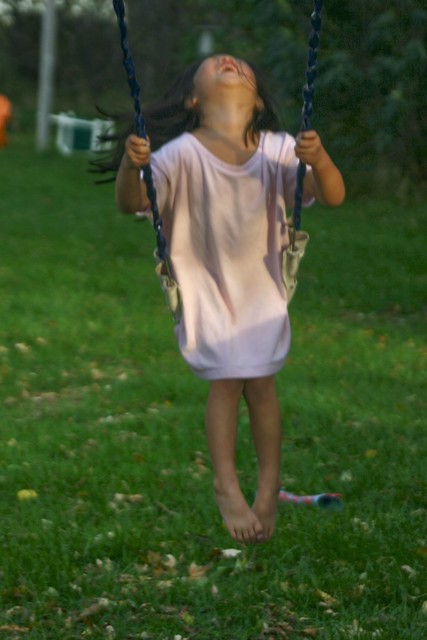
Olivia Swinging
Olivia laughing with joy and enthusiasm as she swings
in the backyard.
(Taken on September 29, 2007.)

To practice enthusiasm, make others aware when you are excited about something. Throw yourself into your projects. Be known for your eagerness, your curiosity, your willingness to give it all you've got. Proclaim your passions. Hold nothing back. Sing your heart out.

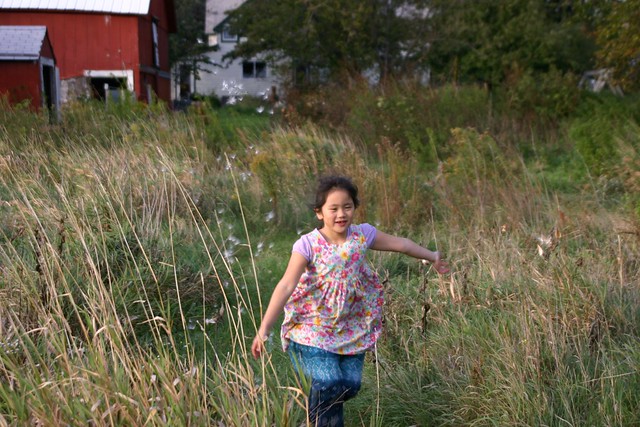
Sophia as Laura Ingalls Wilder
Sophia running with enthusiasm through the pasture
as she spreads milkweed seeds.
(Taken on September 29, 2007.)

Why This Practice May Be For You

Enthusiasm is invigorating. It helps you get up and go. It is a good prescription, then, when you are feeling lethargic and listless, when your energy seems frozen.

Enthusiasm counterbalances apathy and boredom, two common blocks to an engaged spiritual life. A sluggish spirit just doesn't care about anything. The world isn't interesting enough; there's a dreary sameness to all your activities.

Fire in the Clouds - Sunrise 9/29
September 29, 2007, must have been a great day.
I kept finding pictures of things that 
brought back so much joy as I looked at them.
I remember how excited (or enthusiastic) I was when 
I saw this amazing cloud formation in the morning. 

When fatigue or another of these conditions has you dragging through your days, when you find that you've replaced wonder with whatever, go for enthusiasm. If you can't muster it from within, surround yourself with enthusiastic people.

Quotes


It is important to energize our everyday practice and
 daily good works with enthusiasm, 
without anyone else telling us to, 
but  doing it for our own sake.
— The Dalai Lama

Enthusiasm is the greatest power.
For one endowed with enthusiasm
nothing in this world is impossible.
— The Ramayana

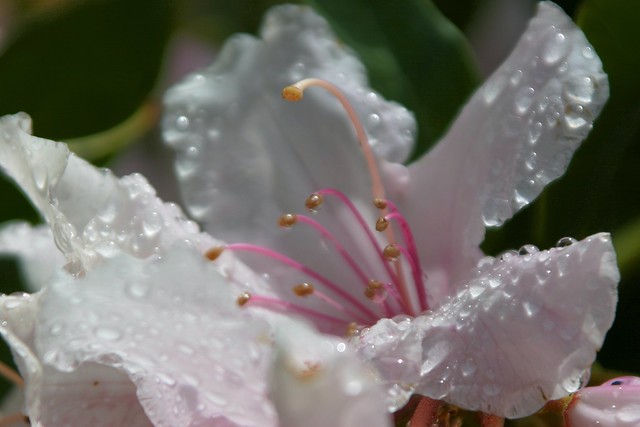
Flower after a mid-day rain
A flower after a rainstorm.
(Taken on May 21, 2007.)

Who are the happiest, richest people you know?... 
These are the people who are living joyful, enthusiastic lives, 
regardless of their possessions or lack of possessions. 
— Shoni Labowitz in Miraculous Living

Nothing great was ever achieved without enthusiasm. 
The way of life is wonderful; it is by abandonment.
— Ralph Waldo Emerson quoted in Lighting a Candle by Molly Young Brown


Books

I read Exuberance: The Passion for Life by Kay Redfield Jamison. This book was about the topic of exuberance as an elated state, a cousin to enthusiasm, happiness, and joy.

The other book I'm planning on reading is Jesus Laughed and Other Reflections on Being Human by Jean Maalouf. "We need not study merely the biography of Jesus. Rather, we need to discover him living now, in our everyday life," wrote Jean Maalouf.

Maalouf is awed by Jesus's ability to learn spiritual lessons from plants, to accept the presence of the kingdom in everyday events, and to proclaim love as the linchpin of our relationship with our neighbors. The author also revels in Jesus's spiritual practices of enthusiasm, joy, attention, freedom, listening, and zeal.

For Maalouf, the heart rather than the head is the gateway to a spiritual life in Christ. This book presents a creative and empowering interpretation of the life and ministry of Jesus Christ.

Film

The Accidental Tourist directed by Lawrence Kasdan.


Music

Almost any recording in the gospel music genre is a good example of enthusiasm. Although there are many single gospel singers, the most enthusiastic performances usually are by groups and choirs.

For great samples of the latter, the Spiritual Practices website suggested listening to the Smithsonian Folkways recordings African American Spirituals. I found the Afro-American Spirituals, Work Songs, and Ballads CD. There are 17 songs on it, all recorded between 1933 and 1939 in the rural south.

I listened to Trouble So Hard, I'm Going to Leland, and  The Blood-Stained Banders. Out of the three, the last one was the most enthusiastic and fast-paced. The other two songs were songs I would associate with working.

The other CD I checked out was African American Spirituals: The Concert Tradition.  I listened to Wade in the Water. It was sung by the Howard University Chamber Choir so it was a completely different listening experience than the other CD. I liked this one much better.

The other song I enjoyed listening to was Oh Freedom that was sung by The Princely Players. The song was beautifully sung and sounded like one that I would hear in a church service or funeral (but it was not depressing to listen to because of the lovely voices and lyrics).

The third song from the CD that I listened to was Roll, Jordan, Roll sung by The Princely Players. As I listened to the music, it made me miss listening to the choir at White Bear Unitarian Universalist Church. They have an incredibly talented group of women and men who come together to sing a wide variety of music. This song I could see them singing.

Art

The spiritual practice of enthusiasm arises out of deep passion and visceral energy. Both qualities, according to the Spiritual Practices website, are apparent in Sonia Delaunay's Flamenco Singer.


Spheres of bright colors — reds, oranges, yellows, blues, greens — radiate away from the central figure of the singer. Some of the disks become spirals before moving off the canvas. The power of such a vocal performance must come from a place deep within, the source of all enthusiasm.

Daily Cue, Reminder, Vow, Blessing

There are three reminders from the Spiritual Practices website that would be ones that I can see using throughout my life.

• Seeing an audience clapping for a performer, is a cue for me to practice enthusiasm.

• Looking up at the radiance of the stars, I am reminded to let my enthusiasm for life shine brightly.

• Watching someone who obviously relishes what he or she is doing, I vow to practice enthusiasm.

Practice of the Day

The antidote to exhaustion may not be rest. 
It may be wholeheartedness. 
You are so exhausted because all of the things 
you are doing are just busyness. 
There's a central core of wholeheartedness 
totally missing from what you're doing.
— Brother David Steindl-Rast quoted in I Will Not Die an Unlived Life by Dawna Markova

To Practice This Thought: The next time you feel like you need a nap, instead do something you are really excited about.

I rarely take naps - instead my days are filled from the moment I wake up to the time I go to bed. Periodically, though, when I am exhausted I do fall asleep and usually it ends up being for a good two hours. Then I feel refreshed.

However, if I'm just dragging for some reason, simply getting outside can lift my spirits. The weather has been getting warm again so I started taking the dogs for walks since I'm not worried about falling on the ice any more if they pull me.

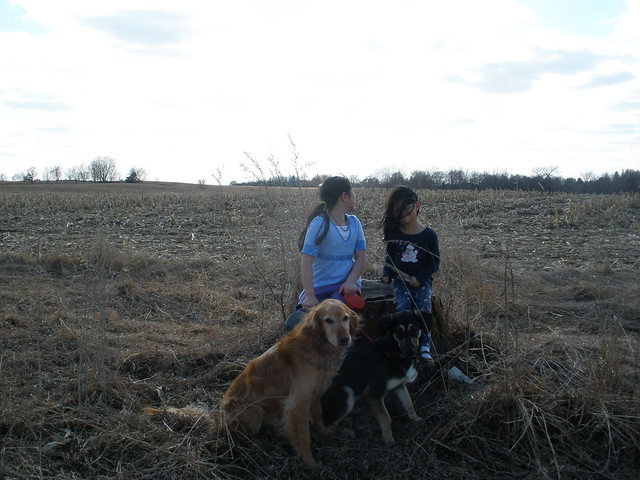
Girls Resting on a Tree Stump
It seems like yesterday, in some ways,
that both Montague and Gretel were with us.
This was taken on April 8, 2009, on
one of our spring walks.
March 21st marks the one year anniversary 
of Montague's death, and - interestingly - 
the birth of the other Golden Retriever we had (Sydne) 
who was born in 1990.

What I want to start doing again is doing creative projects. The year my father died (2012) I did so many creative projects. Even the two years proceeding his death, I was doing a lot of creative activities. In 2013, it was as if everything just came to a halt. I'm hoping that in 2015 I can begin to carve out time for something that I used to be very enthusiastic about.

Spiritual Exercises

Select a favorite hymn or religious song to use in a worship service or ritual. Let yourself go as you sing it. John Wesley, the founder of Methodism, gave some very specific instructions for singing: "Sing lustily and with a good courage. Beware of singing as if you were half dead, or half asleep; but lift up your voice with strength."

Although there are religious songs that I enjoy listening to like On Eagles Wings or Meditation on Breathing or many different Christmas songs, I don't sing in public. Rather, in my mind I sing along with a perfect voice - one very unlike the one I sound like if I was to sing aloud.

Journal Exercises

Both of these topics I wrote about in my personal journal:

Do an enthusiasm examination of yourself. When do you feel most alive? What are you passionate about? Do you always feel free to express your enthusiasm? If not, what tends to stifle this spiritual energy?

Write a profile of a person you would call a "living saint" who is infused with a good spirit. How has this individual moved you? How do you feel in the company of this person? Try to come to terms with your reactions to "holy people" in this exercise.

Discussion Questions, Storytelling, Sharing

Describe a specific incident when you were enthusiastic about a project. What was it? How did the people around you respond to your excitement? Did anyone try to take the wind out of your sails? How did you handle the situation?

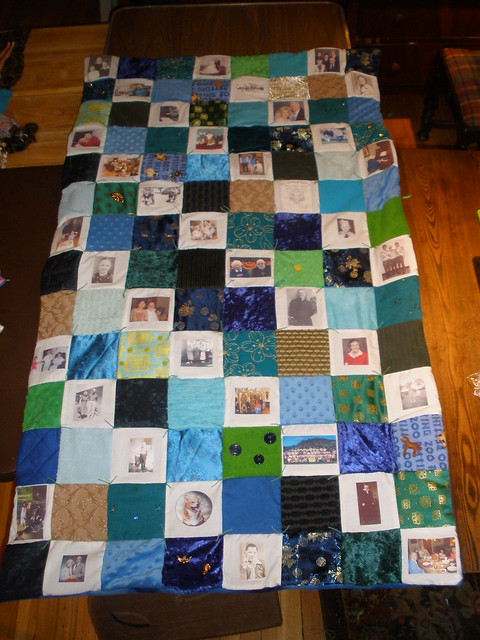
Finished Sensory and Memory Quilt (for my Dad's Christmas Gift)
This is the sensory and memory quilt I made for my dad.
(The photograph was taken on December 21, 2009)

I made a sensory and memory quilt for my dad who had Alzheimer's Disease. The fabrics had different textures, and the pictures were ones that he picked out that were meaningful to him. The back was a very soft fleece.

I gave it to my father on December 27th since there was a big snowstorm. Anyway...he opened the box and looked at the quilt, and immediately started recalling memories and sharing stories about some of the pictures.

He cried when he looked at other pictures. "I've had a good life," he said.

What do you do to revive your spirits when you are feeling sluggish, bored, or apathetic? The most consistent thing that I do to revive my spirits is spend time in nature. Taking a walk with the dogs, exploring a new trail, going to a state park, or even just stepping outdoors to take a walk around the farm can revitalize me when I most need it.

Beautiful tulips that I saw on April 30, 2009.
I was on a trip to Pella, Iowa, with 
my parents and daughters.

Household, Group, and Community Projects

At some point in the future, I would like to do these things:

Create a scrapbook of Enthusiastic Souls, perhaps organized around saint days or birthdays. Read about the lives of people you admire. Copy down meaningful lines from their writing. Find one way to honor this person - with a prayer, a reading, or a specific action.

Make supporting other people's enthusiasms an ongoing activity in your household. Send thank you notes to people whose commitments you admire, just as you would acknowledge a gift. Regularly share your passions with family and friends - send a favorite book with a note about why you love it, recommend a film, e-mail a meaningful quote. And when you spot enthusiastic people, cheer them on.

Sunday, March 8, 2015

Healing Labyrinth - Read 52 Books in 52 Weeks - Week 10

For the tenth week of the Read 52 Books in 52 Weeks challenge, I read The Healing Labyrinth - Finding Your Path to Inner Peace by Helen Raphael Sands. I chose this book for the theme of Enthusiasm which is part of the A to Z Spiritual Practices challenge that I'm doing during 2015.


There aren't a lot of books written about enthusiasm per se, so when I was reading The Healing Labyrinth and saw a section about how to enthusiastically dance and move through labyrinths, this book seemed like an appropriate fit.

There were several things that I learned while reading the book:

- The fish symbol that people sometimes put on their cars is called a vesica piscis. "It is a basic shape of sacred geometry and means 'fish's bladder.' It is formed with two intersecting circles and symbolizes the marriage of opposites, such as Heaven and Earth, the masculine and feminine, light and dark, not unlike the Chinese yin and yang symbol."

- A labyrinth has universal appeal because it is not attached to any one faith or tradition. So, each person who follows its path can draw from it what he or she needs. It is a means of meditation offering us space to listen to ourselves.

- It can be a slow and contemplative experience or fast and energizing; it can help us shed layers of emotion and unravel a problem; or it can stimulate the mind and offer inspiration.

- We can see the shape of the labyrinth all around us in the spiraling and turnings of nature: in the swirl of a thumbprint, in water rippling outwards, in spiders' webs, in the uncoiling of a fern.

- You can connect the labyrinth (that you're walking) but thinking of or naming out loud someone who has died and who was very important to you. Ask this person to accompany you on your journey through the labyrinth.

- If you have a portable labyrinth and want to remember the people who have walked it or the places it has visited, you can make an Ariadne memory thread. You need a ball of brightly colored string, on to which you can attach tags or mementos that are symbolic of your journey. Twine your Ariadne's thread around a cylinder to store it in between each labyrinth event. When you close down the labyrinth in time, you can read out the names of people and the places visited to link the labyrinth with time present, thereby creating a sense of continuity and community. (In the book the author had a shell, mental figurines, an envelope that was hole-punched in one corner and attached to the thread, and a button on the Ariadne's memory thread.)

- Choosing different materials: using Christmas fairy lights to mark the pathways of the labyrinth, mow a pathway for the labyrinth, or flat/smooth rocks. Another idea was to plant a labyrinth with spring bulbs so that each spring the labyrinth would bloom to welcome the new season.

Wednesday, March 4, 2015

Diaper Bassinet and Washcloth Bouquet for a Baby Shower

Sophia, Olivia, and I went to a beautiful and heart-warming baby shower this past weekend for the daughter of our neighbors. We have been neighbors since 1995, and have watched their daughter grow up from a middle-elementary school child to a engaging and thoughtful young woman.

So, I wanted to do a couple crafty gifts along with our other gifts as a way to celebrate this special milestone in her life.

The first project I did was a diaper bassinet. The idea came from this pin on Pinterest that led to Cute as a Fox's tutorial.


I used 14 diapers (size 1) to make the bassinet. There are ten for the bed, one for the backing, one for the top, and two for the base.


The first one took a bit of time to figure out since the tutorial was for size 3 diapers. However, I think they came together nicely.

I made two of them since there were plenty of diapers in the  bag. The second one was easier to assemble and didn't take as long to do.


The second project I did was a washrag bouquet. The idea came from a pin on Pinterest as well.


Basically, you take eight washrags and roll them up, insert them into a cone made from scrapbooking paper, and attach some curling ribbon.


As I looked back on the pin and my washrag bouquet, I would re-roll the washrags as shown in the pin. They look a bit more like flowers rather than washrags in the original pin. Regardless, it was still a fun way for me to present a gift rather than just having them sit in their packaging.

When we got to the baby shower, everything was so beautifully decorated. There were other ideas that  Jeannine (the grandmother-to-be) had seen on Pinterest that she created - like the balloon clouds with blue raindrops that Holly (the mother-to-be) sat under while she opened the gifts.


The little clothesline of dresses, ruffled diaper covers, and colorful toys brought back nice memories of picking out the same type of clothing for Sophia and Olivia when they were younger.


There were fun games - like a diaper raffle and  guessing how many jelly beans filled the baby bottle.


There was the Baby Shower Price is Right game. The total for the products was about $63. Most surprising was how much powdered formula had increased since we had to purchase it back in 2001-2004.


The food was spectacular - everything tasted so delicious - from the fresh fruit kabobs to the chicken salad.

If that wasn't enough: the dessert table was overflowing with beautifully-decorated desserts.


The chocolate-covered strawberries were huge and tasted so fresh - just like they were picked that morning from the strawberry patch.

Holly and her husband (Alfred) received gifts that will completely set up the nursery, and their forthcoming daughter's wardrobe for quite some time.

We had a wonderful time at the baby shower. Seeing how much work and love was put into the baby shower; the handmade gifts that Jeannine and her husband (Kent) made for the baby; and the attentive hospitality of Kent and Holly's brother, Michael, showed toward the guests made the afternoon one that was memorable and special for everyone there.

Sunday, March 1, 2015

Exuberance - Read 52 Books in 52 Weeks - Week 9

For the ninth week of the Read 52 Books in 52 Weeks challenge, I read Exuberance - The Passion for Life by Kay Redfield Jamison.


I was excited to read this book and had rather high expectations for it. However, as chapter after chapter passed, it became clear that what I thought this book would be and what it actually is are two completely different things. So, by the middle of the book I was skimming the chapters. Before long, I simply closed the book and felt like I had read enough of it. This book, unfortunately, was not the best use of my time.

That being said, there were some things I found interesting and wanted to remember:
- It is the infectious energies of exuberance that proclaim and disperse much of what is marvelous in life. Exuberance carries us places we would not otherwise go - across the savannah, to the moon, into the imagination - and if we ourselves are not so exuberant we will, caught up in the contagious joy of those who are, be included collectively to go yonder.
- By its pleasures, exuberance lures us from our common places and quieter moods.
- Joy widens one's view of the world and expands imaginative thought. It makes both physical and intellectual exploration more likely, and it provides reward for problems solved or risks taken.
- One joy, the Chinese believer, scatters a hundred griefs, and certainly it can be an antidote to fatigue and discouragement. Into those set back by failure, joy transfuses hope.
- Theodore Roosevelt seems to have burst into the world a full-throated exuberant.
- Roosevelt's vivacity receded when his father died....It was a devastating loss. For the rest of his life he would miss, though himself incorporate, his father's rare mixture of infectious joy and keen sense of public duty."
- John Muir: "He understood nature, felt nature, and then illuminated her to those who did not. The slaying of the wilderness was to him personal and intolerable."
- John Muir spoke of a more inward journey: "I only went out for a walk," he wrote, "and finally concluded to stay out till sundown, for going out, I found, was really going in."
- Nature is self-evidently exuberant. One pair of poppies, given seven years and the right conditions, will produce 820 thousand million million million descendants.
- Lichens, among nature's oldest and slowest of living things, grow nearly everywhere...and an individual community of lichen may survive longer than most human civilizations.
- Wilson "Snowflake" Bentley...was incapable of indifference to the world around him. When there was a winter storm and snow was flying, he was in the fields or hills; he could not stay indoors. His delight in snow made him an astute observer of it; it then made him an infectiously enthusiastic guide. Exuberance gave him passion, stamina, and a lasting voice to speak out for small beauties.
- Every crystal was a masterpiece of design and no one design was ever repeated. He was as stricken by their impermanence as struck by their beauty: "When a snowflake melted," he lamented, "that design was forever lost. Just that much beauty was gone, without leaving any record behind."
- African elephants: expressions of joy are frequent in elephant families...especially when they greet one another after having been apart. The "greeting ceremony" may involve as many as fifty elephants and occurs after elephants have been separated for as short a period as a few hours or as long a time as several weeks.