Sunday, February 22, 2015

The Mystic Hours - Read 52 Books in 52 Weeks - Week 8

For the 8th week of the Read 52 Books in 52 Weeks challenge, I read The Mystic Hours - A Daybook of Interspiritual Wisdom and Devotion by Wayne Teasdale.


This book actually took me more than a week to read because it is a daily reflection book - so there's one page per day of the year in the book. Each page has a quote and a reflection; with the former being from various faiths. It is a diverse book in terms of beliefs and reflections.

These are some things I want to remember:
- The greatest accomplishment in life is to be who or what you are. (Abbot Thomas Keating)
- Look within to identify our true self and work throughout the year to express it.
- The choice is between nonviolene and nonexistence. (Martin Luther King, Jr.)
- Reason, common sense, and the enduring wisdom of our great religions call us to the realization of our responsibility to embrace this course if we want to survive as a species in a larger community of species. Nonviolence summons us to the clear recognition that we are a fragile human family in a fragile world. In a very real sense, our choice is really between inner growth and destruction.
- Our attachments hold us back from experiencing true happiness. Freeing ourselves from the bondage of attachment requires a mind trained in the pursuit of liberation, a mind able to let go of all that hinders.
- We have to prepare the house by living a committed spiritual life, putting aside time each day for prayer, and most of all practicing compassion and love.
- My religion is kindness...I'd rather be kind than right...You can always be kind. (Tanzin Gyatso, the 14th Dalai Lama)
- Kindness....is the bond connecting all beings in the great web of interdependence in which we all participate and by which we are sustained.
- When we are living in harmony with our nature then we cannot resist being kind, loving, passionate, and merciful.
- If we have no peace, it is because we have forgotten that we belong to each other. (Mother Teresa)
- Only when we remember our inescapable relatedness to one another will peace become a reality.
- Cultivate joy as you would a dear friendship.
- If you would be happy all your life, plant a garden. (Chinese proverb)
- It is often the simple things in life that greatly enrich us and teach us things about ourselves we never knew, but they also open up for us aspects of reality that are necessary for our happiness. Let us not fritter life away in a kind of work and passive entertainment. Rather let us learn the value of contemplation in the power of the simple.
- The mind is like a parachute - it only works when it's open. (Lily Tomlin)
- Genuine growth is only possible if we are open and listening. A closed mind is a recipe for stagnation and mediocrity. People are always threatened by change, especially if it requires them to stretch beyond feelings of security and assumptions about happiness. An open mind and an open heart are indispensable to achieving real maturity, and, even more important, becoming an agent in the happiness of others. Let us strive to keep our minds and hearts open, the openness that education engenders and spirituality develops.
- True greatness is found in the humble disposition. It is an acceptance of reality balanced with an openness to positive change.
- Creativity leads beyond the routine safety of the known. The creative spirit is never satisfied with what we know - or think we know - with past achievements, or the comforts that lull us into a mechanical living of life. Creativity involves stretching beyond our current understanding, attitudes, capacities, and opinions. Through creativity, culture continues to evolve on the back of innovation.
- The creative mind is never content with our current assumptions unless they are founded on deep truth.
- It is not death that is the tragedy of life....[but] what you let die when you are alive. (Robert Muller)
- When they are young, most people have a genuine desire to serve the world, to selflessly contribute to humanity's future and to be future of all sentient beings. Yet many become disillusioned with age and give up on their earlier desire. They settle for something less, like simply achieving the American dream. That dream isn't bad; it's just not enough to realize our potential as spiritual beings.
- A dream that I dream alone is only a dream, but a dream that we dream together is reality. (Raul Seixas). 
- Great societal changes...require vision and a movement.
- When we have a worthy dream, an inspired vision, we cannot keep it to ourselves; we must share it with others if it is to catch the popular imagination and eventually become imbedded in others' collective hopes, becoming the dream of the people.
- Music inspires, opening minds and moving hearts. Great music appeals to our emotions, stirs up feelings, aspirations, and possibilities.
- Let us be aware of music's potential to lead us and inspire us. Let us allow music to carry our deepest intention.
- The highest wisdom is kindness. (Berakot)
- Kindness will eventually transform the entire existence of an individual, having reverberations in the community and the world. Let us allow ourselves to be refashioned by the effective and beautiful quality of kindness.
- When we become truly established in other-centeredness, where we put the well-being of the community above our own self-interest, then we somehow also speak and act for the Divine.
- Zen Buddhism infuses that country's ancient culture, whoever is so grounded in right motivation and behavior thinks, speaks, and acts in the light of the ancestors.
- All we need to know is present in the world; it is written in the nature of the earth. Let us dedicate ourselves to discovering that natural wisdom present in the world so that we can spread this awareness and change the course of the world.
- Courage does not ignore danger, nor does it negate fear; it concentrates on what must be done and on the hope of something better.
- Go placidly amid the noise and haste, and remember what peace there may be in silence.
- It is always the secure who are humble. (G.K. Chesterton)
- The humble are secure precisely because they are humble, and the secure are secure because they have this humility of heart....the security...comes from wisdom.
- It is the easiest thing in the world for a person to deceive himself. (Benjamin Franklin)
- We deceive ourselves when we ruthlessly seek our wants or use other people to obtain them. We lie to ourselves to shield our conscience from the truth. When we deceive ourselves, we are hurting ourselves the most. The cure is pure honesty and humility. True humility never tolerates self-deception.
- Seek the company of the wise, to associate with people who have a similar conviction, who are looking in the same direction. One virtue implies others: A generous soul may also be courageous, kin, compassionate, loving, and patient.
- The purpose each one of us has is not merely a mission external to us, but has a lot to do with unfolding and developing our gifts, especially who we are in our capacity for mercy, kindness, and love, the cultivation of which is an essential part of the task of life.
- Until humankind extends its circle of compassion to all living things, it will not itself find peace. (Albert Schweitzer)
- There is no possibility of a mature spiritual life without humility. Nor is it possible to be a successful human being without it. Humility is also, most fundamentally, a relationship of truth with ourselves.
- We acknowledge our mistakes, not years from now, but when they are made. We must be willing to own up to these mistakes before others and not simply ourselves.
- In compassion, kindness, and love, we discern what is needed and we respond. We are a good listener to some, a provider of strength to others, a fierce  advocate and prophet to still others. 
- No person was ever honored for what he received. Honor has been the reward for what he gave. (Calvin Coolidge)
- Individual happiness by itself, alone is an illusion. It's superficial and doesn't last. When we work for the happiness of others, or as the poet Ralph Waldo Emerson says, pour it on others, we become happy in the process. What we give out returns to us, and if we are constantly contributing to the welfare, joy, and happiness of others, we will receive these blessings in return.
- The first step in personhood is to allow ourselves to be loved. (John Main)
- When we accept love from others, we open ourselves to the possibility to genuine happiness, which arises in us as we find ourselves giving love in return. Being loved increases our own capacities to love - to be merciful, kind compassionate, and sensitive - all capacities that lead to true happiness. Love opens up the whole spectrum of human greatness: other-centeredness, self-sacrifice, heroic virtue, joy, and deeds of extraordinary generosity.
- You cannot do a kindness too soon, for you never know how soon it will be too late. (Anonymous)
- We don't know if we have a tomorrow here in this world: we have no guarantees. But we do have the present moment, the now, and that's where we can choose to be kind, to respond to a loving, compassionate way.
- As soon as the waves have stopped and the lake has become quiet, we see its bottom. So with the mind when it is calm, we see what our nature is.
- Giving of ourselves to help others works in two ways: it benefits the recipient and it benefits the giver.
- Teaches open the door. You enter yourself.
- A person's true wealth is the good he does in this world. (Muhammad)
- None of the material wealth of this world lasts. The only things that follow us into eternity are our good works. 
- The only reason for material wealth is to share it with the less fortunate, not to hoard it for oneself. This is our glory as spiritual beings: to assuage the sufferings of others, to others, to offer what we have to those in need.
- The end and aim of all education is the development of character. (Francis W. Parker)
- The medieval Christian ideal of learning also focused on the education of the whole peson: body, soul, and spirit.
- The Tibetan tradition places great emphasis on the good heart.
- We simply pay too much attention to facts and skills and not enough to fostering responsibility, ethics, charity, and kindness.
- Our relationship with the natural world is not primarily stewardship. It's primarily rapport, admiration, interaction with, and listening to. (Thomas Berry)
- The soul is the sense of something higher than ourselves, something that stirs in us thoughts, hopes, and aspirations which go out to the world of goodness, truth, and beauty. (Albert Schweitzer)
- When we look at the extent of cosmic time, our lives are as brief as fleas. The brevity of life should alert us to the purpose of our existence: to grow in compassion, kindness, love, and sensitivity. Time is short and there is so much to learn, to be, and to do. Impermanence frames the field of our growth. Focus on what is necessary and leave all else behind.
- The positive side of frustration and discontent is the beginning of discovering your dream. It is a sign that the deeper aspects of who you are need to find a vehicle to actualization in your life. Whether the frustration you feel is related to a talent you have that lacks an outlet, a vision you have of where you want to be, or some creative project you can't quite get started on, you have to listen to your discontent because it is. A gift we give ourselves gives us to move us forward in realizing our dream.
- Humor bonds us with others: it builds intimacy, trust, and a positive attitude.
- A sense of humor is one of the surest signs of balance and perspective in ordinary life - a sign that someone understands that life is meant to be enjoyed and that we can find something funny even in our deepest foibles, mistakes, and misfortunes. 
- At the end of life, when someone has lived a life with consciousness and they look back on it, the questions are simple: "Did I live fully?" and, more than anything else, "Did I love well?" (Jack Kornfield)
- To live life with awareness is to live each moment with real sensitivity  and receptivity to others, their sufferings and need. To live fully is to be aware of the opportunities to be compassionate and loving toward others. To love well is to love unselfishly and to strive to be ever more inclusive, extending one's care even to those with whom we would not ordinarily associate. It is to be spontaneously open and receptive to those we meet who may need us in some way.
- Our lives begin to end the day we become silent about things that matter. (Martin Luther King, Jr.)
- To bring the four energies together in the moment - physical, intellectual, spiritual, and emotional - is the fundamental artistic act. This is where the joy arises. (Dick Richards)
- Just as a tree, a bush, or a flower cannot live without roots, we cannot live without  being firmly established in our souls. The soul should also be nourished and cared for, just as a gardener nurtures the growth and well-being of his garden. Prayer, meditation, kindness, and love are ways to nourish the soul, the root of our being.
- Compassion for yourself translates into compassion for others. (Suki Jay Munsell)
- Every time we suffer, we grow. (Ram Dass)
- Suffering has a way of opening our hearts and putting us in touch with our compassionate nature. Suffering teaches us to love and to be kind, compassionate, and sensitive to the struggles of others. It is the greatest means of enlarging our perspective.
- Constantly rushing discourages authentic behavior. It is the opposite of compassion, kindness, love, and sensitiviyt, and more important, it is the enemy of being present, both to the moment and to others. To be truly present, we have to take our time, whether we are looking at the task at hand, which we can then do with good intention and efficiency, or listening to the people around us, who we can respond to authentically and appropriately. When we're in our hurried state, we are unable to attend to spiritual practice. Allow yourself to slow down and be present to others and to the miracle of the present moment.
- You always carry within yourself the very thing that you need for the fulfillment of your life purpose. (Malidoma Some)
- Each person has a mission, a work they must contribute to the whole. It appears vaguely at first, a nagging dissatisfaction or an inkling of desire for greater things, but within a disciplined inner journey, the process of becoming honest with ourselves, we can come to realize our life purpose.
- We cannot do great things, only little things with great love. (Mother Teresa)
- She knew that great opportunities are rare and that the little opportunities that come our way every day provide the occasions for us to grow in love by transcending ourselves.
- Your trials did not come to punish you, but to awaken you. (Paramahansa Yogananda)
- Challenges bring us to our sense about our lives. They can serve as vehicles of realization, helping us to understand why we are here and how necessary the spiritual journey is for us. They awaken us to the serious purpose of life and inspire us not to waste this opportunity on a halfhearted existence.


15 Creative Goals in 2015

I've been thinking about what I want to learn and do in terms of my creative goals in 2015. Although almost two months have already passed, there's still ten months ahead to incorporate more creative time in my life.

During 2015, I want to:

1. Learn how to do fused glass.


2. Do glass blowing.
3. How to build a portable brick oven so I can create homemade pizzas and breads in it during the summer.
4. Finish all the WIP (works in progress) in the bin.
5. Go through all the fabric bins and donate what I no longer like or want.
6. Use the bag of felted wool to make a project (or two).
7. Learn 3 new crocheting stitches.
8. Make a pair of socks using the sock loom.


9. Learn to knit and make something useful.
10. Use some of Dad's clothes and make legacy gifts to give to Mom, Mary, Jim, and me.
11. Do two upcycled crafts that use jeans.
12. Make six handmade cards using inspiration from other DIY cards.
13. Make three homemade bath products.
14. Paint and install a barn quilt.


15. Make something for the next door neighbor's daughter who is expecting her first child this spring, and who has a baby shower in March. Did this on March 1st. I made two baby bassinets from diapers and a washcloth bouquet. 

Monday, February 16, 2015

Spiritual Practices A to Z: Compassion

This is the third focus of the "Spiritual Practices A to Z" challenge that I'm doing that is based on the spiritual practices that are shared on the Spirituality & Practice website. So far I have focused on Attention and Beauty. For the past two weeks, I focused on the spiritual practice of Compassion.

Sophia helping Darlene frost and decorate cookies
for Valentine's Day at the nursing home.
(Taken on February 13, 2015)

Spiritual Practice: Compassion
Enhances: Caring
Balances/Counters: Judgment, Pain

The Basic Practice

Compassion is a feeling deep within ourselves and a way of acting — being affected by the suffering of others and moving on their behalf. Buddha and Jesus are the two most well-known exemplars of compassion, and it is the central ethical virtue in the two religions that developed from their teachings.

Olivia helping Annabelle at the Valentine's Day 
cookie decorating activity at 
the nursing home on February 13, 2015.

As the Spiritual Practices website said, "The spiritual practice of compassion is often likened to opening the heart. First, allow yourself to be feel the suffering in the world, including your own. Don't turn away from pain; move toward it with caring. Go into situations where people are hurting. Identify with your neighbors in their distress. Then expand the circle of your compassion to include other creatures, nature, and the inanimate world."

Sophia tuning her harp in preparation for 
our time at Northwoods Humane Society.
We are starting to do music therapy for the animals 
who are waiting to be adopted there 
which has been very rewarding. 
This is Bridgett listening to Sophia.
(February 13, 2015.)

Why This Practice May Be For You

The practice of compassion increases our capacity to care. It reinforces empathy, sympathy, and charity.

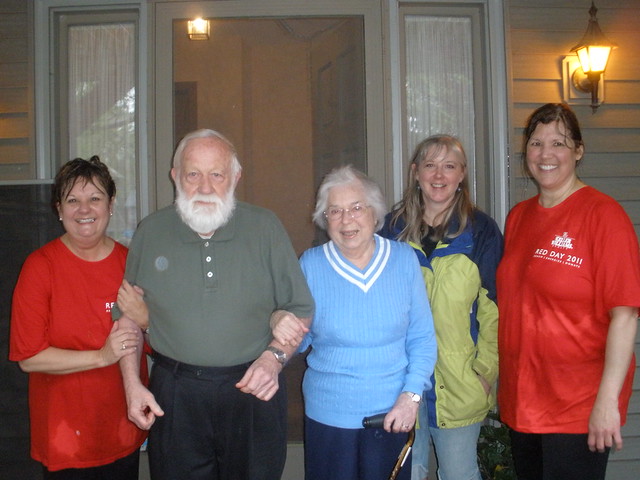
Laurie, My Parents, Me, and Belinda on Red Day
On May 12, 2011, over 30 volunteers from 
Keller Williams in Maple Grove came to 
my parents home to help them with outdoor work 
as well as making their home safe indoors. 
This was for their annual Red Day (volunteer day). 
The volunteers had such great attitudes and 
worked through the pouring rain. 
My parents are so happy - and thankful - that they were chosen to 
receive all the help and improvements to their home. 
Why were they selected? 
Keller Williams was looking for families 
who have made a difference in the community.
My dad was in the very advanced stages of  Alzheimer's Disease, and
my mom had significant mobility and other health issues.

However, when you move toward others with compassion, you are likely to encounter some common attitudes that want you to close your heart again. The usual suspects are judgment and all its associated "isms": ageism, classism, racism, sexism, and nationalism.

On a personal level, your compassion is sabotaged by feelings of ill will toward others: malice and spite. These feelings, and others arising out of personal pain and emotional wounds, are actually symptoms indicating that you need to have compassion for yourself.

Quotes

Compassion is a foundation for sharing our aliveness and 
building a more humane world.
— Martin Lowenthal in Opening the Heart of Compassion


Olivia filling a sock with toiletries and 
other personal care items that will be 
donated to a person experiencing homelessness.
(Taken on February 5, 2015.)

Like a mother who protects her child, 
her only child, 
with her own life, 
one should cultivate a heart of unlimited love and 
compassion towards all living beings.
— The Buddha quoted in The Mystic Vision 
edited by Andrew Harvey and Anne Baring

Olivia and I brought lunch to my mother on Valentine's Day.
I made tuna noodle salad with eggs and 
chopped all the vegetables very small so she could eat them 
(she has lost most of her lower teeth).
We had fresh strawberries and mandarin oranges,
 rosemary crackers, and chocolate cookies.
She has a container of potted tulips that 
will grow over the next few weeks.
(Taken on February 14, 2015.)

The Jain religion in India teaches that because all life is essentially interrelated and interconnected, all living beings should be considered sacred and be respected. This belief forms the basis of the doctrine of ahimsa, which has been translated into English variously as "reverence for life," "nonviolence," and "dynamic compassion."
— Nathaniel Altman in Sacred Trees


When we were volunteering at Northwoods Humane Society on February 13th, we noticed Jet who was in her kennel at the very back pressed up against the wall. She appeared frightened and very timid. Brenda (the executive director) had to carry her out and gently push her into the room where we were sitting. 

Within five minutes of listening to harp music and being petted, Jet was feeling more relaxed. She even ate two bowls of soft food. Her expression and demeanor changed from one of fear and anxiety to one of happiness and relaxation. 

She was moved to a quieter area at Northwoods after her time in the room with us and seemed to be doing significantly better. Her ears were up, she looked alert, and she was so much more engaged and happy. She's going to make a family who adopts her very happy. 

Compassion is the intention to see each human being 
as no better or worse than yourself, 
neither more nor less important, and 
as fundamentally similar to yourself.
— Timothy Miller in How to Want What You Have

 
Because my mom has significant vision issues (she's blind in both eyes), 
we bought her a Valentine's Day card 
that hopefully she could see.
Sure enough, when she took the card out of the envelope, 
she said, "I can see it!"
Her smile was heart-warming for me to see.
Olivia read her the message, and 
I noticed as she was reading it my mom had her hand on her heart.
She had tears in her eyes as Olivia read to her.
(Taken on February 14, 2015.)

To grow old is to pass from passion to compassion.
— Albert Camus quoted in Letters to a Young Doubter by William Sloane Coffin

We are beginning to learn that each animal has a life and a place and a role in this world. If we place compassion and care in the middle of all our dealings with the animal world and honor and respect their lives, our attitudes will change.
— Jane Goodall in The Ten Trusts

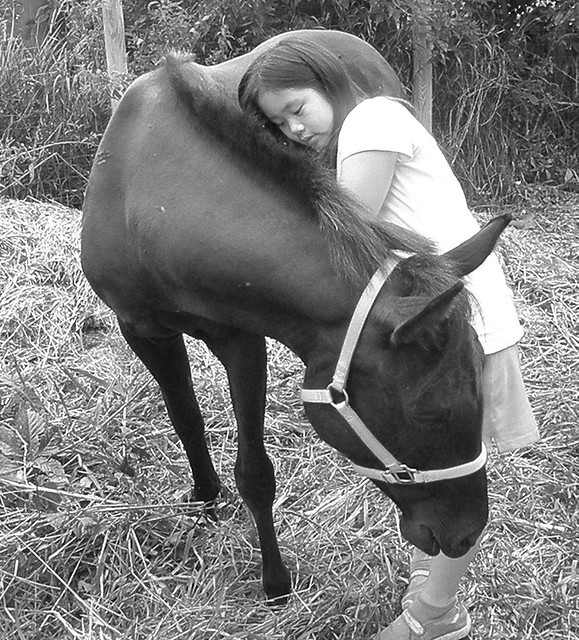
Sophia and Bailey

On the day that Bailey was adopted from the 
Minnesota Hooved Animal Rescue Foundation (August 13th), 
we have welcomed and  tried to provide comfort to her.
She was not use to eating grass (she was in a dry lot and ate baled hay),
 so she needed to be slowly transitioned to 
being able to eat fresh grass.
During the first week after she was adopted, 
the vet came out to do an overall check on her. 
He noticed that she was blind in her right eye, and 
had some pigment issue with the left eye.
This has required compassionate care as 
we helped her learn her new environment, 
meet a new equine friend who was adopted on the same day, and 
helped her trust us. 
(Taken on August 13, 2009)

What do you want to achieve? The Dalai Lama responded, "To be happy. My practice helps me lead a useful life. If I can give some short moment of happiness to others, then I feel that my life has achieved some purpose. This gives me deep mental satisfaction — this feeling always comes if you serve others. So when I help others, I feel happy. For me, the most important thing is human compassion, a sense of caring for one another."
— His Holiness the Dalai Lama quoted in The Big Questions by Lama Surya Das

Dogs Resting While We Pack Books
Sophia packaging up boxes of books that 
we shipped to Lesotho, Africa, to establish a library in a primary school.
(Taken on December 7, 2012.)

All beings wish for happiness, so extend your compassion to all.
— The Buddha quoted in Buddhist Wisdom by David Crosweller

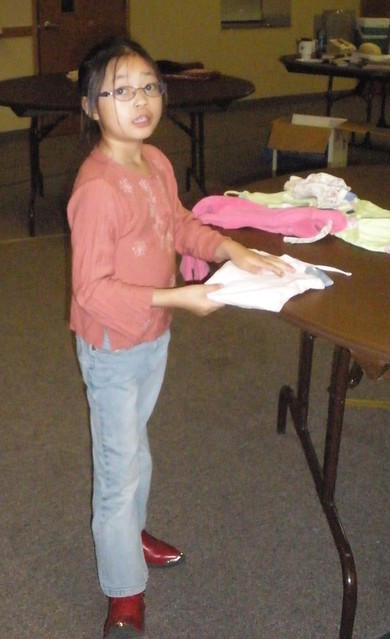
Olivia Folding Clothes
Olivia helping to fold and organize clothes for
a clothing giveaway at a local church.
(Taken on May 19, 2011.)

Every time I hold a bowl of rice, I know how fortunate I am. I know that forty thousand children die every day because of the lack of food and that many people are lonely, without friends or family. I visualize them and feel deep compassion. You don't need to be in a monastery to practice this. You can practice at home at your dinner table. Eating mindfully is a wonderful way to nourish compassion and it encourages us to do something to help those who are hungry and lonely.
— Thich Nhat Hanh in Living Buddha, Living Christ

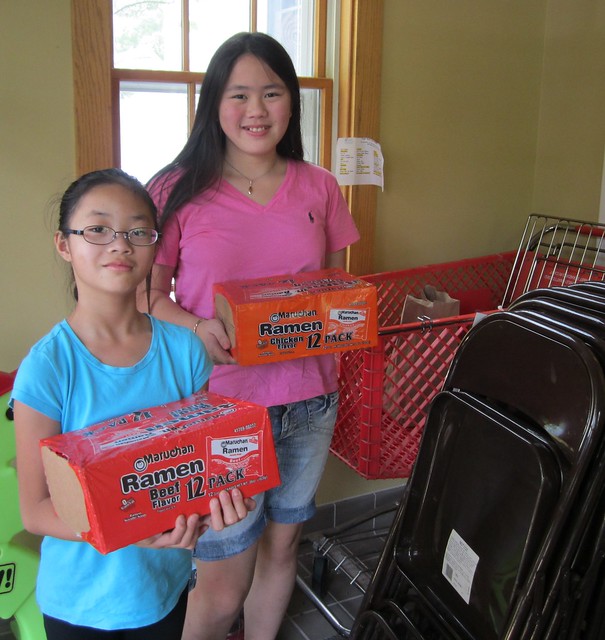
Donating Food to Food Shelf
Olivia and Sophia donating food to the food shelf. 
(Taken on July 31, 2012.)

Books

I checked out two books from the library during the last two weeks: The Rhythm of Compassion - Caring for Self, Connecting with Society and How to Be Compassionate: A Handbook for Creating Inner Peace and a Happier World.

The first book I began reading, The Rhythm of Compassion - Caring for Self, Connecting with Society by Gail Straub, has taken me the entire two weeks to read. The book compares the relationship between soul and society to the in-breath and the out-breath of meditation practice.

She presents stories of individuals who have struggled to maintain balance while caring for self and caring for the world as well as questions that prompt the reader to reflect on their inner life and who they are; and their life of service.

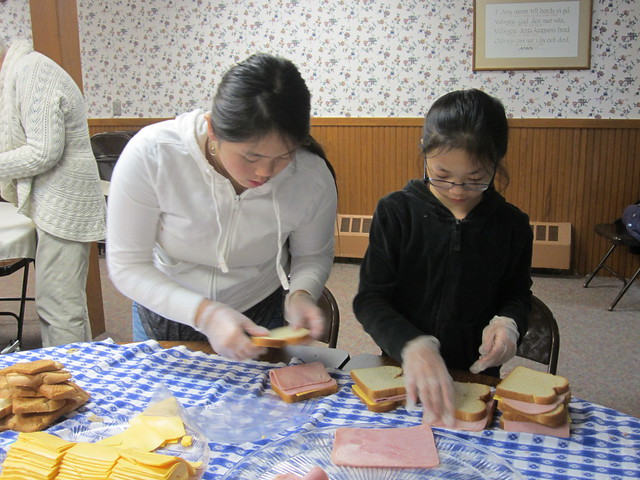
Helping Make 500 Sandwiches
Sophia, Olivia, and I helped make meat and cheese sandwiches 
that were donated to a program that 
served those who were experiencing homelessness.
(Taken on September 23, 2012.)

The most critical part is finding a central image that influences how we see our personal life, identifying the legacies we've inherited from our parents, and exposing where we belong and where we hide.

The author discusses four qualities of mature compassion — a quiet mind, an open heart, presence, and radical simplicity. We can become more compassionate by making a place for imagination, discipline, and support in our lives.

I am petting Bridget as she listens to harp music.
We are volunteering once at month 
at Northwoods Humane Society.
(Taken on February 13, 2015.)

However, our helping is tainted when "the ego wants to fix, to make things perfect, to reorder someone else's life, to do something to maintain the illusion of control."

There are so many insights into this book about my own life and focus on helping others. I am taking my time with it to fully reflect on it, and think about ways to be both more compassionate to myself as I try to be with others through volunteering and service.

The second book that I checked out is How to Be Compassionate: A Handbook for Creating Inner Peace and a Happier World by His Holiness The Dalai Lama. I have not had a chance to read it yet, but it is focused on the Tibetan techniques for how to transform one's mind and heart. The book is supposed to have a "soul-stirring, enlightening array of material gleaned from science, religion, theology, psychology, and [The Dalai Lama's] own adventures of living a compassionate life."

Sophia with Nora - one of the dogs that 
came into the room when she was playing the harp.
Olivia and I each spent time with Nora.
(Taken on February 13, 2015.)

Films

There's a movie called Damien that's a one-man drama focusing on the suffering servanthood ministry of Father Damien, a priest who put his life on the line for lepers isolated on Molokai island in Hawaii. This movie was unavailable through any Minnesota library, so I ordered a book instead about Father Damien.

Music

Benjamin Britten's War Requiem was first performed at the 1962 dedication of the new Coventry Cathedral built next to the ruins of the cathedral destroyed during World War II.

Winston Churchill visiting the ruins of 
the Coventry Cathedral in 941.

In this choral work, Britten alternates the language of the mass with tenor and baritone solos taken from the antiwar poetry of Wilfred Owen, who died on the battlefield in World War I. Compassion is a constant companion of this powerful music.

Wilfred Owen.

The YouTube video I found is 91 minutes. It is an impressive work of art that includes a full orchestra and choir.

According to Wikipedia, "The traditional Latin texts are interspersed, in telling juxtaposition, with settings of poems by Wilfred Owen, written in World War I. The work is scored for soprano, tenor and baritone soloists, chorus, boys' choir, organ, and two orchestras (a full orchestra and a chamber orchestra). The chamber orchestra accompanies the intimate settings of the English poetry, while soprano, choirs and orchestra are used for the Latin sections; all forces are combined in the conclusion."

Art

Two of Pablo Picasso's most famous paintings evoke compassion. Guernica, painted in 1937 for the Spanish Pavilion at the Paris World's Fair, reflects the artist's visceral response to the destruction caused by the Spanish Civil War.


Picasso created this piece in response to the bombing of Guernica, a Basque Country village in northern Spain, by German and Italian warplanes at the behest of the Spanish Nationalist forces on April 26, 1937, during the Spanish Civil War.

According to Wikipedia, "Guernica is a statement against fascism, showing the tragedies of war and the suffering it inflicts upon individuals, particularly innocent civilians. This work has gained a monumental status, becoming a perpetual reminder of the tragedies of war, an anti-war symbol, and an embodiment of peace. Upon completion, Guernica was displayed around the world in a brief tour, becoming famous and widely acclaimed. This tour helped bring the Spanish Civil War to the world's attention."

Weeping Woman, from the same year, is considered to be a postscript to Guernica.


The Weeping Woman series, according to Wikipedia, "...is regarded as a thematic continuation of the tragedy depicted in Picasso's epic painting Guernica. In focusing on the image of a woman crying, the artist was no longer painting the effects of the Spanish Civil War directly, but rather referring to a singular universal image of suffering."

Daily Cue, Reminder, Vow, Blessing

Seeing someone in pain is my cue to practice compassion.

When I was volunteering at the nursing home on February 13th, there were several people who were having difficult afternoons because of their challenges with dementia. All were part of the Music & Memory program, so I helped the CNAs get the iPods with the personalized music and the headphones and put them on the seniors. Listening to the music helps reduce stress and anxiety as well as some of the behaviors that appear because of dementia (e.g., yelling out).

Music has the power to reduce stress and anxiety; and
create the feeling of happiness in those with 
dementia and Alzheimer's Disease.
(Taken on January 23, 2015.)

I am so thankful that I was trained to do the Music & Memory program, and that we are able to bring the gift of music to seniors.

Practice of the Day

If you see on the evening news a person who moves you by his distress, just breathe it in and breathe out to him love and strength.
— Andrew Harvey in The Direct Path

To Practice This Thought: Send love to a stranger you notice is in need.

Spiritual Exercise

Create a Compassion Collage. I didn't do this since I didn't have magazines that I could cut up, but do want to do this in the future. Basically, the activity is to gather pictures of people, places, and things for which you feel compassion. You may take photos yourself, cut them out of magazines and newspapers, copy them from books, or find them in the direct mail appeals from service organizations.

Look for strong pictures to which you have an emotional response, no matter how painful. Include examples of the suffering of animals, nature, and things.

Add words or symbols to represent others areas of concern — "Earthquake" to remind you to feel compassion for victims of natural disasters, "Prison" for political prisoners and those who have committed crimes, or "Garbage" to note the suffering caused by wasteful consumption - for example.

Leave one area of your collage blank for what has not yet touched your compassionate heart. Keep your collage in a place where you can contemplate it at least once every day. One or more images may become the focus of prayer or meditation.

Hand Collage - One of the activities that I did see during the two-week time period focused on Compassion was one that was done at the 4-H BLU conference on February 7-8, 2015. The youth were in small groups and each traced her/his hand onto a piece of white paper.

Inside their hands they put things that they liked to do with others. From the overlapping hands, you could see how the youth were different from one another - yet could come together, support one another, and make a difference in the world.


Above: Sophia and Olivia in their small groups 
working on the hand tracings.
Below: The hand tracings of Sophia's group.

Journal Exercises


Some of the positive and inspiring messages that 
the youth wrote at the 4-H BLU conference 
on February 7-8, 2015.

• Identify an area where you need to be compassionate to yourself. Write about how you will go about this.

Interestingly, this issue came up at the beginning of the month when I was journaling and before I had read about this exercise. I wrote about how the upcoming several months - particularly the next few weeks - already feel like they are out of balance with a lot of volunteering and not enough time at home.

One of the challenges that I'm going to need to address is how to balance my time - homeschooling, volunteering, and caring for my family - so that I don't burn out and/or am not effective.

• Make a list of "missed opportunities" to show compassion to poor, sick, lonely, alienated, or hurting beings. Look for any patterns in your behavior or inaction. Identify an obstacle or rationalization that has kept you from being more compassionate.

This is something that I wrote in my journal about.

Discussion Questions, Storytelling, Sharing

The following are two things to reflect upon not only during this two-week time period, but throughout the year:

• Share an example of a situation when your willingness to be compassionate was tested. What do you usually do when you meet someone in need of help? What kinds of questions do you ask yourself? What conditions do you set?

• Tell a story about a moral mentor you have known-someone who inspired you with his or her compassionate activity.

Household, Group, and Community Projects


At the 4-H BLU conference, each youth wrote her/his name 
on a piece of paper that was tri-folded. On the inside, 
they wrote things that they are proud about themselves. 
On the outside from they wrote their name. 
On the back center, other youth in the small group 
wrote positive qualities about the person. 
It was a way to build self-esteem and acceptance, and 
show compassion to one another through 
supportive words and comments.

• Go on a fast. If you are inexperienced in this practice, begin with a one-day fast. Eat only fruits or vegetables and drink at least eight glasses of water. Or skip a meal a day for one week. Use the time you would have spent preparing and eating food for quiet reflection on the experience of being hungry. Feel compassion for the millions of people around the world who do not have enough to eat. 

I didn't do this, but want to remember that this may be an action to take at some point in the future.

Olivia petting Nora while Sophia played the harp 
at Northwoods Humane Society.
Nora loved all the extra attention and music.
(Taken on February 13, 2015.)

• Volunteer to serve meals at a soup kitchen, to carry meals to shut-ins, to read to people in the hospital, or to do any other activity that puts you close to suffering.

On February 13th, Sophia, Olivia, and I volunteered at Northwoods Humane Society to provide music therapy and extra attention to dogs and cats who were experiencing higher-than-normal levels of anxiety or stress, or needed some one-on-one time with people.

That afternoon, we spent time with about 15 seniors and helped them frost and decorate cookies for Valentine's Day. For many of them, they needed help remembering how to use a knife and put frosting on a cookie, and what to do with sprinkles. It was pretty sobering to see that such a basic activity was so challenging for many of the them.

I also had the opportunity to put the Music & Memory headphones on seniors who had dementia or Alzheimer's Disease who were having difficulty that afternoon.

On February 14th, Olivia and I visited my mom who is considered a shut-in. She was thrilled to have us spend time with her and eat lunch that I had prepared that morning for her. We had a nice conversation and time together.

Sophia, Olivia, and I gave Valentine's Day cards 
to the seniors. Vernon was so excited to receive one, and 
had his tucked in his pocket so he could bring it 
back to his room at the nursing home.
(Taken on February 13, 2015.)

Sunday, February 15, 2015

Chanting from the Heart - Read 52 Books in 52 Weeks - Week 7

This week I read Chanting from the Heart - Buddhist Ceremonies and Daily Practices by Thich Nhat Hanh. This book ties into the fourth spiritual practice I'm focusing on during the last two weeks of February: devotion.


Although there were many beautiful words and thoughts in this book, for the majority of it I skimmed through it since I couldn't picture myself reciting many of the passages.

However, there were some parts that I liked and wanted to remember. One of passages was the Silent Meal Practice. The author said, "From time to time, you might enjoy having a silent meal at home with your family or friends. Eating in silence allows us to see the preciousness of the food and our friends, and also our close relationship with the Earth and all species.

"Sitting silently at the table with others, we also have the opportunity to see them clearly and deeply, and to smile to communicate real love and friendship."

This is the Silent Meal Practice:

1. Looking at your Empty Plate or Bowl

My plate (bowl), empty now,
will soon be filled with precious food.
I see how fortunate I am
to have enough to eat
to continue the practice.

2. Serving Food
In this food
I see clearly
the entire universe
supporting my existence.

3. Sitting Down
Sitting here
is like sitting under a Bodhi Tree.
My body is mindfulness itself,
free from distraction.

4. Looking at the Plate of Food before Eating
Beings all over the Earth
are struggling to live.
I aspire to practice deeply
so that all may have enough to eat.

5. Contemplating the Food
This plate of food,
so fragrant and appetizing,
also contains much suffering.

6. Introducing the Five Contemplations
...[We are advised] to eat in mindfulness,
establishing ourselves in the present moment
so that we can be aware of the food in front of us and
the community surrounding us.
We eat in a way that makes peace, joy, brotherhood,
and sisterhood possible
during the whole time of eating.
Brothers and sisters, when you hear the bell,
please meditate on the Five Contemplations.

7. The Five Contemplations
This food is the gift of the earth, the sky, numerous living beings, and much hard and loving work.
May we eat with mindfulness and gratitude so as to be worthy to receive this food.
May we recognize and transform unwholesome mental formations, especially our greed.
May we take only foods that nourish us and keep us healthy.
We accept this food so that we may nurture our sisterhood and brotherhood and nourish our ideal of serving living beings.

8. Beginning to Eat
(Recited silently while chewing the first four mouthfuls)
With the first mouthful, I practice the love that brings joy.
With the second mouthful, I practice the love that relieves suffering.
With the third mouthful, I practice the joy of being alive.
With the fourth mouthful, I practice equal love for all beings.

9. When the Plate or Bowl Is Empty
My plate (bowl) is empty.
My hunger is satisfied.
I am determined to live for the benefit of all beings.

10. Drinking Tea
This cup of tea in my two hands,
mindfulness held perfectly.
My mind and body dwell
in the very here and now

11. Washing the Dishes
Washing the dishes is like bathing a baby Buddha.
The profane is the sacred.
Everyday mind is Buddha's mind.

*~*~*~*~*~*~*

The Five Remembrances

1. I am of the nature to grow old. There is no way to escape growing old.
2. I am of the nature to have ill health. There is no way to escape having ill health.
3. I am of the nature to die. There is no way to escape death.
4. All that is dear t me and everyone I love are of the nature of change. There is no way to escape being separated from them.
5. I inherit the results of my actions of body, speech, and mind. My actions are my continuation.

*~*~*~*~*~*~*

The Five Awarenesses

We are aware that all  generations of our ancestors
and all future generations are present in us.

We are aware of the expectations that our ancestors, our children,
and their children have of us.

We are aware that our joy, peace, freedom, and harmony
are the joy, peace, freedom, and harmony
of our ancestors, our children, and their children.

We are aware that understanding is the very foundation of love.

We are aware that blaming and arguing can never help us
and only create a wider gap between us;
that only understanding, trust, and love
can help us change and grow.

*~*~*~*~*~*~*

The past has already gone,
and the future has not yet come.
Let us not drown ourselves
in regret for what has passed
or in expectations and worry for the future.
The Buddha has said that we can
be peaceful, happy, and free
in this present moment.
Let us hear the Buddha's words
and let go of our sadness and anxiety.
Let us come back to ourselves
and establish ourselves in what is present right now.
Let us learn to recognize
the conditions for happiness
that are present within us
and around us.

Can we hear the birds singing
and the wind in the pines?
Can we see the green mountains,
the white clouds, the golden moon?
The Pure Land is available
in the present moment.
Every day we can enjoy ourselves
in the Buddha Land.
Every mindful breath and step
takes us to the Pure Land,
revealing all the wonders
of the Dharma body.

I am determined to let go of
hurrying, competing,
being busy and disgruntled.
I shall not run after fame, power,
riches, and sex
because I know
that this does not lead to true happiness.
All it will bring me is
misery and misfortune.

I shall learn to know what is sufficient,
to live simply,
so that I have time to live deeply
every moment of my daily life,
giving my body and mind a chance to heal,
and to have the time to look after and protect
those I have vowed to love.

I shall practice for my mind to grow
in love and compassion,
so that I have the ability to help
beings anywhere
who are drowning in craving.

I ask the Buddhas everywhere
to protect and guide me,
to support me on my path,
so that I can live in peace, joy,
and freedom every day,
fulfilling the deepest aspiration
as your disciple
whom you trust and love.

*~*~*~*~*~*~*

Discourse on Happiness

Not to be associated with the foolish ones,
to live in the company of wise people,
honoring those who are worth honoring —
this is the greatest happiness.

To live in a good environment,
to have planted wholesome seeds,
and to realize that you are on the right path —
this is the greatest happiness.

To have a chance to learn and grow,
to be skillful in your profession or craft,
practicing precepts and loving speech —
this is the greatest happiness.

To be able to serve and support your parents,
to cherish and love your family,
to have a vocation which brings you joy —
this is the greatest happiness.

To live honestly, generous in giving,
to offer support to relatives and friends,
living a life of blameless conduct —
this is the greatest happiness.

To avoid unwholesome actions,
not caught by alcoholism or drugs,
to to be diligent in doing good things —
this is the greatest happiness.

To be humble and polite in manner,grateful,
content with a simple life,
not missing the occasion to learn the Dharma —
this is the greatest happiness.

To persevere and be open to change,
to have regular contact with monks and nuns,
and to fully participate in Dharma discussions —
this is the greatest happiness.

To live diligently and attentively,
to learn about what is wonderfully true,
and to be free of wrong perceptions —
this is the greatest happiness.

To live in the world
with your heart undisturbed by the world,
with all sorrows ended, dwelling in peace —
this is the greatest happiness.

For he or she who accomplishes this,
unvanquished wherever she goes,
always he is safe and happy —
happiness lives within oneself.


Sunday, February 8, 2015

How to Be Compassionate - Read 52 Books in 52 Weeks - Week 6

How to Be Compassionate: A Handbook for Creating Inner Peace and a Happier World by His Holiness The Dalai Lama is the second book I read that is part of my two-week focus on the spiritual practice of compassion.


There were many things The Dalai Lama said that resonated with me and that I found particularly meaningful. His wisdom - which may seem simple given the complexity of today's world - is quite advanced given his experience and insight into the human mind and behavior.

As David Kittelstrom said, "His compassion is not timid or vague; it is solid, resolute, and above all wise. The difference is that His Holiness understands the mind — the power of our thoughts and emotions in shaping reality. He sees the precise relationship between the motivation we have and the results we get, and his life exemplifies the depth of his recognition."

These are the ideas that The Dalai Lama shared that I want to remember:

- Compassion, or the desire to remove the suffering of another, is of course a central ideal
for the practicing Buddhist.

- In my lifetime, I have lost my country and have been reduced to being totally dependent on the goodwill of others. I have also lost my mother, and most of my tutors and lamas have passed away. Of course, these are tragic incidents, and I feel sad when I think about them. However, I don’t feel overwhelmed by sadness. Old, familiar faces disappear and new faces appear, but I still maintain my happiness and peace of mind. This capacity to relate to events from a broader perspective is, for me, one of the marvels of human nature, and I believe it is rooted in our capacity for compassion and kindness toward others.

- We humans have existed in our present form for about a hundred thousand years. I believe that if during this time the human mind had been primarily controlled by anger and hatred, our population would have decreased. But today, despite all our wars, we find that the human population is greater than ever. This clearly indicates to me that while anger and aggression are surely present, love and compassion predominate in the world. This is why what we call “news” is composed of mostly unpleasant or tragic events; compassionate activities are so much a part of daily life that they are taken for granted and therefore are largely ignored.

- We are, after all, social animals. Without human friendship, without the human smile, our lives become miserable. The loneliness becomes unbearable. Such human interdependence is a natural law— that is to say, according to natural law, we depend on others to live.

- When you are young, healthy, and strong, you sometimes can get the feeling that you are totally independent and do not need anyone else. But this is an illusion. Even at that prime age of your life,
simply because your are a human being, you need friends, don’t you? This is especially true when we become old. For example, in my own case, the Dalai Lama, who is now in his sixties, is beginning to show various signs of approaching old age. I can see the appearance of more white hair on my head, and I am also starting to experience problems sometimes with the knees when getting up or sitting down. As we grow old, we need to rely more and more on the help of others: this is the nature of our lives as human beings.

- What is the purpose of life? I believe that our life’s purpose is to be happy. From the moment of birth, every human being wants happiness and does not want suffering. Neither social conditioning, nor education, nor ideology affect this. From the very core of our being, we simply desire contentment material comfort alone is not enough. No material object, however beautiful or valuable, can make us feel loved. We need something deeper, what I usually refer to as human affection. With human affection, or compassion, all the material advantages that we have at our disposal can be very constructive and can produce good results. Without human affection, however, material advantages alone will not satisfy us, nor will they produce in us any measure of mental peace or happiness. In fact, material advantages without human affection may even create additional problems.

- However capable and skillful an individual may be, left alone, he or she will not survive. However vigorous and independent we may feel during the most prosperous periods of life, when we are sick, or very young or very old, we depend on the support of others.

- As human beings we all have the potential to be happy and compassionate people, and we also have the potential to be miserable and harmful to others. The potential for all these things is present within each of us. If we want to be happy, then the important thing is to try to promote the positive and useful aspects in each of us and to try to reduce the negative. Doing negative things, such as stealing and lying, may occasionally seem to bring some short-term satisfaction, but in the long term they will always bring us misery. Positive acts always bring us inner strength. With inner strength we have less fear and more self-confidence, and it becomes much easier to extend our sense of caring to others without any barriers, whether religious, cultural, or otherwise. It is thus very important to recognize our potential for both good and bad, and then to observe and analyze it carefully. This is what I call the promotion of human value.

- The moment you think only of yourself, the focus of your whole reality narrows, and because of this narrow focus, uncomfortable things can appear huge and bring you fear and discomfort and a sense of feeling overwhelmed by misery. The moment you think of others with a sense of caring, however, your view widens. Within that wider perspective, your own problems appear to be of little significance, and this makes a big difference. If you have a sense of caring for others, you will manifest a kind of inner strength in spite of your own difficulties and problems. With this strength, your own problems will seem less significant and bothersome to you. By going beyond your own problems and taking care of others, you gain inner strength, self-confidence, courage, and a
greater sense of calm. This is a clear example of how one’s way of thinking can really make a difference.

- Kindness and a good heart form the underlying foundation for our success in this life.

- We not only need compassion and human affection to survive, but they are the ultimate sources of success in life. Selfish ways of thinking not only harm others, they prevent the very happiness we
ourselves desire.


Sunday, February 1, 2015

The Rhythm of Compassion - Read 52 Books in 52 Weeks - Week 5

I'm tying the Read 52 Books in 52 Weeks with my A to Z Spiritual Practices this year, and this week the focus is on compassion. 

I read The Rhythm of Compassion - Caring for Self, Connecting with Society and How to Be Compassionate: A Handbook for Creating Inner Peace and a Happier World by Gail Straub.

The book compares the relationship between soul and society to the in-breath and the out-breath of meditation practice. The author presents stories of individuals who have struggled to maintain balance while caring for self and caring for the world as well as questions that prompt the reader to reflect on their inner life and who they are; and their life of service.

There are so many insights into this book about my own life and focus on helping others. I am taking my time with it to fully reflect on it, and think about ways to be both more compassionate to myself as I try to be with others through volunteering and service.

Some of the things I want to remember are:
- Our own health - physical, emotional, and spiritual - is inseparable from the health of the planet, and that we can't truly heal one without healing the other.
- An incessantly busy life...is used to deaden deepest feelings and avoid suffering. As you begin to heal yourself, you can be present for difficult situations (e.g., dying parent).
- Healing the soul begins with a commitment to telling the truth. If we tell our story just the way it is...we discover who we are and what matters to us.
- Search for an unhappy or unfulfilled area of your life. In particular, look for an area where you simply cannot overcome a problem even though you genuinely want to.
- I could not be, so I had to do.
- Many people who are deeply committed to social change end up ignoring their own basic needs. Yet exhaustion and lack of self-compassion limit our effectiveness out in the world.
- To continue service, you have to understand that compassion is a living circle, starting with yourself and then encompassing your work in society.

"Everyone can be great because everyone can serve." 
(Dr. Martin Luther King)

- Common challenges as central themes in stories: abandonment, self-esteem, trust, fear of life, fear of death, power, despair, aloneness, emptiness, desire for love, and fear of love.
- Investigate your central image over a period of several months or more.
- Review your life and look for areas in your life where you are chronically unhappy or feel unfulfilled. Look for difficult places you are doing your best to change, but where the pattern of unhappiness continues. The obvious places to dig are relationships, family, emotions, body, work, money, creativity, or spirituality.
- Next look at the common theme or thread running through the pattern: fear of intimacy, lack of self-esteem, fear of rejection or abandonment, mistrusting people or the world, lack of self-responsibility, becoming a victim, over-control or fear of surrender, and fear of success and/or happiness.
- Our parents shaped who we are, and have an indelible impact on what matters most to us.
- The lessons we are compelled to learn from our parents are the very teachings that allow us to go beyond ourselves and reach out to the world.
- My mother taught me that faith is central to living....my concern for others, the love of my home, and the ritual celebrations I host to bring people together are all tributes to her.
- My mother gave me the gift of faith and appreciation for the beauty of the world. My father asked me to put that passion into action.
- My father never had much money, yet he managed to provide us with a rich childhood.
- Both my parents gave me a deep appreciation of artistry and beauty. My mother was saying to me, bring beauty into your life and nourish your faith. My father was saying to me, bring beauty into the world and sustain your hope.
- As I deepen my inner life I am honoring my mother, and as I contribute to the world I pay tribute to my father.

There is no house like the house of belonging. 
(David Whyte)

- Our place of belonging is where we feel most known and accepted. It's a source of strength and frequently a guidepost to our life's calling. The place of hiding is where we feel most alienated and where we wear a false mask to cover our true self. Our mask is usually an area of hidden yet intense suffering.
- Full awareness of both of these forces enriches our self-understanding and our connection to the world.
- To belong is to feel at home with yourself. In a life story, a place of belonging is that place where you feel most alive, most yourself. You feel known and accepted for who you are (e.g., books, music, sports, helping others, art, science, travel, nature).
- The natural world is my soul food, my true church, and my first and oldest love. In nature, I felt completely at home, and yet surrounded by immense mystery.
- Because I felt so alive and so myself in nature it became central to both my inner life and my calling in the world. I go to the natural world for spiritual guidance and renewal.
- Our early sense of belonging can signal what matters to us. It can provide the love that sustains us or the fire that lights our passion.

"Compassion in action is paradoxical and mysterious. 
It is absolute yet continually changing. 
It accepts that everything is happening exactly as it should, and 
it works with a full-hearted commitment to change. 
It is joyful in the midst of suffering, and 
hopeful in the face of overwhelming odds. 
It is simple in a world of complexity and confusion. 
It is done for others, but it nurtures the self. 
It intents to eliminate suffering, 
knowing that suffering is limitless. 
(Ram Dass)

- What can you to deepen your sense of belonging, the feeling of being fully alive? Make a commitment to doing at least one thing each week toward that goal.
- Ironically, our masks manifest the exact opposite of what we intend. A mask of perfectionism sometimes is intended to get someone love. In fact, the tyranny of "being the best" can deeply isolate a person from others.
- On one level, a wake-up call (e.g., illness, death, divorce, or loss of a job) often destroys something, on another level it offers the opportunity for something new to be born. Though all these events are painful, they are also transformers.
- Waking up we begin to live more authentically, we set new priorities so we can spend more time with our family, take care of our health, do nothing for awhile, or explore a new way to give back to society.
- Are you seriously out of balance in any areas of your life? Is a wake-up call at your door asking you to pay attention, to make a change? What do you need to do to bring more balance into your life on a daily and weekly basis?
- We cultivate the capacity to trust that our lives are unfolding just the way they need to....This trust is nurtured by an unabashed desire to live fully, facing our fears and challenges and then getting on with it, finding what we love and doing it, and sharing what we've learned with the world.

"The best way to become a better 'helper' 
is to become a better person. 
But one necessary aspect of becoming a better person 
is via helping other people. 
So one must and can do both simultaneously." 
(Abraham Maslow)

- In America today, some 38 million people live in poverty, and many are single mothers and children. Ten percent of America's citizens control the vast majority of wealth, and the United States now has the greatest gap between the rich and poor of any industrialized country. Unless we change our consumption patterns we will be responsible for the extinction of 25 percent of all species by 2025.
- As a small 5% of the world's population, Americans consume one-third of the planet's resources. While we use up to three times more than our fair share, at least a billion people in our world aren't getting enough food to survive.
- Visionaries like Martin Luther King, Dorothy Day, Thomas Merton, Aldo Leopold, Henry David Thoreau, Simone Weil, and Mahatma Gandhi have guided us toward a socially-engaged spirituality.

"Because we all share this small planet earth, 
we have to learn to live in harmony and peace 
with each other and with nature. 
That is not just a dream, but a necessity. 
We are dependent upon each other in so many ways 
that we can no longer live in isolated communities and 
ignore what is happening outside.
(Dalai Lama)

- Service can manifest both in formal volunteering (e.g., serving in soup kitchens or prisons, or replanting forests) and through information channels (e.g., the father who coaches his son's basketball team as form of mentoring, the restaurant owner who sends her compost to an organic farm or makes sure all of her leftover food goes to homeless shelters). We need all these acts of loving kindness to build the kind of communities we hope for.
- Where is compassion leading me at this time in my life - inward towards personal needs, or outward paying more attention to my role in the world?
- Busyness...seduces the activist into never having time to care for herself.

The rush and pressure of modern life are a form, 
perhaps the most common form, of innate violence. 
To allow oneself to be carried away 
by a multitude of conflicting concerns, 
to surrender to too many demands, 
to commit oneself to too many projects, 
to want to help everyone in everything 
is to succumb to violence. 
The frenzy of the activist neutralizes her work for peace. 
It destroys her own inner capacity for peace. 
It kills the root of inner wisdom that makes work fruitful. 
(Thomas Merton)

- In all of this abundance, what matters most? How am I spending my time? Am I using it compassionately and creatively? What goals does my spirit serve?
- I am seeing that I keep myself incessantly busy so I can avoid the hard areas in my life. How well-defended I am. Is it even worth trying? To approach the issue of society's suffering I first have to deal with why I've chosen to stay so busy. I need to find out what I have no time for something so important to me.
- Her son was her loving caretaker during her final days. The quiet dignity of her death, infused with poignant memories of her full and meaningful life, provided a mirror for him to see his current life choices with stark reality. After her death, he strengthened his spiritual practice.
- What a relief it is to clear away the things that drain our energy and make room for what nourishes us. Now we have the space to really hear our rhythm of compassion.
- Ask which activities (inner and outer) can I eliminate or reduce? Which drain my energy and leave me feeling empty or indifferent? .... Some hints about what you can eliminate or reduce: work, food, television, e-mail, phone calls, complaining, self-absorption, noise, and constantly doing for others. Make a commitment to start eliminating at least one unnecessary activity this week, and then commit to one more for the next four weeks.
- Walk around your neighborhood and be aware of as many details as possible (trees, creatures, birds, plants, stones, water, sky, people, and buildings). Think of things to enhance the outdoors: plant an indigenous herb garden or feed the birds.
- The qualities of imagination, discipline, and support are the friends of balance, helping us find and sustain our rhythm.
- How can I get out of the box of my ordinary routines and let my ingenuity combine some of these preferred activities? Social contribution and family time? Self-care with family time? Offering my special talents to someone in need?

Be brave, start small, use what you've got, 
do something you enjoy, don't over-commit.
(Mirabai Bush)

- Common shadows include become a service workaholic, using your addiction to service as an excuse not to examine your own feelings and your own need for balance.
- As you care for others, you will find your personal healing is accelerated in ways you never imagined.
- The partnership of a quiet mind and an open heart are cultivated through dedicated spiritual practice.
- Listen with ears that don't need to resolve, or solve, or fix anyone. This kind of deep listening is based on acceptance: acceptance of people, creatures, or the environment as they are, acceptance that we can't control or manipulate the way events will evolve.
- I bring my brokenness as well as my strengths to those I care for.
-  It isn't about doing, it's about being wholly and completely with the other person.
In the poignancy of our human condition we connect, and now we both give and receive. With mutuality there is more joy and less effort, a sure sign presence is emerging.
- To deepen presence we sometimes have to face aspects of suffering that frighten or repulse us. We care for an aging parent who loses bodily functions, or a loved one with cancer suddenly doesn't recognize us. In these instances remembering that we can't control things and remembering to simply be ourselves is especially helpful.
- Presence is the opposite of resolving or fixing. It is natural, listening, laughing, crying, cooking, or holding hands. Spontaneity replaced self-consciousness and made room for the grace of healing. Acceptance replaced the need to change or control suffering. Ultimately we understand that the exchange of our very humanness heals us and those we serve.
- Imagine that all you have to do is be fully present to the person or creature in your care, all that's required to serve skillfully is radical simplicity.
- Serving from a place of effortless generosity we experience intimacy with all living things and we are naturally moved to care for those who are in pain. We feel profoundly connected with strangers, people, and creatures we've never met...Service becomes part of our spiritual practice.
- The human family's spiritual bankruptcy is in direct proportion to our disregard for the planet we live on.
- For many of us it's our connection with the earth that reawakens our soul and imbues us with a sense of the sacred.
- Recall a time when you were healed by the earth....Perhaps the natural world offered you solace in time of sadness, or clarity in time of confusion. One way to continue to join your story with the earth's story is to simply focus on one moment of connection each day. You can do this outside in the natural world or as a part of your daily spiritual practice.
- When we experience sustainable living (e.g., recycling, water and energy saved, shared rides) as ongoing practice in mindfulness, suddenly it's not just ecological awareness, but equally spiritual practice. Each of these is mindfulness practice, each is an act of compassion.
- The way we live either contributes further to our ecological crisis or becomes a  central part of its resolution.
- Composting: this practice is a tangible reminder that life and death are a continuous living circle that each person is a part of.
- Beyond the essentials of life, you can buy fewer and fewer things; arrange weekly errands so you need one trip to town instead of three.
- The weaving of sustainable living is a work in progress and doesn't happen all at once.
- By using less we end up with so much more.
- Look at each element and what you can do: water (fix leaks), fire (lower your heat or use less air conditioning), air (use your bike or cluster errands together), and earth (don't buy things you don't need, pay attention to quality and packaging, swap instead of buy, share or loan things).
- Heartbreak is an inevitable part of compassion. It opens us and connects us to those we serve. Staying mindful that we can't explain or fix suffering, we find creative ways to cope. We write poem, paint, turn to prayer, silence, or spend time in nature. Both creativity and the solitude of retreat allow us to integrate the lessons of the world's pain.
- To abandon others in their suffering is to abandon ourselves. To open to the immensity of others' pain is to open to the immense compassion within ourselves. At this juncture our service and our spiritual meet as one.
- We can help alleviate the suffering of all creatures through several compassionate actions: by loving and respecting the animals in our immediate environment: by purchasing and using cruelty-free products; and by protecting creatures as members of the family of life that share this earth with us.
- The spiritual practice of stewardship is an equal partnership of joy and sorrow. An awakened heart takes us on an emotional roller coaster ride where we might witness unspeakable suffering right next to the precious rewards of service.
- Nourish a deep faith through a relationship with the natural world, love of your family, and/or work for social justice.
- To make a contribution to our communities many of us had to re-prioritize our lives, clearing away incessant busyness and the multitude of things that drained our energy. To care for the earth we were asked to create sustainable lifestyles that lead to simpler, cleaner living.
- Living in an earth-friendly way helped break our collective addiction to the consumerism that left us with hollow lives.
- Consuming less and contributing more nourished our souls with the rewards of beauty, peace of mind, family, community, and time for the almost lost pleasures of real conversation, walking, and reading.
- The greatest friend of all is our chosen spiritual practice. Regardless of the form, our practice is a time for silence and solitude. It is a time to reconnect with our spirit, quiet our mind, and open our heart.