Friday, July 31, 2015

Nature Photo of the Week - Week 31 - Found

This week's theme - Found - for the Nature Photo of the Week is an appropriate one for the photo below. It is a bug that I found in the garden that blended in so well with the nearby leaves that I almost didn't see it.


We believe this is a Bush Katydid. According to the Minnesota DNR, katydids are "loosely related to grasshoppers and crickets.

"Minnesota has many species distributed among five groups: bush, meadow, cone-headed, shield-bearing, and true katydids.

"Many resemble muscle-bound green to brown grasshoppers, from 1 to 2 inches long, with powerful hind legs and whiplike antennae. Like most insects, they have two forewings and two hind wings.

"Katydids eat the leaves of many trees and shrubs. They stay motionless among the leaves during the day and feed around sunset."

Friday, July 24, 2015

Nature Photo of the Week - Week 30 - Roots

This week's theme for the Nature Photo of the Week, "Roots," fits perfectly with one of the photos I took of onions that we harvested from our garden.


We planted these as transplants - not much larger than a few straight pins put together in thickness. In a little over two months they have grown to be little green onion bulbs. They are spicy, hot, and very tasty in salsa.

Next year we'd like to grow green onions from bulbs and see if we harvest them earlier in the season when they are about this size and then later in the season when they are much larger and can be kept throughout the winter.

Friday, July 17, 2015

Nature Photo of the Week - Week 29 - Awesome

 This week's theme for the Nature Photo of the Week is "Awesome." As I looked through the photos I had taken during the past week, this one by far - to me - captured the theme.


These bees have been so busy making honey. In almost every cell, you can see the honey that they are making and soon to be capping. The fact that they created these six-sided cells also on their own is truly amazing.

Sophia has done a spectacular job managing her hive and wants to expand the number of hives she has next year. After being able to take care of the bees with her this year, I'm all for adding more hives. We have the winter to build new hives and frames...plenty of time to prepare for getting more bees in the spring!

Friday, July 10, 2015

Nature Photo of the Week - Week 28 - Simplicity

During the 28th week of the Nature Photo of the Week, I chose "Simplicity" as the theme. As I was photographing different parts of the vegetable garden and the flower gardens filled with annuals and perennials, I kept enjoyed the simplicity of this vivid yellow zucchini bloom. 


Its cheerfulness and welcoming appearance invite the bees to visit it. In a couple of months, we'll hopefully seeing some zucchinis to enjoy - either in muffins or cakes. 

Tuesday, July 7, 2015

Outdoor Mom's Journal - July 7, 2015

On the Handbook of Nature Study, there's a monthly Outdoor Mom's Journal. Each month, there are a series of questions that one can reflect upon and respond to that relate to nature and being outdoors. One, several, or all of the questions can be answered. I chose to answer all the questions - even though some don't directly relate to being outdoors.

During my outdoor time this week I went....on a short hike on Ridgeview Trail - Chisago Loop in Osceola, Wisconsin. The description of the trail said, "Hike or snowshoe up a short incline for fabulous view of the St. Croix River. An easy ascent for birding and photography opportunities."

The trail in the early part of the walk.

The first part of the walk was fine, but as the trail became more heavily-wooded the mosquitoes were so overwhelming. I could hear them all around me and each time I would bend down to take a picture, my hand would immediately be covered with at least a half-dozen mosquitoes.

A lone feather on the trail.

I kept hiking hoping that the "fabulous view of the St. Croix River" would be around the next bend. It wasn't. 

Further into the hike, the area was more wooded and 
the trail not quite as apparent.

I saw some impressive cliffs that were covered with grasses, weeds, and trees; and then the trail led into an open area.

As I walked on the path that was not overly used, I realized that no one knew where I was, I didn't have a water bottle, my cell phone has sketchy service in that location, and the view of the St. Croix River was no where in sight. At this point, I thought it was best to turn around.

A little patch of purple wildflowers.

Perhaps coming back to this trail in the fall or early spring when mosquitoes aren't present and the view is a bit more open because of fewer leaves on the trees would be better.

A rock partially covered with moss.

The most inspiring thing I experienced was...hearing all the frogs singing in the backyard and pasture after a very heavy rainfall. I also saw lightning bugs last week which always brightens my mood.

My outdoor time made me ask (or wonder about)...if mosquitoes bother wildlife and livestock as much as they do humans.

There were deer tracks on the trail.

In the garden, we are planning/planting/harvesting....the wild black raspberries are growing and overtaking the garden. The ones higher up are ones that we pick and that the birds will sometimes eat. The ones lower to the ground are being enjoyed by the bunnies - especially the new litter of baby bunnies that are hopping around the driveway and near the garden.

Wild black raspberries.

There are quite a few things in the raised bed gardens that are ripening.

A plant loaded with tomatoes.

We will have quite a few tomatoes ripening all at the same time - lots of cherry and paste tomatoes. The larger tomatoes do not have nearly as many growing as do the cherry tomato plants.

Dill that can be harvested.

We have herbs that can be harvested - lots of parsley, dill, and Thai basil.

When we planted the onions, we did not space them or put them in orderly rows because they came as very tiny transplants. It was easier just to plant the entire clump.

Looking down at the many green onions.
They need to be thinned so some of them can grow larger.

We planted marigolds next to tomato plants to see if that helped them and would deter pests. So far the tomatoes and marigolds seem to be doing well.

One of the colorful marigolds in the gardens.

I noticed that we have peppers growing. There's nothing like a fresh pepper from the garden. Makes me hungry for stuffed peppers.

Green peppers growing next to one another.

This morning I picked some of the green onions. They are hot and spicy, and have so much more flavor than what I could ever buy in the store.

Green onions ready to be used in a recipe today.

I added nature journal pages about....nothing. I have pictures from my trip to Mississippi, Arkansas, and Louisiana from earlier in the year; pictures from around the farm; and a feather and bark that was on the trail from the walk earlier this week that I would like to put in my nature journal.

There comes a point where I get so far behind that it just is too overwhelming to even think about getting caught up. I'm at that point with nature journaling. Maybe once the county fair is done I can make a concerted effort to put into the journal what I have printed and collected.

A blossom on a bean plant. Beans should be coming soon!

I am reading...Simple Living by Jose Hobday. In the description about simple living the author refers to nature:

"The path to simple living may be narrow and winding or it can be wide and quite straight. Both flowers and stickers will grow along the way. Simple living gives a lift to the spirit and a lightness to the step, with surprises aplenty. Even the thistles cross our road buoyantly. They are the tumbling tumbleweeds in our path."

Moss rose in the morning before it opens for the day.

I am dreaming about…when I can look out and have a beautifully landscaped yard that is is colorful and full of flowers, and doesn't have itch weed.


Purple flowers that are growing in a garden that 
I began last fall with bulbs.
Added annuals this spring; and 
Olivia planted gladiolus bulbs in late-May.
All the colors of the flowers in the garden are purple and red.

A photo I would like to share...In less than a week, the zucchini have blossomed with these beautiful, bold flowers.


A zucchini blossom.

How inviting the blossoms must be to pollinators - like our honeybees and wild bees that we are seeing all around our farm.

Friday, July 3, 2015

Nature Photo of the Week - Week 27

For this week's theme of the Nature Photo of the Week, I chose "Stone." This particular stone was near a pathway I was hiking on in Wisconsin.


I liked that a portion of the rock was covered in moss - giving this hard object a rather soft aspect.

What I also found interesting were the markings on the sides of the rock - like it had been scraped in some way as it moved to its current location.

Sunday, June 28, 2015

Nature Photo of the Week - Week 26 - Berries

The theme for this week's Nature Photo of the Week is "Berries."

This week we went to Natura Farms and took a tour with our 4-H Club. There were lots of different types of berries growing - many of which I had never tried before.


I can't remember what kind of berries these were, but they were juicy and tart - like nothing I had ever tasted before.

Wednesday, June 24, 2015

Creating a Barn Quilt Trail + "Log Cabin" Barn Quilt

Back in April, Olivia received a grant from Disney's Friends for Change to create a barn quilt trail in Washington County.

She held an informational and planning meeting on April 19th.


Three families from the Soaring Eagles 4-H Club as well as the president of the Friends of Scandia Parks and Trails met to discuss the project and a timeline.


By early May, we were purchasing MDO signboard, 2x2s and 2x4s.


Thankfully, we had a volunteer who helped transport these large pieces of plywood and lumber since we didn't have a vehicle large enough. He also did all the cutting of the pieces which was invaluable.


We began priming all the wood on May 9th.


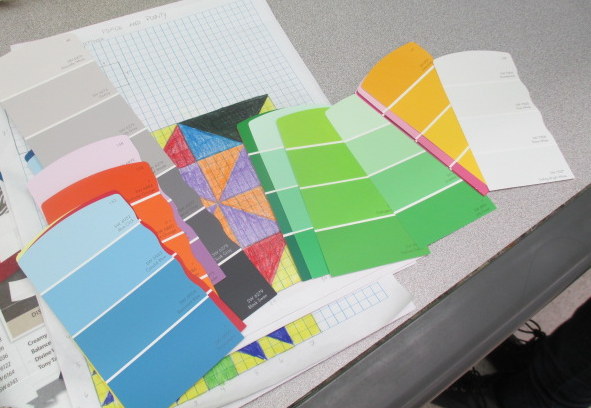
The more exciting part of creating the barn quilts was picking out the colors and painting with them.


There were so many choices that it was difficult to make a decision sometimes.


Each of the seven barn quilt patterns were graphed out using different measurements. They were either done on 6-inch, 8-inch, or 12-inch scales.


The first barn quilt we worked on, Log Cabin, was done on a 6-inch scale. This meant that we had to figure out the design first on graph paper with each block representing a 6-inch square.

Then we transferred the design to the large sheets of primed signboard. We used string that was taped down on both sides and a three-foot ruler to make the lines.


Early in the project, Olivia was interviewed by Mary Divine of the St. Paul Pioneer Press.


She did a phone interview with her first on May 5th and then a face-to-face interview on May 12th. Mary was able to observe Olivia, Sophia, and other volunteers while they worked on the Log Cabin barn quilt.


One of the challenges was keeping all the paint colors straight - especially the yellows which are very close in shade.


This project was a great intergenerational activity. For this barn quilt, there were volunteers who ranged in age from 8-86 years old.


It also was a great way to learn from people who had skills that we didn't have - like woodworking.


The Washington County Barn Quilt Trail had a photographer who came out on a very cold day - 45 degrees! - to photograph Olivia and Sophia at work. We couldn't paint that day because it was so cold, so we ended up sanding wood filler where we had screwed the framework into the barn quilt.


Our hands were so cold!


The next time we painted - just a few days later - it was at least 20 degrees warmer. It made such a difference to be painting in nice weather.


Each of the sections that needed to be painted had to be taped off. The tape remained on the barn quilt until at least three - sometimes up to six - coats of paint were applied and dried.


On the last day of doing "Log Cabin," we screwed together the two big pieces of wood. The wood was either slightly off and/or had warped during the few weeks we had been working on it. So, we had to quickly fill a rather large gap with wood filler, sand it, and paint it before installing it later that afternoon.


While the paint was drying, Olivia and Dan measured the barn to find the center of it.


Around 6:00 p.m., more volunteers came to lift the 100+ pound barn quilt up and onto the 2x4 that would stay in place until the six-inch lag bolts were holding the barn quilt to the barn.


We were all a bit nervous as the barn quilt made its way up since it was so heavy and awkward. Everyone had worked so hard on it that we didn't want to see it fall to the ground.


Not to worry. It finally was in place and resting on the 2x4.


The six-inch lag bolts were put through the quilt and into the barn's huge beams.


Everyone was so happy with how it looked when it was up. It was about 7:30 p.m. by the time it was done - 1 1/2 hours after the process was started.


A couple days later, we went back on a sunny day to look at the barn quilt. It stands out and complements Gammelgarden Museum quite well. The colors tie into the buildings which make the barn quilt all that much more special and relevant to the museum.


This was a fun barn quilt to begin with. It was complicated, but not overly so compared to some other ones that we did with this project.


Olivia (the creator of the Barn Quilt Trail) and Lynne (the director of Gammelgarden) are both very pleased with how the Log Cabin barn quilt turned out, and are excited that it was done in time for Gammelgarden's opening event on the Sunday of Memorial Day weekend.