Monday, October 19, 2015

Nature Goals for 2015 - Update

Now that three-fourths of 2015 has passed, I wanted to check in on my nature goals that I set for myself.

1. Visit three new national wildlife refuges in Louisiana, Mississippi, and/or Arkansas. ACCOMPLISHED!

- Delta National National Wildlife Refuge in Venice, Louisiana.This NWR is near the very end of the Mississippi River.


The river is very wide at this point and has clearly picked up a lot of sediment along the way.


There is a bench and some informational placards to describe the significance of the area. This actual location did not have a lot of visible wildlife.


However, there's another nearby road that leads to the southeastern most point of Louisiana and that had significantly more birds and waterfowl that were visible from the road. I pulled over many times (as did others) to watch the wildlife - or, in the case of local people, do some fishing.

- Bayou Sauvage National Wildlife Refuge in Lacombe, Louisiana. This NWR spans a large amount of space and can best be seen by driving through it on a couple of paved roads. There is a small stop that has a wooden boardwalk/pathway that leads into the bayou.


The sounds of ducks and birds swimming in the water and hiding in the reeds is constant.


There was some vegetation that I had never seen before - like the tree pictured below with brown seed pods. The pods were dry and would rattle. I'm not sure what type of tree it is and could not find it on the internet.


Perhaps my favorite part of the walk was coming across this little tree frog that was nestled in a reed. The reed looked like bamboo, so I wanted to take a closer look. I was pleasantly surprised when I looked inside it and spotted this little green face looking back at me.


- Yazoo National Wildlife Refuge in Hollandale, Mississippi.This NWR wasn't on my list of places to see, yet it was on my way to Greenville, Mississippi where I was spending the night. I thought I'd take a brief detour to see it, and am happy that I did.


Although it was a bit early in the season, there was a monarch waystation at the NWR. It is an enclosed area with a few benches, trees, and variety of plants. The plants - or where they will be - are all marked with signs. There was a little area with water for the butterflies and other wildlife that visit the garden.


Along one of the roads, there was an area of slough. In the Little House books, Laura Ingalls Wilder mentions areas that were slough, but I had no point of reference since I had never slough before. Now, having visited Yazoo NWR, I know to what she was referring.


There is quite a diversity of landscape within the NWR. The picture above is right across from a wooded area pictured below.


2. Visit three new national historic parks in Louisiana, Mississippi, and/or Arkansas. ACCOMPLISHED!

I was able to see three historical parks, sites, or parkways while in Louisiana and Mississippi:

- Audubon State Historic Site in St. Francisville, Louisiana. This was on my must-see list and, thankfully, I arrived in time to go on a house tour and see the grounds.


The Oakley Plantation is where John James Audubon lived for four months. Yet, during that brief time he painted 32 of his bird pictures here.


The grounds had pathways that led through open and wooded areas.


There were old buildings where people were demonstrating what life was like back in the 1800s.


The displays showed items typical of that time period as well.


The main pathway leading from the interpretive center to house was once a carriage road.


Leading to and from the house, the paved road for cars goes under beautiful old trees.


- Natchez Trace Parkway in Natchez, Mississippi. I didn't take many pictures of the parkway since much of it looked like the photograph below. Although the entire parkway is 444 miles long, I was only on it for a small segment.


Nonetheless, it was a beautiful drive and I enjoyed the break from driving on the freeway.

According to the National Park Sevice, "The Natchez Trace Parkway forms an almost continuous greenway, or transect, from the southern Appalachian foothills of Tennessee to the loess soil bluffs of the lower Mississippi River.

"Over its length it crosses four ecosystem provinces, eight major watersheds, and twelve physiographic regions. Forest types range generally from oak-beech in the far south, to oak-pine mixes covering the vast middle section, to oak-hickory dominating in the north.

"Habitats represented within the park are diverse and include: streams, lakes, swamps, riparian woodlands, bottomland hardwood forests, upland hardwood forests, pine and mixed hardwood forests, prairie, fallow fields, and agricultural croplands."

If I ever have the chance, it would be interesting to drive the entire Natchez Trace Parkway.

- Vicksburg National Military Park in Vicksburg, Mississippi.It was raining on the day I visited this park, but I still left the car at some spots and explored different historical points and monuments.


It is a 16-mile, self-guided car tour through the park which is quite large - much larger than I thought. The road passes by many monuments that are tributes to soldiers who fought and/or lost their lives in the battle at Vicksburg.


The land was rolling in parts and forested in others, with deep trenches in many parts.


There were beautiful, pink blossoms on trees. This picture below doesn't do justice to how vibrant the blossoms were against the dark tree bark.


I was surprised at how much diversity there was in the land in terms of hills and ravines. For some reason, I pictured battlefields more level. The images I always saw in textbooks were of flat battlefields - nothing like what is pictured below.


The visits to these historical parks provided a completely different and much more engaging view of American history. I'm so happy that I went to each one of them.

3. Visit six new state parks in Minnesota as a family, and take the dogs with us as we explore new trails (St. Croix, Afton, Fort Snelling, Minnesota Valley, Frontenac, and Forestville/Mystery Cave). IN PROGRESS - 1/6 DONE

We visited St. Croix State Park in Hinckley twice this year - once in June when Sophia and Olivia went camping there through 4-H; and then again in September when our 4-H Photography Club had its first meeting there.


I brought the dogs while the girls participated in the club.


It was a  beautiful day with a lovely blue sky accented with fluffy white clouds. Depending on what section of the trails I walked, sometimes the trees were sparse...


and other times quite dense.


There must have been a rather strong storm some time ago because there were a lot of dead trees. Some were standing, providing great places for birds and raptors to perch.


When I came back from the walk with the dogs, they were excited to have their pictures taken by some of the 4-Hers. 


I'm looking forward to exploring five more state parks. Hopefully I'll be able to do this during the next few months.

4. Visit two new national wildlife refuges in Minnesota (Sherburne and Upper Mississippi) as a family, and take the dogs with us as we explore new trails.

I have not done this yet.

5. Identify and journal three new birds. IN PROGRESS

On my trip to Louisiana, Mississippi, and Arkansas I saw four birds that I have never seen before:

- Boat-tailed Grackle in Venice, Louisiana.


- Northern Mockingbird in Vicksburg, Mississippi.


- Black Vulture in between Vicksburg and Greenville, Mississippi. I didn't get a picture of this type of bird because I was driving. There were about a half dozen of the black vultures in the median.

I also saw a vulture on the side of the road driving from Vicksburg back to New Orleans. Since there were no cars behind me, I stopped on the side of the road. The vulture just looked at me - much like the bird pictured below - and didn't move from the carrion. It was not going to give up its meal.


- Double-crested Cormorant at Lake Chicot, Arkansas as well as in northeastern Louisiana.


I have photographed the birds, but not completed entries in my nature journal because I want to include pictures of them.

6. Identify and journal three new types of wildlife. IN PROGRESS.

On my trip to Louisiana, Mississippi, and Arkansas I saw three new types of wildlife that I have never seen before. I have photographed them and want to include pictures of some of them in my nature journal. So journaling will have to wait until I return to Minnesota.

- Nine-banded Armadillo in Greenville, Mississippi. (Unfortunately, the armadillo was road kill, but I was able to it up close.) Rather than show what I saw, I found a picture of a living armadillo.


- Brown Anole in St. Francisville, Mississippi.


- Eastern Carpenter Bee in St. Francisville, Mississippi. The bees that were visiting these flowers were huge - way beyond anything I have ever seen. They were focused on flying from flower to flower and didn't seem aggressive or bothered that I was so close to them. It gave me plenty of time to enjoy seeing a bee that does not live in Minnesota.


7. Take 12 hikes throughout the year. ACCOMPLISHED

- Hiked briefly at Leroy Percy State Park on Saturday, March 21st. The rutted, muddy road that is pictured below was next to the sign for the state park.

As I drove for probably a good mile on it, sure the car would get stuck the mud, I turned around when I came to a gate to the right hand side indicating this road was not the road to the park, but rather would be the next road over.


No one was at the welcome gate or at the visitors center, so I drove around a bit to see if there were any trails. I didn't see any which is quite different from state parks in Minnesota.

I ended up driving to a section where there were cabins and parking at one where no one was staying. The cabins all were along this river that was clearly flooded.


The ground around the river was very saturated.


Many of the trees were submerged in a couple of feet of water. Since it was raining, I didn't spend too much time outside. It was, nonetheless, nice to get out of the car and walk around a bit.

- Took an extraordinarily brief walk through Winterville Mounds State Park on Sunday, March 22nd. Due to the torrential rain and super-saturated grounds, it was not conducive to a pleasurable hike. Yet, I wanted to go to this park because of its historical significance.


The mounds were build by prehistoric Native Americans and the mounds range in height from between 1-2 stories tall.


There were no large animals used for work at the time, so the mounds were all built by hand. The Native Americans took buckets of soil, brought them to the mound, stomped it down, and then repeated the process. 

- Hiked at Lake Chicot State Park on Sunday, March 22nd. The lake is 22 miles long and 1 mile wide. Is is shaped almost like a crescent moon or the letter "c."


The trail that they had at this state park was partially submerged in areas due to all the rain that this area of the state has been receiving.


Eventually, I came to a path that someone made using logs. The first and middle parts were rather secure in the mud. However, the last few logs still had some movement in them, thus the intention of keeping one's shoes dry did not work.


Despite the water-logged path, it was well worth the time spent. All around were countless birds singing - many of which I had never heard before. Periodically, the red-winged blackbird would chime in - a familiar - and welcomed sound in the spring in Minnesota!

My fourth hike was to Franconia Sculpture Park near Taylors Falls on April 30th. The prairie areas (between the grass pathways) were burned or mowed, so there wasn't too much to see in terms of nature.


However, we enjoyed walking around taking a look at the sculptures and spending time on them.


The sky was a beautiful shade of blue.


The next hike I did was on May 9th at William O'Brien State Park. Again, we were with the 4-H Club, except this time it was a smaller group.


It seems like whenever we go, the kids always gravitate to the large rock to sit on.


I like this path because it is level and winds through beautiful trees that provide a canopy over one's head.


At the end of the walk along the St. Croix River, there's a section that you can climb down and explore the water, beach, and little waterfall that tumbles over a creek bed.


It was starting to get dark by the times the kids were done playing in the water and on the beach.


The next walk I took was only a few days later - on May 14th - when our 4-H club went on a short hike around Koi Acres. Because it was raining, we didn't spend too much time outdoors.

We did have plenty of time, though, to enjoy the waterfalls leading to the pond.


The walkways were made from stone and stood high enough out of the water so our feet didn't get wet.


The koi were swimming around the pond - their beautiful colors so breath-taking in the water.


The colors were so bright compared to the overcast day.


The fish were so inquisitive - wanting to get as close as possible to us as we stood by the edge of the pond.


I'm starting to think that the only time I take hikes is with our 4-H club because the next one that I did was a 5K race at Wild River State Park. 


I had no interest in running the race. Rather, we took our time enjoying the natural scenery.


We saw woods and open prairie.


In the afternoon, there was a rainbow. The unusual thing about it was that it horizontally rather than in an arch-shape. Nonetheless, it was beautiful and I was so happy that we were outdoors to see it.


For the eighth walk, I went back to William O'Brien State Park with my friend, Chris, who was visiting from Arizona. We took a Nordic Walking class on June 13th.


We went on trails that I had never been on before at the state park, so that was a fun experience.


I'm not sure if I would do Nordic Walking again - although it was a great workout. Since I like to take pictures, having the poles attached to my wrists made it more cumbersome to take photos than I would have preferred.

The ninth walk was at Natura Farms in Marine on St. Croix on Thursday, June 26th. We took a tour around the organic farm that was near a lake.


We saw a variety of berries and fruit growing - many kinds I had never heard of or seen growing before.


We saw natural ways of pest control which made me wonder if we would have similar success with the fruit trees at our farm.


I took a very short hike at Big Marine Park (which is a county-owned and operated park) in Marine on St. Croix. It was eerily quiet near the water since there was some sort of sickness that could be spread by the algae on lakes.

The park was treating the lake, but it was still not one that you wanted to go into. Of course, even with a warning, Sophia and Olivia as well as some of the other 4-Hers we were with had reached the dock before the adults arrived and had already put their feet in the water. With a lake as beautiful as Big Marine, I can see why it was tempting to do that.


The 11th hike I took was in Osceola at the Ridgeview Trail - Chisago Loop on July 3rd. I've done the Osceola Loop and wanted to see what this one was like. It started out beautifully with winding paths.


However, the deeper I got into the woods, the worse the mosquitoes were as they would fly in droves - literally - to any exposed skin. Trying to get photos was difficult because the minute I took my hands out of my jacket pocket, they were covered with mosquitoes.


I continued walking through the woods and came to an open area which had slightly fewer bugs. The trail description said that there would be spectacular views of the St. Croix River. I never saw them.


Perhaps I had to go further on the trail...who knows. What I did know was that I didn't have a water bottle, no one knew where I was, and phone service on my cell phone was non-existent. It was clearly time to turn around.


On the way back, I saw some things I didn't see before - like a partially-moss-covered rock. 

The 12th hike was at St. Croix State Park in Hinckley on Satuday, September 13th. Sophia and Olivia were doing the 4-H Photo Club and I took the dogs for a walk. There were nice, paved trails.


Along the trails there were many fall-blooming flowers. It was a great day for a hike.


The 13th hike was at Pleasant Valley Orchard on Thursday, September 17th. After taking a tour of the orchard and the behind-the-scenes operation, we headed out on a nature hike.


We walked past the rows of apples and onto the trail.


Because of the amount of rain that we had been receiving, creeks were swollen and flowing quite rapidly.


The pond was filled and was already showing the change of seasons.


There were beautiful, bright red berries and the sumac was also in full color.


The 14th-17th hikes were all at William O'Brien State Park on Thursday and Friday, September 24-25th. The first hike was just Sophia, Olivia, and me exploring an unmarked trail that high a steep incline and then followed the perimeter of Lake Alice (pictured below). 


Lake Alice was full of weeds like we've never seen before. Not sure why it was like this and if it is indicating some type of issue with the lake.


We were fortunate to see over 30 geese fly in and land in Lake Alice. This is one of the flocks that came in - two more smaller groups joined it.


After we ate lunch, we were joined by another family and we walked along the river. We saw some unusual plant life.


The rocks - as usual - are always so eye-catching to me.


Because we were walking with young children, it seemed like I was noticing smaller things that were closer to the ground - like mushrooms. Never realized how many different types there were along the trail.


We stopped at the end of the trail and spent time tossing rocks into the river.


It was a serene afternoon - despite the light rain.


In the late afternoon, we went on another hike with a different family. We explored another trail and I went on one section that I had never been on before. So - two new trails in one day!

We saw unusual-looking berries. Later found out they are poisonous.


On Friday morning, we went along the St. Croix River again. It's interesting how when hiking with different people you see different things. Today we were more focused on the rocks.


I enjoyed seeing the clouds reflected in the water around the rocks as well as the seeing the kids stand on the rocks. Moments before this photo was taken, it was a bit chaotic as they each tried to find a rock to stand upon.


On the way back from the hike, I spotted this beautiful red and white mushroom. How did I miss this the day before?


The kids also had fun sliding down the rock. It is a very smooth rock - and unless you are sitting on the top, you are prone to slide down.


The 18th hike I took was to Franconia Sculpture Park on Saturday, October 10th. Five months ago, I was here with the 4-H Club, and here I am visiting again with them (although a different group of people).

As the youth were taking photos as part of the Photo Club, I walked around with them. There were tiny pine cones on some of the trees.


Milkweed seeds were scattered on the grass.


The prairie areas that were mowed or burned back in April were now filled with beautiful flowers and grasses.


There were new sculptures to see.


There always seems to be something new to see that I didn't see on a previous visit.


With this goal, I am doing well. I didn't realize how much hiking I do throughout the year. I like the combination of visiting new places as well as seeing the same places within the year and noting the changes in the landscape.

8. Visit 6 nature centers at the state parks and wildlife refuges. IN PROGRESS - 2/6 DONE

None of the wildlife refuges that I visited in Louisiana and Mississippi had nature centers. Rather, they had outdoors displays with information about wildlife typical to the area.

Lake Chicot State Park in Arkansas had a nature center that I visited and learned quite a bit at about the largest lake in Arkansas, some of the wildlife in the area, and the historical significance of the area.

Saw an alligator, though it made me sad that it was in such a small aquarium.


There was a display on the wall with different patches of fur. You could touch the fur and then try to figure out which animal it belonged to using the images on the wall to help.


There was information a bout the Mississippi Flyway - something that the 4-H Wildlife Project Bowl team I am coaching has been learning about over the past few months.


On May 9th, I visited the nature center at William O'Brien State Park.


What was fun about seeing this nature center again was that some of the things that we had studied about during the Wildlife Project Bowl were on display there. I kept thinking, "Hey! I know that!" So, the Wildlife Project Bowl - however overwhelming at times - was well worth the time.

9. Post a nature photo each week based on the Nature Photo of the Week Prompt List. IN PROGRESS.

I wrote about the first 12 weeks of the challenge HERE. Have continued to do the weekly photos and am currently on Week 41. I'm posting photos each Friday and am coming almost to the end of the prompt list. Now with increasingly limited choices, I will have to be more intentional with trying to find something in nature that fits the prompt of the week.

10. Do nature studies at least three out of four weeks of each month (36 entries) both online and in my journal.

Not doing so well on this goal. In fact, haven't done anything at all with this goal. It just seems so overwhelming at this time to go back and try to do this. I may have to let this goal go for this year.

11. Try 2 new outdoor sports. IN PROGRESS - 1/2 DONE

I tried Nordic Walking in June when my friend, Chris, was visiting from Arizona. There are pictures above of the experience.

12. Have 6 picnics when the weather is pleasant and we aren't battling with mosquitoes. IN PROGRESS - 4/6 DONE

April 30th marked the first picnic of the season with our 4-H club at Franconia Sculpture Park.


It was a beautiful day - sunny and clear...and we didn't need to wear jackets which was nice. Quite a change from the previous year when we had snow well into May.

The next time we intended to have a picnic was on May 9th. When we arrived at William O'Brien State Park it was a little too chilly for the kids to be outside, so we ended up eating in the visitors' center.


We were able to go on a walk along the river, though, which we all enjoyed.

About a month later, on Thursday, June 26th, we went with some families from our 4-H club to Big Marine Park for a picnic. It was a gorgeous day for a picnic in the shade.


After lunch, the kids played on the playground. It was a bit hot in the sun, so we headed out within an hour so they wouldn't all get overheated.

On Thursday, September 24th, we had a potluck picnic when we went camping at William O'Brien State Park with another family from our 4-H club. We had a great dinner - and I introduced them to the way that my dad used to roast marshmallows.
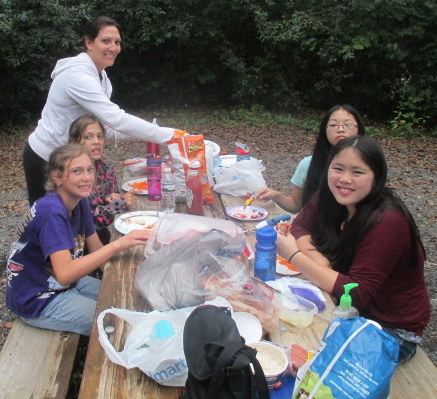


He would roast one until it was golden brown and then ever-so-gently remove the toasted "shell." Then he would re-roast the inner portion of the marshmallow for another treat.

There's still time to have two more picnics with some warm weather this week. Maybe Sophia, Olivia, and I can have a picnic in our backyard with the picnic table from my parents' home.

My mom used to love picnics...even if it was in the backyard. Of course, having a view of the lake made it seem like a vacation spot in many ways. I'll miss being able to see the lake.

13. Go camping twice during the year at new state parks. IN PROGRESS 

We went camping, but it was at William O'Brien State Park - a park where we have camped before. Nonetheless, we had a great time and introduced another family to camping and camper cabins.


The camper cabin is one out of three that are in a circle at William O'Brien. There's another camper cabin in the adjacent campground. This section is a bit more quiet and private.

We made a fire in the fire pit which is always a highlight of camping.


This time we didn't monkey around with food. Hot dogs it was. Simple. Easy. No-fail. Not like some of the other disasters we've tried to make on an open fire.


We hot a potluck picnic followed by s'mores and roasted marshmallows for dessert.


After dinner, the girls played Wild Animalopoly.


The camper cabin is such a good fit for what I enjoy about camping - without all the hassle of setting up a tent. I also feel so much safer in a camper cabin versus a tent...especially after the bear incident in Grand Marais.


I'm not sure if there's time left to go camping this year. The water is shut off at some campgrounds in preparation for winter. Perhaps there's another option.

14. Learn 3 new outdoor skills and/or hobbies.

Nothing new learned here yet. Other activities have taken my time.

15. Attend 4 workshops, classes, or activities at state parks.

I did a 5K walk at Wild River State Park in June (photos are above) and a Nordic Walking class at William O'Brien State Park in June (photos also are above).

There are some classes offered at the state parks during November and December. Perhaps I can find two that would work with my schedule and that are of interest.

Sunday, October 18, 2015

Healing Your Holiday Grief - Read 52 Books in 52 Weeks - Week 42

As the holidays approach, this will be the first one without both my dad and mom. My dad died on January 5, 2012, and my mom died on August 15, 2015. I found a book at the library called Healing Your Holiday Grief - 101 Practical Ideas for Blending Mourning and Celebration During the Holiday Season by Alan D. Wolfelt.


Some of the recommendations that will be helpful for me going into the holiday season include:
- Give yourself a rest break today. Lay down for at least 20 minutes during the afternoon and relax. Sleep if sleep comes.
- Simplify your holiday rituals instead of abandoning them altogether. Keep the traditions that matter most to you and set the others aside, at least for now.
- Where do you feel most spiritually-connected to the person who died? Go there today and feel her/his presence.
- If you keep yourself too busy during the holidays, you may leave yourself no time to work on the critical need of mourning. Don't overschedule and don't try to "keep busy" simply to avoid the pain.
- Think about the earliest memories of holidays spent with the person who died. Do you have photographs from those years? If so, get them out and spend some time cherishing them today.
- The holidays are a time to take stock of our lives and give thanks for all that is good in them.
- Which holiday tasks were normally handled by the person who died? If you make a list, you'll probably find that some are more essential tasks than others.
- As you schedule your days and weeks, block out generous periods of time for rest and renewal. Your grief will likely make you feel tired and you'll nee extra rest.
- During your alone time, take long walks, meditate, pray - do whatever helps you nurture yourself during this naturally difficult time.
- Plan to spend time with your family this holiday season. Rekindle old traditions. Renew old relationships.
- Instead of concentrating on everything you have to do during the holidays, concentrate on whom you are doing it for. Who do you care about and what would truly be meaningful to them?
- Focus on the people, not the production of it all.
- This year, instead of making a holiday gift list, make a holiday relationship list. Write down the names of the special people in your life and next to each name, write something you can do for or with that person that will strengthen your relationship.
- If you are sending holiday cards, include special, individualized notes to everyone you can think of who is grieving this death. Writing the notes will help you mourn and reading the notes will help the recipients heal, too.
- Tell someone a holiday memory o the person who died. Use her/his name and relate as many details as you can remember.
- Buy yourself new bedding a good new pillow.
- Get ready for bed right after dinner. Take your phone off the hook, bathe or shower, listen to soothing music, sip hot herbal tea in bed as you read a good book or favorite magazine.
- Make a list of things you most and least enjoy during the holidays. Make time for the things you enjoy and abandon those you don't.
- Shop somewhere you usually don't. Browse through an antique shop or flea market. Visit an art gallery. Drive to the mall two towns over.
- Pile up mail-order catalogs next to a comfortable chair and spend all day lingering over each and every one.
- If you tend to buy things to fill some emotional need, don't go shopping. Instead, make a list of everything you've purchased in the last six months. Then consider how you feel about those purchases today.
- Ask yourself: Do I feel like giving presents or do I feel like I have to give presents? If the latter, tell your friends an family that you're not up to gift-giving this year and ask that they honor your feelings by not giving you gifts either. With the possible exception of gifts to children, it's OK to skip gift-giving this year.
- Knit, sculpt, paint, write, or cook - whatever medium moves you - for gifts.
- Using cloth from clothing that belonged to the person who died, make throw pillows, quilts, or cuddly bears. These huggable keepsakes are a tangible link to the person who died.
- Tell your friends an family that in lieu of gifts this holiday, you'd like them to write down special memories of the person who died. These notes or letter will become mementos your family will treasure forever.
- Read a poem or a short spiritual piece in memory of the person who died at the holiday table.
- Spend some time listening to your favorite holiday tunes.
- Ways to renew yourself: massage, hike through a forest, go for a drive with no particular destination in mind, go see a movie, get together for lunch with a friend, or go for a long walk.
- Place a single flower in a vase on the table in memory an honor of the person who died.
- Frame small photos of those who have died and use them as part of your holiday centerpiece.
- Choose a special candle in memory of the person who died. Select a large candle that will last for several holiday seasons.
- Bring flowers to the cemetery.
- Spend an afternoon doing something that was meaningful to the person who died.
- Find a holiday memento that belonged to or reminds you of the person who died. During the holidays, display it somewhere you'll see it everyday.
- Go through photos and holiday memorabilia and gather up everything that belonged to or reminds you of the person who died. Photos of him/her during the holidays are particularly nice.
- Place all the photos and trinkets in a special album. You might also write captions describing the circumstances of each item. When it's finished, display the album somewhere everyone can see it. One of your new traditions can be rediscovering the album each holiday season an reminiscing together.
- Decorate your holiday tree with ornaments, keepsakes, and photos of the person who died.
- Holidays are a time of introspection - a time in which we think about what's truly important to us and what gives our lives meaning.
- Plan an early morning breakfast or walk in a location where you can see the sun rise. Have hot chocolate, rolls, and fresh fruit next to a lake.  Make a sunrise ceremony one of your new holiday traditions.
- Watch the stars on a clear evening.
- Plan something you enjoy doing every day - reading, baking, going for a walk - whatever brings you enjoyment.
- Think about what gives your life meaning and what doesn't. Take steps to spend more of your time on the former and less on the latter.
- Do something childish - blow bubbles, go sledding, make a snowman, visit a toy store, or climb a tree.
- What did the person who died love to do? Start a new tradition of doing that thing.
- Shop for small gifts you can give anonymously throughout the holidays. Groceries or meals might be appropriate for those in need. Write notes to accompany the gifts. Tell the recipients how wonderful they are.
- Light therapy is an effective treatment for SAD sufferers. Spend 20 minutes outside each day outside may do the trick.
- Whether or not you usually send holiday cards, plan to do so this year if you have the energy. Thank those who helped you at the time of the death and in the weeks after. Write personalized notes and enclosed them in a holiday card. Include a photo of the person who died and a copy of the obituary.
- What were the favorite holiday foods of the person who died? Continue to prepare and enjoy them as a family to keep their memory alive.
- Write a note to a special someone telling her/him how blessed you feel to have her/him in your life.
- Make a list of short-term goals for the next three months. Include some that relate to mourning (e.g., make a memory book).
- Make a list of long-term goals for the next year. Be both realistic and compassionate with yourself as you consider what's feasible and feels good and what will only add too much stress to your life.
- Rid yourself of some of the tasks and commitments you have so you can take time to mourn and heal.

Friday, October 16, 2015

Nature Photo of the Week - Week 41 - Sunshine

For the 41st Nature Photo of the Week theme, "Sunshine," I chose flowers that reminded me of sunshine and the sun.


These flowers were at Franconia Sculpture Park along the trail that goes through the park and leads to various sculptures.

Our 4-H Photography Club met again this month and spent about 1 1/2 hours walking through the park. Between taking photographs of the sculptures, I enjoyed looking at the natural areas of the park - seeing milkweed seeds on the grass pathways, sections of prairie, and a beautiful, clear sky.

We have been very fortunate these past two meetings to have such lovely days to spend outdoors taking photos. I am grateful for the parent who is leading these sessions. If they weren't set up, chances are we would not have been out exploring the sculpture park on this particular afternoon. I would have missed all the beautiful things I saw...plus the always-changing fall leaves which are in full splendor right now.

Sunday, October 11, 2015

Grieving the Death of a Mother - Read 52 Books in 52 Weeks - Week 41

I miss being someone’s daughter…
So now I go through life with one less person keeping an eye on me, 
one less person loving me. 
- Joyce Maynard

Last week, I wrote that my mother had died on August 15th. Shortly after her death, I ordered quite a few books from the library. I'm finally getting around to reading them in their entirety.

The almost-two months have been filled with daily activities related to her death: planning and having her visitation, funeral and burial; packing up her and my dad's home of 41 years; making home improvements to ready their home for sale; writing thank you notes to people who helped with the funeral and/or made gifts in her memory; and so on.

This is on top of trying to homeschool, lead a 4-H club, and maintain a home. Nothing in any of those areas is perfect or how I would like them to be in an ideal world.

These aren't ideal circumstances, though. What I am able to do is my best given what has happened.

At any rate, the book I was able to read this past week is called Grieving the Death of a Mother by by Harold Smith. This is for Week 41 in the Read 52 Books in 52 Weeks challenge. I found this book to be equally as valuable as the one that I read last week. This one, though, had an interesting theme in that it was focused specifically on the death of a mother. (I would be interested in reading a book about how to deal with the death of a father...although that happened for me in January 2012...four years this coming January.)


Below are some points in the book that resonated with me:
- A mother’s last breath inevitably changes us. Motherlessness can be paralyzing or it can be empowering.
- The one we would have turned to is no longer there to comfort us.
- A mother might not have known what to say or do, but she would have listened to the end of our sentences, even the ones that rambled incoherently.
- Grievers are reminded of their loss by the birthday card not received or sent; a present not given or received; a missed regular phone call.
- I miss my mom’s house. I miss home. I miss my bedroom. I miss the closet filled with childhood toys and memorabilia.
- Do these two young teens have any idea how much they will eventually miss such moments with their mother? Can anyone comprehend this before her death? I want to whisper: “Guys, pay attention. Look at your mother. Listen to her. Memorize the moment. Someday this memory will comfort you – or confront you.”
- Now, no one worries about me. After all I am big [girl]. The world is scarier without a mom actively worrying and aggressively praying.
- I miss her listening to my stories. Some stories get told (or I tell the short version) because no one listens as thoroughly as a mother does.
- After the initial mourning period has worn off – about thirty days – rarely does anyone say, “Tell me about your mother.”
- The death of a mother creates a demanding learning curve.
- Things look different after you have buried your mother, after this shadow shines across your path and across your memories.
- Amazingly, your brain logs in the fact that your mother’s death, but it takes a long time for your heart to absorb the reality.

 “I’ll never forget my experience in 1947. 
So you may well know that my sympathy is heartfelt. 
There is no supporter like your mother. 
Right or wrong from her viewpoint you are always right. 
She may scold you for little things, but never for the big ones."
- Harry Truman's note to Dean Archison, 
who had served as secretary of state, 
upon the death of Archison’s mother

- Your mother’s death affects you regardless of the status of your relationship at the time of death. In ways apparent and not so apparent, motherloss shapes you.
- “Betty had been the most important person in her son’s life – the person who had advised him, admired him, believed in him, encouraged him, protected him against enemies. No one else…could fill those roles.” (in reference to Andrew Jackson’s mother, Elizabeth Jackson)
- Victoria Alexander believed that every griever has three needs: to find the words for the loss, to say the words aloud, and to know that the words have been heard.

With human relationships, nothing is ever final. 
- Laura Davis

- Death was the only way her suffering could end.
- I had hoped for a nap but was too agitated. Later as I showered I reminded myself that “the show must go on.” So, I just flipped a switch and did my thing. We all have to flip that switch at some point, just to make it through.

You lose your history, your sense of connection to the past. 
You also lose the final buffer between you and death. 
Even if you’re an adult, it’s weird to be orphaned. 
- Therese Rando

- We rejoiced that Mom no longer suffered, and we grieved that she was gone from us.
- She faded as a photograph fades if it is left in too sunny a place, until only the dim outlines of personality remained.
- Part of a son’s or daughter’s stress is witnessing the vulnerability of a mother in the last days.
- I aged that morning. I felt older, alone, abandoned. Never have I felt so alone. I had wanted to be there for her and I wasn’t.

But at any age, the loss of a mother is a special bereavement. 
To be cut off from the one who bore us, 
nourished us and taught us the first and deepest lessons of life, 
leaves us lonely in a way no other deprivation can. 
- F.J. Bowman to Harry S. Truman

- The fraternity of the bereaved is perhaps the oldest fellowship of humankind. Within the fellowship cluster those who wear the badge of particular loss – who speak a language never chosen and learned in pain and tears. One such cluster of the fellowship is those who become orphans – children without parents – regardless of chronological age. On [August 15th, my sister, brother, and I] became members of that fellowship – mid-life orphans, receiving the mantle of full adulthood, bearing the title of the older generation of our family. (Adapted from Kay Collier-Slone’s quote)
- Grieving is the constellation of internal thoughts and feelings we have when a mother dies. Mourning, on the other hand, is the outward expression of our grief.. Grief is what we feel; mourning is what we express.

My mother and I shared so many things….
In fact, my mom taught me everything – 
except how to live without her. 
I was 43 when she died, and I was devastated. 
- Darcie Sims

- You do not delay mourning for a mother by avoiding it or by throwing yourself into your work; rather, you delay reconciliation with the loss.
- Mourning for a mother can be difficult to explain to a supervisor or colleagues who have never been touched by motherloss or who has a strained relationship with a mother.
- Here before my eyes and at my fingertips was the residue of someone’s entire life, the record of a human existence. A mother’s death forces a son or daughter to deal with her possessions. Whether furniture, art work, or even fabric that she was going to use “some day,” collectibles, clothes, the good china – a decision must be made about all of it.
- The work of discarding and saving, boxing and bagging, trashing and storing can be heart-taxing work.
- Each object seemed to tell its own story, or was somehow a part of her story. I had to pick and choose. For some, the cleaning out, keeping, and throwing away is too final. Who wants to dump their mother’s “things” into garbage bags?
- We talked about new traditions for old treasures
- The box stayed unopened and inside the front door of my home for months. As I came and went I reminded myself that I should unpack it. But to take out the objects would add a note of finality that I wanted to evade – they belonged in my mother’s house.
- Irreverence…is a valid way of coping with the stress of making funeral arrangements.
- Viewing a mother in a casket can be a collision with reality.
- Few children forget the day of their mother’s funeral.

There was no longer anyone who would 
ever again claim me as their child. 
No longer was anyone living who had been present at my birth, 
who had witnessed my first steps, 
heard my first words, 
walked me to my first day of school, or 
paced the floor, nervously, the first time I borrowed the family car. 
No one knew the details of my life and 
my family’s history. 
I was no longer anyone’s child. 
-Alexander Levy

- We walked through the dark, dismal rooms…..everything was gone: clothes, furniture, books. Without the familiar, the house seemed alien. I looked to the “marker” places where familiar items had been as long as I could remember. For example, the clock….missing!
- I felt sad backing down the driveway that last time. We had moved in just (months) after my eighth birthday…
- A mother’s death does not have to be recent to be felt on a holiday. Just hearing “I’ll be Home for Christmas” can challenge my emotional control. It may be “beginning to look like Christmas,” but it doesn’t feel like Christmas.
- Others found the second or third Christmas without mom more challenging: in some cases, they were numb during the first. Some feel a fresh sense of loss every Christmas.
- When she was gone, I suddenly thought, “Why am I doing this? For whom? ….I’m all dressed up, an my mother won’t see me.”
- In a large sense I turned a page in my lie when my mother passed on. I realized that all the things I was doing were simply not enough.
- I will never be the same again. For some a mother’s death turns into a “Developmental push” that “may effect a more mature stance in parentally-bereaved adults who no longer think of themselves as children.
- On the anniversaries of my parents’ death, I travel to the cemetery. There’s nothing of them there…It is a place I go to spend time with memories. I’ll sit a while and wonder about many things, especially about the strange experience o having become an orphan as an adult.
- I miss Mom, and I am finding a place for her in my life even though she is not physically present.
- Abraham Lincoln said: “All that I am, or hope to be, I owe to my angel mother.”
- For many adults, the first person you call with good news is your mother. In the great moments of life, we want to call and say, “Hey, Mom, guess what?” Now there’s no mother to call.
- Without denying any o a mother’s mistakes or negative qualities, a son or daughter can choose to stop rehearsing the wrongs, or hunt for the slightest good to remember. Grieving children have found guidance in the words of Paul, “Whatever is true, whatever is honorable, whatever is just, whatever is pure, whatever is pleasing, whatever is commendable….think about those things. (Phil. 4:8)
- Creating a cherishable memory is not unlike creating a work of art or a quilt. It requires sitting in the quiet of a beach or a park or woods and giving oneself permission, “I want to remember the time Mom…” or “I choose to remember how Mom always….”
- In the “scrapbook of our mind” there are some snapshots we put toward the front, some we place toward the back. Some pictures we choose not to include. I is, after, my album of memories.
- Part of my mourning is not “hanging out” with memories of the last years of mother’s life as dementia wreaked havoc. I am not ignoring the memories. I am not afraid to go there. I just don’t stay long if I am summoned by a particular painful memory.
- Birthdays also activate grief responses, not only because they remind us of the phone call or card that never comes but because each one we celebrate brings us closer to the neon number: the age a mother was when she died. Because we identify so strongly with our mother’s body, and because our fate was once so intertwined with hers, many of us fear that the age of physical demise will also be our own. To each the year is a milestone, to pass it becomes on o our most glorious achievements.
- For many, a memory is like a bulb that gradually dims and goes out.
- Mothers are not dead until we stop telling stories about them or repeating, often to a new generation, “My mother always said…”
- My children need to know, too, about the people of the past who have impacted their young lives, for each family is a reflection of the experiences and values of its preceding generations. Like my mother, I will tell the family stories to children who aren’t always eager to listen. And hope that when their turn comes, they will remember them.
- Memories are summoned by a scent, a smell, a taste, a touch, a word, a sound.
- Some sons and daughters indict themselves with lists o regrets and “I should have’s.” Did I visit Mom enough? When I visited, did I stay long enough? Was I patient with Mom? Could have done “more”?
- Some daughters and sons have done too much “more” and have negated their own health, jobs, and relationships.
- I fell apart when Mom died. I didn’t know what to do with myself. My whole life was organized around Mom’s care.
- I regret that I ignored my own family, including my spouse. I couldn’t do enough for Mom, which meant I didn’t do enough for my spouse. At times, I was a walking zombie. The day after we buried Mom, my spouse said, “I’ve met someone…I want a divorce.”
- Listen to “Beautiful Isle of Somewhere” – it's a song.
- I miss having someone interested in anything and everything I have to say.
- Remember your mother’s “words of wisdom.”
- No matter how we struggle to be wholly separate, no matter how far away we plant ourselves, we are destined to exist in relation to our mothers, to the very source of our lives. Our achievements are their achievements. Our failures are their failures. Our dreams are only variations of those our mothers dreamed for us. We reject their expectations, or strive to live up to them, but we live our lives forever in the shadow of theirs.
- It can be demanding to reconcile the frail woman I visited at the nursing home with the robust mother of my childhood.
- Ways to honor a mother:
o Display photos of your mother.
o Re-frame old pictures. At holidays, bring out special pictures that are holiday-related.
o Visit or revisit places your mother loved.
o Do a good deed in honor of your mother
o Watch some of your mother’s favorite movies.
o Use your mother’s china or glassware for special meals.
o Plan ways to pass on your mother’s possessions.
o Remember your mother on All Saints’ Day (November 1) or All Souls’ day (November 2).
o Save something your mother owned to pass on to grandchildren or great grandchildren.
o Refinish a piece of your mother’s furniture.
o Compile something of your mother’s” recipes, poems, or sayings.
o Plant a tree or bush in honor of your mother.
o Find a way to uniquely honor your mother on Mother’s Day.
o Complete a project your mother started.
o Donate flowers in honor of your mother to a place of worship on a Sunday nearest her birthday, anniversary, or day she died.
o Continue a tradition of your mother’s” an open house or a Fourth of July gathering, for example.
o Create something of beauty in honor o your mother. Take your mother’s clothes and make a quilt.
o Visit her grave
o Donate money or time to an organization seeking a cure for the disease that claimed your mother.
o Compose a doxology of twelve things in your mother’s life for which you are grateful.
o Write your will and end-of-life documents.
o Find a unique way to celebrate your mother’s birthday.
o Cook your mother’s favorite recipes. Make copies of the recipes to pass on to future generations.
o Pass on one of your mother’s recipes.
o On the one year anniversary of Eleanor Roosevelt’s physician’s mother, she wrote to him, “This time is sad for you, but I hope also it brings you happy memories for that is as your mother would want it to be. She would want you to feel her love and her protective presence and she would rejoice in your growth. You probably do not realize it but you have grown in personal strength and power in this past year…the 28th must have some feeling of loss but this note and the flowers are to bring you a message of love and remembrance of your Mother and gratitude to her for what she was…”
o When I die...Mom will know me. I expect to hear again, “Oh, Honey, I am so glad you have come to see me. How long can you stay?” However long I will wrestle with motherloss – the rest of my life – will seem as only a brief interlude as I answer, “Forever, Mom. Forever.”

Friday, October 9, 2015

Nature Photo of the Week - Week 40 - Arch

Yesterday, we went on a field trip with our 4-H club to the Guthrie Theater and CostumeRentals. We did a backstage tour of the Guthrie Theater which was interesting; and were able to see over 70,000 costumes at CostumeRentals (a shared facility between the Guthrie and Children's Theater).

This view is from the lobby of the Guthrie as you walk towards the main stage in the theater (there are three different stages which I didn't realize - all of varying sizes and designs).

This week's theme "Arch" for the 40th week of the Nature Photo of the Week is actually two sets of arches - one in the foreground and one in the background of the photo.


The bridges cross the Mississippi River and the lock and dam system is to the left in the picture. There's a lot going on in the photograph...but, then again, this is in the heart of the city. Lots of action and different things to look at compared to things I normally see living in the country.

Sunday, October 4, 2015

Healing Grief, Finding Peace - Read 52 Books in 52 Weeks - Week 40

On August 15th, my mom died. It has been a whirlwind of activity since her death - from planning and having her visitation, funeral, and burial; to going through her and my dad's home to get it ready to sell.


Shortly after her death, I checked out a book from the library called Healing Grief, Finding Peace - 101 Ways to Cope with the Death of Your Loved One by Dr. Louis E. LaGrand. I finally took the time today to read the book from cover to cover. There were a lot of great ideas for working through grief and honoring the memories and life of a loved one.

These are some things that I thought were interesting and relevant to what I am going through:

- Recognize that no one escapes getting into a “negative” state. It’s part of life. Yet a constant negative emotional life is unhealthy for the brain, hastens the aging process, contributes to host of degenerative diseases, and attracts more stress.
- It is healthy to look back and reminisce about your loved one, yet it is crucial that as soon as possible you spend much more time focusing on the present and directions to take for the future.
- Those who cope well and adapt to massive change have learned how to deal with the new conditions of their lives, paying more attention to the present moment. At the same time, you still build a new relationship with the person who died by learning to love in separation through memories, traditions, spirit, and in lessons learned.
- You have no power to change what happened. You have to own it as a part of your history.

Wisdom is avoiding all thoughts that weaken you. 
(Dr. Wayne Dyer)

- Will you be loss-oriented in the months and years ahead – or will you be restoration-oriented?
- Will you maintain your bitter primary focus on loss, or give more time to rebuilding? Put another way, are you going to allow the death of your loved one to define you?
- We’ve lost ourselves, are on autopilot, and long for the security of the familiar, but in reality, we ultimately have to build a new life without the many interactions that used to occur when our loved one was with us.
- Make a list of your new routines and force yourself to repeatedly make the difficult transitions.
- Redefining ourselves, that is building a new identity after the death of a loved one, is another significant task commonly forgotten in grief work.
- Grief if your response to deep love – an essential of lie. Whenever you choose to love, as we all do, you automatically choose to grieve.
- What does it mean to successfully heal from suffering the death of a loved one? The operational answer is peace of mind through radical acceptance.
- Relate to others with courtesy, respect, and humility, even as you grieve. By making an effort to relate to others this way, you’ll find yourself making repeated value-driven choices to reach this reachable goal.
- What must I do differently to reduce the pain and manage my sadness? The key word is “differently.”
- Act as you wish to be is an age-old recipe for adapting to change;

“A child’s life is like a piece of paper on which every person leaves a mark.”
Chinese proverb

- The emotionally resilient mourner is the person who doesn’t believe they can go down, that they must keep looking for the signs, seeing the gift, looking for the lesson. What have I learned and to whom have I given?
- Recognize how far you have come. When you review your day, credit yourself for where you are in your grief work. Every hour, every day is a victory.
- Review each day for the good things that happened.
- Re-encountering feelings of intense grief and crying, especially in the early months of your loss, is normal. Sometimes called “Grief attacks” these episodes are usually triggered unexpectedly.
- Take time out each day just for yourself. Make a list of the things that you want to do with this alone time that will ease your suffering or that will help you relax.
- Find a place where you enjoy being alone – a particular room in your home, a natural setting , etc.
- Solitude can balance the heavy stress you are under and raise your energy level. It is also an excellent opportunity to connect with your spiritual side and access the insight of your positive inner voice. Read something that will help you cope (e.g., poetry or verses).
- Use and develop your spiritual resources and spiritual practices.
- Beginning the day with a morning devotion.
- One of the tasks of grieving is to discover ways to express that eternal connection.
- Plant a memorial garden in the spring or tulip bulbs in November in honor of your loved one.
- Start a new tradition that honors your loved one on a birthday or other significant day.
- Write a history of your relationship with the deceased to be given to your children. Frequently use the qualities and talents the deceased admired in you or brought out in you. Some have also loved well by continuing to work toward reaching certain goals, knowing that the deceased would be so proud when they were attained.
- Have an annual church service in her/his memory.
- Light a candle in your home on special days as a visible inclusion of the loved one in the day.
- Service to others is the oldest, most effective, and most recommended copying strategy for mourners on the plant. The personal power-releasing factor it gives you is hope. Equally important, acts of kindness will keep you socially engaged at a time when you need it most. Sharing has always been an anxiety reducer.
- Focus on people. Believe that if your give to the world, the world gives back to you tenfold. Practice hospitality in the lives of others in the best way possible: giving them hope by your presence and commitment. Come to know the joy of committed service. Everyone wants to be acknowledged, valued, and celebrated.
- Give some items of clothing to Goodwill or other thrift store.
- Volunteer to visit someone at your local nursing home.
- Feed the birds.
- Give your full attention when speaking to family, friends, or strangers; you will be showing love for them.
- Make it a priority every day to be an influence in the lives of others by focusing on how you will make them feel good, and you will find another opportunity to reinvest in life.

“It is one of the beautiful compensations of this life that 
no one can sincerely try to help another 
without helping himself.” 
Ralph Waldo Emerson

- It is not unusual to have unfinished business with the loved one who died, especially if the death was unexpected.
- Find a quiet place where you can speak out loud to the deceased. This could be by the cemetery, the lake, any place.
- Rituals can be something you do every day, week, month, or year with the intent of honoring the loved one and knowing he or she will never be forgotten.
- A healthy way to release the constant focus on your loss is to incorporate a highlight to look forward to into your daily and/or weekly schedule.
- Jot down three things you will look forward to doing on each of the next three days. On the evening of the third day, write down three more for the next three days. These special highlights should not be the usual diversions, like painting or mowing the lawn, to keep busy, but ones that are at the top of your want list.
- Think of the things you want to accomplish that will lift you up, that you can think ahead about, and that will give encouragement.
- As you begin to accept your loss and eat well, your physical pain will lessen.
- Depression is a sign that we are emotionally depleted, with a sense that there is no place to go. Depression is our inability to give up the old for the new. And that is exactly what grieving is all about, giving up the way life used to be with our special person and adapting to a different life.
- Regular activities requiring your presence will be a factor in reducing or presenting long bouts of reactive depression. The key word in regular. Force yourself to develop outside interests, a project , or a service where you must be around people.
- Brisk walking will promote sleep, reduce depression, relieve neuromuscular hypertension, and decrease anxiety.
- Try green exercise: anything you do outside in nature: gardening, walking, or biking, where you can take your mind off the feeling of exercise as work and simply enjoy the beautify around you.

When you are sorrowful look again in your heart, and 
you shall see that in truth you are weeping for 
that which has been your delight. 
Kahlil Gibran

- Many guilt-ridden mourners say, “I should have….” These all reinforce unnecessary guilt. We all review our relationship with our loved one and if we had a chance to do it over, would quickly change some of the things we did or did not do. That is part of the human condition. You did what you felt you had to do at the time, given the pressures and circumstances.
- With most all of the guilt generated when mourning, you did not deliberately intend to set out to inflict pain or suffering or contribute to the circumstances surrounding the death. Few people do.
- Hold on to treasured items and collect new ones.
- Symbols are often variable keepsakes that represent something other for the mourner than just their physical appearance (e.g. cardinals).
- If any object, picture, or memento that you look at brings added sadness, then put it away or get rid of it.
- One of the ways to love in separation and establish a new relationship with the deceased is to pick out some of the characteristics of your loved one or the ways he or she helped you realize a particular goal. Model his or her giving. Focus on the good qualities and use them, even further develop them, with the intention of honoring the deceased.
- Consider buying and caring for goldfish. Again, they are alive and colorful and can reduce the sense of isolation.
- Compare the clothing you presently wear and what you wore in the past that made you feel good. If necessary, purchase a new outfit or two.
- Have a room redone in the home or paint one yourself in a new uplifting color.
- If the loss has occurred close to big holidays (within 4 months or less) you may still be experiencing some degree of shock, numbness, and disbelief. If that is the case, the effect of these significant dates may be mitigated. The following year, however, after the shock and numbness have worn off, the dates may be far more difficult for you.
- Tell family and friends specifically what you can and cannot do around the holidays.
- You don’t have to follow the exact schedule or routines of the past. Consider starting a new tradition.
- Find a way to symbolically honor your deceased loved one: have the deceased’s favorite dessert or meal, say a prayer, display or give something s/he created, place a flower in a special place at the table). Be sure to include your walking program on that particular day.
- Keep things simple and focus on the values, beliefs, joy, and wisdom of the deceased.
- Saying goodbye by talking aloud to the person who has died. Say how you feel about not being there at the time of their death. Find a quiet room in your home, place a picture or other symbol of the loved one across from you, and say whatever you need to say. Explain why you were not there, why you are sorry, and that your love will always be with the person. As the person to send you a sign that they have heard you and are okay. Then stay alert for a response in the days or weeks ahead.
- Create a sacred place in one corner of a room in your home. Add a comfortable chair.
- Surround yourself with things that bring loving memories, such as pictures and mementos. These are life-giving.
- Try meditation – walking or listening to tapes.
- Use music, photo therapy, the visual arts, and writing poetry to tell stories or create symbols that have special meaning to you. Work with an expressive arts therapist if needed or look on the internet for ideas.
- Instead of watching violent shows or stressful news-related programs, create an experience that you want by selectively choosing uplifting programs on channels you have not watched before.
- Consider the gains that come due to your loss. This in no way means that you are minimizing the death of your loved one or trivializing the anguish and sorrow you are experiencing. Nonetheless, there are gains that occur which may help you find some semblance of meaning in the death of your loved one and help in adapting to your loss.
- Visiting a cemetery or memorial garden can be a help to your grief work or a hindrance. After the visit, assess how you feel. What insights have you derived from the visit, if any?
- Some people have a corner in their garden or on a nearby piece of land that they own, even a place they used to go with the loved one.
- It is not uncommon for what was important before to now become insignificant.
- Believe that love lives on. Although the physical relationship has ended, love never dies. Love and the person’s spirit are always present if you simply look into your heart or quietly sit and use the gift of your inner silence.
- Ask yourself what you are thankful for each evening.
- Creating helps bring meaning back into life.
- Whatever you create is an extension of you that can help restore interest in life.
- The sooner you can reconnect to purpose – or find a new one – you can better integrate your great loss into life.
- Consider deciding to carry on a project started by your loved one.
- To rediscover purpose, think of who or what inspired you before your great loss. Whom do you admire? Who are you thankful for? What needs to be accomplished in your community or regionally? How can you make a difference in someone else’s lie? Let your voice and actions be heard. How do you want to make something better? Purpose brings peace. Build your day around your purpose.
- Set out to intentionally look for beauty each day and incorporate it into your lifestyle.
- Identify the beauty in your thoughts and wishes. Get in touch with that which stirs the soul. Schedule time each day to focus on beauty as a coping response.
- Find and explore a new interest.
- Every week, go to someplace in your county that you have never visited. Or try learning a skill you may need in the immediate future. Look up topics you have little knowledge of on the internet. All of this stimulation will not merely help your brain; it will take the focus off the constant dwelling on your loss.

As a side note, this is Week 40 of the Read 52 Books in 52 Weeks challenge. The last book I read and wrote about on my blog was during May on Week 20. Unless I have a tremendous amount of spare time in the next few months (which is unlikely), I think it is realistic to start from this point and move forward rather than trying to backtrack for weeks 21-39.

Friday, October 2, 2015

Nature Photo of the Week - Week 39 - Details

During the past week, it has been raining off and on. This morning, it was raining and when there was a break in the rain, we went to the apple orchard for a tour with our 4-H club.

This beautiful orange flower was in a container garden outside of their little shop.


The level of detail in this one flower amazes me. I look at all the petals and how beautifully they are arranged. The different size petals - from the tiniest ones in the center to largest ones on the outside of the flower - are all a vibrant shade of orange - a welcome color against the gray sky.

It seemed like this was a fitting photo for theme of the 39th week of the Nature Photo of the Week: Details.