Sunday, July 13, 2014
0pen Heart - Read 52 Books in 52 Weeks - Week 29
This book, however, left me feeling both surprised and a bit disappointed. It did not have the depth that I was expecting considering the topic as well as what Mr. Wiesel is capable of writing.
Open Heart centers on Mr. Wiesel’s open heart surgery at 82 years old. Prior to and following the surgery, he reflects back on his life. He thinks about people, situations he’s been in, books he’s written, and his time at concentration camps, including Auschwitz.
It is clear that he feels an immense sense of gratitude and love towards his life, children, and grandchildren. He conveys these eloquently not only for the benefit of the reader, but more so for his family who will read and treasure his words.
He wonders if he has done enough for those who survived as well as those who perished during World War II at the hands of the Nazis. He wrote about his family who also were sent to the concentration camps. Although he spent time with his father at one, his family died before they could be liberated. Yet, as Mr. Wiesel points out, “In truth, my father never leaves me. Nor do my mother and little sister. They have stayed with me, appearing in every one of my tales, in every one of my dreams. In everything I teach.”
Mr. Wiesel’s faith is woven throughout the book. He questions God; reflects upon mankind and decisions people make and their impact; and wonders about justice and tolerance.
I found parts of the book interesting – particularly because they struck a personal chord with me or reminded me of situations that I’ve encountered in my life. The first one was as Mr. Wiesel was nearing the time of the surgery and seeing his family before the nurses were going to bring him to the operating room. He thinks, “Through the tears that darken the future, a thought awakens a deeper concern, a deeper sorrow: Shall I see them again?”
It reminded me of when my dad was going to have two different surgical procedures done at one time many years ago. Before he was going into surgery, he handed me his small leather-bound notebook that had some information in it. I was to hold onto it while he was in surgery and give it back to him when he left the hospital.
When he was in surgery, I opened the notebook. There was a note that my dad wrote that said something to the effect of how – if he didn’t make it out of surgery – that he wanted us to know how much he loved my mom, his kids, and grandkids. Like Mr. Wiesel, my dad wondered if he was going to make it out of surgery and wanted his family to know how much he loved them. As a side note, I re-read what my dad wrote many times while he was in surgery. It meant to me to know that his family was on the top of his mind at such a critical time.
Something I learned was written in the sixth chapter. Mr. Wiesel was asked to count to ten as the anesthesiologist began his work. He asked for a minute before he began counting because as “a practicing Jew, before giving up his soul, if he lacks the time to properly prepare himself, [he] must at least recite a short prayer – a kind of act of faith – a prayer he has known since childhood.”
I liked the advice he shared that was from a Talmudic sage: “It is incumbent on you to live as if you were to die the next day.” That’s such good advice, and worth hearing multiple times. How many times do we waste parts of our day, only to regret it later? It is much better to live intentionally and try to make the most out of each day rather than letting time slip away.
The author shared a bit about his novel The Forgotten which deals with Alzheimer’s Disease and the fear of forgetting. He wrote, “I compare the patient to a book whose pages are torn out day after day, one by one, until all that remains is the cover. I wonder whether this disease could strike an entire community. Or an entire era.”
I have never heart of the analogy of Alzheimer’s Disease to a book, but it is a quite fitting description. I always described the process of Alzheimer’s Disease that I was seeing in my father as one of a beautiful oak tree.
In its glory, the oak tree is strong, large, and has deep and wide-spread roots. It is anchored in the ground and its branches are so beautifully and widely outstretched. Gradually, a leaf falls off here and there. Before long, an entire branch may be revealed…its leaves having fallen gently to the ground – at times, imperceptible to those around it.
As time passes, more branches are revealed. Before long, the entire tree no longer has leaves. It is only a complicated framework…a tangle…of branches, large and small.
Eventually, branches begin to fall. Some small. Some large. And then only the trunk – the core of the tree – remains. It is still anchored into the ground – its foundation. Yet, it is only a shell…a fragment… of what was once there. That – to me – describes Alzheimer’s Disease and what I witnessed.
At any rate, Mr. Wiedel’s analogy to a book reminded me of the oak tree. Of my father. Of loss and grief. Of reflection. And, perhaps, that’s the point of this book. It is to make one reflect on one’s life – just like the author reflected on his life.
If that’s the goal, then Open Heart succeeded in doing that. For that, I am thankful that I read this book.
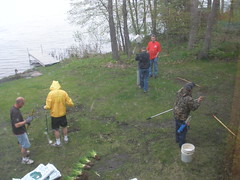
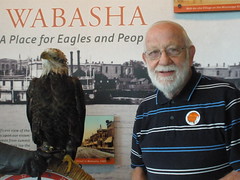
BILL HATFIELD – guy who helped us on Gunflint Lake.
Sunday, July 25, 2010
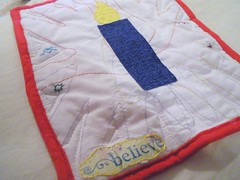
July Journal Quilt
This is the most recent journal quilt I made. It's about 9" x 12", and is the 7th one in a series of quilts I've made this year (I started in January).
Some elements of the quilt that aren’t visible in a picture and/or are more subtle:
-The Soft Texture of the Fabric: The white fabric is from a used bed sheet and the red backing and trim is from a dress that I got at a free clothing giveaway that didn't fit properly.
-Dragonfly on the Backing: The red fabric features a pink dragonfly on the back in the center. There are two lighter-printed (and still red) images of a dragonfly also on the back. This reminds me of all the dragonflies that we saw on our trip to La Crosse. Dragonflies also symbolize renewal, positive force, and the power of life in general. In addition, dragonflies frequently represent change. Since they live a short life, it knows it must live its life to the fullest with the short time it has - which is a good thing to keep in mind.
-Sashiko Embroidery on the Candle: I did a simple running stitch horizontally for the entire height of the candle. The yellow flame has 31 little crosses on it. This represents the sashiko (a type of Japanese embroidery) quilt that I worked on a lot during July.
-White-on-White Quilting: I did some free-motion quilting (very, very basic…nothing fancy) to secure the three layers together.
Below are the major activities of the month and how they are symbolized in the quilt:
4th of July: The girls rode horses in the parade and did very well. This was clearly a highlight of the year, and will be remembered for many years to come. The 4th of July is represented in the quilt by:
- The colors red (backing/border/dad’s hand), white (background), and blue (Olivia’s hand, blue candle with blue sashiko stitching, blue symbol for water [on the left hand side of the quilt], and the blue ink used for the word “believe.”
- There also is a purple star in the lower right hand corner of the quilt. The star has 4 lines (for the fourth of July).
Trip to Colorado: From July 6th-9th, I helped my dad take a trip from Minnesota to Colorado to see his younger brother who was suffering from diverticulitis. Both my uncle AND dad have Alzheimer’s Disease. Although it was a needed and much-appreciated visit for everyone involved, it also was extraordinarily physically exhausting and emotionally—draining.
It was incredibly difficult to see how much the disease has robbed my father of his mind over the past year since his diagnosis. Yet, despite these “behind-the-scenes” difficulties due to Alzheimer's, my dad provided tremendous encouragement, support, and love to his brother.
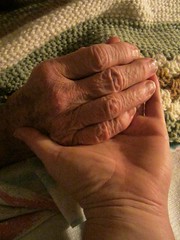
Seeing his put his arm around his younger brother’s shoulder, give him a hug, or simply hold his hand were probably some of the most powerful images I have from that trip. One photo in particular that I took – a close-up of my uncle’s hand holding my dad’s hand – is one that I like the best. It shows how love can transcend obstacles (like Alzheimer’s Disease); and how powerful the sense of touch can be to healing and comfort.
Helping, caring for, loving, supporting – these are represented in the outlines of the hands on the quilt (the red handprint is my dad, the orange is my mom, green is me, blue is Olivia, and purple is Sophia).
4-H and the Chisago County Fair: Sophia and Olivia joined 4-H this year, and were able to exhibit projects at the Chisago County Fair. In the quilt, there are 4 green “H”s that represent the 4 “H”s in 4-H: head, heart, hands, and health.
Trip to La Crosse: On July 19th-20th, I took my mom, dad, Sophia, and Olivia to La Crosse (Wisconsin).
The trip is represented in several ways on the quilt:
-The blue candle in the center represents the votive chapel at the Shrine.
-The candle flame has little yellow crosses.
-Two wavy blue lines – represent the girls swimming, laughing, and having fun in the water.
-Two orange “U” shape lines – represent smiles and good memories from the trip.
-One red “V” shape – represents an eagle and our visit to the National Eagle Center.
Crafting for the Washington County Fair: Sophia, Olivia, and I have been busy crafting this month as we get ready to enter projects in the Washington County Fair. The outlines of our hands represent the handiwork that we are doing.
*´¯`•.¸.• *
“I believe in the imagination. What I cannot see is infinitely more important than what I can see.”
~Duane Michals, Real Dreams
There’s one part of the quilt not yet addressed – the word “Believe.” This is hand-stamped on a piece of fabric from a bed sheet. It was sent to me through a swap on Swap-Bot. The sender had tied a handmade booklet with this fabric that was stamped repeatedly with “Believe.”
During July, the word “believe” seemed to be a recurring theme:
-I believe in the power that horses have in helping children who have sensory integration dysfunction, speech delays, and physical delays/disabilities. It’s amazing what therapeutic horseback riding has done to help Sophia and Olivia over the past 4-5 years that they have been a part of the riding programs (this is Sophia’s 4th year and Olivia’s 5th year riding).
-I believe in the power of love and compassion – particularly as shown through my dad and uncle as they support one another in their journey through Alzheimer’s Disease; and my parents as they support one another as they both struggle with different aging issues.
-I saw my parents’ strong religious faith and the meaning it has for them – belief in something greater than this world that they cannot see, but trust is there – as we journeyed to The Shrine of Our Lady of Guadalupe.
-I believe in the power the arts and creativity have to help me work through grief issues and other difficulties in my life. The arts (and crafts) give me an ability to create beauty or find hope amidst sadness – it’s a way to create items that can be passed along to my daughters (some they receive now and others they’ll receive when they are older).
The author, Sarah Ban Breathnach, said, "Dare yourself to believe in your creativity, wherever it may lead you. Trust that where it leads, is exactly where you're supposed to be. Your authentic self knows where you're headed. Don't wrestle with Spirit, collaborate with it."
-I saw Sophia and Olivia believe in themselves and talk with confidence about what they had learned with the 4-H judges at the Chisago County Fair.
-And, I have to believe that the emotional difficulties and struggles I am experiencing right now – especially as they relate to caregiving and loneliness - will lead to a greater good. I don’t know what…but hopefully it will make some positive difference in the world at some point.
“The future belongs to those who believe in the beauty of their dreams.”
~ Eleanor Roosevelt
Sunday, June 22, 2014
And the Mountains Echoed - Read 52 Books in 52 Weeks - Week 26
This 402-page book took me much longer to read than anticipated - both because of its length and because of the nature of the story. I found it to be emotionally-draining to read at times since grief and loss issues permeated so many of the chapters.
There seemed to be a theme with all the characters' life stories: that one's life never is how you anticipate it to unfold. The characters dealt with child abduction, adoption under false pretenses, loss of a sibling and child, violent deaths, physical maiming because of a dog bite, trying to reconnect with a loved one who no longer recognized the person, and memory loss due to dementia/Alzheimer's Disease.
Yet, despite the sadness of each of the stories, they also showed how each person dealt with adversity, overcame it as best s/he could, and how their lives developed despite tragedy.
One thing that was difficult to follow in And the Mountains Echoed was that the author introduced new characters frequently without explaining the connection to other characters. Conceptually, the reader knows that somehow everyone is intertwined and connected with one another, but the relationship between the characters is often not clear until the end of a chapter. The reader is left with a feeling of, "Oh...that makes sense now" and "I wish I would have known how they were related at the beginning of the chapter so I could better understand what I just read."
The parts about caregiving and memory loss were ones that were more poignant for me due to the relevancy to my life. One of the characters, Nabi, was a caregiver to Suleiman. After Suleiman died, Nabi said:
"For a time, I was quite literally at a loss as to what to do with myself. For more than a century I had looked after Suleiman. My daily existence had been shaped by his needs, his companionship. Now I was free to do as I wished, but I found the freedom illusory, for what I wished for the most had been taken from me.
"They say, Find a purpose in your life and live it. But, sometimes, it is only after you have lived that you recognize your life had a purpose, and likely one you never had in mind."
Later in the book, Pari (who was abducted by an uncle so she could be adopted by and live with another couple) has aged from a child to middle-age woman. What is expressed in the book is something that I have thought often, but have never read or heard anyone mention it before. So reading this passage reaffirmed that what I feel must be a shared experience with others...even though it isn't talked about.
The author writes:
"Pari catches a glimpse of her reflection in the plate glass. Normally, especially of late, when she steps in front of a mirror an automatic mental process kicks into gear that prepares her to greet her older self. It buffers her, dulls the shock.
"But in the shop window, she has caught herself off guard, vulnerable to reality undistorted by self-delusion. She sees a middle-aged woman in a drab floppy blouse and a beach skirt that doesn't conceal quite enough of the saggy folds of skin over her kneecaps. The sun picks out the gray in her hair.
"And despite the eyeliner, and the lipstick that defines her lips, she has a face now that a passerby's gaze will engage and then bounce from, as it would a street sign or a mailbox number....It is a little devastating. This is what aging is....these random unkind moments that catch you when you least expect them."
A third passage that resonated with me was when Pari is read the note that her brother, Abdullah, (whom she was separated with as a child and never knew until he was an adult with dementia and they were reunited) wrote to her with the hope that one day she would receive it. He wrote it when he was first diagnosed with Alzheimer's Disease - three years before Pari would hear the note read to her. The note began:
"They tell me I must wade into waters, where I will soon drown. Before I march in, I leave this on the shore for you. I pray you find it, sister, so you will know what was in my heart as I went under."
Having watched Alzheimer's Disease affect multiple people on my father's side of the family (my father, uncle, and grandfather), those three sentences took my breath away. That is such an accurate and poignant description of what the diagnosis must feel like, and the knowledge that inevitably the ability to communicate and to connect with loved ones will be lost. Writing things down that are important and that you want others to know is essential.
Despite the challenges with a complex plot and numerous characters that were introduced in rather circuitous ways, And the Mountains Echoed is very touching and emotional. It speaks of life's hardships and the difficult choices one must make. Even deeper, it speaks about how the choices you make now may have a ripple effect - or echo - over time.
Sunday, May 15, 2011
The Impact of Volunteering
Now, having all the bird feeders and bird bath set up close to the window so he can see the birds is wonderful, and gives him something to talk about with us as well as his friends at Open Circle (the adult day care program he attends in Hopkins)!
That being said, for her to see so many people from Keller Williams have such positive and uplifting spirits – to be literally singing in the pouring rain – to be so focused and hard-working – to be dedicated to finishing the job despite their clothing being soaked with rain – these are the things that will continue to inspire and motivate her on even her most difficult days.
As my mom looks at the flowers blooming, and the hostas and perennials growing; as she’s enjoying fresh vegetables from their garden; as she’s watching her grandchildren dip their feet and hands in the lake from the dock…she will always remember and see the many people who came forward to make a difference in their lives.
RED Day also has given a very important long-term gift to our family: the ability to create memories while we can. By freeing our time from raking, weeding, and planting, volunteers from Keller Williams are giving us an opportunity to take my parents out this spring and summer to different places as a way to keep them both active and engaged; and as a way to build memories between parents and children; and grandparents and grandchildren.
Taking my parents to various places during the coming months would not be possible if volunteers from Keller Williams had not done as much as they did. Our time with our parents would be spent trying to do yard work rather than spending quality and meaningful time with them.
RED Day has truly given our family the gift of time…and of memories that I know we will cherish in the future. For this, I am truly thankful and feel incredibly blessed.
Wednesday, September 19, 2012
5 Short-Term Goals to Help with Grieving
Although this is not the most cheerful topic I've written about, it is a necessary one. Setting goals and being proactive, to me, is an important part of grieving and moving through complex feelings related to the loss of someone I loved dearly.
So, from October through January, five of my short-term goals are:
1. Go through all of Dad's homilies and create a book. Copies of the book will be given to family members as well as those who would be interested in reading his homilies. All of the homilies were written while he was a Deacon for about 15 years.
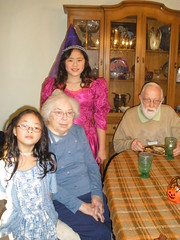
2. Do a countdown to Halloween with a focus on doing activities that are meaningful. Every year we would get together as a family for a Halloween dinner. The children would change into costumes and go out trick-or-treating. This was a happy time when the grandchildren could show their grandparents their costumes; and we could spend time together as a family.
This year, I'd like to do something similar to the Countdown to Christmas...but, perhaps, a shorter duration (1 week versus 24 days). I'd like to try to create some positive memories to replace difficult ones from last year (see #5 below).
4. Host Thanksgiving. This will be the first Thanksgiving since Dad's death. Even though he wasn't able to be with us last Thanksgiving since he was in the nursing home, this is the first Thanksgiving that he truly isn't with us.
Honestly...my goal is just to make it through the day. Having a higher expectation that it will be "fun" or "a celebration" is too much the first year after his death. That being said, I'd like to do some things that positively remind me of Dad (e.g., make some food I always made for him that I knew he enjoyed; make the dressing he taught me to make; have all the bird feeders filled since he loved birds).
5. Reduce the number of activities and commitments from October 1st to Epiphany to reflect upon and deal with grief of Dad's death. This will be a highly stressful and emotionally-difficult time period because of dates firmly etched in my mind:
=> October 3, 2011 - I had to take Dad to the nursing home. Without going into detail, suffice it to say that the ride to the nursing home was incredibly sad, not to mention the time waiting in the lobby.
It was made even more difficult when Dad had a period of awareness while waiting in the reception area. He looked at me and said, "I will miss home" and I knew he knew where he was and why he was there. It was a horrible feeling because this was not where he wanted to be;
=> October 9, 2011 - The last time we gathered as a family for a birthday party;
=> October 15, 2011 - The day Dad didn't know me even though I told him my name and that I was his daughter. Despite this, we had a good visit together and two of my favorite pictures of him when he was at the nursing home are from that day - one in which he is genuinely smiling as he's listening to what I'm saying
“Ann Marie, Dad. It’s Ann Marie,” I said gently. “It’s okay,” I said trying to acknowledge that he couldn’t say my name.
Within five minutes of being on the phone with him he asked his Stephen Minister (who also was in the room with him) if he knew who was on the phone.
On many levels, it was such a sad conversation for me. It represented an end to conversations on the phone with Dad that I enjoyed for so many decades...and of being called by my name by Dad. He always seemed so excited when I called and would announce to Mom that I was on the phone: "Dorothy! It's Ann Marie!" I miss hearing that. A lot.
=> October 20, 2011 - The last time Sophia, Olivia, Mom, and I spent with Dad where he was walking, able to look at the birds, enjoyed seeing Eenie and Shadow (two of our cats), and smiled authentically;
=> October 23, 2011 - The day I was called by the nursing home to tell me that Dad was transported to the hospital after an outburst at the nursing home. I sat with him in a locked ward while he was in full restraints while the medicine to calm him took effect. (Dad was a very peaceful, calm man so this behavior was very out of character...the disease clearly had full control of him at that point.)
My head was resting on the metal bars of the hospital bed, and he took his hand and gently touched my hair. Then he spoke a grammatically-correct sentence (the first one I had heard in a very long time...probably well over a year): "I am sorry I ruined your life," he said.
Of all the things he could have said...that was not the one I wanted to hear. It, truly, is the farthest thing from reality. Yet, probably to him - as he realized he was in wrist and ankle restraints and in a dark, quiet room - that it probably looked dismal. Although I assured him he didn't ruin my life, and that I was so happy he was my dad...this one sentence he said still haunts me and is upsetting to me today.
=> October 24, 2011 - The day I was called by the hospital he was transferred to (the geriatric psychiatric unit which treated seniors who have Alzheimer's Disease, dementia, depression, and a host of other diseases of the mind/memory) saying I needed to come right away because he had to be put in full restraints again and couldn't be calmed down. I sat next to him in his bed to comfort him until he fell asleep.
=> October 23-November 4, 2011 - the days he was in geriatric psychiatric unit and then returned to the nursing home. Out of all the days there, there was only one near the beginning where he seemed to recognize me when I came to visit him. He waved towards me and told the nurse who was feeding him, "Look who's here!" That was the last time I heard him say a full sentence and show recognition of me - albeit for a brief moment.
The amount and variety of medication used to reduce the stress and anxiety from Alzheimer's Disease basically left Dad unable to walk, hold his head up, feed himself, smile, and talk. For all practical purposes, Dad's personality and "spirit" was taken away during this time period.
Seeing other seniors in the unit was equally as disheartening, sad, and emotionally difficult. It was a period of seeing suffering, fear, anxiety, depression, and stress at its worst. Likewise, it also was a time that I saw respect for and dignity taken away from those who deserved better during the last part of their lives.
Took him outside since it was a nice day. The nurses helped get him into a jacket and put a heated blanket on his lap to help him stay warm. We took him on the swing. Although he seemed to enjoy the movement of the swing, it was a bittersweet time. It would be the last time he went outside.
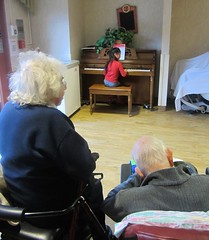
November 27, 2011 - Sophia, Olivia, Mom, and I visited Dad. Sophia played the Edelweiss on the harp:
and both the girls and I played a song on the piano for Dad and Mom.
It was the last time the girls saw their grandfather. (They were able to talk to him on the phone the day before he died and say goodbye to him.)
=> November 28, 2011 - Dad was put on hospice care;
=> Thanksgiving/Christmas/New Year's Eve/New Year's Day - The holidays spent without Dad because he was in the nursing home and his needs far exceeded what we would have been able to handle on our own...not to mention not having a vehicle to transport a wheelchair in;
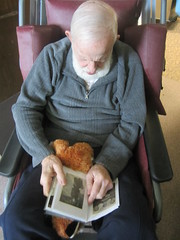
December 15, 2011 - This was the last day I saw Dad's eyes open for a prolonged period. I made a scrapbook for him with pictures of people and things I thought he'd like to see.
=> New Year's Eve - I spent this holiday evening with him (after visiting my mom in the hospital due to complications from diabetes). That's when he said his last word to me: "Yes" when I asked him if he wanted something to drink;
=> New Year's Day - I got the call that said I needed to come in because he was dying and it was time to say "goodbye";
=> From January 1st-5th - I remained at his bedside until he died at 6:57 a.m. on January 5, 2012. (I remain very thankful to my brother to this day for staying with Dad and Mom for four hours each night - from 8 p.m. until midnight - so I could sleep in the family lounge; and then be able to spend the other 20 hours of each day with Dad and Mom and ensure that both were receiving the medical care they needed.)
=> January 6, 2012 - Would have been Dad's 80th birthday. It is also Epiphany and he always referred to himself as an Epiphany Baby.
Sunday, February 26, 2012
Embroidery Journal Project - February
First, this piece is about 12" in diameter. The fabric is 100% cotton as is the embroidery floss. I plan to embroider 12 designs of the same size over the course of 2012. At the end of the year, I'll combine the squares with other fabric to create a quilt.
This month I chose a mandala because (to me) it is a peaceful and calm image. I like how the design is repetitive and orderly. This reflects many of my activities at home in February that were focused on getting things back in order, simplifying, and de-cluttering (and then donating usable items to several organizations).
Starting at the core of the mandala, the shape is outlined in purple - one of my favorite colors.
There is - to me - what looks like a tree trunk with a heart above it (where the branches and leaves would be). I used brown embroidery floss for the trunk and a dark green floss for the heart.
The dark-blue hearts are empty because February has been a tough month for me. With my Dad's funeral done; and a lot of the the post-funeral legal, thank you letters, and "busy work" complete, it leaves more time to reflect upon what has happened not only last month, but for the 2 1/2 years leading up my Dad's death and the toll Alzheimer's took on him and our family.
Needless to say, there has been a sense of emptiness, loneliness, and sadness at times during Feburary. Thus, the empty hearts.
Under the blue hearts is an orange "arrow" pointing to a golden yellow heart. I chose these colors because I thought of the "coldness" of grief slowly warming...changing...lessening...to hope and happiness.
The joyful color of yellow - the warmth of good memories - will (I can only hope) return. The yellow hearts all have a little piece missing out of them. This is truly how I feel right now...that there will always be a piece of my heart missing. Always. I will always miss my Dad...for so many reasons. And, there is nothing that can replace him or his reassuring presence in my life.
But I can hope that grief will subside...that happiness will return...and that love (as symbolized by the red outline) will be a more strongly-felt emotion than sadness.
Monday, August 20, 2012
Blogging Tips & Links to Challenges I've Done
For me, I originally started the blog as a way to give some insight into what inspired the creation of Harvest Moon by Hand's products.
When I began homeschooling Sophia and Olivia, I began adding more posts about what we did. This was, in part, as a way to share ideas with other homeschooling families much in the same manner as I was inspired and learned from other homeschooling blogs.
The second tip for bloggers is to participate in challenges and blog hops. Both are wonderful ways to connect with other people who have blogs with whom you may not normally connect.
I have done some fun, meaningful, and life-changing challenges and blog hops throughout the years. Below are some of the ones I've done with links to posts I've written about them:
- 3 in 30
- 30 Day Vegan Workshop
- 30 Days of Giving Thanks
- 30 Days to a Simpler Life
- 52 Books in 52 Weeks
- 52 Weeks of Baking
- ABCs of Homeschooling
- Art Every Day Month
- Embroidery Journal Project
- Flashback Friday
- Handbook of Nature Study/Outdoor Hour Challenge
- Heartwarming Animal Stories Reading Challenge
- Journal Quilt
- Kids Clothes Week Challenge
- Muffin Tin Monday
- No Impact Experiment
- P52 - Photo Challenge
- Preparedness Challenge
- Project Simplify
- Simple Woman's Daybook
- Summer Blog Challenge
- Summer of Color
- Take a Stitch Tuesday
Because of the challenges and blog hops, I have:
- set and reach goals in a variety of areas;
- tried new recipes;
- improved my homeschooling efforts and teaching skills;
- broadened the type of arts and crafts I've tried;
- expanded the number of embroidery stitches I can do;
- explored the farm and nature at a greater depth;
- enjoyed looking at past pictures and reflecting on childhood days;
- read many books;
- did a variety of types of journaling (e.g., written, embroidery, quilting);
- made children's clothes;
- reduced my impact on the environment;
- organized and simplified the home; and
- wrote more frequently than I would have if I didn't have a blog.
The most important tip I have for bloggers - whether they are new or have written for some time - is to enjoy the process. If it becomes laborious, take a break. Writing and blogging should be fun and bring you joy...not be a burden. Life is too short to do something that isn't worthwhile and/or pleasurable.
Tuesday, October 11, 2022
Bittersweet - Book Notes
A few months ago, the pastor at church had mentioned a book he read while on sabbatical called Bittersweet - How Sorry and Longing Make Us Whole by Susan Cain. His sabbatical focused on grief and loss, so I was curious to check this book out of the library and see what it was about.
Although there were some parts that resonated with me, the majority of the book seemed like it was meant for someone else. I did find the section about how creativity can be associated with sorrow and longing particularly interesting.
At any rate, here are the parts that were most interesting to me:
- Humans are wired to respond to each other's troubles with care. This instinct is as much a part of us as the desire to eat and breathe.
- Sad moods tend to sharpen our attention: They make us more focused and detail-oriented; they improve our memories, and correct our cognitive biases.
- What if we took whatever pain we couldn't get rid of, and turned it into something else? We could write, act, study, cook, dance, compose, do improv, dream up a new business, and decorate our kitchens; there are hundreds of things we could do, and whether we do them "well," or with distinction, is beside the point. This is why "arts therapy" - in which people express and process their troubles by making art - can be so effective, even if its practitioners don't exhibit their work on gallery walls.
- Whatever pain you can't get rid of, make it your creative offering - or find someone who makes it for you.
- Min Kym, a famous violinist, had her violin stolen. "The moment my violin was stolen, something died in me....I have to accept that the person I was with the violin gone. But I've been reborn....There's space now for a new me to emerge....When you do recover from any loss - when you heal, when your soul starts to heal from the shock - a new part grows."
- In our house, getting into a good college was the holy grail. My mother dreaded my departure, but even more she desired my success.
- May I be free from danger, May I be free from mental suffering, May I be free from physical suffering, May I have ease of well-being.
- May I be safe, May I be happy, May I be healthy, May I live with ease.
- A mother who developed Alzheimer's kept saying to her daughter, "I just want you to know what a good daughter you've been. I just want you to know." She would say this every single time the daughter called and visited. I won't be able to tell you much longer, so please remember how much I love you. A good daughter, a good daughter, you've been such a good daughter."
Sunday, March 20, 2016
Find Your Strongest Life - Read 52 Books in 52 Weeks - Week 12
I did the online test recommended in the book at stronglifetest.com to determine my lead and supporting roles in life. According to the test, my lead role is advisor and supporting role is creator.
As a side note, I took the test about a month or so ago and my supporting role was caretaker. It's interesting that this shifted because I was still seeing myself as someone who was providing support and/or encouragement to a senior at a nursing home who my daughters and I had developed a strong friendship with over the past three years. He had a heart attack on March 4th, went on hospice care the following week, and passed away on March 15th.
At any rate, this has truly thrown me for a loop because it is one of many deaths that Sophia, Olivia, and I have experienced since 2012 - first my dad in January 2012; then many people at the nursing home who we thoroughly enjoyed visiting and spending time with; then my mom in August 2015 followed by one of our cats (Maggie) in September 2015; and now John.
It's too much loss. Too much grief.
And, perhaps, with John's death I'm seeing in myself a shift away from caregiver/someone who others depended on for either care and/or friendship. Since 2009, when my dad was first diagnosed with Alzheimer's Disease, I've been in a caregiver role. I feel like that ended on March 15th. That's how deeply I'm feeling these collective losses.
I'm still a parent. Yet, that is a very different role - to me - than being a caregiver.
So, back to Find Your Strongest Life. The two roles reflective of who I am at this point in my life are an advisor and creator. A description from the book of each role follows.
You begin by asking: 'What is the best thing to do?'
Your thrill comes from knowing that you are the person others turn to for the answer. You don’t necessarily want to be the person who actually makes the changes happen. Rather, what excites you is being valued by others for your insight and your judgment.
You know that the best advice is never general, but rather is tailored to the unique characteristics of the person or the situation.
You can be demanding and opinionated, but above all you are discriminating: "good enough" is never good enough for you. There is always a better arrangement, a better solution, and you come alive when you are called upon to find it. And when you do, you don't question your decision.
The reason people seek you out for guidance is precisely because you are so assured, so confident in your intuition. Instinctively you know this, and you're proud of it.
Your best quality: Your ability to find a solution.
Always: Search for data to support your advice.
Be careful you: Don’t get frustrated by other people’s failings.
Your smartest career move: Any job where you’re paid to be opinionated.
You know you are an Advisor if:
- You ask lots of questions.
- You are impatient for things to get done.
- You take pleasure in fine distinctions.
- You are always explaining things.
- You trust your gut.
Your strongest moments are when:
- You discover the few critical improvements that make the difference.
- Someone calls you up out of the blue and relies on your opinion.
- You clarify a complex issue for someone, she acts on what you told her, and you see her succeed.
To make the most of your role:
- Do your homework.
- Learn to tailor your advice to the person.
- Learn to hide your impatience.
- When you find yourself in a management role, be sure to surround yourself with action-oriented people.
You begin by asking: 'What do I understand?' You aren’t immune to the feelings and perspectives of others, but your starting point is your own insight, your own understanding. You are a thoughtful person, someone who needs time alone to mull and muse and percolate. Without this alone time, events pile up on you haphazardly, and your confusion starts to overwhelm you. So you look forwar to time by yourself - early in the morning, late at night, long flights - and you use this time to get clear.
You are a creative person. What form this creativity takes will depend on your other traits and talents, but whether you write, paint, sing, complete projects, or make presentations, you are drawn toward making things.
Each thing you make is a tangible sign that you have made some sense of the world, that you have organized the chaos in some useful way. You look at what you've made, you take pleasure in what you now understand, and then you move on to the next creation.
Your best quality: Your ability to find patterns invisible to others.
Always: Find time to be by yourself.
Be careful you: Don’t think so long, you never do anything.
Your smartest career move: Any job where you’re paid to produce new content.
You know you're a Creator if:
- You feel uncomfortable if a day goes by without producing some tangible sign of insight or understanding.
- You push yourself hard, rarely stopping to celebrate your accomplishments. There's still so much left to make sense of.
- You read a lot of nonfiction.
- You are inspired by the achievements of others - not their growth and development, necessarily, but what they have achieved. You are more interested in destinations than journeys.
Your strongest moments are when:
- You figure something out.
- You spend time by yourself reading, writing, preparing your mind.
- A fresh insight dawns on you.
- You have an in-depth conversation with someone.
- You get a chance to show your expertise.
To make the most of your role:
- Take time to celebrate what you've achieved.
- Explain to others that you are at your best when you have time to think things through, that you're not good at making snap decisions.
- Deliberately involve other people in helping you think things through.
- Carry a notebook with you. Insights pop up at inopportune moments, and you will want to have a place to capture them.
What do I do with this information? I don't know. There's a lot to reflect upon given what has happened over the past four years and where I envision my life going in the future.
Saturday, November 12, 2011
30 Days of Giving Thanks - Day 12 - Larry and Maureen
I remember taking the train from the depot in downtown Minneapolis with my sister to visit Larry and Maureen. (Those were the days were it was still safe to stick young children on trains by themselves and not worry about them.)
Larry and Maureen had four children and my parents had three children, so when we gathered together it was a lot of fun - playing indoor games as well as playing outdoors and exploring their large backyard.
We would always enjoy wonderful meals - both Larry and Maureen are great cooks. I remember being a teenager and copying recipes for food that I enjoyed at their home. Their recipes became some of the first ones in my recipe box.
So, today I gave Maureen a thank you note and some pictures from October 9th when they visited our family at St. Therese for a birthday party we were having there.
Maureen stayed with my mom during the past week and provided help and support as she recovered from being in the hospital in October as well as is dealing with grief and loss issues associated with my dad being at St. Therese (nursing home) from October 3rd-23rd, the hospital for 11 days, and now back at St. Therese as of November 4th.
With Maureen helping my mom during the past week, I was able to stay at home and accomplish more with the girls with homeschooling. It feels good to be able to mark things off the plan that I created for the school year; and move forward with some of the lessons and activities that have had to be put on hold because of caregiving responsibilities.
Both Larry and Maureen have been so supportive, insightful, and encouraging throughout the years...particularly on this journey of Alzheimer's Disease with my dad.
There have been many times where it's been very stressful, sad, and discouraging. However, having people like Larry and Maureen in my life have truly made some of the most challenging days a bit easier.
Wednesday, January 19, 2011
Mid-Week Motivation
Sometimes, in the middle week, it's nice to get a little inspiration to carry oneself through the rest of the week. I thought it would be nice to begin a weekly post where everyone can share what they are working on or have recently completed for their family or themselves; or given as a gift.
One of the projects I made recently was a miniature quilt and pillow for my father. It's for a stuffed animal that I gave him on Christmas. The stuffed animal reminds him of his Corgi that he had back in the 1960s-70s. Corgi (my parents, for some reason, didn't give our dog a name - just called him by his breed-name) was a was a gentle dog who was a constant and loyal companion to our family. He as a great dog who went on camping trips with my dad and on family trips.
When Corgi got leukemia when he was older, my father eventually had to bring him in to be euthanized. Needless to say, it was a traumatic and sad time. My father's grief, to this day, is still as raw it was when it happened many years ago. Perhaps, even more so, because he has Alzheimer's Disease. Things that happened many years ago can seem more "fresh" and recent than things that just happened yesterday - or last week - to him.