Sunday, January 11, 2015

Good Citizens - Read 52 Books in 52 Weeks - Week 2

For the second week of the Read 52 Books in 52 Weeks challenge, I read Good Citizens - Creating Enlightened Society by Thich Nhat Hanh. This ties into the first spiritual practice that I focused on during the first two weeks of January: Attention. 


I thoroughly enjoyed this book and found so many ideas that would enhance my life and how I relate to others. As I'll be doing for this year's challenge and spiritual practices, I'm noting parts of the book that I want to remember:

- A Buddhist contribution to global ethics...is based on observing and understanding the world with mindfulness, concentration, and insight. It [is] an awareness of...the interconnectedness of of all things.
- Practice mindfulness wherever we are, whatever we are doing, at any time.
- We practice this way not only for ourselves but also to preserve ourselves so that we are able to help others and be connected with all life.
- When other people suffer less, we suffer less. And when we suffer less, other people suffer less.
- Being mindful means...[to] stop and observe deeply what is happening in the present moment...we can see the suffering that is inside us and around us. 
- When we have the characteristics of someone who is virtuous, we don't make people suffer. This kind of virtue offers us a guideline, a way of behaving that doesn't cause suffering to others or to ourselves.
- Practice generates mindfulness, concentration, and insight. 
- To do something effectively and ethically, we need to be our best selves in order to be able to handle the suffering.
- When we bring out attention to our in-breath and our out-breath, we stop thinking of the past; we stop thinking of the future; and we begin to come home to ourselves.
- If we don't go home to ourselves, we can't be at our best and serve the world in the best way. We have to be ourselves to be our best.
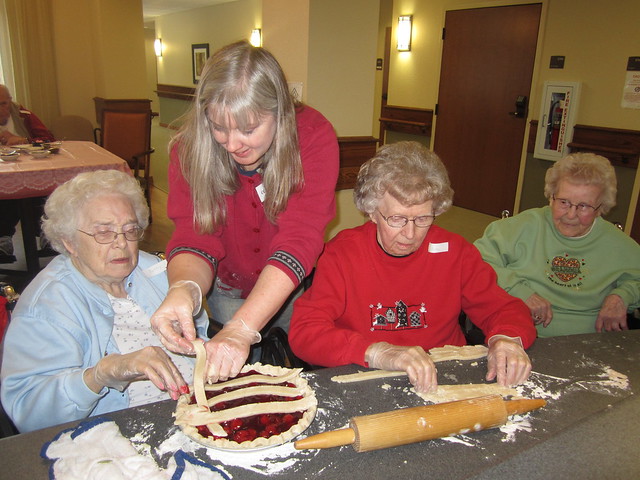
Helping Do the Lattice Crust
Helping Betty do the lattice work on a pie while 
two other residents at the nursing home work on other pies.
(Taken on February 9, 2013.)

- We have to acknowledge our bodies first because tension and suffering accumulate in the body.
- We can't do our best if we don't know how to release the tension and the pain in ourselves.
- There is suffering in this world - birth, sickness, being separated from those we love, having to be with those we hate, poverty, disease, violence, hunger, despair, worry, depression, old age, and death....There is suffering inside us and around us- near us and on a global scale.
- We have to observe deeply what is happening around us before we can understand its causes and hope to transform it.
- Each of us has some amount of suffering, but we handle it with beauty.
- Stress, tension, and fear can accumulate in our bodies and minds and cause us to suffer.
- There is great joy in us, even in those things that contain suffering. For example, the Buddha saw that old age contained suffering. But I'm old and I'm so happy, he said.
- Even death is not exactly suffering. Death is also part of life. We know that many cells of our bodies are dying at every moment, so that new cells can be born. So death takes place all the time. Without death, birth isn't possible. 
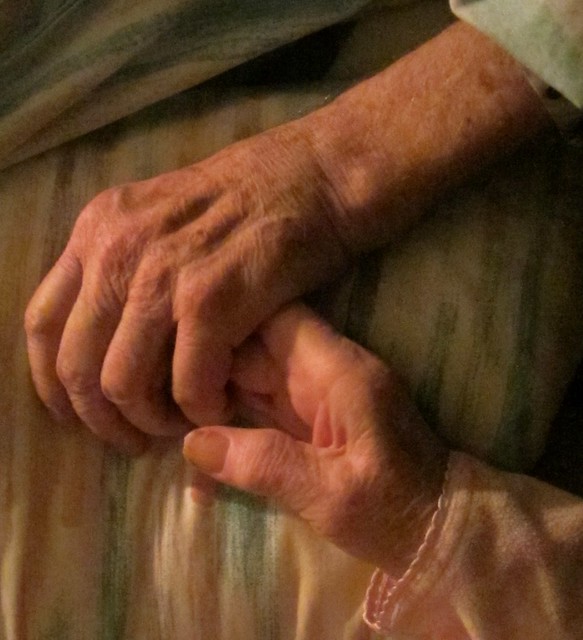
Mom and Dad's Hands
Dad and Mom's hands taken 
two days before Dad died.
(Taken on January 3, 2012.)

- If we look deeply, we see that we are not really dying; we will continue in other forms. Changing from one form to another may be something joyful.
- You may choose not to suffer, even if pain or sickness is there. How you see life and your particular situation depends on your way of looking.
- When we have some pain, whether it is physical or mental, we can recognize it as suffering, but we don't need to exaggerate it.
- We have to produce peace in ourselves and reduce the suffering in ourselves first, because we represent the world. Peace, love, and happiness begin with ourselves. The suffering we see out in the world is reflected in the suffering, fear, and anger inside. So when we take care of ourselves, we are taking the first step toward taking care of the world.
- Compassion and love are born from understanding. 
- Understanding requires understanding the difficulties, frustration, and pain of the person you lvoe. If you have already understood your own pain, it will be much easier to understand the pain of the other person.
- The path of suffering is the...path of wrong view, thinking, speech, actions, livelihood, diligence, mindfulness, and concentration. 

Chickpea and Tomato Salad
Tomato and chickpea salad.
(Taken on September 11, 2012.)

- If it is good food, healthy food, then there will be no problem, there will be well-being. If it's not appropriate, then we can become ill.
- Mindful consumption of edible food also affects how we shop. Mindfully shopping at the grocery store or marketplace means you know what to buy and what not to buy. We can choose healthy food. Mindful consumption affects the way we cook.
- Merely by the way we eat, we can help preserve our planet - if we know how to eat properly and in such a way that can help us cultivate compassion.
- Over 40,000 children die every day because of the lack of food or the lack of nutrition. Yet in many countires in the West people waste a tremendous amount of food. We use the cereal we grow to make alcohol and feed livestock. We want to eat chicken, pork, and beef, but in order to make a pound of meat we have to use ten to twenty times as much cereal. Yet the people in the world don't have enough grain, rice, and corn to eat. So when we look deeply at our piece of meat, we know that it has been made from huge amounts of grain that could have been used to save people who are dying from hunger and malnutrition.
- Let us eat in such a way that we keep our compassion alive, reduce the suffering of living beings, preserve our planet, and reverse the process of global climate change.
- Depending on the content, consuming television, books, films, the Internet, and conversations can be either healthy or toxic.
- If we listen to gossip, judgment, and insult, then we are consuming these things.
- If what we consume fills us with irritation, anger, or craving, then it creates more irritation, violence, and suffering in the world.
- We may feel like we can't live without consuming certain sensory impressions. But if we try, if we have the space, the opportunity, and the supportive environment to consume health nutriments, our suffering diminishes. 
- Examples of toxic volition are the cravings for fame, wealth, sex, revenge, and causing others to suffer. If you are motivated by that kind of desire, it's as if the desire has abducted you and your are being pulled in the direction of death.
- Collective consciousness: we are influenced by the ways of thinking of the people around us, and we consume the views of other people in many ways.
- Danger of craving is that we believe that the object of our craving is what we really want, that it is what can truly bring us happiness....When craving arises in us, we're no longer at peace. We're not satisfied by what we have and who we are.
- When the flame of craving is inside us, we no longer have the capacity to live happily right now in the present.
- Look deeply in order to see the true nature of the object of our craving. If we see it clearly, it will lose its appeal and then we will be free.
- When the roots of suffering are absent, we can be free and happy, and we can act ethically, motivated by our understanding and compassion.
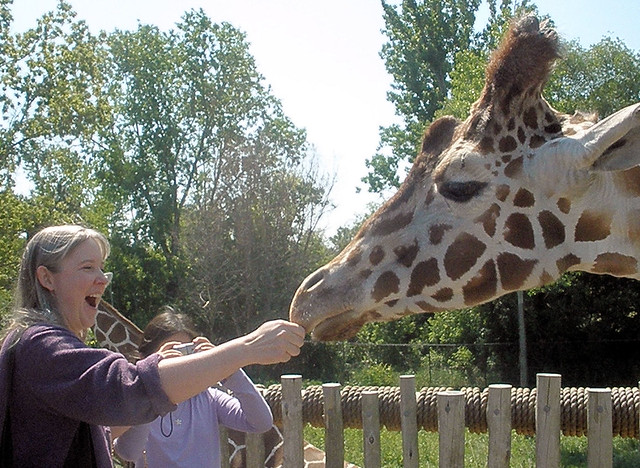
Me Feeding Giraffe
Me feeding a giraffe a treat on
June 3, 2009.

- Choose to consume only food, sounds, sights, and environments that increase your happiness and avoid those that cause suffering. Choose to eat healthy food, focus our awareness on beautiful sights, listen deeply to those who use loving speech, and make a concentrated effort to be around those who bring us more happiness.
- Each of us has the capacity not only for great happiness but also for bringing great happiness to others.
- Only if we live ethically can we experience happiness and well-being.
- There is not true well-being that does not consider the well-being of others.
- Don't do anything when you're not awake and clear-minded. Wait until you're yourself and quite awake before you make a decision.
- Sometimes we choose not to tell the truth in order to help the other person to survive....We need deep understanding to be able to practice opening the door and making exceptions.
- When we do harm to the environment, we do harm to ourselves; when we do harm to another person, we do harm to ourselves.
- The ecosystem and we humans are not two different things. When we kill the ecosystem, we're killing ourselves.
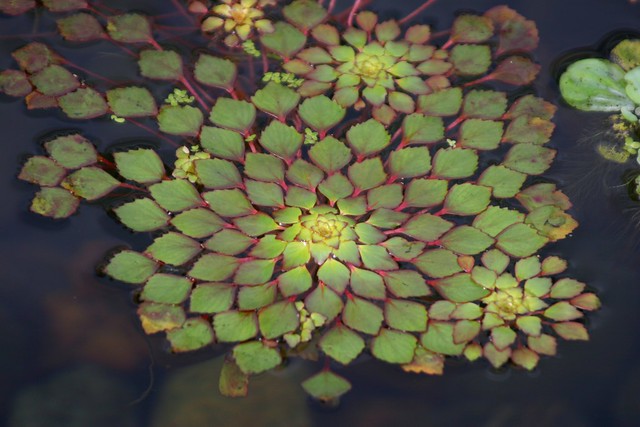
Pond Plant at Como Zoo
A plant at the Como Conservatory.
(Taken on October 17, 2007.)

- If the minerals, plants, and animals no longer existed, humans would not exist either. We can only be here if they are here.
- When you produce a thought, it bears your signature. If it's a thought of compassion, forgiveness, or non-discrimination, you will continue beautifully into the future because that thought has your signature on it. It can heal you and heal the world.
- Whatever you have done bears your signature. Even when your body is no longer there, your thought continues.
- Select the kind of livelihood that can express compassion and understanding. You know how to make good use of your time to transform suffering into happiness and help people.
- Right Livelihood is the kind of occupation that will not make us suffer, and by which we can express our ideal of compassion and understanding. Even if it brings less money, it brings much happiness. You know you're on the right path, and that alone can make you happy. Right Livelihood brings well-being.
- When we practice Right Livelihood, we think about the impact of our work, not just its profitability. 

There are four guidelines concerning Right Speech: 
- Speak truthfully, without lies.
- Speak consistently, without saying one thing to one person and something else to another.
-  Speak respectfully, without insult.
- Speak accurately, without exaggeration.

This following passage reminded me of the seniors at the nursing home with whom Sophia, Olivia, and I volunteer: 

When we get old, we don't have all the excitement and stress that young people may have. 

We have more maturity and we have learned from years of unskillful experience to be more skillful. 

So old age is wonderful. 

When you are a young person, you are like a young creek, and you meet many rocks, many obstacles, and difficulties on your way. 

Another View of the Falls

You hurry to get past these obstacles and get to the ocean. 
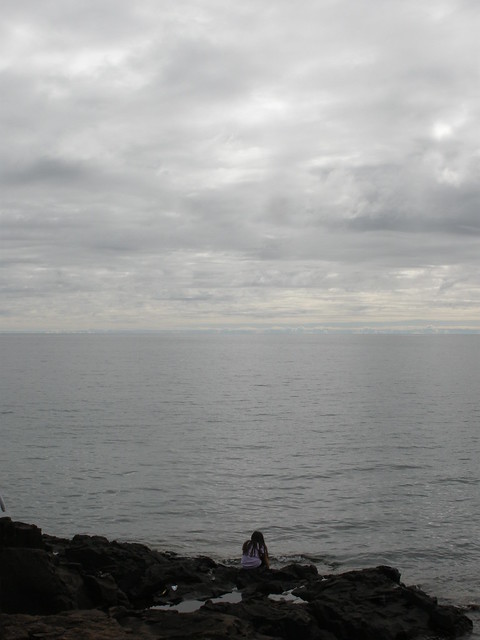
Sophia by Water
September 9, 2010

But as the creek moves down through the fields, it becomes larger and calmer and it can enjoy the reflection of the sky. It's wonderful. 

You will arrive at the sea anyway so enjoy the journey. 
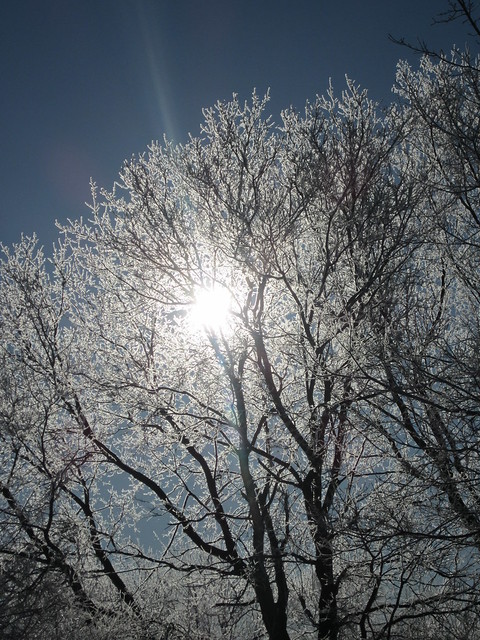
Snow through the trees
March 2, 2013.

Enjoy the sunshine, the sunset, the moon, the birds, the trees, and the many beauties along the way. 
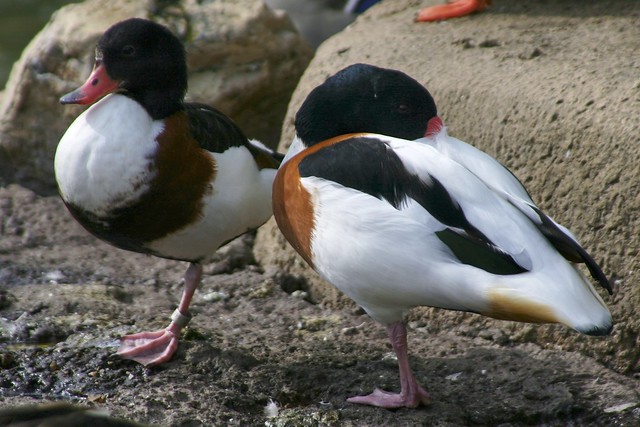
Two Ducks
October 17, 2007.

Taste every moment of your daily life. 

Old age can be very enjoyable.

Another interesting passage dealt with being ill:

Being ill is often the only way we take time to rest. When you are sick and you cannot go out, you have time to look deeply and spend some time with yourself. This may be one of the only times when you really lie down and spend some time coming home to yourself.


Sophia's Hand with IV
November 20, 2009.


Another passage I found intriguing was the thought of seeing with our ancestors' eyes. It made me reflect upon my father, my grandparents, my great-grandparents, and so forth who are all a part of who I am:

One day I looked outside at the mountain, and I saw so clearly that as I was looking at these mountains, all my ancestors - my father, my mother, my grandparents, all the lineages of human ancestors - were in me and were looking at the mountain together with me. We saw the beautiful dawn together and enjoyed a concert of color.

You can smile, and know that all of them are smiling your wonderful smile. You walk peacefully and all of the mare walking peacefully with you.

I thought of my dad when I read the following passage:

What you produce in terms of thought, speech, and action is your continuation, your karma. The dissolution of this body does not affect your continuation. Our actions will have an effect on us and on the world. 

Your karma can assure a beautiful and a better continuation. If we know how to handle our thinking, speech, and action, we will continue to create happiness in the world, even when our body is no longer present in its current form.

I liked this thought:

So if we have lost someone who is very close to us, and we are grieving [his] death, we have to look again. That person is still continuing. We can do something to help [him] to continue more beautifully. [He] is still alive inside us and around us. Without our new way of looking, we can recognize [him] all around.

You have never lost [him]. [He] is still alive, very near you. [He] may bei na new form, different than in the past....[He] hasn't died; [he] hasn't disappeared. [He] continues in [his] new form. And we have to practice looking deeply in order to recognize [his] continuation, and support that.

Friday, January 9, 2015

White-Breasted Nuthatch - Outdoor Hour Challenge

This week we focused on the white-breasted nuthatch for the Outdoor Hour Challenge. We used the Handbook of Nature Study to learn a bit more about this bird that we frequently see:

=> Nuthatches and black-capped chickadees both have black feathers on the top of their heads, but the nuthatches do not have a black bib like the chickadees do.

Birds at Feeder 10-29-12
Variety of birds at the feeder including 
a nuthatch and black-capped chickadees.
Taken on March 13, 2013.

=> Nuthatches and chickadees hunt together all winter. Chickadees hunt over the twigs and smaller branches, while the nuthatches prefer tree trunks and the bases of the branches.
=> You often see this bird upside down. It holds itself safely in this position by thrusting its toes out at right angles to the body, thus getting a firm hold upon the bark.
=> The front toes are strong and the hid toe is very long. It is armed with a strong claw.
=> The bird runs about on the tree so rapidly that it has earned the name of "tree mouse."
=> The beak is long and slender, being as long as the head or longer.

Nuthatch
A nuthatch figuring out which seed to take.
Taken on October 29, 2012.

=> The beak is fitted to reach in crevices of the bark and pull out hiding insects or to hammer open the shell of nut or acorn and get both the meat of the nut and the grub feeding upon it.
=> After eating suet, it will wipe its bill on a branch, first on one side and then the other, until it is perfectly clean.
=> Nuthatches are a great benefit to trees in winter because they hunt for hiding pests on the trunks.
=> Their food consists of beetles, caterpillars, pupae of various insects, and seeds of ragweed, sunflowers, and acorns.
=> During the winter this bird is commonly seen. During nesting season, they usually retire to the deep woods to occupy a cavity in a tree used by a woodpecker last year or make a hole for themselves.
=> The nest is lined with leaves, feathers, and hair.
=> A female nuthatch lays between five to nine creamy, speckled eggs.

Next, we read in the Handbook of Nature Study about the feet of birds on page 40-41.

“The feet of birds are shaped so as to assist the bird to 
get its food as well as for locomotion.”
~ Handbook of Nature Study, page 41

This section compared a hen's feet with a duck's feet:
=> The hen is a digger of the soil so her claws are long, strong, and slightly hooked. They are covered with scales to protect her feet from injury when scratching in the hard earth.
=> The wings help a hen to move along more quickly when she runs.
=> Her strong toes help give her a firm foothold when she runs.
=> Her tracks look like three toe-marks projecting forward and one backward.
=> A duck has the same number of toes as the hen, but there is a membrane, called the web, which joins the second, third, and fourth toes.
=> The first or hind toe has a little web of its own.
=> The webbed feet are like a paddle for propelling in the water, and help the duck on land from sinking into the soft mud because of their breadth and flatness.
=> The duck's legs are shorter than those of the hen and are placed farther back and wider apart. They are essentially swimming organs and are not fit for scratching or running.
=> A duck on land waddles because the short legs are so far apart and so far back. Yet, in the water, the duck is a graceful bird.
=> The hind claw of a hen enables her to clasp a roost firmly during the night whereas a duck's  foot could not do this.

Last, we read some more about the nuthatch on All About Birds and learned some facts about these birds:

Size and Shape
The largest nuthatch, this is still a small bird with a large head and almost no neck. The tail is very short, and the long, narrow bill is straight or slightly upturned.

Color Pattern
White-breasted nuthatches are gray-blue on the back, with a frosty white face and underparts. The black or gray cap and neck frame the face and make it look like this bird is wearing a hood. The lower belly and under the tail are often chestnut.

Behavior
White-breasted Nuthatches are agile birds that creep along trunks and large branches, probing into bark furrows with their straight, pointed bills. Like other nuthatches, they often turn sideways and upside down on vertical surfaces as they forage. They don’t lean against their tails the way woodpeckers do.

Nuthatch on Plum Tree
A nuthatch in the plum tree.
Taken on November 11, 2007.

Habitat
White-breasted nuthatches are birds of mature woods and woodland edges. They’re particularly associated with deciduous stands, including maple, hickory, basswood, and oak, though they can be found in some coniferous forests.

Food

White-breasted nuthatches eat mainly insects, including weevil larvae, wood-boring beetle larvae, other beetles, tree hoppers, scale insects, ants, gall fly larvae, caterpillars (including gypsy moths and tent caterpillars), stinkbugs, and click beetles, as well as spiders. They also eat seeds and nuts, including acorns, hawthorn, sunflower seeds, and sometimes crops such as corn. At birdfeeders they eat sunflower seeds, peanuts, suet, and peanut butter.

Nuthatches at Feeder
A nuthatch at the feeder.
Taken on February 22, 2011.

Nuthatch Songs

We listened to what nuthatches sound like by listening to a recording of nuthatch songs on All About Birds.

Facts
The White-breasted Nuthatch is normally territorial throughout the year, with pairs staying together. The male has to spend more time looking out for predators when he’s alone than while he’s with his mate.

In winter, white-breasted nuthatches join foraging flocks led by chickadees, perhaps partly because it makes food easier to find and partly because more birds can keep an eye out for predators.

White-breasted nuthatches who are making lots of quick trips to and from a feeder – too many for it to be eating them all – may be storing the seeds for later in the winter, by wedging them into furrows in the bark of nearby trees.

Nature Journal Entries

Both Sophia and Olivia did a entry in their nature journals about nuthatches. This is Sophia's nature journal entry:


This is Olivia's nature journal entry:


(We used Outdoor Hour Challenge: Birds - Woodpecker, Chickadee, Nuthatch, and Towhee as inspiration and a starting point  for our nature study.)

Sunday, January 4, 2015

Everyday Sacred - Read 52 Books in 52 Weeks - Week 1

This year I'm doing Spiritual Practices from A to Z - a personal challenge that includes (among many different types of activities) reading books that tie into the spiritual practice that I'm focusing on that week.

For the first two weeks of January, the spiritual practice is Attention. The book I read that related to attention was Everyday Sacred - A Woman's Journey Home by Sue Bender.


The author wrote another book that I read several years ago called Plain and Simple about her time that she spent living with the Amish. I enjoyed that book and was curious to see what Everyday Sacred was like.

The motivation for the book came from the fact that Bender was struggling to apply the simplicity and peaceful wisdom that she learned from the Amish to her busy life. One day she heard about the story of a begging bowl: each day a Zen monk goes out with an empty bowl in his hands. Whatever is placed in that bowl will be his nourishment for the day. 

She translates this practice into her philosophy and basis of this book: if we approach each day afresh, with our bowls waiting to  be filled, we will find at the end of that day that extraordinary things - some so small that we we may tempted to overlook them - have come our way.

There are some parts of the book that I want to remember including these excerpts:
=> All my thoughts, feelings, and experiences...might be connected to everyday sacred. 
=> A story about three bowls: "The first bowl is inverted, upside down, so that nothing can go into it. Anything poured into this bowl spills off. The second bowl is right-side up, but stained and cracked and filled with debris. Anything put into this bowl gets polluted by the residue or leads out through the cracks. The third bowl is clean. Without cracks or holes, this bowl represents a state of mind ready to receive and hold whatever is poured into it."  
=> Oryoki (the Japanese name for a begging bowl) means "just enough."
=> In the book She, the author talks about "creative ordering." Bender now spends one hour a day sorting - either a room, drawer, cabinet, closet, or file. Having a limited time frame, and without rushing, I was able to approach each job with focused attention, she said. 
=> "What you do may seem insignificant, but it is very important that you do it." (Mahatma Gandhi)
=> Get rid of things or you'll spend your whole life tidying up. A book about Albert Schweitzer's life said, "...a clearing in the woods - cutting out from the thicket to make way for the sun." That's what I would do - make way for the sun.
=> A person who had a knee injury had to walk slowly on a hike through a national park. "She discovered her slowed pace helped her look at the world as if through a microscope .... I'm seeing these wonderful things because I can't walk very fast."
=> In many religious traditions a monk sets out with his begging bowl and exchange is made. Food is placed in his  bowl and he accepts the offering gratefully. The offering gives him strength to do his work and, in return, he gives guidance and wisdom. Who gives? Who receives? Both are giving and receiving. The monk puts his bowl away when he is finished eating. If he ate all the time, there would be no time to digest. 
=> Even when I am doing things I enjoy, I don't leave time to digest or savor what is happening. I almost never pause before going on to the next "doing." The solution? Put a lid on the bowl (metaphorically speaking).
=> We all need a certain amount of fallow time. Watching the grass grow, sitting on the hillside, staring out the window daydreaming. When we don't have it, there is a deeper intelligence that won't come forth. These "little Sabbaths" replenish my body - and spirit.
=> Wabi sabi is a beauty of things imperfect,impermanent, and incomplete. It is a beauty of things modest and humble. It is a beauty of things unconventional.
=> I read one page in each of three small inspirational books at the start of each day.
=> Fresh paint, fresh start.
=> The Japanese Zen monk...The first thing I noticed was a rectangular big, about twelve by nine inches, held on by a two-inch-wide piece that went around his neck. The materials was made up of pieces of dark-colored cloth; browns, rust, deep, deep purple held together by tiny white running stitches. The Buddhist tradition has something called a rakusu which is a sacred object.


=> In the Buddhist tradition, generosity is the ground for everything else .... By placing generosity in my bowl meant I could practice generosity toward myself and others.
=> Each time you say something critical about yourself you are making that message to yourself more real.
=> Watching you wash you truck...felt [like] I was witnessing an act of devotion .... I do think it sort of reflects that my business is in order when I have a clean, well-conditioned truck. It says something about me.
=>  What if the whole family was together at Thanksgiving and the turkey exploded? If the four of you were killed at that moment, who would you want to have your worldly goods? ....This is a chance to think about the people in our lives, a chance to be grateful and express our gratitude .... Stop at the end of the day, even a particularly difficult day, and make a list: a gratitude list.
=> Harriet's father fills the trucks with flowering bulbs...[and] plants these bulbs along the way, anonymously, as he crisscrosses America - a Johnny Appleseed of the highways .... I wonder how many other things he's done that I haven't noticed! Now, when Harriet sees daffodils and crocuses growing along a freeway she thinks of him and smiles. Sometimes you need someone else's eyes to show you the beauty that's been in front of you all the time.
=> Too often we take these small acts of kindness for granted. We think we have to have a large achievement or gift to offer others. Small kindnesses make a difference - they have echoes out of proportion to the effort they take. 
=> "We can do no great things, only small things with great love." (Mother Teresa)
=> Mitzi really listens. As a result, I have the experience of being heart by another person - a huge gift.
=> "I don't think we have time to waste being unhappy about decisions we've made." (Helen Delfonti)
=> If we ask for help, we can help others. Accepting other people's generosity is a form of generosity. How we receive a gift can be a gift to the giver.
=> "We ourselves make each day what it is. The fortunate and unfortunate will always be with us, but our responses - maintaining dignity and equilibrium - to whatever befalls us, determine whether the day is good or not." (Christy Bartlett)


52 Week Money Challenge

At the beginning of the year, there seems to be quite a few posts about the 52 Weeks Money Challenge on Facebook and Pinterest. Perhaps you've heard about it.

During the first week of the year, you save $1. For the second week, you save $2. And so on...until you come to the 52nd week of the year and save $52. By the end of the year, you will have saved $1,378.

A handy check-off chart can be found at this pin which leads to A Mother Thing.


This year, I'm going to do the 52 Week Money Challenge in reverse. So, during the first week I'll save $52 and then end the year on week 52 by saving $1. It seems like it would be a better fit because there are more expenses it seems towards the end of the year than at the beginning.

I've already deposited $52 in a savings account for the week, so I'm off to a good start.

Here's the 52 Week Money Challenge Reverse Chart below:


Either way, making it a point to save money this year is a good goal. What's even better, by the end of the year $1,378 will be in a savings account and can be invested!

Thursday, January 1, 2015

35 Simple Healthy Changes to Make in 2015

Over on Keeper of the Home there was a list of 101 Simple Healthy Changes Anyone Can Make in 2015.

Looking at the list, I found many that I would like to try in the upcoming year. They are listed below, and as I complete them I'll write a post about them and link them to my list.

If I need directions, ideas, or references as I'm working on the changes, I'm going to refer to the list on Keeper of the Home since she has links to additional information, recipes, and directions for each of her items.

These are the changes that I am most interested in making:

Waste Less

1. Compost your kitchen scraps. (Or try worm composting.)

2. Eat whole foods, not packaged ones. One suggestion on the list that I noted was the recommendation to use white cheese in a block rather than orange cheese to avoid food coloring. Organic or raw cheese is better than non-organic and/or processed.

Also, shop the perimeter of the grocery store where the meat, fish, dairy,vegetables, fruits, and whole grain baked goods are located. Some of the rows have good ingredients (e.g., brown rice, coconut milk, baking powder), but for the most part it is best to stay out of the aisles.
depended on it!

3.Creatively re-purpose and put some ideas to good use in a new way. (I do some of this already, but not nearly as much as I could.)

4. Stop using wrapping paper and gift bags, and go eco-friendly with your gift wrapping. (I made fabric bags for birthdays and Christmas. Sophia and Olivia don't like them as much as when their presents are wrapped in wrapping paper. However, environmentally I always feel better when I use the fabric bags than when I use wrapping paper.)

5. Start a mason jar collection and use them in multiple ways in your kitchen.

Eat More Real Food

6. Learn to define real food.

7. Cut your kitchen prep time. Do meal planning; and use appliances like the bread maker, Vita Mix mixer, and crockpot.

8. Save money on real food at Costco. Determine if a membership is worth it to purchase items like organic fruit, yeast in bulk, and larger quantities of items like maple syrup.

9. Roast a whole chicken; and then use the bones to make broth and can it.

10. Make your own spice mix.

11. Start using your crockpot to make something beyond the typical stews and casseroles.

Make Quick Switches

12. Use your crockpot to make the easiest homemade yogurt ever. (Live Renewed has a recipe for making homemade yogurt that I would like to try.)

13. Figure out what one small change you could be making and how to get over the barrier that’s holding you back.

14. Choose one of these 21 strategies for cutting down the sugar you consume.

15. Switch out one or two of your pantry staples for these healthier choices.

6. Find a simple homemade recipe to learn to make.

17. Choose one of these 7 foods to avoid (refined sugar, high fructose corn syrup, food dyes, preservatives, MSG, GMO, trans-fat). Look on Keeper of the Home page with suggestions for alternatives to replace them.

18. Add more fruits and vegetables to your diet.

19. Switch over one of these nine common kitchen products to get rid of more hidden toxins. For example, bleached paper products can be replaced by natural ones (they are brown rather than white). Two things that we use are coffee filters and parchment paper - both which have natural alternatives available.

Choose unbleached flour instead of bleached. Also, choose baking powder without aluminum. Rumford is one brand that doesn't have aluminum in it. Use arrowroot instead of cornstarch - the latter of which can be genetically modified.

Buy frozen instead of canned vegetables since most cans contain BPA in the lining.

20. Make one of these ten quick and easy household switches listed on Keeper of the Home. The most realistic for us to do and follow through with is to use natural soap (the kind that we keep by the sink to wash our hands).

21. Make a plan to avoid just one of these four, toxic fake foods. The one that I would be curious to try is to purchase nothing with artificial colors in it.

Clean Greener

22. Make just one of these 67 homemade, all-natural cleaning recipes.

23. Freshen up your carpet with this super simple, 2-ingredient recipe.

1/2 cup baking soda
20-40 drops essential oil of choice

Mix baking soda and essential oils together, and put in a shaker container with holes in the lid (such as a large, empty spice container). Let this mixture sit for 24 hours to allow the essential oil to permeate the baking soda. To use, sprinkle lightly over carpet. Let it sit for 10-15 minutes, and then vacuum as usual.

24. Try a natural air freshening spray around your home.

- 12-15 drops of pure essential oil (I like grapefruit, orange, lemon, and lavender, but go with any scent that you enjoy)
- 1/2 cup white vinegar
- 1 1/2 cups water

You can also make an even stronger version of this spray by using a higher ratio of vinegar to water and upping the essential oils (more like 20 drops) to use in a small diffuser bottle. This works better for just a quick spray into the air to freshen up a bathroom before guests.

25. Let the sun whiten your whites. Install a clothesline and hang clothes during all months except winter.

Love Your Skin (Naturally)

26. Make some safe and natural beauty products.

27. Make one out of this long list of skin scrubs, toners, cleansers, masques and more – all easy, all naturally nourishing.

28. Make homemade toner that's easy to make and good for your skin.

Raise Healthy Kids

29. Make healthier lunches for Sophia and Olivia.

30. Get more of the good stuff in them with with these real food snacks.

31. Make a plan to include the girls in the gardening this year and teach them to love vegetables more.

Move That Body

32. Make an exercise plan that will actually work for you.

Keep Your Family Well With Natural Remedies

33. Treat a nasty cold with one of these 10 natural cold remedies.

34. Fight the yuck this winter with our favorite herbal remedies for colds and coughs, stomach viruses and headaches.

35. Try one of the cold kicker. Supposedly the concoction works despite its less-than-appealing combination of items.

Monday, December 29, 2014

Bacon and Cashew Caramel Corn

This fall we went to a local gourmet candy business for a special event. One of the products that sold out was bacon caramel corn. Because of the demand, they made another batch of it for those who wanted to come back the next day and purchase it.

Clearly this was something worth trying. Yet, I wanted to learn how to make it myself rather than pay someone else to make it for me.

So, I looked online for a recipe that sounded good. Came across one for Bacon and Cashew Caramel Corn at Bon Appétit. The picture shows popcorn all covered with caramel with lots of bacon and cashews.

Making the recipe as noted below won't produce the same results. It is delicious and something I would make again. Plus everyone who tasted the bacon and cashew caramel corn liked it and wanted more.

This is the bacon and cashew caramel corn that I made. 
Look closely...there are actually pieces of 
bacon and cashews in there.

That being said, I would double the caramel next time and at least triple if not quadruple the cashews and bacon.

I also did not use the tea bag or cayenne pepper. Rather, I completely skipped the tea bag step (which was fine) and substituted black pepper (again, tasted fine).

Below is the recipe and how I modified it the first time I made it. The next time I make it, I'll do what I believe will result in an even better batch of bacon and cashew caramel corn by doing what I suggested above.

Ingredients

• 1/2 cup popcorn kernels
• 2 tablespoons vegetable oil
• 6 ounces bacon, chopped (I doubled this)
• 1/2 cup unsalted raw cashews (one 2.5-ounce package) (I doubled this)
• 1 teaspoon coarse kosher salt or coarse sea salt
• 1/4 teaspoon cayenne pepper (I used black pepper)
• 1/4 cup heavy whipping cream
• 1 oolong tea bag (I didn't use this)
• Nonstick vegetable oil spray
• 1 1/2 cups sugar
• 1/4 cup water
• 2 tablespoons light corn syrup

Nutritional Information 

One cup contains: Calories (kcal) 199.7 %Calories from Fat 40.3 Fat (g) 9.0 Saturated Fat (g) 2.6 Cholesterol (mg) 13.8 Carbohydrates (g) 26.6 Dietary Fiber (g) 1.2 Total Sugars (g) 17.9 Net Carbs (g) 25.4 Protein (g) 4.6 Sodium (mg) 257.0

Directions 

• Preheat oven to 300°F.
• Heat popcorn and oil in covered heavy large pot over medium-high heat until kernels begin to pop. Using oven mitts, hold lid on pot and shake pot until popping stops. Pour popcorn into very large bowl.
• Cook bacon in heavy large skillet over medium heat until almost crisp. Using slotted spoon, transfer to paper towels to drain; cool.
• Add bacon and cashews to bowl with popcorn. Sprinkle with coarse salt and cayenne (or black pepper); and toss to coat.
• Bring cream and tea bag just to boil over medium heat. Remove from heat; let steep 15 minutes, occasionally pressing on tea bag with back of spoon to release flavor. Discard tea bag. (Note: I didn't do this step at all - even the heating of the cream. I just left it cold.)
• Line rimmed baking sheet with foil; coat with nonstick spray. Coat 2 wooden spoons or heat-resistant spatulas with nonstick spray; set aside.
• Stir sugar, 1/4 cup water, and corn syrup in large saucepan over medium-low heat until sugar dissolves. Increase heat to high; boil without stirring until syrup turns deep amber, occasionally swirling pan and brushing down sides with wet pastry brush, about 13 minutes. (Note: It took less time to reach a deep amber color on my stove.)
• Remove from heat and immediately add cream (mixture will bubble up). Stir until blended.
• Immediately drizzle caramel over popcorn mixture; toss with sprayed spoons until evenly coated.
• Transfer to sheet.
• Place caramel corn in oven and bake until caramel is shiny and coats popcorn, tossing mixture occasionally, about 20 minutes.
• Immediately get all pans, spoons, and anything that touched the caramel into hot, soapy water. This will save a lot of time with washing these items since the caramel won't have had time to harden.
• Cool the caramel corn completely on sheet on rack, tossing occasionally to break up large clumps.
• Note: this can be made 2 days ahead.
• Store in an airtight container in the refrigerator.

15 Nature Study Goals for 2015

Inspired by Barb at The Handbook of Nature Study who set nature study goals for the past year, I wanted to do the same for 2015.

Sophia and Olivia exploring a creek at Banning State Park 
which was the site of an old quarry.
June 3, 2013.

As I looked back on pictures that I took of places that Sophia, Olivia, and I have explored throughout the past six years, I realized what beautifully rich memories I have of these experiences together in nature.

Olivia and Sophia at Jay Cooke State Park on June 4, 2013.
The water was very high and had flooded some areas.
The bridge at the park also was destroyed and later rebuilt.

We have had fun hiking and exploring so many different areas not only in Minnesota, but in different states; and have met obstacles and challenges along the way that we have faced and accomplished.

Sophia crossing the suspension bridge at 
Tettegouche State Park on June 4, 2013.
The bridge moved quite a bit with each step that you took, and 
no more than two people could be on it at the same time.

The reward of pushing ourselves at times was well worth it. We saw places that others may not ever see or know about because they just drive or walk by parks and other natural areas.

The girls by the highest waterfall entirely in the state on Minnesota 
at Tettegouche State Park on June 4, 2013. 
(There's another waterfall that is higher, 
but it is in both Minnesota and Canada.)

As I look at 2015, I want to continue to do what we have been doing - hiking, exploring, and having fun in nature. Equally as important is documenting our experiences and what we learn either in journals or online.

In addition, I have an opportunity to take a trip in March to Louisiana, Mississippi, and Arkansas (three states I have never visited) so I've been focusing on the national wildlife refuges and historic parks; and state parks in each of those states as I thought about what I wanted to do in 2015.

Also, I wanted to continue to explore Minnesota's state parks and wildlife refuges. So far I've been to 17 of the state parks (there are 67) and only 1 of the wildlife refuges (there are 13 - not including the wildlife districts).

So, my goals for 2015 include:

1. Visit three new national wildlife refuges in Louisiana, Mississippi, and/or Arkansas.

It's interesting to explore the wildlife and natural landscapes of different states.

Nature Walk at State Park
Olivia and Sophia on the Ridge View Trail on the 
St. Croix National Scenic Riverway in Osceola, Wisconsin,
on September 24, 2012.

All three of these states that I will be traveling to have a variety of refuges that have such diverse features and elements that are significantly different than what I would see in Minnesota.

2. Visit three new national historic parks in Louisiana, Mississippi, and/or Arkansas.

I was pleasantly surprised to see quite a few national historic parks. Each one has different elements that make a visit worthwhile.

Olivia by a Dinosaur Track
Olivia near dinosaur prints at the visitor center at 
Dinosaur State Park in Rocky Hill, Connecticut,
on September 4, 2011.

There are several national historic parks on my list of places to visit when I travel in a few months.

3. Visit six new state parks in Minnesota as a family, and take the dogs with us as we explore new trails (St. Croix, Afton, Fort Snelling, Minnesota Valley, Frontenac, and Forestville/Mystery Cave).

Eventually I would like to visit all of the state parks in Minnesota. It seems like there a few that we keep returning to because of their beauty (like Gooseberry Falls) and proximity to home (like William O'Brien and Interstate).

Mom Dad Sophia Olivia at Gooseberry Falls
At Gooseberry Falls State Park with Sophia, Olivia, and my parents 
on September 7, 2010.

The parks we visit have all been with family - so memories are made there each time we take a walk, go on a hike, or do a program.

Going on a Nature Walk
The girls with Gretel and Montague at 
William O'Brien State Park on December 9, 2011.

4. Visit two new national wildlife refuges in Minnesota (Sherburne and Upper Mississippi) as a family, and take the dogs with us as we explore new trails.

The wildlife refuges are further away from our home so it will be necessary to take them so that we can spend more time exploring each one.

Olivia Looking at Hawk in Tree
Olivia watching either a Cooper's Hawk or Sharp-shinned Hawk at 
the Minnesota Valley National Wildlife Refuge on March 16, 2009.

I'm excited to see what two more of the refuges look like, and what type of wildlife we'll see at each one.

5. Identify and journal three new birds.

Rarely do I see new birds in Minnesota. It is when I travel that I have the opportunity to see birds that I have never seen before.

Roadrunner
Roadrunner at Laguna Atascosa National Wildlife Refuge 
on May 1, 2010.

I'm hoping that in March there will be quite a few birds before they completely migrate north. If nothing else, I'm hoping to see birds that are native to the southern states that we don't see in Minnesota.

6. Identify and journal three new types of wildlife.

As I've been reading about wildlife in the southern state and national parks, and wildlife refuges there's been quite a few mentions about alligators, poisonous snakes, and the Louisiana black bear that is active year round. Reading about this type of wildlife makes me a bit nervous.

Alligator
An alligator at the Estuarium on 
Dauphin Island on August 31, 2009.

I suppose, though, it has been no different than some of the hikes I've taken in northern Minnesota where black bears, moose, coyotes, and wolves are common.

Or...as I recall, the time that the fisher (the animal) was stalking Sophia, Olivia, and me on Ridge View Trail on the St. Croix National Scenic Riverway in Osceola, Wisconsin, as we were walking the dogs. We're thinking that Aspen - who was a mere 7 weeks at the time - might have looked like a good meal.

7. Take 12 hikes throughout the year.

Although I'll be doing quite a bit of hiking at state parks and wildlife refuges this year, I'm hoping that perhaps some of the hikes will take place in other areas as well.

Sophia in Gnome House in Tree\
Sophia tucked in the "gnome tree" at 
William O'Brien State Park on June 1, 2008.

There are many natural areas that have pathways and walkways that would make for a nice hike.

Another Section of the Trail
A wooden pathway through a bog and forested area at 
Lake Itasca State Park on September 4, 2012.

If I need ideas, there's a website that has hiking suggestions in Minnesota.

Dogs in St. Croix River
Montague and Gretel in the St. Croix River on May 27, 2008.

Maybe even driving around I'll come across some local, county, or regional parks that have good hiking trails.

8. Visit 6 nature centers at the state parks and wildlife refuges.

I enjoy visiting nature centers and looking at the displays - especially when there's a hands-on element.

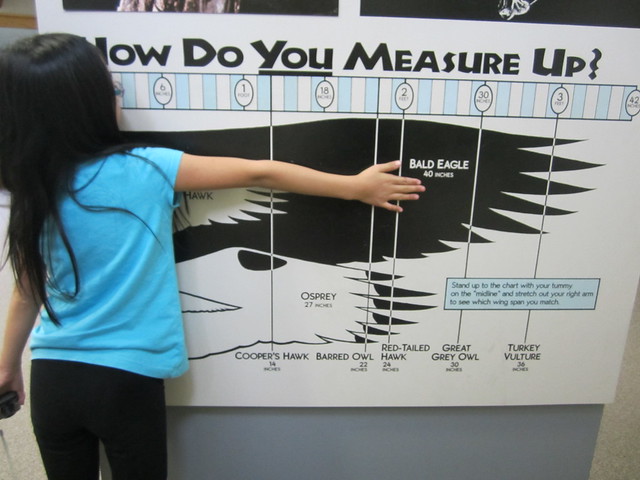
Olivia - Arm and Wing Span Comparison
Olivia checking out how her arm span compares to 
that of different birds at the 
William O'Brien State Park Visitor Center on May 26, 2012.

Reading the information gives a much deeper and better understanding of the area I'm visiting.

9. Post a nature photo each week based on the Nature Photo of the Week Prompt List.

There's a great list of ideas of what to photograph in nature.

Fossils
Fossils at Dinosaur State Park in Connecticut 
on September 4, 2011.

Two years ago I did a weekly photography challenge and enjoyed it. Last year, the format changed so I found another one. I did the challenge for about four months and stopped. The prompts weren't ones that I found inspiring. Having nature prompts, on the other hand...well, that's something I would enjoy.

10. Do nature studies at least three out of four weeks of each month (36 entries) both online and in my journal.

This may be the most challenging goal for me this year. I enjoy taking photographs and documenting what I see outdoors. However, I wasn't as diligent as I have been in the past in terms of keeping a nature journal and/or posting a record of what we've done.

Alligator
An alligator sunning itself on an island at 
South Padre Island Birding and Nature Center on April 30, 2010.

I'm hoping that in 2015 I can get re-focused and re-committed to nature journaling again. It's something that I truly enjoy looking back upon...it's just the effort of written and visual documentation that can be overwhelming at times.

11. Try 2 new outdoor sports.

As I look back on the past several years, we have experienced many fun and memorable outdoor sports. One of our favorite ones was dog sledding. We did this twice - once in Duluth and once in Ely.

Sophia, Olivia, and I dog sledding near 
Duluth, Minnesota on February 25, 2014.

We also went ice climbing which was a new experience. Although it wasn't a favorite of Olivia's (because of the heavy equipment), I certainly enjoyed the challenge and would do it again.

Getting a firm hold
Olivia and I went ice climbing at Gooseberry Falls 
on February 26, 2014, while Sophia watched.

We have tried some outdoor sports - like canoeing - through the state park's "I Can!" program.

Learning How to Paddle
The girls learning how to paddle a canoe 
on June 24, 2012.

The park provides all the equipment for free or either a very low cost in order for people to learn new skills and enjoy the outdoors.

Sophia and Olivia in the Canoe
Putting their new skills to work by canoeing on Lake Alice 
at William O'Brien State Park on June 24, 2012.

We have learned how to do rock climbing - first at Taylors Falls a couple of times.

Sophia and Olivia Rock Climbing
Olivia and Sophia rock climbing 
at Interstate State Park on June 23, 2012.

And then Olivia and I moved onto rock climbing on the North Shore which was far more challenging since you start from the top of the cliff, are lowered down to a point, and then climb your way back up. There is no ground beneath you - only Lake Superior.

Olivia making her way back up the cliff at Tettegouche State Park 
on July 12, 2014.

By trying new sports, we have learned ones that we prefer. For example, we have done both canoeing and kayaking now. Without hesitation, we all agree that kayaking (using sea kayaks with rudders) is much more enjoyable and something we would like to do more regularly.

Sea kayaking on Lake Superior at 
Split Rock Lighthouse State Park on July 12, 2014.
The lake was so calm we were able to explore a shipwreck 
that was easily visible from our kayaks.

Doing sports that we had not done before has given us opportunities to see places that we would never have seen otherwise.

Sophia (in front) in the kayak exploring a cave along the shores of Lake Superior.
This was below and to the northeast of Split Rock Lighthouse. 
The only way to access it is by kayak or canoe.
We did this on July 12, 2014.

One of the favorite activities of the girls is swimming.

Playing in Lake Shetek
The girls having fun swimming in Lake Shetek 
at Lake Shetek State Park on June 9, 2012.

One of the things I need to remember is that not all our outdoor activities have to take place at a state park.

Sophia, Olivia, and I back from canoeing on Gunflint Lake in
Grand Marais, Minnesota, on June 5, 2013.

There are so many places to explore and do outdoor sports throughout the state.

Olivia kayaking in a tandem sea kayak and 
Sophia paddling her sea kayak far ahead and to the right
on Gunflint Lake in Grand Marais, Minnesota, 
on June 5, 2013.

It's just a matter of searching for them and being open to new experiences.

12. Have 6 picnics when the weather is pleasant and we aren't battling with mosquitoes.

I remember growing up how we would go on picnics. I think it was a way for my parents to save money rather than going to restaurants.

At any rate, my mom and dad would pack well-balanced lunches and even include a free treats - like chips and - if we were lucky - pop. They found parks that had playgrounds so we could play for a bit.

Picnic on the Way to Pella
Having a picnic in Albert Lea, Minnesota, on April 29, 2009. 
We were on the way to Pella, Iowa, to see the tulips in bloom.
It was a bit chilly that day - as evidenced by 
Olivia wrapping herself in a blanket and 
my mom wearing the hood on her coat.

Sometimes just having a picnic under a tree on the nature trail or on the deck in the backyard is equally as special.

Sophia and Olivia on Picnic
Having a picnic on our nature trail on August 27, 2010.
We brought Gretel and Montague out to join us 
after we ate the food.

I've introduced doing picnics when we travel with mixed results. When the weather is nice and there's playground equipment...and no bees or mosquitoes...we have a great time.

Picnic in Lindbergh State Park
Having a picnic at Lindbergh State Park on September 4, 2012.
We went on a short hike and the girls played on the swings
before we continued on our driving trip.

Perhaps one of my goals - in addition to doing picnics - is to make sure that we have all the equipment we need (like forks, knives, and spoons) and that there is enough food and beverages for everyone. I've been known to forget some of these items which has made the picnic rather challenging.

Stopping for a Picnic
Having a picnic on the way back from the trip to 
Lake Itasca State Park on September 6, 2012.

There are a lot of inspiring images on Pinterest and recipes I'd like to try that would make good picnic fare.

13. Go camping twice during the year at new state parks.

We have been camping at several state parks in camper cabins and a tent. For me, the camper cabins feel safer and are more comfortable than tent camping.

Inside the Cabin
In a camper cabin at Lake Shetek State Park on June 9, 2012.
What this doesn't show is that the temperature and
humidity were both very high...and there was no air conditioning.
It was rather stifling inside the cabin, but 
we were thankful to have brought fans with us.

We can concentrate on other things besides setting up a tent and making sure everything in it stays dry - especially if it's raining.

That being said, the girls enjoyed camping in a tent in June 2014, so perhaps purchasing a tent and doing some tent camping may be something we explore in 2015.

The Girls and I  at William O'Brien Camping
Olivia, Sophia, and me making dinner over a campfire 
while we were camping at William O'Brien State Park 
on August 24, 2008.

One thing that we want to do is improve our skills and the diversity of what we prepare for meals while we are camping.

Olivia making dinner while camping 
at Wild River State Park on June 7, 2014.

We need to learn how to cook more complicated meals over a fire, and to cook meals (or parts of it) on a portable stove.

14. Learn 3 new outdoor skills and/or hobbies.

In addition to camping, cooking over an open fire, and outdoor sports, it would be good to add to our list of skills and hobbies that we can do.

Last year we learned how to fish.

Sophia learning to fish at 
Wild River State Park on June 7, 2014.

The year before that we learned how to operate a motor on a fishing boat. We had better luck with operating the motor in 2013 than we did in 2014.

Sophia learning to operate a motor on a fishing boat 
on Gunflint Lake on June 4, 2013.

Our ride back to Gunflint Lodge after our (rather: my) mishap with the motor was a quiet one as we reflected on how our ride with death could have had a rather unfortunate outcome had the safety bracelet not come undone from the motor and we had not had a paddle to get us to a dock that (thankfully) had a year-round resident who assisted us. 

But I digress. Let's focus on the positive. We learned a new skill.

For 2015, I'm thinking along the lines of things that can be done around our home and farm. Skills that would be practical - like new types of gardening, learning to build raised beds, making an outdoor oven in which we can bake pizza or bread. All of these things would be done outdoors - and surrounded by birds, wildlife, and a beautiful landscape.

15. Attend 4 workshops, classes, or activities at state parks.

Adding Seaweed
Olivia doing a fish painting at a program offered at
Interstate State Park on June 5, 2012.

Building a bluebird house
Sophia learning how to build a bluebird house on
March 16, 2013, at William O'Brien State Park.

And so there it is: 15 goals for 2015. I'm looking forward to doing them.