Wednesday, June 24, 2015

Creating a Barn Quilt Trail + "Log Cabin" Barn Quilt

Back in April, Olivia received a grant from Disney's Friends for Change to create a barn quilt trail in Washington County.

She held an informational and planning meeting on April 19th.


Three families from the Soaring Eagles 4-H Club as well as the president of the Friends of Scandia Parks and Trails met to discuss the project and a timeline.


By early May, we were purchasing MDO signboard, 2x2s and 2x4s.


Thankfully, we had a volunteer who helped transport these large pieces of plywood and lumber since we didn't have a vehicle large enough. He also did all the cutting of the pieces which was invaluable.


We began priming all the wood on May 9th.


The more exciting part of creating the barn quilts was picking out the colors and painting with them.


There were so many choices that it was difficult to make a decision sometimes.


Each of the seven barn quilt patterns were graphed out using different measurements. They were either done on 6-inch, 8-inch, or 12-inch scales.


The first barn quilt we worked on, Log Cabin, was done on a 6-inch scale. This meant that we had to figure out the design first on graph paper with each block representing a 6-inch square.

Then we transferred the design to the large sheets of primed signboard. We used string that was taped down on both sides and a three-foot ruler to make the lines.


Early in the project, Olivia was interviewed by Mary Divine of the St. Paul Pioneer Press.


She did a phone interview with her first on May 5th and then a face-to-face interview on May 12th. Mary was able to observe Olivia, Sophia, and other volunteers while they worked on the Log Cabin barn quilt.


One of the challenges was keeping all the paint colors straight - especially the yellows which are very close in shade.


This project was a great intergenerational activity. For this barn quilt, there were volunteers who ranged in age from 8-86 years old.


It also was a great way to learn from people who had skills that we didn't have - like woodworking.


The Washington County Barn Quilt Trail had a photographer who came out on a very cold day - 45 degrees! - to photograph Olivia and Sophia at work. We couldn't paint that day because it was so cold, so we ended up sanding wood filler where we had screwed the framework into the barn quilt.


Our hands were so cold!


The next time we painted - just a few days later - it was at least 20 degrees warmer. It made such a difference to be painting in nice weather.


Each of the sections that needed to be painted had to be taped off. The tape remained on the barn quilt until at least three - sometimes up to six - coats of paint were applied and dried.


On the last day of doing "Log Cabin," we screwed together the two big pieces of wood. The wood was either slightly off and/or had warped during the few weeks we had been working on it. So, we had to quickly fill a rather large gap with wood filler, sand it, and paint it before installing it later that afternoon.


While the paint was drying, Olivia and Dan measured the barn to find the center of it.


Around 6:00 p.m., more volunteers came to lift the 100+ pound barn quilt up and onto the 2x4 that would stay in place until the six-inch lag bolts were holding the barn quilt to the barn.


We were all a bit nervous as the barn quilt made its way up since it was so heavy and awkward. Everyone had worked so hard on it that we didn't want to see it fall to the ground.


Not to worry. It finally was in place and resting on the 2x4.


The six-inch lag bolts were put through the quilt and into the barn's huge beams.


Everyone was so happy with how it looked when it was up. It was about 7:30 p.m. by the time it was done - 1 1/2 hours after the process was started.


A couple days later, we went back on a sunny day to look at the barn quilt. It stands out and complements Gammelgarden Museum quite well. The colors tie into the buildings which make the barn quilt all that much more special and relevant to the museum.


This was a fun barn quilt to begin with. It was complicated, but not overly so compared to some other ones that we did with this project.


Olivia (the creator of the Barn Quilt Trail) and Lynne (the director of Gammelgarden) are both very pleased with how the Log Cabin barn quilt turned out, and are excited that it was done in time for Gammelgarden's opening event on the Sunday of Memorial Day weekend.

Sunday, June 21, 2015

Nature Photo of the Week - Week 25

The theme for this week's photo is "Birth." This is a drone bee (a male) emerging from a cell.


The bees had created a double layer of cells in the beehive to fix a frame-spacing error on our part. We didn't realize that the bees were so precise in amount of space they like between the frames in the hive. The spacing was off no more than a half an inch, but that made all the difference in the world to the bees.

As inexperienced beekeepers, we are learning how amazing and industrious these creatures are each time we visit them.

At any rate, we had to remove these cells from the hive, properly space the frames, and give the bees another opportunity to build onto the frame.

After we closed the hive, we were able to watch these drones emerge from their cells. It reminded me of when we had chickens and watched the little chicks peck their way from their eggs.

It's a slow process in the sense of the pace in which we live our lives. Yet, in reality, these baby bees know exactly what to do in a relatively short period of time.

Once they emerged, they walked around a bit and then began looking for food. Interestingly, there was honey in some of the cells that was leaking out. The drones found it and we could watch them eat it.

We placed the honeycomb near a container garden that is filled with flowers that attract bees. We're not sure if they went to the flowers since we had to move on with our day, but at least they were very near two food sources right after they emerged.

Sunday, June 14, 2015

Nature Photo of the Week - Week 24

This week the peonies started blooming. They are so fragrant and remind me of peonies my grandma used to grow along the side of her home and in her flower garden in the backyard.

One of the themes for the Nature Photo of the Week is "Fragrant" - so this seemed like a fitting photograph to choose.


Each of the peonies had ants in them. When I was younger, I didn't like the ants crawling over the flowers - especially after the flowers had been picked and were inside in a vase on the table.

I was told that the ants helped the petals open. According to the Heartland Peony Society, though, peonies don't rely on ants for the flowers to open. The Society said, "Some people think ants are required to open the flowers, but this does not to appear to be true .... Peonies produce small amounts of nectar and other ant attractants to encourage ants to help in opening the dense double flower buds found in many peonies." So, it looks like they are beneficial, but not necessary to the flowers opening.

Interestingly, the Society noted that, "Ants may be found covering certain varieties and avoiding others, this is totally normal." They also recommended not trying "to get rid of the ants on your peonies. This is a natural and temporary activity. Once the buds have opened the ants will disappear - also normal."


I also was interested in the meaning and symbolism of peonies. According to Teleflora, "With a recorded history that dates back thousands of years, it’s not surprising that even the mythology surrounding the origin of the peony has multiple versions.

"One legend has it that the peony is named after Paeon, a physician to the gods, who received the flower on Mount Olympus from the mother of Apollo. And another tells the story of that same physician who was 'saved' from the fate of dying as other mortals by being turned into the flower we know today as the peony."

The peony is the traditional floral symbol of China, the state flower of Indiana, and the 12th wedding anniversary flower. They are known as the flower of honor and riches. Teleflora noted, "With their lush, full, rounded bloom, peonies embody romance and prosperity and are regarded as an omen of good fortune and a happy marriage."

Another thing I was curious about was if peonies were edible. According to What's Cooking America, "In China the fallen petals are parboiled and sweetened as a tea-time delicacy. Peony water was used for drinking in the middle ages. Add peony petals to your summer salad or try floating in punches and lemonades."

Each week, new things are blooming and the landscape is changing. I've enjoyed spending more time outside and am looking forward to taking more photos of nature this week. I'll see which ones fit with the themes remaining for the year.

Tuesday, June 9, 2015

Nature Photo of the Week (Weeks 13-23)

One of my goals for 2015 is to take 52 pictures using the Nature Photo of the Week Prompt List. Rather than post each week, I am doing a group posting for 11 weeks.

Ideally I would have been taking one photo per week since my last posting at the end of March when I returned from a wonderful trip to three southern states (Louisiana, Mississippi, and Arkansas) where I was able to go on many nature walks.

However, it hasn't worked out that way. Instead, I went back on nature photos that I took from April through this past weekend, and picked about two dozen photos that I liked. From those pictures, I chose 11 of them that matched the prompts.

Feather: There were two wood ducks in the backyard at my mom's home in April. The feathers on these ducks are brilliant, and the picture doesn't do them justice since it is taken through a screen and window. Had I opened the door leading to the deck and backyard, they would have flown off.

My dad used to have a wood duck house next to the lake and each year there would be a new family of ducks that would use the house. They truly are beautiful, vibrantly-colored birds that are a joy to watch.


First day of...: Beekeeping. Sophia received a scholarship from the Minnesota Hobby Beekeepers Association to establish a hive. In April, she built a hive from a kit they provided, and then received a container of bees with a queen. We're excited to see how the bees do during their first year, and to watch the process of establishing a hive from scratch.


View: This is the view I had while walking on one of the trails at William O'Brien State Park. This one is along the St. Croix River. It's such a peaceful and quiet part of the trail. The trees provided a nice canopy along this section of the walk.


Refreshing: This spring the tulip and hyacinth bulbs came up along the driveway. After the snow and cold of winter, it was refreshing and uplifting to see a garden filled with shades of purple and magenta along with crisp white.


Stream or creek: Our 4-H club visited Koi Acres. This was the stone pathway that we crossed to get to the pond that had some of the koi.


Fish: At Koi Acres, there is a natural swimming pool/pond that has koi in it. These are big fish who were friendly and inquisitive. Each had unique markings and colors. Even in the drizzling rain, I could have spent hours just watching the fish swim in the pond.


Hidden: This heron was hiding among the tall grass at the pond at Gammelgarden to the left of the picture. All of a sudden, as we were painting the barn quilts (for part of the Barn Quilt Trail project) that afternoon, we noticed the heron slowly walking along the shoreline. It made its way out of the grasses and into this open area to turn slightly back from where it had walked. The heron stood there for a long time before continuing on its walk along the edge of the pond.


Just do it!: On the afternoon of June 5th, there was a big snapping turtle trying to cross a busy highway in the country. A woman stopped and was crossing the road to get the turtle to the other side.

We passed where she was and found a place to safely turn around so we could offer her our shovel. We stopped as did another family, and collectively each of us helped in some way to get this turtle back to a safe area and far from the road. I wondered how old it was and if it had ever come in contact with humans before.


Early: Early in the season, I enjoy watching how seeds emerge. These are beans that are about a week old. On some of them, you can still see the casing of the seed while others have pushed it away to  reveal the new, young leaves. Within 60 days, we should be enjoying fresh beans from the garden.


Little things: Among the huge hostas and ferns under the pine trees in the front yard are delicate bleeding hearts and columbine. Below is wild columbine that we found on the side of the road more than a decade ago. It would have been mowed by the county and no one or thing would have benefited from it.

When Olivia and I were out taking a look at the front gardens, we noticed a big bumblebee going from flower to flower on the columbine plant. It made me happy that this plant is helping the bees!


Fragile: This White Admiral butterfly was in the driveway on June 7th when we were painting barn quilts (again). The butterfly would fly around a bit, and then land on the rain-soaked sand and gravel on the driveway. Interestingly, this butterfly typically isn't spotted in our county in Minnesota. Rather, it is found to the west and north of us - mainly in the northeastern part of the state.


Now that the weather is much warmer; and things are growing and blooming, I'm hoping to spend even more time outside to notice and observe the changes each week in the plants, flowers, and world around me.

Sunday, June 7, 2015

Take-Out, Fake-Out: Beef & Broccoli {Crockpot}

Last year I was doing 101 Days of Summer Fun, and the theme for Mondays was Make It Monday. I made "Take-Out, Fake-Out: Beef & Broccoli" that everyone enjoyed. However, I forgot to take a picture.

So, I thought I'd make it again this summer while we were working on the Barn Quilt Trail project. The recipe is from a pin that I saw on Pinterest that led to Table for Two. It's a perfect Chinese-inspired main entree for four people that can be made in a slow cooker.

Beef & Broccoli that I made on June 7th

The ingredients include:

1 pound boneless, beef chuck roast, sliced into thin strips (this is put in the crockpot raw - do not precook or brown the meat)
1 cup beef consumme or beef broth
½ cup low sodium soy sauce
⅓ cup dark brown sugar
1 tablespoon sesame oil
3 garlic cloves, minced
2 tablespoons cornstarch
4 tablespoons sauce (from the crockpot after dish is cooked)
Fresh or frozen broccoli florets (as many as desired, I used about 2 cups)
White rice, cooked

The instructions are very easy:

In the insert of the crockpot, stir together the beef consume, soy sauce, dark brown sugar, sesame oil, and minced garlic.

Place your slices of beef in the liquid and stir to coat.

Turn the crockpot on low and cook for 6 hours.

After this time period, whisk together the cornstarch and cooking liquid in a small bowl to create a slurry. Pour the mixture into the crockpot and stir to mix. Add the broccoli florets. Cook on low for an additional 30 minutes to thicken the sauce, and defrost and cook the broccoli.

Serve over white rice. Enjoy!

Adding other vegetables - like snow peas - might be 
something that we would enjoy as well.

Tuesday, May 26, 2015

Top 10 Spring/Summer Chores: #7 - Plant Seeds and Transplants

Each year, there are things that we need to do in the spring and early summer. These are both chores that make getting through these seasons much easier; and things that will help the wildlife and/or flora.

1. Spring cleaning and purging - inside the home as well as outdoor (hobby shed, barn, and tractor shed).

2. Muck out the barn.

3. Repair the mailbox and post after having it damaged by the snow plow.

4. Tune up/service the lawn tractor.

5. Repair and/or replace the pasture fence.

6. Prepare the garden beds - create new ones and build new raised beds.

7. Plant seeds and transplants.


Flowers, vegetables, and herbs ready to be transplanted.

8. Build a chicken coop and introduce chicks to their new home.

9. Make repairs to any buildings damaged during the winter; and then paint them.

10. Start splitting and stacking wood.

*~*~*~*~*~*~*

This week, I'm focusing on planting seeds and transplants. Through our 4-H Club, we received ten Garden-in-a-Box kits. Three of the kits were given to families to manage at their own homes, and seven were kept at our farm to use as demonstration gardens, be used to harvest and share produce for those who participate in the summer gardening program; and to donate the surplus produce to the food shelf (our goal is 30 pounds).

Loading 35 bags of dirt into a pick-up before realizing that we didn't have enough vehicles with a significant amount of carrying capacity to carry 75 more bags of dirt.
Thus, we rented a U-Haul to transport 110 bags - or 2.2 tons - of soil to the farm.

The raised beds are different from the ones I've used in the past.

Friends/fellow 4-H parents help set up the 3'x4' bags for raised beds.

These are heavy-duty bags that "pop up" into a 3'x4' garden.

Each garden required 11 bags of soil. 
Once the 440 pounds of soil was put in the gardens,
they weren't going anywhere. 

We added 11 bags of soil (or 440 pounds) and two cups of fertilizer.

Olivia and Sophia work with fellow 4-Hers to set up the gardens.

It was so easy to set up the gardens compared to building raised beds from wood.

Bailey and Hoss supervise the work of 4-Hers.

The hardest work was behind us once the gardens were established.


About six days later, we put the transplants in the gardens. (It's amazing how quickly six days can go by.)

Olivia transplanting a tomato plant.

We are using the posts as a temporary way to mark off 12"x12" squares. We have 7 plants per raised bed or 49 plants total.

We placed different transplants into each section depending on their height. The plants that will grow the tallest are in the back row (the north side) and the shortest plants are in the front row (the south side). In this way, all the plants will receive the maximum amount of sunlight.

The plants are all in the garden and ready to start growing.

We have five spaces per garden (35 spaces total) to fill with other transplants or seeds. Some of the seeds we have and others we still need to purchase. We also need to purchase a few more transplants for this gardens as well as others that we want to establish this year. Our goal is to have everything in planted by end of the first week of June.


This past Sunday, we put down newspapers and then bark chips on top of that. It finishes of the gardens nicely. We still need to trim around the gardens and cut back some of the wild black raspberries that are growing on the north side of the 4 raised beds.

It will be interesting to see if our challenges with weeding are not as great as in past years since we are not planning to add any compost from our farm to the raised beds. We will be planting other gardens in which we do use compost from our farm (from the horses), and will see if there is a difference in terms of the number of weeds.

Other than that, it is such a sense of satisfaction to have gardens again. In a couple of months we should be enjoying fresh vegetables!

Sunday, May 17, 2015

Finding Deep Joy - Read 52 Books in 52 Weeks - Week 20

For the 20th week in the Read 52 Books in 52 Weeks challenge, I read Finding Deep Joy by Robert Ellwood. This is a book that is part of the "Joy" focus in the Spiritual Practices A to Z that I'm also doing this year.


Some of the things that I found interesting in Finding Deep Joy were:
- Joy lies hidden deep down at the heart of all things - boulders, trees, dolphins, zebras, and ourselves.
- Joy can be tapped in such a way that we can recognize its presence everywhere.
- When this deep joy comes, it is just there, independent of outer events....It is a pure joy of being that can well up in the most ordinary settings...even in a hospital bed or a prison cell.
- Joy is not only your right, your heritage; joy is you at the deepest level, and your joy is one with the infinite, timeless joy of the unbound universe.
- Yet so often we block joy. We get caught up in our routines, our little fears and goals. We merely skim the surface of little puddles of joy as we run by.
- After going through a great personal joy or sorrow - falling in love or losing a loved one - you come to a point where you just don't feel it so strongly anymore. You may even feel emotionally numb.
- Questing for happiness in the world of things turns our gaze away from the genuine wellsprings of deep joy, which have little to do with possessions, excitement, entertainment, or fun - though deep joy enhances all innocent pleasure.
- We ought to be able to know joy in each moment, in each person we meet, or each object we see, however transitory the event, unprepossessing the person, or trivial the object to the casual eye.
- Love or compassion is the supreme ethical value simply because it expresses the unity of the universe. Its opposite, hatred, which wants to alienate and separate and distance people and things, is at cross-purposes with the true nature of the universe and can never ultimately prevail.
- Compassion is simply expressing in action the interrelatedness of all life, all being; the person who talks about cosmic oneness but does not express it in compassion has not begun to understand it.
- Joy represents a state of equilibrium, one that is tension free.
- What the joyous person has is a radiance, a smiling serenity accented by a twinkle. That person may be of any religion or none.
- You should abstain from harming others, falsehood, theft, and greed; you should observe purity, contentment, study, and religious devotion....When you set foot on the spiritual path to deep joy, you must give up all that is untrue to yourself and all that harms others, all that caters to the self-centered appetites and passions, and all forms of excess, while taking on a simple lifestyle, an even-tempered frame of mind, and emphasizing higher things.
- The ill effects of negative thoughts, words, and deeds that might be no great sin for an ordinary person will be much greater for one seriously engaged in any spiritual path....That is because the higher your aspirations - or sometimes attainments - the greater the inner schism created by departures from them. The farther apart the poles of aspiration an behavior, the greater the chance that the whole system will fly off kilter and degenerate into chaos.
- It is said that you can break a bad habit or establish a good habit by carefully not doing the former and doing the latter for one month. Try it: do not overeat, drink, smoke, or whatever the compulsion is, for one month. Then do what you set yourself to do for a month - meditation, regular exercise, good eating, whatever. See if the negative dependency has not lost its power and the good become well established.
- So far as the rest of your life is concerned, the key is to live in a manner that is congruent with your spiritual practice.
- Your lifestyle and surroundings should be calming, tend toward joy, and foster a sense of living for more than sensual and material  gratification.
- If you want to find and keep joy, it helps to live in reasonable simplicity, neither in abject poverty nor choked with material goods.
- If you move toward simplicity - living in a clean and neat but unostentatious home, earning an honest living and spending within your means, eating wholesome food and keeping regular hours, you will set the physical conditions for joy.
- Living moderately and simply does not mean stifling creativity...No human activity is closer to the wellsprings of deep joy than creativity. Cultivate it in your own way. If you enjoy cooking, prepare your wholesome food as creatively as possible. Ornament your house with art or furnishings made by yourself or your friends. Spend part of your free time writing or painting. It doesn't matter so much what you do, but find something creative that you like and feel good at, and spend time with it.
- It is important to have a collection of books on topics consonant with your spiritual quest, the sort you return to time and time again for inspiration. Related pictures and symbols might be on the walls.
- You must not try to push anyone else in the household....into a lifestyle they have not freely chosen. If they choose to live less simply than you or around different values, you must accept this cheerfully and not let it become a source of contention, just as they must accept your way. All this is part of the love and wise moderation of the path to joy.
- Take time out to cultivate deep joy....In times of great suffering, poverty, sorrow, or anxiety - above all, of sadness - it is even more important.
- No obligations imposed by troubles are so great that they preclude all recourse to deep joy, even if for only a few minutes saved for prayer or meditation.
- In real engagement with life, the seeds of joy are always there, for engagement means looking outward rather than toward the self.
- Live here and now, in the present moment. Remember that deep joy is now; pain is mostly past and future.
- Past and future are not real. They are only constructions of mind. True, the mind may use certain memories as building blocks to reconstruct the past and to fashion the future. Still, what we are in the present really determines how we read past and future. If we are anxious and depressed, we will tend to drag up unpleasant and crazy-making memories from the storehouse of the past and build a future out of the darkest present trends in our lives. If we are full of deep joy in the present, we will make a past out of happy memories or of crises from which we emerged triumphant. We will look forward to a future in which everything that is now going well only grows in power.
- Clean up the present moment, fill it with joy, and let its sunshine dissipate the clouds of past and future. This does not mean that nay bad thing that objectively did happen or will happen is magically made nonexistent. But their power to hurt will be gone. They will just be there, but impotent.
- Don't worry about ten years or even ten minutes from now. Stay in touch with deep joy here an now, in the present, one second at a time. Nothing can destroy it so quickly as not allowing yourself even the present second of joy! Grief, heavy problems, and physical pain are real, but they depend on tight bondage to the past and future for their reality.
- Difficulties are opportunities.
- The bad times can aid you in learning compassion.
- It is the nature of compassion and caring to do all that is humanly possible to change the situation so that happiness rather than suffering is what is shared.
- Joy is ours by right and we are empowered to take charge of our lives.

In spring, hundreds of flowers; in autumn, a harvest moon;
In summer, a refreshing breeze; in winter, snow will accompany you.
If useless things do not hang in your mind,
Any season is good for you.
- The Gateless Gate (Zen text)

There were suggestions of things to do:
- Think back over your life and record the moments when you have felt the most joy. Perhaps they have to do with the smell of autumn...or the satisfaction of having helped someone. Consider keeping a journal for this purpose.
- Pain, disappointment, suffering, and death are realities in everyone's life. Thing about your own greatest heartaches and hardships. What can you affirm of value beyond these painful experiences? What can you affirm of value in them?
- Whatever your present circumstances, list 10 things for which you are grateful today.
- Find an image of (or simply visualize) your favorite saint. Look deeply into his or her eyes until you catch a little of that saint's joy - real sanctity is caught, not taught!

Sunday, May 10, 2015

Simple Living - Read 52 Books in 52 Weeks - Week 19

For the 19th week of the Read 52 Books in 52 Weeks challenge, I read Simple Living by Jose Hobday.


- Simple living is about freedom.
- Choose space rather than clutter, to choose open and generous living rather than a secure and sheltered way.
- Freedom to choose less rather than more. It's about choosing time for people and ideas and self-growth rather than for maintenance and guarding and possessing and cleaning.
- it is about poetry and dance, song and art, music and grace. It is about optimism and humor, gratitude and appreciation.
- It is a relaxed grasp on money, things, and even friends.
- Simplicity cherishes ideas and relationships.
- It doesn't cling nor try to possess things or people or relationships. Simplicity frees us within, but it frees others, too. People don't have to compliment our clothing or admire our collections. They aren't distracted from what's real.
- It makes us welcome among the wealthy and the poor alike. The poor are not offended by our dress and the rich are not threatened. This applies to clothing, housing, and transportation.
- Attending to simple living yields unsuspected abundance, joy, and freedom.
- Having things that are meaningful to us contributes to simple living.
- We have to know what matters in this life.
- The native tradition is always to seek harmony. If you have many needs and desires, harmony is not possible.
- The best way to sell ourselves is through what we believe in through our values and principles.
- Don't listen to what they say, look at how they live. That's where their beliefs are.
- Simple living requires us to take a good look at our consumer mentality, our spending mentality, and our misunderstood right to squander the gifts and good of this world for a few so that many are deprived and suffer.
- We learn to appreciate what we have.
- We gain not only material space but inner room for things that are new and exciting. We gain an uncluttered spot for something lovely and beautiful. We gain time. We have more room in our soul. Our soul feels clean and empty, swept out - uncluttered and unfettered.
- Our spirit yearns for more quality....It requires more love in our actions.
-  There's a depth, a quality, an inner smile that goes with being really present, because the ultimate wonder is that we are present to ourselves.
- Parenthood is difficult...because discipline is required - of patience, of waiting, of understanding requires extraordinary love and attention, consciousness, care, and time.
- What food do I need each day to keep me healthy?
- As we look at our basic clothing needs, we ask, "What do I really need?"
- The spiritual task is to discern between real needs and the extras. We don't need the extras.
- If you have all of your needs met, all of your helps met, most of your preferences met, and most of your luxuries met, you are not living a gospel life. You are blind to the real world, especially to the poor.

Sunday, May 3, 2015

Where Women Create - Read 52 Books in 52 Weeks - Week 18

During 2015, I'm doing two challenges: Read 52 Books in 52 Weeks and Spiritual Practices from A to Z. The latter challenge is what is guiding my reading choices for the year.

The spiritual practice I am currently focusing on is "Imagination." I found a book at the library called Where Women Create - Inspiring Work Spaces of Extraordinary Women by Jo Packham.


This was more of a browsing book versus reading book, although there is plenty of text throughout it. I just found that was looking at the pictures and concentrating on the more visual elements of the book than the written words.

The overall feeling, though, as I completed the book was "clutter" and "chaos." I'm sure there's an organizational system in each of the artist's work space. However, for me, the majority of the spaces had so much stuff. It was just too much. I would find it difficult to concentrate and be inspired with so many distractions around me.

Everywhere in the work spaces was something. There was often no open space on walls, in closets, in drawers - anywhere. That would drive me crazy.

One artist did have a floor that I liked. It was hand-painted and had big square blocks on it. The outlines (maybe 1" wide borders) were a sage green. In one corner, a diagonal line was drawn and then divided in half so there were two small triangles. One of the blocks was painted purple, and then the two small triangles were red and turquoise separated by a gold line/border. The other square was painted red and the two small triangles were gold and purple separated by a turquoise line/border.

What I did take away from the book were some helpful tips:

- To launch your imaginary voyage, carve out a private space and time, even if it's only an hour sketching.
- Give yourself time to straighten up at the end of a session so you can start the next time without being too overwhelmed.

There were some good quotes too:

- Live simply so that others may simply life. (Anonymous)
- The future belongs to those who believe in the beauty of their dreams. (Eleanor Roosevelt)
- What things are true, what things are honest, what things are just, what things are pure, what things are lovely, what things are of good report; if there be any virtue, and if there be any praise, think on these things. (Philippians 4:8)
- Not merely an absence of noise, real silence begins when a reasonable being withdraws from the noise in order to find peace and order in his inner sanctuary. (Peter Manard)
- Use it up, wear it out, make it do, or do without. (Old New England Proverb)

Sunday, April 26, 2015

Cool Spaces for Kids - Read 52 Books in 52 Weeks - Week 17

For the 17th week of the Read 52 Books in 52 Weeks challenge as well as the Spiritual Practices from A to Z challenge, I read Cool Spaces for Kids by Sam Scarborough.


This wasn't one of the books recommended on the Spiritual Practices from A to Z list for this week's focus (Imagination), but I felt that the book captured the spirit of imagination.

The book is a delightful compilation of ideas and patterns for creating items that would foster a child's imagination. Many of the ideas brought back wonderful memories of the earlier years of Sophia's and Olivia's lives when they would play for countless hours with imaginative toys and props that I collected for them.

They would spend a lot of time in their indoor play space - a dramatic play area as I referred to it.  The play area would change each week or so - one week it was a bakery, another week a veterinarian's office, and another week a campsite. Their minds would transport them to these worlds and they would play and imagine what life was like in these places.

The one section that I particularly enjoyed in Cool Spaces for Kids was the treehouse section. The author offered advice:
- Plan a fantasy space. Spend some time planning with your children.
- Build together. Build trap doors, fixed step ladders for little ones, and hanging ladders for older climbers.
- Decorate the interior. Make curtains, add floor cushions and blankets. Take up roll-up mattresses and sleeping bags.
- Add swings and slides. Add a zip line or create a suspension bridge or walkway.
- Build signposts and pulley baskets. Hoist up a picnic basket on a pulley for lunch supplies or books and other toys.
- Build a treehouse without damaging the tree. 

Another idea that would be appropriate for tweens/teens is to make a games table. The author suggested using decorative scrapbook paper and decoupaging it onto the wooden table. This is a different - and quite beautiful - way to embellish a table while giving it another practical purpose. Perhaps this could be a future 4-H project for one of the girls since both enjoy playing games.

Thursday, April 23, 2015

Spiritual Practices A to Z: Hope

The eighth spiritual practice this year, is focused Gratitude. These ideas came from the Spirituality and Practice website which has a wide variety of ideas for bringing this practice to life.

Spiritual Practices: Hope
Enhances: Optimism
Balances/Counters: Despair, Impatience

The Basic Practice

Hope is a positive and powerful spiritual practice with the strength to pull us through challenging times. It is usually described with light metaphors — a beam, ray, glimmer of hope; a break in the clouds; or the light at the end of the dark tunnel. It is often discovered in unexpected places.

Sophia as Laura Ingalls Wilder at Sunset
Sophia skipping through the pasture as she spreads milkweed.
We were hopeful that the seeds would take and new milkweed plants would grow.
Almost eight years later, there are countless milkweed plants
throughout our farm. 
Our dedication to spreading milkweed seeds has paid off!
(Taken on October 20, 2007)

Hope can be learned with practice; and certain attitudes support it. One is patience or an ability to tolerate delays and a willingness to let events unfold in their own time. The other is courage or having an attitude of confidence even when facing the unknown. A third is persistence or the determination to keep going no matter what happens. We have hope when we can say, all will be well, and we mean it.

Why This Practice May Be For You

Hope is the basic component of optimism - or a tendency to dwell on the best possibilities. It goes well with another spiritual practice — enthusiasm - which is equally energizing.

But a more common — and very telling expression — is "Hope for the best, but expect the worst." As the Spirituality and Practice website said, "The more likely outcome, it implies, is the worst. When we are without hope, we easily fall victim to such negativism. When the light of hope is absent, we are overcome by gloom and doom, despair and defeatism."

Quotes

The Chinese have a saying: If you keep a green bough in your heart surely the singing bird will come.
— Chinese saying quoted in The Web in the Sea by Alice O. Howell

Singing Female Rose-Breasted Grosbeak

A singing female rose-breasted grosbeak on 
a pine tree in the pasture.
(Taken on June 10, 2011)

Hope is the foundation for creativity, inspiration, joy and all those emotions which allow us to transcend ourselves.
— Verena Kast in Joy, Inspiration and Hope

Books

Soul of a Citizen - Living with Conviction in Challenging Times by Paul Rogat Loeb

I also found a book at the library called The Cure for the Chronic Life - Overcoming the Hopelessness that Holds You Back by Deanna Favre and Shane Stanford.

Film

Cast Away - I have watched this movie several times and it truly does capture the essence of hope.

Places in the Heart

Music

According to the Spirituality and Practice website, "Rock music is basically a hopeful medium, despite all the lyrics about personal woes and the messes and miseries of the world. When we need a boost, nothing is quite as effective as putting on a pounding rock song and joining in the defiant and hopeful chorus."

The site suggested several different songs to listen to including:

- "I Can See Clearly Now" by Johnny Nash

I remember this song when it came out in the 1970s. I liked it then and I still enjoy listening to when I hear now. It's one of those songs that instantly uplifts your mood. The lyrics are so hopeful:

I can see clearly now, the rain is gone,
I can see all obstacles in my way
Gone are the dark clouds that had me blind
It's gonna be a bright (bright), bright (bright)
Sun-Shiny day.

I think I can make it now, the pain is gone
All of the bad feelings have disappeared
Here is the rainbow I've been prayin for
It's gonna be a bright (bright), bright (bright)
Sun-Shiny day.

Look all around, there's nothin but blue skies
Look straight ahead, nothin but blue skies

- "You Can Make It If You Try" by Sly and the Family Stone

I had never heard this song before. The solo keyboard music about a minute or so in reminds me of a band I used to listen to in the late-1980s, The Wallets. Only that part - the rest of the song has more of a 70's flair to it.

- "I Shall Be Released" by Bob Dylan

The video that accompanies this song has lots of pictures of prisoners, some famous people who were imprisoned, and prisons. It would be nice to know what all the images are to give them some context, but it still is an interesting compilation of images to reflect upon as one listens to the music. One must have had hope to be able to endure the situations shown in the photographs.

- "I Will Survive" by Gloria Gaynor Stevens

This is a live version of this song. For the first minute it is a bit slow-going, but then the song kicks in and it is the way that I remember it. In some respects it looks like she is someone in deep despair at the beginning of the song, but then moves to hope and living her life to the fullest as she gets rid of someone who didn't have her best interest at heart. She will survive...and will do well in her life!

Daily Cue, Reminder, Vow, Blessing

• Turning on a lamp is a cue for me to practice hope.

• When I plant a seed or a bulb, I am reminded to plant hope in my heart.

Whenever I have planted a bulb in the fall or spring, it is always with hope that it will grow. I envision the colorful flowers emerging months later - brightening the yard and bringing happiness to everyone who seems them. Sometimes the flowers come up, sometimes they don't. Regardless, I still will continue to plant bulbs with the hope of transforming the environment.

Planting Nasturiums

The girls were planting nasturiums and bulbs in the backyard.
(Taken on May 27, 2011)

The same is true for trees. I think of all the trees we planted in May - 43 of them - in the pasture and front yard. Will I ever see them at their full size. No, probably not. But, that's not important. Someone will see them and enjoy them in the future...and they'll know that someone took the time to plant them so that they could enjoy them. Hopefully that cycle continues indefinitely.

Practice of the Day

No true effort is in vain. Look at the fields over there. The grain sown therein has to remain in the earth for a certain time, then it sprouts, and in due time yields hundreds of its kind. The same is the case with every effort in a good cause.
— Badshah Khan quoted in Nonviolent Soldier of Islam by Eknath Easwaran

To Practice This Thought: Sow some grain for a good cause, and don't concern yourself with results. 

I do have many packets of wildflowers that could be randomly tossed into the field and see what happens. Will they germinate? Hopefully...and with that the landscape would be significantly more beautiful. Butterflies, bees, and other pollinators would have more food.

The only way I can do this is by opening the packets of seeds and sowing them. Imagine if they did yield hundreds of their kind. What an amazingly beautiful image people could hold in their minds as they go about their days and lives.

Bee on Flowers
A bee on a wildflower in the pasture.
(Taken on September 25, 2011)

Spiritual Exercises

• Write affirmations to express your hopes for yourself and a better world. The sacred texts from all traditions contain assurances that give rise to hope. For example, "Even though I walk through the darkest valley, you are with me."

I haven't had a chance to do this yet. We just started working on the Barn Quilt Trail and it is taking quite a bit of time to get everything set up.

Journal Exercises

These are all things I would like to write about at some point:

• Quickly write a list beginning with "I hope for . . ." Try writing it with your non-dominant hand to access your less expressed feelings.

• The Chinese have a saying, "If you keep a green bough in your heart, surely the singing bird will come." How and where can you make a place for hope in your life? Describe specific opportunities.

• Write a reflection on the ways you have been a life-bringer and a bearer of hope to your family, friends, or community.

Girls Visiting Adoption Agency

Visit to the adoption agency that helped us adopt Sophia and Olivia.
(Taken on March 8, 2012)

Discussion Questions, Storytelling, Sharing

Again, I haven't had the opportunity to reflect on these questions but would like to at some point:

• Share the story of a time when the strength of hope was a spiritual resource that helped pull you through a difficult period.

• What do you think people mean when they say to you, "Don't get your hopes up too high?" What would be a good response to this advice?

• Does the prospect of the future fill you with anxiety or hope? Why?

Household, Group, and Community Projects

I haven't done this yet, but I think it is worth doing some time during the upcoming year:

• Have a family meeting to talk about your attitudes toward the future. Identify people who have nurtured your optimism. Then find ways to honor these mentors of hope — writing letters, adding their pictures to a household shrine, or making a contribution to an organization in their names.

• Plant trees. Many people plant trees in whose shade they will never sit during their lifetimes. This act reflects confidence and hope in the future.

Olivia planting a tree in the pasture in April 2015.

Olivia, Sophia, and I planted 43 pine trees this spring in the northwest pasture and the area next to the driveway.

Sophia planting a tree in the pasture in April 2015.

They are seedlings at this point - ranging in height from 6-8 inches tall. How different everything will look when these trees are three feet...six feet...twelve feet...twenty feet tall. The shade and shelter that they will provide to animals and people makes me so happy...and hopeful...for the future.

Wednesday, April 22, 2015

Poet/Poetry Study - Ralph Waldo Emerson

Ralph Waldo Emerson, an American poet, essayist, and philosopher, was born on May 25, 1803, in Boston, Massachusetts. After studying at Harvard and teaching briefly, Emerson began in the ministry and became an unwilling preacher.

Unable in conscience to administer the sacrament of the Lord’s Supper after his nineteen-year-old wife died of tuberculosis, he resigned his pastorate in 1831.


The following year, he sailed for Europe and visited two people: Thomas Carlyle and Samuel Taylor Coleridge. He returned to New England and began challenging traditional thought.

In 1835, he married his second wife, Lydia Jackson, and settled in Concord, Massachusetts. Emerson was known in the local literary circle as “The Sage of Concord," and became the spokesman for Transcendentalism, an American philosophic and literary movement that was a reaction against scientific rationalism.

Emerson’s first book, Nature, best captures his view of Transcendentalism - the belief that everything in our world (even a drop of dew) is a microcosm of the universe.

Ralph Waldo Emerson died of pneumonia on April 27, 1882.

*~*~*~*~*~*~*~*~*

Beauty

Was never form and never face
So sweet to seyd as only grace
Which did not slumber like a stone,
But hovered gleaming and was gone.
Beauty chased he everywhere,
In flame, in storm, in clouds of air.

He smote the lake to feed his eye
With the beryl beam of the broken wave;
He flung in pebbles well to hear
The moment's music which they gave.

Oft pealed for him a lofty tone
From nodding pole and belting zone.
He heard a voice none else could hear
From centred and from errant sphere.

The quaking earth did quake in rhyme,
Seas ebbed and flowed in epic chime.
In dens of passion, and pits of woe,
He saw strong Eros struggling through,
To sun the dark and solve the curse,
And beam to the bounds of the universe.

While thus to love he gave his days
In loyal worship, scorning praise,
How spread their lures for him in vain
Thieving Ambition and paltering Gain!
He thought it happier to be dead,
To die for Beauty, than live for bread.

Sophia thought: Huh... The beginning was pretty...it was beautiful. Towards the end it took on a bittersweet tone almost. It reminded me of a red rose because one of the things I think about when I think of beauty is a rose.

Olivia thought: I liked it, but it wasn't exactly my favorite. I liked the way it was said - the words. I didn't even notice that it rhymed. 


*~*~*~*~*~*~*~*~*~*

The Mountain and the Squirrel

The mountain and the squirrel
Had a quarrel,
And the former called the latter
“Little prig.”

Bun replied,
“You are doubtless very big;
But all sorts of things and weather
Must be taken in together
To make up a year
And a sphere.

And I think it no disgrace
To occupy my place.
If I'm not so large as you,
You are not so small as I,
And not half so spry:
I'll not deny you make
A very pretty squirrel track.

Talents differ; all is well and wisely put;
If I cannot carry forests on my back,
Neither can you crack a nut."

Sophia thought: That was cute. It was kind of funny that the squirrel told off the mountain. What does "prig" mean? (a self-righteously moralistic person who behaves as if superior to others). The beginning and ending was the best compared to the writing in the middle.

Olivia thought: That was really cute. I really liked that one because it sounded so funny. I liked the last part where the poet wrote about carrying forests on one's back and how the mountain can't crack a nut.

*~*~*~*~*~*~*~*~*~*

The Humble-Bee

Burly, dozing humble-bee,
Where thou art is clime for me.
Let them sail for Porto Rique,
Far-off heats through seas to seek;
I will follow thee alone,
Thou animated torrid-zone!

Zigzag steerer, desert cheerer,
Let me chase thy waving lines;
Keep me nearer, me thy hearer,
Singing over shrubs and vines.

Insect lover of the sun,
Joy of thy dominion!
Sailor of the atmosphere;
Swimmer through the waves of air;
Voyager of light and noon;
Epicurean of June;
Wait, I prithee, till I come
Within earshot of thy hum,—
All without is martyrdom.

When the south wind, in May days,
With a net of shining haze
Silvers the horizon wall,
And, with softness touching all,
Tints the human countenance
With a color of romance,
And, infusing subtle heats,
Turns the sod to violets,
Thou, in sunny solitudes,
Rover of the underwoods,
The green silence dost displace
With thy mellow, breezy bass.

Hot midsummer's petted crone,
Sweet to me thy drowsy tone
Tells of countless sunny hours,
Long days, and solid banks of flowers;
Of gulfs of sweetness without bound
In Indian wildernesses found;
Of Syrian peace, immortal leisure,
Firmest cheer, and bird-like pleasure.

Aught unsavory or unclean
Hath my insect never seen;
But violets and bilberry bells,
Maple-sap, and daffodels,
Grass with green flag half-mast high,
Succory to match the sky,
Columbine with horn of honey,
Scented fern, and agrimony,
Clover, catchfly, adder's-tongue
And brier-roses, dwelt among;
All beside was unknown waste,
All was picture as he passed.

Wiser far than human seer,
Yellow-breeched philosopher!
Seeing only what is fair,
Sipping only what is sweet,
Thou dost mock at fate and care,
Leave the chaff, and take the wheat.

When the fierce northwestern blast
Cools sea and land so far and fast,
Thou already slumberest deep;
Woe and want thou canst outsleep;
Want and woe, which torture us,
Thy sleep makes ridiculous.

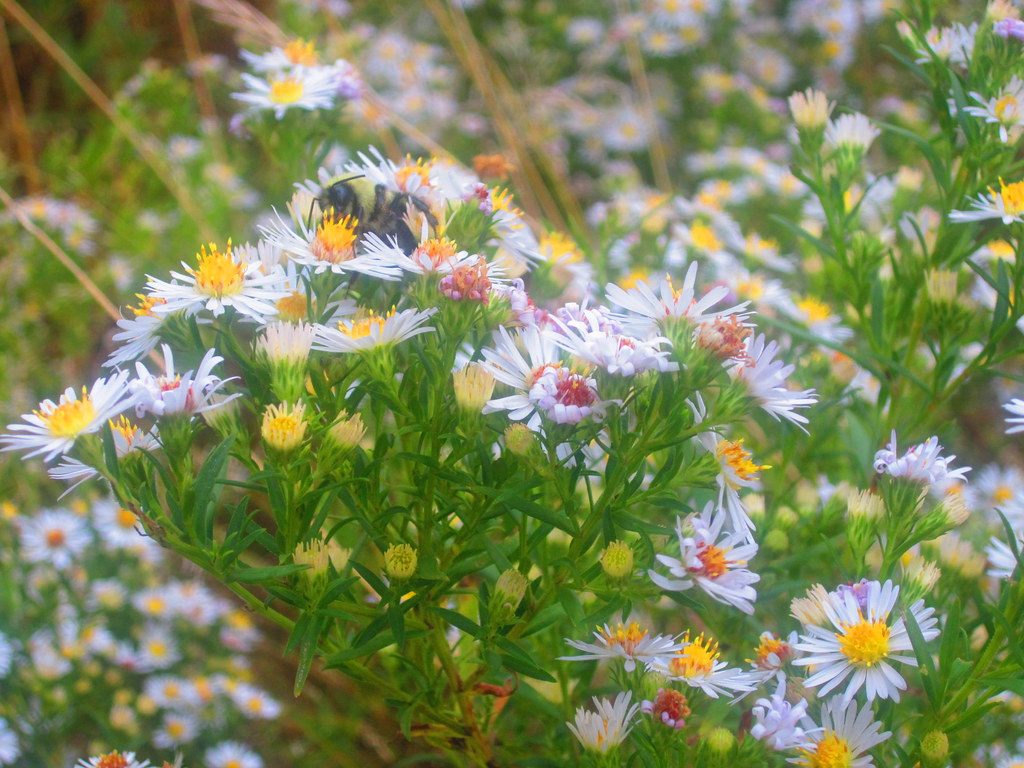
Sophia thought: That one was too long. The title was a little bit misguiding because I was expecting a bumblebee or honeybee. That's what I was imagining it to be about. I was thinking the poem would be more like the Mountain and Squirrel. I didn't really this one. It was a bit too involved. 

Olivia thought: This one was good. I liked the name and beginning of it, but not so much the end. I liked how at the beginning the poet described how the bee was going on its journey for nectar. 
*~*~*~*~*~*~*~*~*~*

Not poems, but famous quotes:

=> To laugh often and much; To win the respect of intelligent people and the affection of children; To earn the appreciation of honest critics and endure the betrayal of false friends; To appreciate beauty, to find the best in others; To leave the world a bit better, whether by a healthy child, a garden patch, or a redeemed social condition; To know even one life has breathed easier because you have lived. This is to have succeeded.

Sophia thought: I liked that. It certainly makes you want to be a better person. I think I've done some of these things. I need to work on leaving the world a better place.

Olivia thought: I liked the beginning of that one - especially the part about winning the respect of intelligent people and the affection of children. I would agree that these are some of the things that make a person successful.

=> Do not go where the path may lead, go instead where there is no path and leave a trail.

Sophia thought: That's kind of inspirational. I like the idea of making your own path and not simply following others.

Olivia thought: That one is good. When it said "Don't go on the path" I thought, "What if you don't know where to go if there's no path? You could get lost." 

=> You cannot do a kindness too soon, for you never know how soon it will be too late.

Sophia thought: That's kind of ominous. Do a good deed now or you may never get a chance to. I do think that has some truth to it.

Olivia thought: I like that one because it shows that you should do something right away rather than waiting and not being able to do it...and maybe regretting that you never did it.

=> What lies behind you and what lies in front of you, pales in comparison to what lies inside of you.

Sophia thought: That's interesting. It kind of sounds like you could either be a really good or bad person. 

Olivia thought: It kind of reminds me of the past, present, and future thing. The first part is leaving the past behind you; the second part is not worrying about the things that will happen in the future; and the last part is about learning to live in the present moment.

=> To be yourself in a world that is constantly trying to make you something else is the greatest accomplishment.

Sophia thought: I don't think anyone has ever done that. There is always someone who can always change you for both the positive and negative.

Olivia thought: Makes sense. It shows that you should be yourself no matter what people say.