Sunday, February 1, 2015

Spiritual Practices A to Z: Beauty

Throughout 2015, I am going to do "Spiritual Practices A to Z" based on the spiritual practices that are shared on the Spirituality & Practice website. There is a list available of spiritual practices that are from A to Z. Some letters have two practices, but the majority have one.

I am choosing to focus on one spiritual practice for two weeks, and then move onto another one. There are quite a few different ideas - from reading, watching movies, listening to music, looking at artwork, journaling, and spiritual exercises.

So, for the past two weeks, I have focused on the spiritual practice of beauty.

Spiritual Practice: Beauty
Enhances: Simplicity, Pleasure
Balances/Counters: Clutter, Habitual Life

The Basic Practice

As the Spiritual Practices website says, "The Navaho blessing 'May you walk in beauty' catches the essence of this spiritual practice. Beauty is both a path you travel and what surrounds you on the path. In the splendor of the Creation, we see its outer forms. In morality and benevolence, we recognize its inner expressions.

Purple Log Pathway
A pathway of logs painted purple.
Taken on May 20, 2010 at  
Franconia Sculpture Park.

"Start this practice with the assumption that beauty is everywhere just waiting for you to notice it. Allow yourself to feel its effect upon your soul. Some experiences will stop you in your tracks and take your breath away. Others will be more subtle but equally sublime. Then make your actions reflections of the beauty all around you."

Shadow on a Rock
A shadow on the road.
Taken on June 1, 2008.

Why This Practice May Be For You

Clutter gets in the way of beauty. If we have too many things and tasks in front of us, we may not notice what is beautiful about them. The contrast is simplicity; by paring away excesses, we make an opening for splendor.

Buckets and Shoes
A simple part of a home in Pella, Iowa.
Taken on April 29, 2009.

Routine and rigid thinking also restrict our appreciation of beauty. If we are stuck in a rut, we never discover the refreshment waiting just around the corners of our daily schedule. If we have a narrow understanding of aesthetics, we are limited in our ability to recognize beauty's varied manifestations.

Beauty is startling, stimulating, and soothing. Try this practice when you need to be pulled out of your habitual way of seeing and being. Its cultivation produces pleasure.

Quotations

The Buddha taught that morality is the true beauty of a human being, not one's physical appearance or outer adornments.
— Joseph Goldstein in Transforming the Mind, Healing the World

Another Amish Home
Clothing hanging outdoors to dry at an Amish home.
Taken on August 24, 2012.

To recognize, appreciate, or create beauty is to bring gladness into life.
— Paul Brunton quoted in Meditations for People in Crisis edited by Sam and Leslie Cohen

Sophia laughing...a typical look
Sophia on August 9, 2007.

It's the beauty within us that makes it possible for us to recognize the beauty around us.
— Joan Chittister in The Psalms
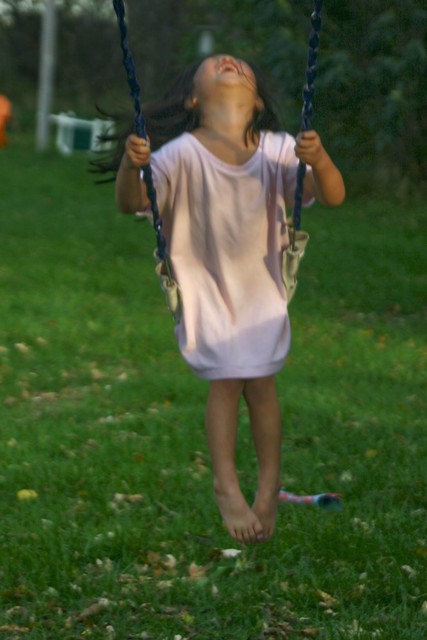
Olivia Swinging
Olivia swinging in the backyard on
September 29, 2007.

Show me the goodness,
the beauty,
the kindness
in everyone I meet.
— Rebbe Nachman of Breslov in The Gentle Weapon

Sophia Reading Papa His Favorite Book
Sophia reading my dad his favorite book 
when he was a child on August 23, 2010.

Books

Kent Nerburn, who believes that beauty nourishes the soul, wrote a collection of stories in Ordinary Sacred: The Simple Beauty of Everyday Life. I enjoyed reading this book of  spiritual teachings about the simple beauty in everyday life, and wrote a review which included many ideas from it that I wanted to remember.


I also read The Ink Garden of Brother Theophane by C. M. Millen. The book is about Theophane, a young monk who lived at a monastery in the mountains of Mourne, Ireland, during the Middle Ages.


Theophane is out of step with the other members of this community of scribes who spend their long days hunched over the Bible and other religious books they are copying. He feeds the birds from crumbs left over from his meal.

Something that stood out was a small passage about how when "...he open the door a breeze kissed his brow and removed every trace of Theophane's frown. With every step forward he felt less alone - each scent and each sound seemed to welcome him home."

That statement is reflective of how I often feel when I take the time to be outdoors and simply relax. It's a connection to a place that feels like home...a place where I'm comfortable and enjoying spending time.

He continues: "What a lovely sound: the wind against the elm making music for me! What a lovely song of the gray blackbird as she claps her wing! It is lovely writing out in the wood. It is a humble, hidden house for good."

What I also found interesting was the different plants that, when boiled, will transform the water into beautiful colors: "Weld blooms bring orange, cabbage leaves, green. The more madder I get, the redder it seems. The buckthorn turns golden, while woad leaves turn blue, and bilberries spill very bright violet hues. And from the wee crocus such a a strong yellow shade."

As Theophane would be gardening and harvesting the plants for the colors they would produce, the "best yields of all, for Theophane's part, were the peace in his heart and the joy in his heart."

The Ink Garden of Brother Theophane pays tribute to the Theophane's reverence for nature, his love of beauty, and his use of imagination to find his own true calling.

A third book that was recommended is Living the Japanese Arts & Ways - 45 Paths to Meditation & Beauty by H. E. Davey. I just received this book a few days before the end of the month, so haven't had time to read it.

Basically, the book focuses on the five central attributes at the heart of the Japanese Arts and Ways: harmony, asymmetrical balance, artlessness, impermanence, and unity with the universe. These are all evident in bonsai, yoga, calligraphy, tea ceremony, ikebana, and the martial arts. The author discusses 45 concepts of the Japanese Ways, many of which have Taoist roots. I'm looking forward to reading this book.

Films

Girl With a Pearl Earring is an artistic film that tells the story behind one of Jan Vermeer's most known paintings. It reveals beauty in its many guises — in the unspoiled beauty of a young girl, in the artist's fascination with light, and in the pleasures of the senses.

Music

Joe Cocker's pop song You Are So Beautiful is a simple testimony to the power of beauty. As the Spiritual Practices website says, "The lyric repeats the title and says little else. Still, there seem to be layers of feeling behind the words. Cocker uses his distinctive voice to convey a palpable yearning not only for the object of his desire but for beauty in general. Listen especially for how his voice cracks on the final phrase."

I listened to the song and watched a video on YouTube. The images shown were women and men who were young and fit. In essence, just exterior beauty.

Mom, Dad, Girls, and Ruth
Sophia, Ruth (who was our first Brazilian exchange student), 
Mom, Olivia, and Dad on June 4, 2009.
Mom and Dad invited us over to enjoy lunch together.

As the song continued, images of my parents, the seniors with whom we volunteer, and people in my life came to mind.

Dorrinne and Annabelle
Dorrine and Annabelle making a strawberry pie 
at the nursing home on February 9, 2013.

These people, to me, represent beauty. None of them has that perfect shape or size; or are young. All had or have the beauty of years and wisdom...and the generosity of spirit and kindness.

Conversely, when I think of Sophia and Olivia - at only 14 and 12 years old respectively - their beauty is both exterior and interior. What radiates from both of the girls is what I admire most in everyone - a spirit of kindness.

Olivia dressed up as St. Lucia. 
She visited seniors on December 12, 2014,
who were spending their first Christmas in the nursing home 
as well as some seniors who make a point of 
always visiting when we go there, like John.

 They are so giving with their time and skills, and they have made such a positive impact on others.

Sophia playing the harp for 25 seniors at the nursing home 
on December 22, 2014.

These are the qualities that I think of when I think of beauty.

Art

Georgia O'Keeffe - One Hundred Flowers is an impressive collection of Georgia O'Keeffe's paintings of enlarged flowers. Here are huge blossoms — the originals are up to 6 feet tall — filling the canvas. I'm still waiting for this book from the library, and am looking forward to seeing the images in it.

Daily Cue, Reminder, Vow, Blessing

• The sight of a vibrant red (or substitute the color of your choice) today is a cue for me to notice something beautiful in my environment. 

I didn't use this cue during the two weeks that I was focusing on this spiritual practice, but I want to remember it as something to use at some point.

• When I see a stunning sunset, I am reminded to cherish beautiful experiences.

This is easy to do when living in the country. Our view is of open land to the west so the sunsets are often amazingly beautiful.

Sunset on December 23rd
A beautiful sunset with differing shades of color
Taken on January 8, 2008.

When I growing up, my family lived on a lake. The back of our home faced west, so often times at dinner and after dinner, we would enjoy the setting sun. My dad loved to capture the beautiful sunsets on his camera. After he died, I developed the film on his camera. The last photograph he took: a sunset. An absolutely stunning sunset.

• When I encounter someone in need, I vow to express the beauty within me with an act of service.

During the last part of January, Sophia, Tia (the volunteer director at the nursing home), and I worked on the Music & Memory program. We spent a tremendous amount of time with training back in October, and then setting up the program during December and January. Our goal was to launch the program on January 23, 2015, and we did.

The Music & Memory program is for seniors who have Alzheimer's Disease or dementia. The nursing home received a grant to pilot the program with ten seniors. Each one we have uploaded music that we think they would enjoy listening to based on what their family shared with us and/or what we know about them.

Almost immediately when the seniors heard familiar songs, their demeanor changed. Smiles broke out on their faces.

Philip - who normally is asleep each time I see him - 
was alert and smiling when listening to the music.

The expression of pure joy and deeply feeling the music was so evident.
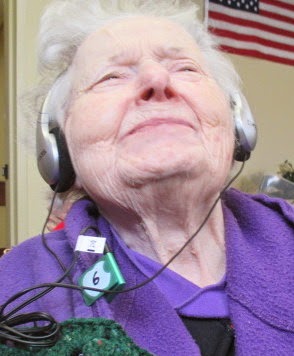
Annabelle listened with joy as the songs
resonated with her spirit.

For others, concentrating on each song and being drawn into another world in which they were calm and relaxed was rewarding to see.

Ollie and his wife spent time together while 
Ollie focused deeply on the songs.
His wife said she could tell he was enjoying 
what he was listening to on the iPod.

Being able to be part of this program and bring it to seniors who need it and would appreciate it, was truly a gift. I feel so honored to be able to be a part of it.

Practice of the Day

We all share beauty. It strikes us indiscriminately....There is no end to beauty for the person who is aware. Even the cracks between the sidewalk contain geometric patterns of amazing beauty. If we take pictures of them and blow up the photographs, we realize we walk on beauty every day, even when things seem ugly around us.
— Matthew Fox in Creation Spirituality

To Practice This Thought: Describe the most surprisingly beautiful thing you have seen today.

When I went out to fill the horses' water tanks, Bailey (the horse) came into the barn to watch me. As I was putting a small bucket on a hook on the wall, she stood behind me and rested her head on my shoulder. I could feel the weight of her head on my shoulder and feel her breathing.

Bailey


As the water was filling, I looked into her deep, brown eyes and looked at her thick, black coat. She's such a beautiful horse. I think of when she joined our family and how nervous and skittish she was because of where she lived prior to being rescued and going into foster care. She's so trusting now...and that is something that I find equally as beautiful about her.

Spiritual Exercises

Beautify your home. The Spiritual Practices website said, "Start by clearing out any clutter and things you are not using. Affirm your commitment to simplify your life by giving away or discarding at least one excess possession. Then choose one area of the house to give special attention. Perhaps you will clean and polish the wood furnishings or scrub all the tiles. As you are working, admire the textures, colors, and structure of each item."

I focused on the mudroom, kitchen, downstairs bathroom, dining room, and living room since these are the first rooms that you see when entering the house. After spending a considerable amount of time putting things away in cupboards, washing the dishes, sweeping, vacuuming the floors, and thoroughly washing off all surfaces - everything looked so much better.

We finally donated six bags of items that were waiting to be brought into the thrift shop. Doing this freed up quite a bit of space which was nice.

Book Excerpt

I read Clutter Busting: Letting Go of What's Holding You Back by Brooks Palmer, and did a review.

In addition, the Spiritual Practices website included an excerpt from the back of Palmer's book that showed many ways to get rid of the clutter in our lives. Here is an excerpt on beauty which encompasses the process of letting go of things:

• Remember that nothing is sacred except you.

• If it doesn't fit anymore, physically or psychologically, let it go.

• Take the items that you are going to review out of their space and move them to another room, or outside, so you can get a fresh perspective.

• If you hesitate, trying to decide whether something is worthwhile, it's clutter.

• If you haven't used it in a year, it's clutter.

• If you find yourself defending the object because of how much it cost you, it's clutter.

• If the item makes you feel out of sorts, it's clutter.

• Always remove from your home what you know to be clutter. Otherwise, it will continue to detract from your life.

• No clutter is labeled CLUTTER. Clutter is invisible. It was put in its location subconsciously. That's why you have to ask if each thing is truly helpful to you or if it's clutter. Sometimes the most cherished thing is clutter. If it's not useful to you now, toss it.

• People can be clutter. Be honest in your relationships. If knowing someone diminishes you, s/he is clutter. You can speak honestly with him/her and see if s/he can change. If not, you can just let him/her go.

• Donate or give away gifts that you don't like.

• Feel good about the process of tossing, and avoid the guilt. Advertisers taught you that things are more valuable than you. They were wrong. You are right.

• Keep the things that feel alive to you. Things have either a living or a dead essence. When you clutter bust your life and home, you will very quickly become aware of the difference, and you will drop the dead things into the trash can.

• Be ruthless. Clutter will try to trick you. Question everything.

• First impressions are always correct. If your first feeling is that the thing is clutter, it is. No dumpster diving.

• Your activities can be clutter. I guarantee that something that you are doing in your life now is clutter. You may be thinking that your value is determined by the activities in your life. That is untrue. You are already valuable! There is no need to prove anything. Those days are over. Ask, "What makes me happy?" Whatever is left over, toss.

• Any piece of clutter could be the thing that stands between you and your happiness. Nothing is too small to be disregarded. Every piece of clutter keeps you from rolling down the freeway of your life with the windows open and your favorite songs playing, with you singing along.

• Toss the trophies, the things that you own only because they are "valuable." Anything you own to impress others is a waste of your time. No one cares.

Journal Exercises

• For one week, or seven entries, describe and react to beauties: (1) a beauty experienced in childhood, (2) a beauty experienced at school or work, (3) a beauty in nature, (4) a beauty in your home, (5) a surprising beauty, (6) something most people consider to be beautiful, (7) something few people consider to be beautiful.

I did this exercise and thoroughly enjoyed it. Each prompt brought out different memories and things that - in some cases - I had forgotten about. I'm so happy I took the time each morning for a week to reflect upon and write about these beautiful things.

Discussion Questions, Storytelling, Sharing

The following questions and prompts are ones that I would like to reflect on at some point. I didn't have the opportunity to do that during the past two weeks.

• In German the word "beautiful" is related to shining. A beautiful person is one whose inner brilliance permeates his or her entire being. Tell your family or friends about your most memorable encounter with a person who was shining.

• Share a story about a beautiful place that comforted, restored, or inspired you.

• Recall a time when a work of art revealed to you the intrinsic beauty in something you had considered ugly or disagreeable. What does this experience reveal about the nature of beauty?

• Did your parents encourage your appreciation of beauty? What did they do? How is this quality honored in your present home?


Household, Group, and Community Projects

• Have a make-over. First, think about what would make you feel more beautiful: a haircut, a manicure, different make-up, a new outfit? 

On January 15, 2015, after a couple of years of growing out my hair, I was ready to donate to Children with Hair Loss. I went to a new stylist who specializes in make-overs for women over 40 years old. The first step was to cut off an 11-inch ponytail to donate.

Taken on October 22, 2014, 
at William O'Brien State Park.
By the time I went in for the makeover, 
my bangs were below my eyebrows, 
my hair a bit longer, and I looked very tired.

Once that was done, it was time for shampoo and conditioning my hair. The stylist even did a scalp massage which was so relaxing.

Next, it was onto something that I had thought about, but had never done in my 48 years of life: waxing. I had basically my whole face waxed with the exception of my forehead, nose, eyes, and lips. Everything else was fair game. Although it was uncomfortable, it certainly wasn't as painful as I envisioned. My face feels like it did when I was much younger - so smooth.

My eyebrows were "cleaned up," but she said there wasn't much to do. Apparently I had a nice shape to my eyebrows and not that many stray hairs.

Next came the makeup application and lesson. As my skin has aged, the products that I used in my 20s aren't the same things I should be using now. So, I've been wanting to do this for many years now. The stylist ended up using mineral makeup which I've heard of, but have never used. After applying it, it is set with a light mist of water.

Since I wanted a more natural look that didn't take a long time to apply, she concentrated on my eyes. By far, when I look at pictures and what people have noticed since the makeover are my eyes. It takes no more than 5 minutes to put on the eyeliner, shadows, and mascara - but a what a difference the right colors and application can make.

The last step was the haircut. I had come into the salon thinking that I would leave with a cut below my shoulders. However, the stylist said that if I did that then I would wake up the next day looking basically like the same person. So, I said that I trusted his judgment and to create a style that he thought would look best.

More inches came off my hair so that it is now above my shoulders, and has layers and no bangs. It is a substantial change and one that certainly has surprised people when they see me. It has been a good 20 years since I had hair this short, and a good decade since I haven't had bangs.

After the makeover on January 15, 2015.

This process has been uplifting, liberating, and inspiring. It has changed my attitude and made me happy that I took the time to care for myself. The four hours that I spent at the salon were pivotal in so many positive ways.

• Organize a community beautification project for a local park, school yard, street, or highway. Pick up litter, trim the grasses and bushes, plant flowers, or arrange rock gardens. 

In May, the 4-H club that I lead will be planting flowers at a local historical society. The club also is waiting to hear if it received a grant from the Minnesota 4-H Foundation. If it does, it will provide the opportunity to our 4-H club to do quite a few community service projects that relate to flowers, flower gardening, and container gardening from April through September 2015.

Saturday, January 31, 2015

Nature Journaling with Photographs

During January, I focused my nature journaling on incorporating photographs into the entries.

For the first week, I walked outside and looked at the rather bleak landscape. When I looked down, however, what caught my attention was track marks through the snow. They were pheasant tracks, so I took a picture of them. A leaf happened to be near the tracks, so it shows a nice natural comparison in terms of size.


I added some facts, a drawing of what a pheasant's track would look like in the mud, and noted the colors of a male ring-necked pheasant. There was even a poem that I found that captured what pheasants are like, so I wanted to include that as well.

During the second week of January, I focused on the red berries that catch my eyes since they are in such sharp contrast to the white snow and bare branches everywhere.


After learning the name of the shrub (American Highbush Cranberry), I explored its unique characteristics a bit deeper. 

I  enjoyed using colors of Prismacolor color pencils to decorate the page and tie into the red berries that the cedar waxwing birds enjoy eating in the spring.

It seems that I wasn't the only one in the home who had the idea to incorporate a photo into my nature journal. Sophia found a couple of pictures of Bailey (the horse) that tied into her nature journal entry for the week.


There's something about photographs that just seem to bring the nature journal page alive. I plan to continue to do this throughout the year when I think a photograph will enhance what I am writing about and exploring.

Sunday, January 25, 2015

Clutter Busting - Read 52 Books in 52 Weeks - Week 4

For the fourth week of the Read 52 Books in 52 Weeks challenge, I read Clutter Busting - Letting Go of What's Holding you Back by Brooks Palmer.


This book had so much helpful and insightful information about what clutter is and represents in one's life. There were action steps to take and questions to reflect upon. I'm happy that I read it.

There are key points that I would like to remember from this book:
- Clutter busting is actively breaking through barriers and letting go of the unnecessary clutter that crowds your life. It helps restore clarity and insight....You naturally replace lack of motivation, anxiety, and unhappiness with peace of mind, certainty, and acceptance of change and progress.
- The things that move and inspire you are fertilizer. They make your life blossom. Clutter, however, is inorganic. Nothing grows from its existence - not anything we can love, that is. 
- Where your attention goes, so spreads your life force. Where you put your energy and attention, you leave your mark. 
- You don't need something outside you to remind you of why you make a difference.
- There were pictures of their kids when they were much younger. None of the photos were of the kids as they were then, in their late-teenage years. There were a lot of pictures of dead relatives and of friends they didn't see anymore. And most of the photos were of other people....These were indications that they were stuck in the past, when things were "better," as they imagined them to be. Nothing in their [home] signified or celebrated the life they were living now.
- You overlay the present moment with a memory. It is a way of pretending that everything is all right. Meanwhile, the present suffers because your attention is not there. The longer you spend in the memory of the past, the further away you move from actual joy of right now. 
- Go through all the recipes [that you have accumulated] and pick the ones you want to try.
- Always come back to yourself when deciding what to keep or toss. Does the item make you feel good? Does it improve your life? Or have you been hanging on to it because of the memories associated with it?
- Clothing represents different emotional periods of your life. If you keep a lot of things you don't wear, your clothes closet has become a photo from your past.
- (Regarding letting go of emails:) "It feels pretty bad trying to keep this memory going....It's like someone died, and you won't let them go....It's up to you, but if you hang on to this pain, you'll be slowly destroying what is gentle and good in you. It's time to bury the dead. You deserve to have the fullness of life in your heart." (The woman released all the emails. She looked lighter. The dead weight of emotional clutter is debilitating. Shedding that clutter fills you with lightness.)
- What items from the past have you been keeping that interfere with your present goals?
- Keep photos that jump out and animate your heart, that make you feel grateful for the experience you have had. They are a reaffirmation that you are a deserving person.
- Be aware of whether you are holding on to photos to relive the past or to honor a memory.
- You need to have a spacious, smooth surface by your head every night before you go to bed. Otherwise, you take all the crap to sleep with you every night. You're going to have to get used to peaceful stillness again.
- (Regarding a full nightstand:) "This is what's going on inside your head. How could you think clearly with this kind of noise going on all the time? It would be like living right next to the airport."
- Are you living in a graveyard? Is it what you want? Memories of the past can capture your attention, but how much fun is that? If you're living in the cemetery of the past, that means a great big part of you is dead. But some part of you is still alive: your essence, the pure feeling of existence.

Homemade Crunchy Dill Pickles

This past September I made homemade dill pickles. When I was growing up, my parents made dill pickles. My mother never bought pickles in the store - if she could can them there was no reason to buy them.

One batch of pickles that I made in September 2014.

It wasn't until I was purchasing groceries on my own that I realized that pickles could be crunchy. I read on City Boy Hens that "The reason that homemade pickles generally become mushy over time is that there is an enzyme on the flowering end of the cucumber that does not get destroyed during the canning process. As a result, it breaks down the fibers in the cucumber over time and turns it into a soft and mushy pickle within six months."

According to City Boy Hens, "The secret is a product up in Canada called Pickle Crisp by Bernardin (Canada’s answer to USA’s Ball). Just 1/4 teaspoon in each quart jar will keep your pickles crisp for long past a year!"

So, I thought I'd give pickle making a try after finding Pickle Crisp at Fleet Farm. There also was a package of flavorings which included Pickle Crisp that I thought I'd try as a comparison.

Another batch of pickles that I made in quart jars
during September 2014.

First, I made the pickles using the package of flavorings. It was easy to do because I just made the solution and put it in the jars with the cut-up cucumbers. After putting them in a water bath for the recommended time, they were done.

Then I made a batch of pickles using the recipe on City Boy Hens that makes six quart jars:

Ingredients: 

5 lbs. pickling cucumbers
8 cups water
8 cups pickling vinegar
1 cup pickling salt (don’t use table salt. It will cloud your brine and turn your pickles to an unpleasant color)

Into each jar add:

1/2 teaspoon mustard seed
1 large garlic clove (sliced)
1 bunch dill
1/4 teaspoon Pickle Crisp

Directions:

Weigh, wash, and gently scrub cucumbers. Discard any that appear spoiled. Cut the ends off of each end of the cucumbers.

Fill your canner with water about 2 inches higher than the height of your jars and bring the water to a boil. This will take a bit of time.

Sterilize your jars in the oven at 225 degrees for 10 minutes and continue to keep them warm in the oven until they are needed.

Place canning seals and rings in a small pot and begin to warm them up.

In the mean time, begin making your brine solution and bring it to a boil.

Carefully remove sterilized jars from the oven and add dill, garlic, mustard seed and pickle crisp to each jar.

Firmly pack each jar with as many pickles as you can possibly fit into this space.

Once packed, pour the brine into each jar using a canning funnel, making sure to leave a 1/4″ head space in each jar. (Note: I did 1/2" head space because that's what two other recipes for pickles instructed.)

Wipe the lip of each jar with a wet paper towel. Using tongs, place the seals and rings on each jar.

Carefully place each sealed jar into the canner and process in boiling water for 15 minutes.

Carefully remove each jar from the boiling water and leave to cool on thick towel.

Listen for the ping of each jar as it seals. Once the jars cool, store them in a dark. cool place for at least six weeks to allow the flavors to develop.

As a side note, on Pick Your Own, there's a very helpful FAQ list regarding canning pickles.

A jar of pickles I made using the recipe on
City Boy Hens' website.

Both versions turned out very well, and each has a slightly different flavor. We definitely are going to can more dill pickles during the 2015 season after seeing how easy, flavorful, and crisp the pickles are to make.

Wednesday, January 21, 2015

Sewing Pillowcases for Pine Ridge Reservation

For the 4-H club that Sophia and Olivia belong to (and which I am the leader), we did a community service project at December's meeting that focused on sewing pillowcases for children who live at Pine Ridge Reservation in South Dakota.

The children are all living in extreme poverty, so we thought that having something as simple as a handmade pillowcase might be something that they would enjoy.

All the fabric and thread for the pillowcases was donated by two families. So, the only cost to the club was members' time and the postage to ship the pillowcases to South Dakota.

We followed ConKerr Cancer's website had a tutorial about how to sew pillowcases using two different pieces of fabric.

Basically, you lay out the larger piece of fabric right side down on the table.


Then you put the smaller piece of fabric (for the edging) on top of that and roll the larger piece up until it is enclosed in the smaller piece - like a hot dog.


Sew along the edge.


Pull the larger piece out from the sewn "hot dog."


After ironing the fabric, we followed a video about how to sew French seams. This was very helpful because it is counter-intuitive to how you would sew a pillow. You actually sew on the outside of the pillowcase first by putting the WRONG sides together.


Then you flip the pillowcase so the RIGHT sides are together and sew. This process is how you hide the seams - or do French seams.


When you're done, you have a pillowcase.


The girls were happy with how their pillowcases turned out and even more so knowing that a little girl or boy would receive and use them.


I made a pillowcase too. Mine is the one on the right - the blue one with lime-green trim.


The 4-Hers (including Sophia and Olivia) and I made ten pillowcases to donate.


Seeing all the bright, colorful pillowcases makes me smile. I'm hoping it does the same for each of the children who receive one.

Sunday, January 18, 2015

Ordinary Sacred - Read 52 Books in 52 Weeks - Week 3

For the third week of the Read 52 Books in 52 Weeks challenge as well as the Dive Into Diversity challenge, I chose Ordinary Sacred by Kent Nerburn.


This is a short book - only 122 pages - and it is comprised of different short stories. Some I found particularly inspiring and relevant, while others were interesting but not as moving. I enjoyed the writing style of the author, and would enjoy reading other books he has written.

Some of the things I want to remember from the book include:

- A quote from Mahatma Gandhi: It is better in prayer to have a heart without words than words without heart.
- The heart knows much that the mind cannot see.
- Our lives are filled with....ordinary moments when the hidden beauty of life breaks into our everyday awareness like an unbidden shaft of light. It is a brush with a sacred, a near occasion of grace. Too often we are blind to these moments. We are busy with our daily obligations an too occupied with our comings and goings to surround our hearts with the quiet that is necessary to hear life's softer songs.

Waterfall
Taken on July 20, 2010.

- The Confucian philosopher Zou Shouyi said that we too often fail to recognize wisdom in those without talent, achievement, and fame. Jesus, in the Beatitudes, tells us to look to the meek, the poor in spirit, and the pure in heart. The Native Americans tell us to look at the elderly, because there lives have walked the long path toward wisdom.
   They all are reminding us that traces of the sacred are everywhere before our eyes, and that our task, as surely as performing acts of worship, is to find these sacred moments, hallow them with our attention, and raise them up as a celebration of the mystery of life.
- You feel privileged that a child has chosen you as someone to value, and you know that your attention can help give shape to a life.

Dandelion Bouquet
Taken on June 1, 2008.

- How little..do we understand of life's wondrous ways, and how hard it is to see the blessings in the shadows.
- Let the beauty we love be what we do. (Rumi)

August Journal Quilt without Border
Taken on August 24, 2010.

- We are known by the things that we love, and remembered for what we held dear.

3 Generations
Taken on April 24, 2012.

- What object that I take for granted will be the memory by which I will be known? What will [people] remember that I loved?
- Once you have flown, you will walk the earth with your eyes turned skyward. (Leonardo Da Vinci)
- Our life is a work of art. We must seek always to be its artist.
- "I need to thank you. You have to let me thank you. It's all I have to give."

Towards the end of the book, there was a story that reminded me of the older people who I have loved in my life (like Dad, Mom, and my grandparents) and the ones with whom Sophia, Olivia, and I volunteer with at the nursing home.

Dad Teaching the Girls
Taken on April 29, 2009.

These are excerpts that made me pause and reflect:

- There is a wisdom that comes with age. The old have walked the path we tread. They have seen the landscape through which we are traveling. They have felt our passions and known our dreams, though perhaps in different shapes and in different measure. In their eyes we can see our future. In our eyes they can see their past. In some fundamental way, they know the place where we are going.
- They also know that few will seek them out. They have accepted the fact that few will ask them to share what it is that they have come to understand. Their time has come and passed; the younger generations want little more from them than reminiscences.
- I was honored to speak to both these men. I hope I showed them proper respect in our conversations. I hope, too, that I was listening to them for what they can teach me about life, not merely for what they can reveal as witnesses to the past.
- We live so strongly within the boundaries of our own experience. If we long for anything, it is usually for a time past, when we were younger, stronger, better looking, and not yet so bound by decisions we have made.
     We seldom long for a future where our bodies are less but our spirits and insight are more. Yet, that future is there. It is in the eyes of those who have lived longer, seen more, and come closer to a resolved understanding of their place and purpose on this planet.
- There is no death. Only a change of worlds. (Chief Seattle)
- It is the streets, the people, the birds, the animals, the trees - the joys and struggles and passions of everyday life - where my life now brushes against the sacred and my spirit finds its strongest voice.
- I have done what I could, tried in my way to be an instrument of peace.

There was a section in the book about a mother and her children. It resonated deeply with me because it reflects what I've been trying to do with Sophia and Olivia, and how I live my life.

Girls and Me Picking Up Gretel
Taken on March 27, 2008.

These are the highlights from that story:
- She is a woman with a good heart. I can tell by the objects she carries - a bouquet of flowers, a box of thank-you notes. She understands the power of beauty, the need to show gratitude and thanks.
- The quiet believers [are] those who live a life of service, trying to shape their small corner of the world into a place of warmth and love by making each ordinary act of life a prayerful offering.
- We want our children to be people of faith, but we do not wish them to be blinded by belief....[We want them to be] alive with the sacredness of life, the kinship of all creatures, and the true conviction that we are each our  brothers' and sisters' keeper.
- We pass no judgment on how the spirit speaks, asking only that it speak in a voice of kindness and love.
- For our children are but gifts that we are given, a moment's grace that we are asked to shape and share. We should raise them to be open to the world - full of faith, but not blind with belief; respectful of all who are honest seekers; and guided in their lives by a kind a caring heart.
- Give them the eyes of wonder. Show them, as best you are able, the beauty of everything in the universe - the stones, the trees, the birds, the people.
- Show them the connection, not the obligation, in their daily affairs. Let them see that the phone calls they make to grandmothers, and the thank-you notes they write to people they barely know, are really gossamer threads strung between hearts. Teach them that a life of service is a life of peace, and that a small faith can be as powerful as a large belief.

There was a story in particular that stood out about a girl who he befriended. She told him at her eighth grade graduation, "Thanks for paying attention to me, even though I'm just a kid."

Mom, Dad, and Girls at First Communion
Taken on January 9, 2010.

He thought in response, "Had it not been for her, those people would not have been gathered together. Had it not been for her freshness and promise, there would have been no tears. Yes, she was 'just a kid.' But that kid had brought us together and opened our hearts in a way no adult could ever have done."

As he reflected more about what she said, he finally realized what he wanted to say not only to the girl, but to all children:

Never apologize for being "just a kid." For you are the most important person in the world.

You are promise. You are possibility. You are hope when our hope has dimmed. You are joy when our hearts are heavy. In you, we see the world as we dream that it could be.

Remain excited when you see a leaf; it tells us there is still beauty in the small, when our eyes have gotten too focused on the great.

Play with each other on playgrounds; it shows us that all people of all backgrounds can meet each other with open hearts.

Keep talking to the dogs and the cats and the pigeons and the ducks; it reminds us that the spirit is present in all living things.

Keep laughing and giggling when you are surprised and delighted; it offers our ears the music of grace.

Do whatever it is that your heart would have you do. Laugh, cry, stomp your feet in anger, dawdle in the morning, resist bedtime at night. Allow us to see how important the moment is to you, and to share, for an instant, the importance of that moment.

For you remind us what it means to be alive.

You command us to be strong, you remind us to be gentle.

In your eyes, we see the eyes of all children, and, for an instant, we understand what we have in common with all mothers and fathers at all times in all places on the earth.

No, never apologize for being "just a kid." For you are strong beyond your wildest imagining. Your goodnight kiss can stop an army; your tears can melt the hardest heart.

For you have the gift of innocence. You have the gift of dreams.

When we see you laughing and playing, our spirits take wing.

When we lift you and hold you, we are consecrating a world of hope.

He concluded with how he saw both of their roles:

For we each have our jobs, she and I. Mine is to hold her safe in unseen hands. Hers is to be a mirror to my dreams.


Friday, January 16, 2015

Horse - Outdoor Hour Challenge

For this week's nature study we focused on horses. We read the section in the Handbook of Nature Study about horses and found these facts interesting:

=> The length of the horse's leg was evolved to meet the need for flight before fierce and swift enemies.

Visible Horse - Skeleton
The anatomy of a horse drawn onto a horse 
at the Minnesota Horse Expo. 
Taken on April 23, 2009.

=> The horse has one toe that has a strong, sharp hoof.

Difference in Foot Structure
Comparison of foot structure.
September 4, 2011.

=> The horse's feet are not good for marshy places. A horse will mire where a cow can pass in safety.
=> The ears, if turned back, denote a treacherous disposition. They should point upward or forward. If the ears are laid back it is a sign that the horse is angry; sensitive, quick-moving moving ears indicate a high-strung, sensitive animal.

Bailey Visiting Mom
Bailey's ears are upright - she's curious about 
my mom's walker.
Taken on Mother's Day on May 9, 2010.

=> The eyes are placed so that the horse can see in front, at the side, and behind, the last being necessary in order to aim a kick.
=> The nostrils should be thin-skinned, wide-flaring, and sensitive.

Hoss's Nose
Hoss' nose.
Taken on December 9 , 2012.

=> Scent is one of the horse's chief aids in detecting the energy.
=> The horse has six incisors on each jaw; behind them is a bare space called the bar. Back of the bar, there are six molars or grinders on each side of each jaw.
=> At the age of about three years, canine teeth or tushes appear behind the incisors. These never seem to  be of much use.
=> A full-grown horse has 40 teeth in all: six incisors, two canines, an twelve molars on each jaw.
=> The hair is shed each year.

Hoss' Color Change
The top of Hoss' tail
Taken on April 22, 2010.

=> The horse's powerful teeth can inflict deep wounds and he can kick and strike hard with the front feet; still more efficient is the kick made with both hind feet while the weight of the body is borne on the front feet.
=> The mane and forelock are useful in protecting the head and neck from flies; an the tail is an efficient fly-brush.

Olivia Turning Bailey
Olivia walking around a bit on Bailey.
Taken on August 6, 2010.

=> A colt's legs are so long that it must spread the front legs wide apart in order to reach the grass with its mouth.
=> When a colt or the horse lies down, it lies flat upon the side. In lying down, the hind quarters go first, and in rising, the front legs are thrust out first.

Bailey and Hoss Resting in Pasture
The horses relaxing in the pasture.
Taken on May 6, 2010.

=> Horses can walk, trot, canter, and gallop. When walking, two or more feet are always on the ground. When galloping, just before landing the body is in the hair and the legs are all bent beneath it.

Horses Galloping to Get Breakfast
The horses running out to get their hay for breakfast.
Taken on April 11, 2012.

=> Timothy hay, or hay mixed with clover, is good for the horse. Oats and corn are the best concentrated food.

Snow Still Coming Down
During the winter, it's important that the horses 
receive enough hay to keep them warm and their energy sustained.
Taken on March 23, 2011.

=> A horse should be fed with regularity, and should not be used for a short time after having eaten.
=> Grooming of a horse is a part of its rights, and its legs should receive more attention during this process than its body.

Horse Topiary by the Ordway
The girls are standing by a horse topiary
that was outside of the Ordway.
Taken on May 29, 2007.

Outdoor Hour Time:

Each day, Sophia and Olivia spend time with Bailey and Hoss. Bailey is a Pony of the Americas and Hoss is a miniature horse. They are each responsible for feeding the horses - once in the morning and once in the afternoon.

Bailey has provided our family with many learning opportunities with regards to her eyes and vision since she is blind in her right eye (which we didn't know when we adopted her). The veterinarian always spends time educating us about her eyes and changes he sees with them, and has given us many opportunities to look into her eyes with the equipment he uses.

Nature Journal Entries:

Both the girls did a page in their nature journals about horses. This is Sophia's page:


She incorporated some photos from the fall of Bailey with her and of Bailey rolling on the ground (both of the horses do this throughout the year).

This is Olivia's page:


She said she spent quite a bit of time drawing the horse. Her entries also have a lot of information that she writes from facts she finds on the internet.

(We used Autumn 2010 OHC #3: Horses as inspiration for this Outdoor Hour Challenge.)