
Last year Cooper ate part of the Advent calendar...the one I hand-embroidered that had little pockets. I never got around to making new little felt envelopes to put the calendar, so although I planned out this year's activities, the girls didn't open an envelope each day from Thanksgiving weekend to Christmas.
Because we didn't do the countdown, we didn't do activities each day for Christmas. Nonetheless, we did do quite a few while still homeschooling and lots of practicing on the piano and harp for multiple performances during December. It seemed like the presence of the Christmas season was in our home each day, but just not in additional activities like we've done in past years.
So, 2014 included the following activities:
On November 29th, Sophia played the harp at Northwoods Humane Society for some of the dogs, cats, and kittens who were waiting to be adopted.

Many came in quite anxious, but as they listened to the music they relaxed and seemed to truly enjoy the music.

There were several staff and volunteers who came in and listened to Sophia play as well. So, both people and animals benefited from her playing the harp that afternoon.
On December 1st, we made snowman pizza.

Even though there was no snow on the ground, it seemed like a fitting thing to do.

On December 4th, we had a 4-H meeting and the girls brought toys for Toys to Tots. Collectively, the club donated over 500 toys. Between the ones that were shown here and the ones that are not shown, they were able to fill an entire car.

Needless to say, the Marines were very happy with their visit to the club meeting, and the impact that the club would make on children this year who otherwise would not have received a toy.

They also worked on activity bags that will be donated to a shelter for women and children who are escaping domestic violence situations.

The fabric was donated by one of the families, and I sewed several bags. The canvas ones were pre-purchased ones that I ironed decorative fabric onto. The mother who donated the fabric was so happy to see how the material was used.
The next day, December 5th, we did our second-annual program for seniors about St. Nicholas.

We showed them figures that represented St. Nicolas and symbols that tie into the season.

This year we played a game after I read a story about St. Nicholas. The seniors had three fabric bags of "gold" (actually, dried lima beans) that they were supposed to throw into the basket. We went around the room twice. The top two winners from the nursing home and the top two winners from assisted living got to pick out prizes.

Then - so that everyone left with something - I made little shoes out of paper and put about a half dozen candies in each one.

Sophia and Olivia passed them out.

They had fun doing it and seeing how happy the seniors were to receive a gift and chocolate.

The gold coins were definitely a treat.

The next day, December 6th, was actually St. Nicholas Day. One shoe for each family member was put on top of the bench in the mudroom. St. Nicholas filled them during the night.

Sophia's and Olivia's boots are shown below.

Olivia enjoyed looking at her book about Egypt right away.

Sophia - after looking at what she received - divided the coins by denomination.

The following day, December 7th, we got a Christmas Tree. After looking at the ones at Prairie Restoration, the girls picked one that they felt would fit into the family room.

This year they were old enough to help tie the tree to the roof of the car.

Up until this year, they haven't been able to do this.

Definitely a milestone year...and a rite of passage.
Decorating the Christmas tree took two days because the lights from last year didn't work. So, the girls sorted the ornaments. We decided on ones that were important to us, and ones we could let go.
There were decorations that we also felt ready to donate to the thrift store...an entire bag full.

By the evening of the 8th, we had the tree decorated.
On December 9th, we focused on the Grinch. We made a healthy snack - Grinch kabobs.

And a not-so-healthy drink: Grinch floats with green sherbet and Sprite.

On Friday, December 12th, we went to the nursing home again. This time - while Sophia was downloading music onto the nursing home's computer for the Music & Memory program, Olivia and I went around to visit the residents.
First, she went to the room where a relaxation activity was taking place. She was dressed as St. Lucia, and Tia asked that walk around so everyone could see her. It ended up that many of the ladies wanted to give her a hug...and vice versa. It was very touching to see how much they enjoyed seeing her.

The girls had filled each of the Swedish baskets I had made with Swedish fish - a type of candy. They have the texture of a Gummy Bear and are slightly sweet.

Olivia - in her St. Lucia outfit and holding the tray of Swedish baskets - headed out with me to visit seniors. We focused on seniors who were spending their first Christmas at the nursing home or assisted living...and we tucked in a couple visits to seniors we always try to visit when we are there.

We saw our friend, John, we was so happy that we visited him.

Visited new residents.

And we visited residents who we always make a point of seeing, like Dale and Dorrine.

The next day, December 13th, we celebrated St. Lucia Day at home. I made Lucia Buns for the girls.

Some had raisins and others didn't. Olivia was awake, but Sophia was still pretty tired when they came out of the oven.

On Sunday, December 14th, the girls were in the Christmas play at church. Sophia was the accompanist on the piano and played all the songs - not only for the children to sing to, but the entire congregation.
It was a HUGE responsibility and honor for her to be able to do that. She played the pieces flawlessly thanks to her many hours of practice.

Olivia was a reader and got to stand at the pulpit.

She even sang at the pulpit along with the choir on the altar while Sophia was playing the piano.
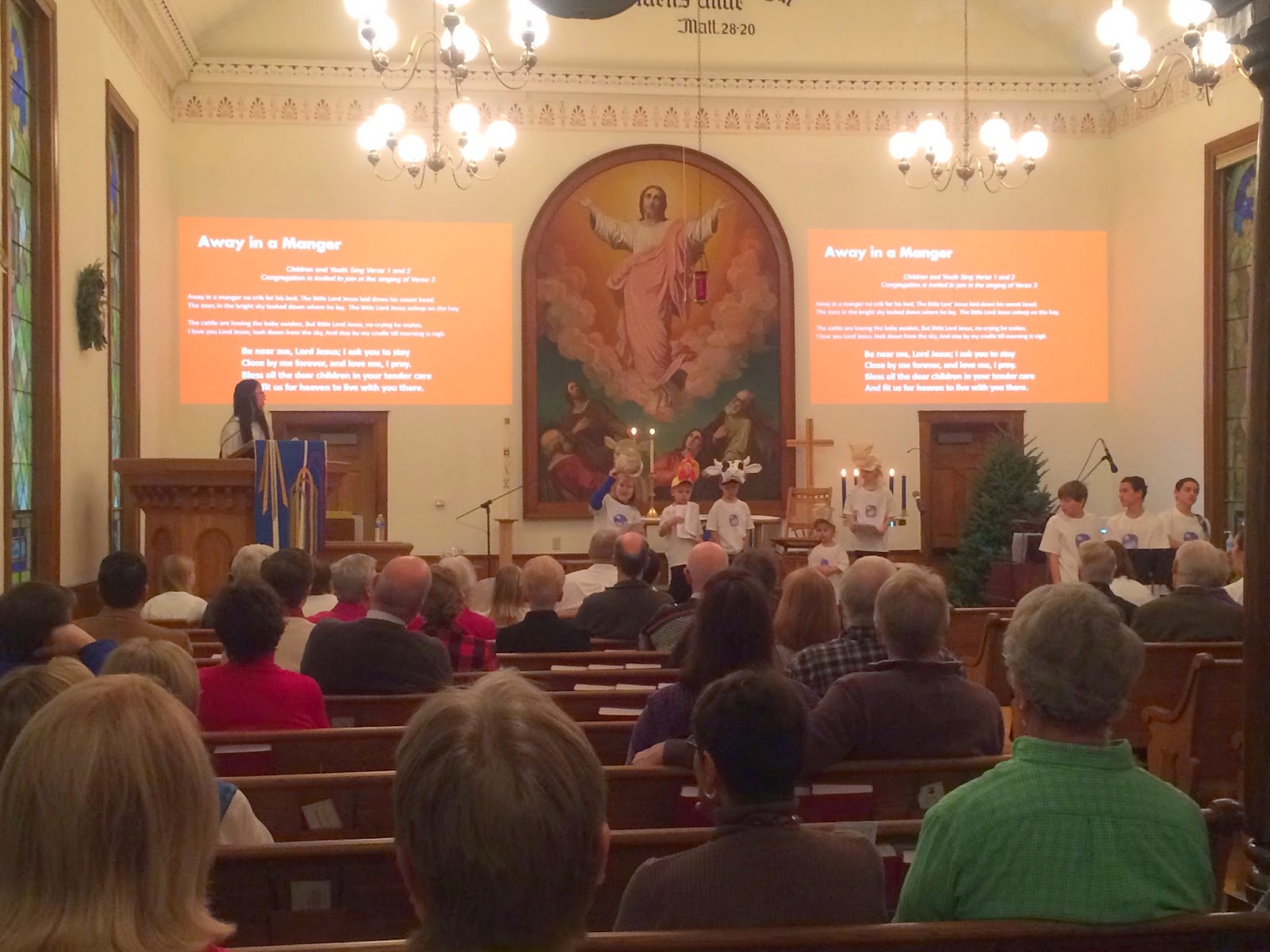
The children sang Silent Night holding battery-operated candles.

They finished with Joy to the World.

Although we had done the activity bags earlier this month at the 4-H meeting, I knew that many of them had multiple items (e.g., color crayons, coloring books, stuffed animals).
So, on December 15th, Sophia went through each one and pulled out the duplicates. By doing this, we were able to create six more activity bags.
Now the bags are ready to be donated to the shelter so that the children who are coming in with their moms have something to keep them occupied.

Each of the bags has things to keep a child busy while the mother fills out paperwork. Some of the youth at the 4-H meeting created homemade games - like puzzles and tic-tac-toe boards.

On Tuesday afternoon, December 16th, we spent time at the open house at the nursing home. Sophia played the harp during the party.

While she was doing that, Olivia, John (one of the residents), and I passed out gifts to those in assisted living.

This is the second year we've done this, and John and we were looking forward to having this time together to do this special activity.
The next day, December 17th, Olivia made a gingerbread tree.

Sophia made a gingerbread house.

When they first started doing this, they needed my help. Now, they work by themselves and then surprise me with their creations. I was very impressed with what both did this year.
On December 20th, we put candies and cookies in the mailbox for the postman. I had been baking for the past few days, and we wanted to share what we made.

There were vanilla-frosted brownies, peppermint shortbread cookies, almond macaroons with a cherry center, spiced pecans, macadamia nut/coconut candies, peanut butter balls, pretzels and Spanish peanuts in almond bark, bacon-cashew caramel corn, caramel corn made with puffcorn, and some candies.
On December 22nd, Sophia, Olivia, and I did a Christmas concert at the nursing home. This time the concert was for the nursing home residents, but many from assisted living also came over to hear us play the harp and piano.

Sophia played many songs on the harp; and Olivia and I each played three songs on the piano.

While Sophia played, Tia (the volunteer director) sang to some of the songs. For "Go Tell it on the Mountain," Tia started singing and before long we could hear many of the residents singing along with her and the harp music. It was really touching to be able to see and hear the group singing together.
On December 23rd we had another snowman day. This time we decorated powdered sugar mini-donuts with miniature chocolate chips and a candy corn in the middle for the noses.

In order to get the chocolate chips to stay, we had to use a bit of white frosting. It was more challenging than we thought because frosting does not want to stick to powdered sugar. Nonetheless, we thought the whole plate of snowman faces looked cute.
Before we knew it, it was December 24th - Christmas Eve. We had a relaxing day, and then went to the 3:00 church service. Sophia played the piano for two songs while the children's choir sang to one of them, and the choir and their parents and friends sang to the second song. Again, she did a great job playing the piano.
After the service, we saw two family friends - Ruth and Thom - and they all gathered by the tree in the fellowship hall.

At home that night, we opened some presents. One was for everyone: a new griddle. We haven't had one for months, and now finally we have one again. The girls have missed having pancakes, French toast, and grilled cheese sandwiches. These things taste best when made on a griddle....or at least they do to us.

Sophia and Olivia made a plate of cookies and strawberries for Santa along with a glass of water.

This year they cleverly made the treats into a happy face.

They left notes for Santa.

Sophia's was colorful and detailed.

Olivia was so tired that she didn't want to write one. So she left that to Sophia instead. Needless to say, it was brief and to the point. "Dear Santa, I have nothing to say. Merry Christmas and a Happy New Year. P.S. I'm in a bad mood. Please send me so Christmas spirit." Olivia signed her name so she must have approved the letter.

She said the next morning she was just very tired and wanted to go to bed. It had been a long day...and a long week so far.
The girls made a plate of treats for the reindeer. I didn't notice it at the time, but did when I was looking at the pictures: the carrots create a face and hair.

Normally they haven't done this. I think they were either tired or having more fun with doing these things this year than in past years.
Finally....December 25th - Christmas Day. Eenie wanted to sit by the nativity scene. It's in a new location this year because Aspen and Cooper would have tried to pull the burlap off the bureau and - along with it - all the ceramic figurines.

So, we put a low table where the couch used to be in the family room. Not having the couch there thanks to the ice dam damage back in March actually worked to our favor this Christmas.
We took a look at the top of the piano. There are stockings for the horses, cats, hedgehog, and dogs. Now, there are more animal stockings than there are people stockings.

The last three stockings I made were done on Christmas Eve of all days. I started during the day and finished at night. The bones and candy cane have sequins and beads on them, thus they took a while to make. I still need to add the names of the pets onto the top with fabric paint.

Our tree was missing some lights - one string that we've had for many years went out.

It seems like this is the year of things breaking and needing replacement.
Lucy wanted to take a turn at the nativity scene after Eeenie was done.

Olivia woke up early on Christmas Day as usual, and we both went downstairs. We open our stockings together. Shadow wanted to join us.

After we opened our stockings, we got ready, gathered the dogs, and headed over to my mom's home. Last year she was in the hospital for Christmas, so I think it meant a lot to her to be able to have it at her home again.

We opened stockings first and then presents. During this time the dogs were having a challenging time with all the activity and noise. They were having a difficult time with all the sensory overload and people.

Despite their challenges, the girls enjoyed opening gifts and spending time with their cousins.

Before we left, I had Olivia take a picture of my sister, brother, and me. I realized that I don't have any pictures of just us three together.

We came home, rested a bit, an then opened the gifts that Santa brought and that we wanted to give to one another.
Again a common theme this year was replacement of things that had broke or were destroyed.

For example, those boots that Sophia received. One of the dogs ate half of one of her boots. They are essential for doing farm chores - especially when the ground is wet by the barn. She was wearing a tall boot and a half-eaten boot for several months...until Christmas. Now she has two boots that hopefully the dogs won't get their mouths on!


