Friday, November 21, 2014

Turkeys - Outdoor Hour Challenge

When we first moved here in 1995, there were no wild turkeys around our farm, down the road, or within five miles of us.

Slowly, as the years passed, the turkeys gradually spread and moved north and slowly west. About five or so years ago, we started noticing that the turkeys were getting closer to us.

By Winter 2013, there was a very large of turkeys that were spending lots of time at the farm next door in the wooded area next to cornfield. They would walk between that area, across the road and into another cornfield, and then continue their journey to their nightly roosting spot.

It has been a joy to see the wild turkeys - especially when they are in large flocks. Even if I don't see them, their tracks indicate that they are around and spending time in the neighborhood.

Wild turkeys
A small group of turkeys looking for food.
You can see the beard on some of the turkeys if you look closely.
Taken on February 5, 2013.


For this nature study, I had scheduled it to be done by November 21st. With preparing for the holidays, and music and theater performances that required lots of practicing at home and church we didn't do this nature study until December.

Nonetheless, it was equally as interesting in December as it would have been a month prior.

First, we read about wild turkeys in The Handbook of Nature Study on pages 138-140. We learned:
=> The bronze breed most closely resembles our native wild turkey.
=> The feathers have a glittering bronze with greenish and purple iridescence, and each feather is tipped with a narrow jet band.
=> There is a tassel of black bristles called the beard which hangs limply downward when the birds are feeding; but when the male stiffens his muscles to strut, this beard is thrust proudly forth.
=> The heads of all are covered with a warty wrinkled skin, bluish white on the crown, grayish blue about the eyes, and the other parts are red.
=> Beneath the throat is a hanging fold called the wattle.
=> Above the beak is a fleshy pointed knob called the caruncle, which on the male is so prolonged that it hangs over and below the beak.
=> When the bird is angry, the carunculated parts swell and grow vivid in color, seeming to be gorged with blood.
=> The eyes are bright, dark hazel with a thin red line of iris.
=> The ear is just behind the eye and very tiny, yet is extremely efficient and can hear the smallest sounds.
=> The legs of the young turkeys are nearly black, fading to a brownish gray when mature.
=> The middle toe of the three front ones is nearly twice the length of the one on either side; the hide toe is the shortest of the four.
=> The spur is a very effective weapon.
=> The wings are large and powerful; and the turkey can fly well for such a large bird.
=> They roost high, choosing trees or the ridgepole of the barn.

Wild turkeys
The turkeys were all lined up in a row. 
There were both males and females in this flock
Taken on February 5, 2013.

I had to laugh at this description of a male turkey because it reminded me of the ones we had here: "The gobbler is the most vainglorious bird known to us; when he struts to show his flock of admiring hens how beautiful he is, he lowers his wings and spreads the stiff primary quills until their tips scrape the ground, lifting meanwhile into a semicircle fan his beautiful tail feathers; he protrudes his chest, and raises the iridescent plumage of his neck like a ruff to make a background against which he throws back his red, white, and blue decorated head."

Wild turkeys
Turkeys in a corn field.
This flock was walking towards its evening roosting spot.
At dusk and daybreak the turkeys could be seen roosting 
in the high branches of trees in a forested area.
Taken on February 5, 2013

The Handbook of Nature Study had even more facts that we found interesting:
=> Turkey hens usually begin to lay in April. She strays off a lone, seeking the most secluded spot she can find to lay the large, oval, brown-speckled eggs.
=> Incubation takes four weeks.
=> Turkey nestlings are rather large, with long, bare legs and scrawny, thin necks. They are very delicate during the first six weeks of their lives.

Wild Turkey - Audubon picture
Drawing by John Audubon.

After we read about turkeys, Sophia and Olivia both did an entry in their nature journals.

Olivia incorporated photographs that were in the newspaper's Outdoor section in November.


Sophia did her own drawing and included facts she found from various sources.


When we were done with the lesson about turkeys, I gave each of the girls a Running List of Mammals that is available on the Handbook of Nature Study website. It looks like a great way to keep track of the mammals that they see during the winter.

Wednesday, November 19, 2014

Fra Angelico - Artist/Picture Study

The first artist that we focused on for the 2014-15 homeschool year was Fra Angelico (1395-1455) who was part of the Italian Renaissance period.

Fra Angelico (christened Guido di Pietro) quietly painted for the glory of God. Guido was born in Italy in about 1387. As a youth, he worked on illuminated manuscripts (a vividly-colored text that was hand-painted and lettered).

At the age of 20 years old, he dedicated his life to Christ by entering the Dominican Convent of Fiesole; and become a Dominican monk. It was there that he received the name Fra Angelico which means "the angelic one."

While he was a monk, he painted the walls within convents, monasteries, and churches. When the Dominicans moved to a new building in Florence, Fra Angelico was asked to paint murals to decorate the walls.

One of the things that is to be noted, according to Barry Stebbing in an article he wrote for Homeschooling Today, is "...there is no expression or emotion on [people's] faces. This was the traditional way of painting during earlier centuries in Christian art. This style had b een handed down from one generation to another from as early as the beginning of the Byzantine period (A.D. 313 to A.D. 1453), and Fra Angelico remained true to its simplicity and spiritual purpose."

Stebbing continued, "Fra Angelico only painted when he was asked to do so by the church authorities. Before beginning, he prepared himself with fasting and prayer. It is said that he often wept whenever he painted the crucified Christ. Unlike many artists of his time who painted stories from Greek mythology, Fra Angelico only painted religious subject matter, focusing mainly on the deity of Jesus Christ."

When Fra Angelico died in 1455, he was called beato - or blessed.

For the artist/picture study of Fra Angelico, Sophia and Olivia looked at six paintings by this artist for a period of time; and shared what they remembered about them when they no longer were looking at the paintings.


The Last Judgment

This painting (circa 1431) represents the Last Judgment, executed by Jesus. On the right side, are those condemned to Hell and on the left side it represents the saved ones and the saints. In the center, the opened tombs symbolize the resurrection of the dead.

Sophia Remembered:
=> The picture is split into three different aspects. The top part is the top half. In that part, the background is all white and it looks like it is in water.
=> In the center of that half of the picture there is a big, round oval-like area and the inside has lots of people surrounding it, and surrounding that there is an egg-shape center part which has Jesus sitting in the center almost looking like he's hovering.
=> Still in the white area there is a left and right wing with two rows on each side with people - like saints and kings and angels, and they have sort of a halo around them.
=> On the lower part of the inner egg-shaped part there are two angels that are leaning down holding trumpets.
=> Jesus has a sort of golden glow around him. You can't see his face that well, but he's not smiling or  grimacing - he's sort of neutral.
=> On the bottom half, on the left-hand side there people who are dancing and wearing bright clothes. They look like they are praying to Jesus.
=> In the background you can see a bit of what might be a castle, but you can't see too much of it.
=> On the right hand side the people are cowering away from Jesus and have weapons - guns and knives - and are pointing it at the upper section. The area around them is brown, dead, and generally unappealing.
=> Behind them and to the right there are circles in the ground with people inside of them - sort of like tombs. There are also dead people on the ground. Generally everything is dark and gloomy on that side.
=> But on the other side, everything is green, flowers are blooming, and everything is bright and happy.
=> In the center, in between the left and right bottom part of the picture, leading up to the white section, is a white walkway and cut into the walkway are many square-shaped holes that run up and down the walkway.
=> At the very front of the picture on the walkway is a box that appears to be a coffin with its lid slightly cracked.

Olivia Remembered:
=> At the top there are these wings. On the two wings there are people on both sides, and in the center there is a person.
=> To the right of the picture, there looks like a battle going on.
=> To the left, there are happy people who are dancing. They look like they are celebrating something.
=> The main colors of the picture are red, blue, and white.
=> To the left, there looks like there is a castle.
=> To the far right, there looks like people who are dead.
=> In the middle of the picture, there is a stone walkway and on it is a box that is open.
=> There are lots of people in the picture.
=> The mood is both happy and sad.

*~*~*~*~*~*~*~*~*~*


Transfiguration of Christ, 1437-1446 Museo di San Marco, Florence

Sophia Remembered:
=> The picture is shaped like an egg with a flat side (the flat side is the bottom).
=> There is an outcropping of rocks and they're white and jagged.
=> The background is all golden and warm and glowy.
=> On the rock is an egg-shaped glow that is taller than a man. In front of that is a man wearing a white robe with arms out-stretched. He has a beard and shoulder-length hair that is a tannish-brown color.
=> There are seven people below him on the rock.  Three of the six men are in front of Jesus, and are cowering down on the ground away from his bright light.
=> Then there are two other men with beards and they are back to the side of the picture. You can only see their heads so they look like headless things floating besides Jesus.
=> Between the men who are cowering and the men who are body-less, there are two more people. On the right there is a man and he appears to be a Friar because the top of his head is bald, but he has a ring of hair around his head. He has his hands clasped in prayer.
=> On the other side of the picture is a woman with a shawl over her head and she's looking at Jesus Christ solemnly.
=> Jesus is looking down on the men who are cowering with a look like he's giving them a test - like, can you withstand my brightness or glory?
=> The colors that she used in the picture are sort of pastel and around Jesus' head there is a halo except there is a red streak going up and to the sides.

Olivia Remembered:
=> There are people in it: Jesus and Mary (I think). One is a saint, I think. I don't know the other people.
=> Jesus is standing on a big, flat, grayish-yellowish-whiteish rock.
=> There is a big sun - but it looks like a big yellowish-whiteish egg.
=> The colors in the picture: brown, dark brown that looks like red, brown, white, gray, yellow, gold, and dark gold.
=> Two people are kneeling on the ground and wearing the brownish-reddish robes.
=> The people have these weird gold thingies on their head. Not halos. People don't wear them these days.
=> The background is a yellowish-goldish color with a gray trim around it.
=> Jesus is wearing a white robe and has a brown beard and hair. He has long hair - a little past his shoulders, but not much.

*~*~*~*~*~*~*~*~*~*


The Madonna with Saints, 1438-1443 San Marco Museum, Florence

Sophia Remembered:
=> The backgorund of the picture is a sky which appears to be dark blue. Below the dark blue sky is what appears to be a setting sun because it's a pale pink. But you can't see the sun because there are evergreens in front of where the sun.
=> On either side of the picture, there appears to be drapes that protrude a little bit into the picture.
=> Attached to the drapes are two garlands of what looks like apples that are strung up behind the throne.
=> A little bit in front of and on the ground is a platform that has a chair built into it...a throne, really.
=> You have to step down from the throne to get to the platform; and if you step down one more step there's a picture that's leaning against the top step. In the picture, Jesus is hanging from the cross with two people on either side.
=> On the left hand side of the throne, there are people who are more brightly dressed. On the right hand side, they aren't dressed as brightly. They appear to be priests and holy men.
=> At the moment, there are two people in front of the throne. One man has what appears to be cloth in front of his hands like a gift. The other man has his back to us, but he is appearing to be holding a cap in his hands as he faces the throne. Those two are the most brightly-dressed people.
=> Sitting on the throne is a woman and a baby. The woman who appears to be Mary is holding who appears to be baby Jesus.
=> The colors in the picture are subdued. They still are bright, but not as bright in real life.
=> No one is really smiling in this picture. They seem to be paying homage to the Lord's son because they have gifts in their hands.

Olivia Remembered:
=> In the picture there is a big group people wearing robes
=> In the background there is a bunch of pine trees and the setting sun in the night sky
=> There is a wall in front of the pine trees that looks very nicely done with black decorations and black stones.
=> On the stone wall, there are two torches that are spitting out fire.
=> There's a big chair wall thing that is hollow on the inside - it's a stone chair.
=> There are two people sitting on the chair - a mother and a baby. The baby does not have any clothes on. The mother has a red dress on with a blue cape or cloak.
=> The ground appears to be covered in a carpet or rug with scenes on it - like pictures.
=> On the right side there are a bunch of people with brightly-colored outfits, like red and blue. On the other side, there are two people wearing brightly-colored clothes and the other half are wearing black robes with white.
=> There are two people who are kind of in front of the throne. One of them is facing the front of the picture and is holding a silk piece of cloth and the other person is facing it (so you can see the person's back) and appears to be holding a box.
=> The people are the halo things. One of the people in the picture that is looking sideways is wearing black and what appears to be a bubble on his head.
=> In front of it, there is a picture on the ground with Jesus on the cross.

*~*~*~*~*~*~*~*~*~*


The Deposition from the Cross, 1443

This painting portrays Christ supported by several people, with Mary Magdalene keeping his feet, as a symbol of human repention. (Repention is to change mind or attitude against God.) A figure on the right, with a red hat, is showing the cross' nails and the horns crown, symbols of passion and sacrifice. Mary, wearing a dark dress, is showed in the traditional gesture of keeping hands joined.

Sophia Remembered:
=> In the picture, it looks almost like you could close it in on itself  and wear it - like a locket.
=> There are bunch of people and they are drawn around a man who is being taken down from a cross, and some of the people are praying and some of them have halos around their heads.
=> There is a priest whose is kind of standing over Jesus. He has a black hat.
=> In the background there are trees of a dull olive green color.
=> At the front of the picture on the side where you would close the locket there are two golden pillars.
=> The background has the countryside and at the top it has been cut out to look like the three tines of a crown.
=> All of the picture has a little bit of gold in it. The back part, the columns, the edges.
=> The picture doesn't have a lot of very bright colors, but there is some red.
=> The picture has sort of a matte finish...it's not glossy or shiny. However, the gold in the picture does have some gloss.
=> The women are wearing dresses with head coverings and are a variety of colors.

Olivia Remembered:
=> The picture sort of resembles the death of Jesus and the rebirth of him.
=> At the bottom or the main section of the picture, you can see a bunch of people. Four of them are putting Jesus on the cross.
=> The three triangles at the top of the picture kind of reminds me of top of a throne.
=> The colors in the picture are red, blue, brown, gold, black, and a darkish-brownish-greenish color for the trees.
=> In the sky there are six angels. They seem to be talking with the angel in the middle of them.
=> The ground appears to made from black stones or flowers or coals. I'm thinking it's coals, though.
=> To the left, there is a city or town.
=> To the right, there is a big mountain or hill.
=> The people were wearing robes which were blue and red and maybe white and black.
=> Jesus was wearing a white thing around his waist - whatever that is - and that is about it. His hair is brown and you can't really see his face because he's dead.
=> To the right there were white clouds and to the left towards the city there were gray clouds - like smoke.

*~*~*~*~*~*~*~*~*~*


I found Fra Angelico's The Annunciation and Life of the Virgin. It was painted in 1426 and is tempera on wood. It is at the Museo del Prado, Madrid. The three figures to the left of the painting represent Adam and Eve being escorted out of the Garden of Eden by an angel.

As Sophia began describing the picture to me, I realized she was looking at a different picture. She showed it to me, and sure enough...the painting was a different one. The one that Sophia and Olivia was looking at was Fra Angelico's The Annunciation that was done between 1438-47 as a fresco at the Convent of San Marco in Florence.


So, we stuck with the fresco that the girls had been looking at, and they shared what they remembered about it.

Sophia Remembered:
=> In the picture there are two females. One of them is sitting on a brown stool and she is bent slightly forward. She has a delicate face with a slight tinge of pink to her cheeks. The lady has blondish-orangeish hair with a red band around the top of her head. Her hair is short and doesn't fall past her shoulders. She has a golden halo around her head and is wearing a white dress with a red neckline, and blue shawl/blanket around her shoulders and on part of her lap. The blanket is a dark blue and the underside is golden. Her arms are crossed in front of her - almost like she's holding a baby, but she's not.
=> She's facing another lady who has blonde hair with a bit of gold in it and a halo. Her hair is slightly more curly around the edges, and she's wearing a pink dress with sleeves almost down to her wrist and gold embroidery at the neck of her dress and across the chest. The dress is about the shade of a pink rose, and the waist is like a Greek tunic style. The dress falls all the way to the floor. There's also gold embroidery at the floor - a few inches above the hem.
=> She also has a pair of wings...not angel wings... more like falcon/fast-flying wings. The wings are thin but sharp looking.
=> There are lots of different colors and patterns on her wings. There is red, gold, dark blue, blue...a wide variety.
=> The colors go from red and gold and yellow to darker colors at the end.
=> She has one foot forward and is slightly leaning on it, almost in a bow.
=> They are in a room that opens out onto a lawn and the entire room has archways that lead out. So, it is almost like being in a courtyard, but with a roof.
=> At the far end of the room, there is a door cut into the stone. Through the door you can see a a really tiny square window.
=> The outer walls are white but with a distinctive pinkish hue. The inside and part of the roof are more of a golden hue.
=> The walls, roofs, and column seem to be made out of something made from marble or granite. It's not new because there are cracks in it.
=> You can only see a little bit outside, but the part you can see there's a green lawn, a tall wooden fence, and beyond the fence are lots of tall, green trees.
=> There is plenty of light in the picture. It's not dull and dreary.
=> The pillars aren't very tall...probably a person's height and then it goes into the door.
=> At the top of the columns where they connect with the arch, there's a black line running around the inside of the columns. It's low enough that if one of the ladies stood up, they could touch it with the top of their heads. It's very weird.
=> The grass is a dark green. But it doesn't look like grass. It looks like carpet, partially because it looks like it is flat and has a pattern in it.

Olivia Remembered:
=> In the picture, there is a building with lots of arches and columns. It kind of looks like the Coliseum.
=> There are two people in the building. One of them is sitting on a stool and her arms are kind of folded.
=> She is wearing a white dress with a dark navy blue cloak.
=> She has a halo, so she is probably an angel, but she doesn't have wings.
=> The other woman has a pinkish-reddish dress with gold designs on it. She has a pair of wings that look like the wings of a falcon.  They are pointy at the end and are sharp looking at the top.
=> The colors in the wings are a very dark blue, with a sky blue (maybe slightly darker). There is kind of an orange and yellow in the picture.
=> Outside of the building there is a fence.
=> The ground looks like it is made out of flowers.
=> The building looks like it is made out of marble with cracks in it.
=> The picture was set during nighttime so there is a candle on the ground by the door.
=> Through the door you can see a little square window.
=> There are lots of shadows - especially around the ceiling.
=> The columns are fancy at the top (not like the Greek columns that you see in temples - like the Temple of Athena...the Parthenon).
=> Behind the fence you can see trees that don't look like trees and big, tall shrubs.

*~*~*~*~*~*~*~*~*~*


Adoration of the Magi, 1445

Sophia Remembered:
=> In the round picture, there is a bunch of people who are coming from both sides of the picture. They are all coming down to see one person.
=> The person that they are coming to see is a naked baby who has blonde hair and is sitting in Mary's lap.
=> Mary has strawberry-blonde hair, but it looks like she has a boy-cut, and she has a halo around her head.
=> Mary is wearing a pink dress with a little bit of white around the collar.
=> She has purplish-blue robe over her dress with gold at the edge.
=> Next to her is Joseph. He has a brownish beard and a blue cloth over his head.  It is covering his hair.
=> He has a shirt that is the same color as his head piece, and orange fabric around his shoulders and waist.
=> He has his left hand holding onto his orange wrap and his right hand up in a stop sign, but his fingers are curved in a bit.
=> His head is slightly turned down and he appears to be looking at the ground.
=> Behind him is a long line of people who are coming down from higher ground to see his son.
=> In front of Jesus there are people who are kneeling who are looking at him with awe and adoration.
=> There are many types of people who are coming to see him. Some have fancy dresses and jewelry. Others have merchants clothes, and others have clothes that have holes and patches in them.
=> There was a lot of orange and red in this picture. It's very distracting to the eyes.
=> Behind Mary and Jesus there is a barn. Because the barn is set on part of a hill, it is higher than where Mary and Jesus are sitting.
=> The barn has crumbling stone walls and a thatched roof. Because it is three-sided, it doesn't look very warm.
=> The front of the barn is slightly slanted because it is set on the hill.
=> Inside the barn there is a donkey that is eating out of a trough. Next to the donkey is a brownish-reddish cow that is laying down.
=> Further inside the barn are horses that appear to be being saddled by their riders.
=> To the right of the barn are the ruins of a big white structure. On the ruins are people who are wearing nothing but white cloths that are looking down upon the people who are coming to see Jesus.
=> Connected to the ruins of the white house is an archway that is above some of the people traveling to see Jesus.
=> On the side of the roof of the barn there is a peacock. It seems large next to the barn, but it is very pretty.
=> There is another bird that is flying down, but it is not a peacock. I think it is a pheasant or a quail.
=> On the left hand side of the picture, there appears to be a little patch of dark trees and shrubs. It seems dark and ominous compared to the rest of the picture.
=> Behind the white structure and barn, there is a couple of big rocks that are laying on the hill.
=> The atmosphere of the photo is cheerful and bright. But at the same time, not a lot of people are smiling.
=> Some of the people who are coming to see Jesus are riding horses.

Olivia Remembered:
=> There is a big giant mountain-like hill. Below it there is a barn, and behind the barn are buildings.
=> There are thousands of people in the picture coming from the top of the hill and beside it.
=> In the barn there is a donkey that is eating from a manger. Beside the manger, there is a cow that looks like a flaming cow because it is a reddish orange color.
=> Behind the donkey there are horses which have or are getting their saddles on; and there are horseshoes.
=> The colors in the picture are green, blue, red, brown, white, and a light tan - like the color of a person's skin.
=> Mary is holding a baby which is naked.
=> Besides Mary is Joseph who has a halo around his head. His is gold. Mary and Jesus have halos too. Jesus' halo is gold and red...it's not like a normal halo which is gold.
=> There are people surrounding Mary, Joseph, and Mary. They have very nice clothes and are giving gifts.
=> On the side of the people who are giving gifts is a dog. The dog is a dark brown and is staring at nothing.
=> On top of the barn there is a peacock. It doesn't look like a peacock, though, because it isn't a bright blue.
=> Also, there is another bird that I'm 100 percent sure is a pheasant.
=> To the left of the barn there are the ruins of a big, white building.
=> On these two big stone marble blocks there are five people who don't have normal clothes. They just have white cloths around their waists.
=> The ground appears to be black stones with little stones too.
=> There are a couple of trees in the picture, but not many.

Sunday, November 16, 2014

The Xanadu Adventure - Read 52 Books in 52 Weeks - Week 47

Going through the alphabet this year as a way to do the Read 52 Books in 52 Weeks challenge has yielded some interesting books. This week, The Xanadu Adventure by Lloyd Alexander, was not one of them.


There are very few books that begin with the letter "X" (minus the words "a," "an," and "the"). Needless to say, I picked what I thought was a book that looked somewhat interesting. I was wrong. This was surprising because Lloyd Alexander is a Newbery Medal winner, so I expected a more engaging story. 
Basically, the main character (Vesper Holly) and her friends are excited to be sailing off to the newly-discovered archaeological site of Troy. Before they reach Troy, she and her friends are tricked and imprisoned in a palace called Xanadu.
Xanadu's master is Dr. Helvitius - Vesper's arch-enemy. His goal is to dominate the world, and the first step to doing that is destroying Vesper. She has thwarted him often, and each time he ramps up his efforts to get rid of her. 

Perhaps part of the challenge in reaching this book is that these characters have been introduced in other books, so this one builds upon other experiences that they have had. Reading The Xanadu Adventure was liking walking into an event where everyone knew what was going on - except for one person. In this case, the reader who had not read any books with Vesper Holly in them.

I ended up skimming most of the book and then giving up towards the end. I just could not identify or be interested in the characters or plot line. It was better to end the book prematurely than dragging out something that was miserable to read. There were other things that were deserving of my time.

Friday, November 14, 2014

Pigeons - Outdoor Hour Challenge

Since we live in a rural area, the only time we see pigeons is if we are in a city. It seems like they tend to congregate in more populated areas in Minnesota. Even though they aren't a bird we regularly see, it still is worth learning about them when we do see them.

So, we read pages 50-53 in The Handbook of Nature Study about pigeons. There was a lot of interesting information including the following things that we learned:
=> All of the domestic varieties of pigeons have been developed from the Rock pigeon, a wild species common in Europe and Asia.
=> The carrier pigeon was developed because of its usefulness; its love and devotion to its mate and young; and its homesickness when separated from them.
=> When a knight started off on a Crusade or to other wars, he took with him several pigeons from the home cote; and after riding many days he wrote a letter and tied it to the neck or under the wing of one of his birds, which he then set free, and it flew home with its message; later he would set free another in like manner. The drawback to this correspondence was that it went only in one direction. No bird from home brought messages of cheer to the wandering knight.
=> They are the only bird which can drink like a horse, that is, with the head lowered.
=> The walk of a pigeon is accompanied by a nodding as if the head were in some way attached to the feet.
=> When the bird walks, it sends waves of iridescent colors over the bird's plumage. 
=> Both parents share the labors of incubating the eggs.
=> Rats, mice, weasels, and hawks are the chief enemies of the pigeons.
=> Since pigeons cannot fight, their only safety lies in flight.

Facts about pigeons from the All About Birds website

Size & Shape
Larger and plumper than a mourning dove, rock pigeons are tubby birds with small heads and short legs. Their wings are broad and pointed; and the tail is rounded and wide.

In lieu of a current picture of pigeons to show their size, here's one from Japan taken in November 2003.

The pigeons flew up and landed on me.
I'm holding Olivia - who is about 10 months old -
she didn't seem bothered by them.
Maybe it's because they were on her back and 
not near her face.

We were visiting a temple and there was a huge number of pigeons. They would fly up onto people and make themselves quite comfortable. It was unlike anything I had ever experienced. If I recall the experience correctly, people were feeding the birds and that's why they were so unafraid of humans.

Color Pattern
Variable in color, but most birds are bluish gray with a black tip on the tail. Most birds have iridescent throat feathers. Wing patterns may include two bars, dark spots, or can be plain.

Behavior
Pigeons often gather in flocks; and generally run or walk on the ground as they peck for food. When alarmed, the flock may suddenly fly into the air and circle several times before coming down again.

Habitat
Pigeons tend to congregate in cities and towns. They also can be seen in farmland and fields; and on rocky cliffs.

Intriguing Facts

Pigeons can find their way home, even if released from a distant location blindfolded. They can navigate by sensing the earth’s magnetic fields; and by using sound and smell. They can also use cues based on the position of the sun.

Egyptian hieroglyphics and Mesopotamian cuneiform tablets show that pigeons were domesticated more than 5,000 years ago. The birds have such a long history with humans that it's impossible to tell where the species' original range was located.

Pigeons depicted in Egypt.

Rock Pigeons carried messages for the U.S. Army Signal Corps during World War I and II, saving lives and providing vital strategic information.

Food 
Pigeons eat seeds and fruits. Pigeons also readily eat food intentionally or unintentionally left by people, including bread crumbs and littered food.

Birdseed Treats in Tins
Birdseed with gelatin hardening in muffin tins.
(Taken on December 18, 2010.)

Nesting 
The clutch size is 1-3 white eggs; and pigeons can have anywhere from 1-6 broods per year. The incubation period is 18 days and nestling period is 25-32 days.

Nest Description
During nest building, the female sits on the nest and makes a flimsy platform of stems, straw, and sticks from materials brought to her one at a time by the male. Pigeons reuse their nests many times, and they don't carry away the feces of their nestlings the way many birds do. This means that over time the lightweight nest grows into a sturdy mound resembling a pot, and sometimes has unhatched eggs and mummies of dead nestlings.

Lots of Ants
Straw and other grasses...plus lots of ants.
(Taken on June 8, 2009.)

Building
Males often choose the nest site;and then sit and coo to attract a mate. The site is a cranny, nook, or ledge on either cliffs or human-made structures, often beneath an overhang or eaves. Pigeons may nest in stairwells, in rooms of abandoned buildings, or rain gutters.

Songs
The pigeon has different songs. To hear them, go here: Pigeon Songs

Backyard Tips

To attract pigeons, provide open areas where the birds can easily find food. Note that seed on the ground can attract rodents, so it’s best to provide only as much food as the pigeons can eat during their visit. Alternatively, offer grain (e.g., dried corn, peas, sorghum) on a platform feeder.

Outdoor Time

We had scheduled this nature study to be done by November 14th. However, with music lessons, play rehearsals, practicing at home for performances on top of homeschooling - we didn't do the nature study during the week scheduled.

As I looked back on photographs during that time period, there isn't one that I took of time we spent outdoors. Although there wasn't snow on the ground, it was quite chilly for November and we weren't ready for it. We ended up staying indoors with the exception of taking care of the horses and the girls swinging on their swings in the backyard.

Nature Journals

The girls each did a page in their nature journals about pigeons. Sophia's nature journal looks like this:


and Olivia's page about pigeons in her nature journal looks like this:


Sunday, November 9, 2014

Water for Elephants - Read 52 Books in 52 Weeks - Week 46

During the past week I read Water for Elephants by Sara Gruen for the Read 52 Books in 52 Weeks challenge. Water for Elephants was another book that I had on my list that was one Oprah's Book Club books.


As with the other book, I was not disappointed with this one. Once I read the prologue, I was hooked. There was no way that I could not finish reading this book.

The story revolves around Jacob Jankowski, a 93 year old man who is residing in an assisted living facility, who once worked on circuses for almost seven years. He never discussed his life in the circus for 70 years until a circus came to town to set up across the street from the facility. One of  the residents claimed he had worked in the circus and brought water to the elephants. This set Jacob off because he knew it wasn't true, and it began the unfolding of a story that took place during his youth.

Jacob, an Ivy League dropout who had been studying to become a veterinarian, was orphaned and penniless when he jumped a freight train in the dark, and in that instant, he transformed his future. By morning, he was working as a veterinarian with the Flying Squadron of the Benzini Brothers Most Spectacular Show on Earth. By evening, he fell in love with one of the performers who was married to one of the show's animal trainer who was a paranoid schizophrenic.

The story takes place during the uncertainty and chaotic time of the Depression and Prohibition. It's a time when the circus is a refuge of sequins and a dream world for children and adults alike. Behind the glamour and excitement, though, lies a darker world, where both animals and men are dispensable.

Conceptually I have an understanding about Prohibition. However, I did not realize that there was a risk when drinking homemade alcohol. One of the workers named Camel was having trouble standing and walking. Eventually, he realized he was becoming paralyzed. One of the other workers, Walter, explained to Jacob that Camel had "jake leg." It was also called jake walk or limber leg.

Basically, someone made a big batch of Jamaica ginger extract (or jake) and put plasticizers (cresol compound) in it. They did it "to get around the regulations that require that Jamaica ginger extract be rendered unpalatable so it won't be used as an alcoholic beverage."

The Jamaica ginger extract went out all over the country and when someone drank it they would be paralyzed. It started anytime within two weeks of drinking the alcohol. Apparently tens of thousands of people were paralyzed as a result of drinking it.

Jacob realizes how fortunate - and close - he was to ending up like Camel: Camel had offered him some "brackish liquid...on the first day on the show" but he had refused.

The most difficult part of this book for me was how the animals were treated - especially the elephant. Hearing how they were fed and punished made my stomach turn in some parts of the book. I cannot even begin to imagine the cruelty the animals that became part of the circus had to endure. What a miserable life.

The other part was how the workers and some of the performers were thought of by those in the circus' management and upper-level workers. I had never heard of "red-lighting" before - how workers were thrown off the circus trains while they were moving in the night if it was determined that the person was of no value to the circus any longer.

Water for Elephants gave a glimpse into a world that no longer exists in terms of the human oddities show. I do remember when I was younger seeing one of these types of shows at the Minnesota State Fair. This would have been in the 1970s and early 1980s. Apparently back in the Depression, there was a wider variety of people who had unusual physical characteristics.

The narrator’s transition from the young circus veterinarian, to the elderly, cantankerous nursing home resident is a well-crafted, bi-lateral view. Whether in his twenties admiring beautiful, equestrian performer, Marlena and caring for the animals he loved so dearly or in his nineties mulling over where to have breakfast and the indignities of old age, the quick wit comes through loud and clear.

One thing that Jacob said in the nursing home was something that reminded me of my mother and thoughts that she has echoed at different times during recent years. "My platitudes don't hold their interest and I can hardly blame them for that. My real stories are all out of date. So what if I can speak firsthand about the Spanish flu, the advent of the automobile, world wars, cold wars, guerrilla wars, and Sputnik - that's all ancient history now. But what else do I have to offer? Nothing happens to me anymore. That's the reality of getting old, and i guess that's really the crux of the matter. I'm not ready to be old yet. But I shouldn't complain..."

He also said that he no longer liked looking in a mirror. One day, as he was brushing his hair, he said he froze "...at the sight of my old hand on my old head. I lean close and open my eyes very wide, trying to see beyond the sagging flesh. It's not good. Even when I look straight into the milky blue eyes, I can't find myself anymore. When did I stop being me?

It's interesting because I've often had similar thoughts as I've aged - about not recognizing the person looking at me in the mirror. Often times, like Jacob, I avoid looking in the mirror. My reflection is not the person I remember I am.

Water for Elephants had such a range of every conceivable emotion. It was beautifully written and very engrossing. It is a story that pulls ones into a captivating world, where fact and fiction combine. The characters are so clearly described that they can easily be pictured. This book was an honest, moving glimpse into a world filled with excitement, cruelty, adventure, and challenges...and one that I will remember for a very long time.

Friday, November 7, 2014

Woodpeckers and Wintering Birds - Outdoor Hour Challenge

This week we talked about woodpeckers and wintering birds. We do see quite a few types of woodpeckers at our feeders as well as in the trees on our farm. In addition, black-capped chickadees, nuthatches, dark-eyed juncos, blue jays, finches, sparrows, and cardinals are also commonly-seen birds in Minnesota.

For this nature study, we concentrated on woodpeckers. The All About Birds website had some interesting information about downy and pileated woodpeckers which is noted below.

DOWNY WOODPECKERS

Size & Shape
Downy woodpeckers are small versions of the classic woodpecker. They have a straight, chisel-like bill, blocky head, wide shoulders, and straight-backed posture as they lean away from tree limbs and onto their tail feathers. The bill looks smaller for the bird’s size than in other woodpeckers.

Color Pattern
Downy woodpeckers give a checkered black-and-white impression. The black upper-parts are checked with white on the wings, the head is boldly striped, and the back has a broad white stripe down the center.

Males have a small red patch on the back of the head. The outer tail feathers are typically white with a few black spots.

Behavior
Downy woodpeckers move more acrobatically than larger woodpeckers. Their rising-and-falling flight style is distinctive of many woodpeckers. In spring and summer, Downy Woodpeckers make lots of noise, both with their shrill whinnying call and by drumming on trees.

Habitat
You’ll find downy woodpeckers in open woodlands, particularly among deciduous trees, and brushy or weedy edges. They’re also like to be in backyards, orchards, city parks, and vacant lots.

Food
Downy woodpeckers mostly eat insects, including beetle larvae that live inside wood or tree bark as well as ants and caterpillars. They eat pest insects including: tent caterpillars, corn earworm, apple borers, and bark beetles. About a quarter of their diet consists of plant material, particularly grains, acorns, and berries.

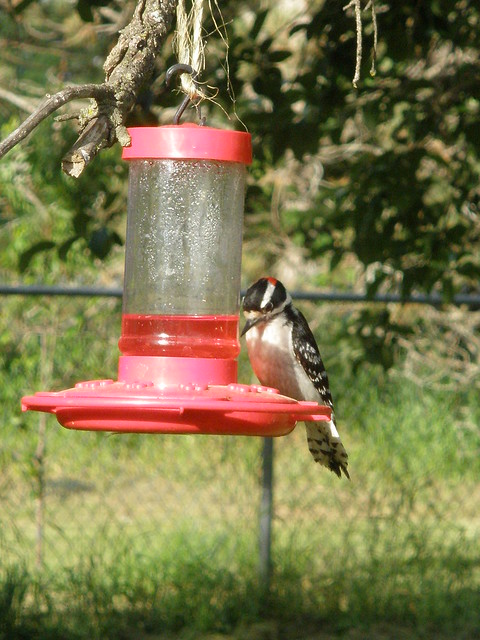
Downy woodpeckers are common feeder birds, eating suet and black oil sunflower seeds and occasionally drinking from hummingbird feeders.

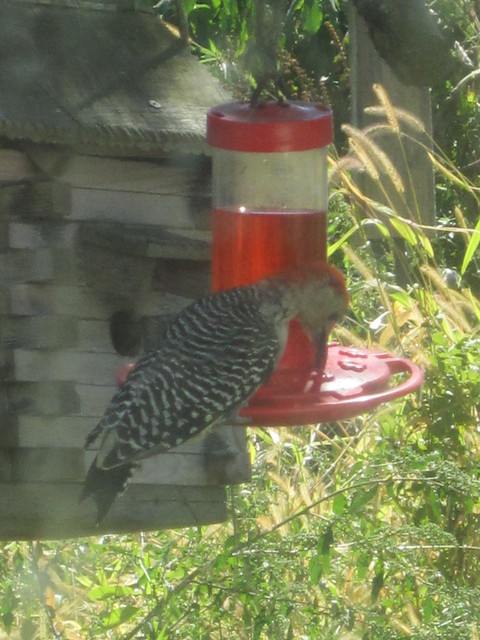
Woodpecker Drinking from Hummingbird Feeder
This woodpecker visited our hummingbird feeder 
daily during the early summer.
June 8, 2011


Nesting 
A clutch typically has between 3–8 eggs, with one brood per season. The incubation period is 12 days and nestling period is 18-21 days. The eggs are completely white.

Nest Description
Both male and female downy woodpeckers excavate the nest hole, a job that can take between 1 to 3 weeks. Entrance holes are round and about 1-1.5 inches across. Cavities are 6-12 inches deep and widen toward the bottom to make room for eggs and the incubating bird. The cavity is lined only with wood chips.

Nest Placement Cavity
Downy woodpeckers nest in dead trees or in dead parts of live trees. They typically choose a small stub (averaging around 7 inches in diameter) that leans away from the vertical, and place the entrance hole on the underside.

Nest trees are often deciduous and the wood is more than likely infected with a fungus that softens the wood, making excavating easier.

Sounds
To hear what a downy woodpecker sounds like, click here: Calls

Backyard Tips
Downy woodpeckers enjoy visiting backyard bird feeders. They prefer suet feeders, but are also fond of black oil sunflower seeds, millet, peanuts, and chunky peanut butter. Occasionally, downy woodpeckers will drink from oriole and hummingbird feeders as well.

Interesting Facts

In winter Downy woodpeckers are frequent members of mixed species flocks. Advantages of flocking include: (1) having to spend less time watching out for predators and (2) better luck finding food from having other birds around.

Male and female Downy woodpeckers divide up where they look for food in winter. Males prefer to feed on small branches and weed stems while females prefer larger branches and trunks.

Downy woodpeckers eat food that larger woodpeckers cannot reach, such as insects living on or in the stems of weeds. You may see them hammering at goldenrod galls to extract the fly larvae inside.

Woodpeckers don’t sing songs, but they drum loudly against pieces of wood or metal to achieve the same effect. People sometimes think this drumming is part of the woodpeckers' feeding habits, but it isn’t. In fact, feeding birds make very little noise even when they’re digging into wood.

PILEATED WOODPECKER


The nest holes these birds make offer crucial shelter to many species including swifts, owls, ducks, bats, and pine martens.

Size & Shape
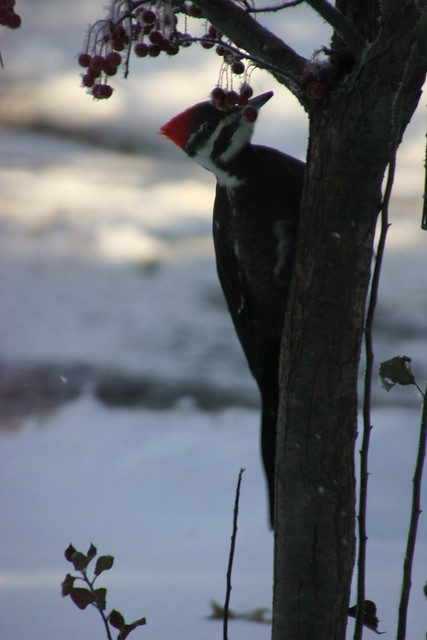
The pileated woodpecker is one of the biggest, most striking forest birds on the continent. Nearly the size of a crow, it has black with bold white stripes down its long neck and a flaming-red triangular crest that sweeps off the back of the head.

Close-up of Pileated Woodpecker on Cherry Tree
Pileated woodpecker on our plum tree.
December 12, 2007.

The bill is long and chisel-like, about the length of the head. In flight, the wings are broad and the bird can seem crowlike.

Color Pattern
Pileated woodpeckers are mostly black with white stripes on the face and neck; and have a flaming-red crest. Males have a red stripe on the cheek. In flight, the bird reveals extensive white underwings and small white crescents on the upper side, at the bases of the primaries.

Woodpecker on Pear Tree
Within an hour of putting out new feeders, 
this woodpecker and others found it.
This one is on our pear tree.
November 11, 2007.

Behavior
Pileated woodpeckers drill distinctive rectangular-shaped holes in rotten wood to get at carpenter ants (their main prey) and other insects. They are loud birds with whinnying calls. They also drum on dead trees in a deep, slow, rolling pattern, and even the heavy chopping sound of foraging carries well. Their flight undulates like other woodpeckers, which helps separate them from a crow’s straight flight path.

Food
In addition to carpenter ants, pileated woodpeckers also eat other types of ants, termites, woodboring beetle larvae, and other insects such as flies, caterpillars, cockroaches, spruce budworm, and grasshoppers. They also eat nuts and wild fruits, including hackberry, sassafrass, greenbrier, blackberries, poison ivy, holly, dogwood, sumac berries, persimmon, and elderberry.

In some diet studies, ants constituted 40 percent of a pileated woodpecker's diet, and up to 97 percent in some individuals. Occasionally, pileated woodpeckers visit backyard bird feeders for seeds or suet.

Habitat
Pileated woodpeckers are forest birds that require large, standing dead trees and downed wood. Forests can be evergreen, deciduous, or mixed. In the East (including Minnesota) they live in both old and young forests and may even be seen in partially-wooded suburbs and backyards.

Interesting Facts

The pileated woodpecker digs characteristically rectangular holes in trees to find ants. These excavations can be so broad and deep that they can cause small trees to break in half.

A pileated woodpecker pair stays together in its territory all year round. It will defend the territory in all seasons, but will tolerate new arrivals during the winter.

Nesting 
The clutch size is 3–5 eggs; and one brood per season is common. The incubation period is 15-18 days, and the nesting period is 24-28 days. The eggs are white.

Nest Description
The male begins excavating then nest cavity and does most of the work, but the female contributes, particularly as the hole nears completion. The entrance hole is oblong rather than the circular shape of most woodpecker holes.

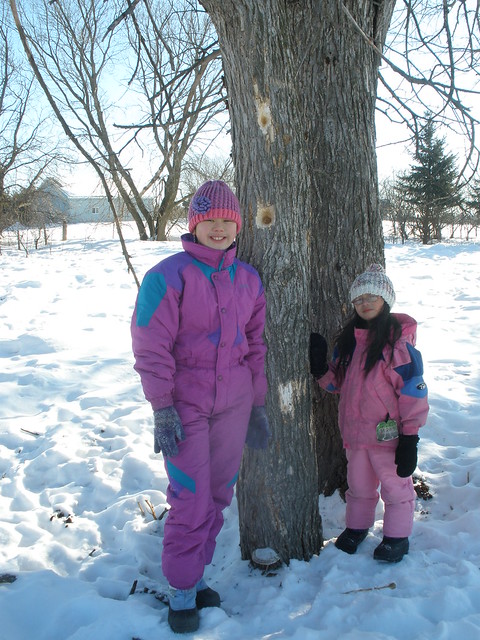
Woodpecker Holes in Tree
The girls outside braving the 0 degree weather.
They are standing next to woodpecker's holes in the tree.
February 8, 2011

For the finishing touches, the bird climbs all the way into the hole and chips away at it from the inside. Periodically the adult picks up several chips at a time in its bill and tosses them from the cavity entrance.

Pileated woodpeckers do not line their nests with any material except for leftover wood chips. The nest construction can take between 3-6 weeks, and nests are rarely reused in later years. Cavity depth can range from 10-24 inches.

Nest Placement
Nest trees are typically dead and within a mature or old stand of coniferous or deciduous trees, but may also be in dead trees in younger forests or even in cities. Dead trees are a valuable resource as nest sites or shelter for birds and other animals, and pileated woodpeckers battle for ownership with European starlings, wood ducks, red-headed woodpeckers, red-bellied woodpeckers, Eastern bluebirds, and great crested flycatchers. Occasionally bats and swifts share roost cavities with pileated woodpeckers.

Sounds
To hear what a pileated woodpeckers sound like, click here: Sound.


*~*~*~*~*~*~*~*~*~*

In addition to learning about woodpeckers, we studied a bit about birds' feet as noted on pages 40-42 of The Handbook of Nature Study. We also visited a website that looked at different types of bird feet.

“The feet of birds are shaped so as to assist the bird to get its food as well as for locomotion.”
~ The Handbook of Nature Study, page 41 ~

Outdoor Time:

This week during our outdoor time, we actually spent time watching the birds that came to the feeder so we could get a better look at their feet.

After doing that, we went outdoors to see what birds we could observe.

Woodpeckers that We've Observed in the Past


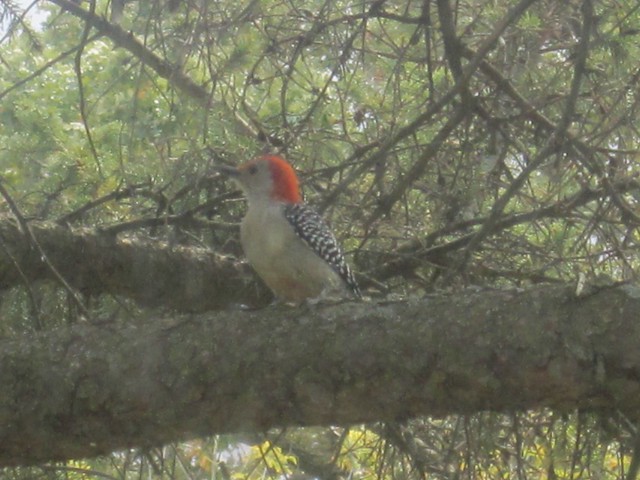
Red-Bellied Woodpecker
Red-bellied woodpecker in the pine tree.
September 21, 2012.

Flicker Drinking from Feeder
Red-bellied woodpecker drinking nectar 
from the hummingbird feeder.
For at least a few weeks, this bird would visit the feeder daily 
(sometimes more than once a day.)
It would always announce its arrival with a loud call.
It was such a joy to see it each day.
September 14, 2012.

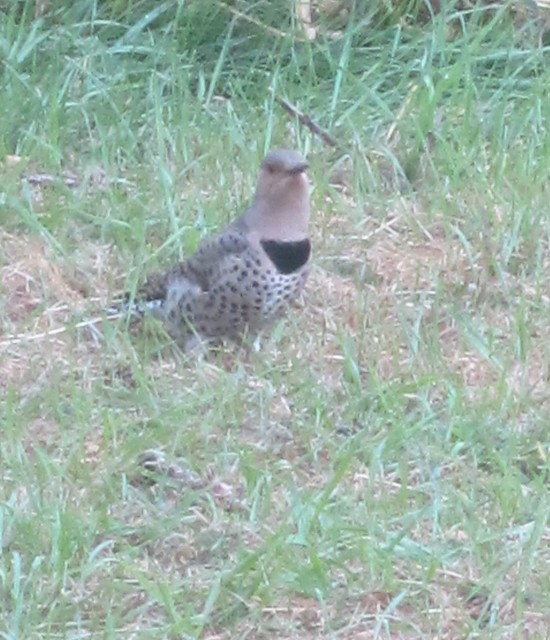
Northern Flicker
This was a northern flicker that was in the backyard.
September 21, 2012.

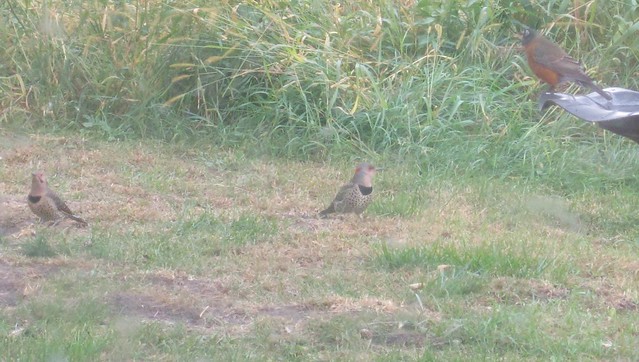
Robin and Northern Flickers
These two northern flickers were hanging out with 
a robin that was on the bird bath.
September 21, 2012.

Nature Journal Entry

The girls each did a nature journal entry. Olivia used pictures she found from the internet as starting points for her journal page.


Sophia researched different facts and drew pictures to illustrate what she learned.


It's interesting to see the different styles of journaling take shape as the girls get older.


Monday, November 3, 2014

Where the Heart Is - Read 52 Books in 52 Weeks - Week 45

This week for the Read 52 books in 52 Weeks challenge, I read Where the Heart Is by Billie Letts. This book is on Oprah's Book Club list, so I was interested in reading it for that reason.


Like many of the books this year that I've read, this would not have been one that I would have thought about reading unless I was doing the challenge. However, I'm happy I did. The story - although filled with some very sobering and difficult situations - somehow keeps the focus on the positive elements of life. Many of the characters face struggles - either ones due to poor choices they have made or ones that have been thrust upon them - yet plod forward and persevere.

As the main character, Novalee Nation, says, "...Our lives can change with every breath we take...Let go of what's gone....and hold on...to what [you've] got....We've all got meanness in us...but...we have some good in us, too. And the only thing worth living for is the good. That's why we've got to make sure we pass it on."

Where the Heart Is begins with the story about Novalee, a seventeen-year-old girl who is seven months pregnant who was heading for California with her boyfriend, Willy Jack. He drops her off at the Wal-Mart in Oklahoma to use the restroom, and continues on the journey without her.

So, Novalee finds herself stranded at the Wal-Mart with just $7.77 in change. Somehow she manages to live in the store and not be discovered for a couple months.

It is during this time that people come into Novalee's life; and they become her true friends and new family. These people support Novalee and her already strong spirit. They are down-to-earth, deeply caring people who are willing to help a homeless, jobless girl.

From a kind, generous older lady named Sister Thelma Husband to eccentric librarian named Forney Hull who loves Novalee more than she loves herself, they are all there to support Novalee.

About two months after her arrival in Oklahoma, she has her baby one night at the store. Her friend, Forney, happens to see her there, breaks the window of the store, and helps deliver the baby. Needless to say, she receives much publicity and financial support.

When she's in the hospital, her mother (who abandoned her when she was a young girl), shows up and convinces Novalee that they will begin their life over. Novalee trusts her mother, and gives her all the money she received hoping that her mother follows through on the promise to get a home where they all can live...a place that Novalee has dreamed of her whole life.

Novalee has dreamed her whole life of living in a house since she has always lived on a home on wheels. She keeps a journal full of magazine pictures of houses; and she looks through them, she imagines her dream house and how it is furnished. Truly, she wants to make sure that her baby grows up in the best environment that she can create.

Of course, the mother simply takes the money and disappears again, leaving Novalee with no money and no place to live. Sister Thelma just happens to show up and offers to let Novalee and her baby live with her husband and her in their trailer home.

Soon, Novalee takes charge of her future by working and bringing in money to support herself and daughter. Through her friendship with Moses Whitecotton, she develops skills in photography. She builds on the information he shares with her by reading many books and magazines from the library where Forney works. She visits photography exhibitions and takes many photographs to build her skills.

Although she is not educated when she arrives in Oklahoma, by the end of the story she is enrolled in college and is supporting herself through her photography skills.

Where the Heart Is also follows Willy Jack's life and the string of bad decisions he makes. His journey is a sharp and negative contrast to Novalee's life, filled with alcohol, prison time, failed singing career, and an encounter with a train that amputates both his legs.  In the end, his journey tries to lead him back to Novalee to apologize to her and let her know that he lied about something that meant a lot to her.

She ends up finding out about Willy Jack by reading a newspaper article; and - in her compassionate and quiet, unassuming manner - meets him at a hospital where he was transported to after being a victim of a robbery. He talks about lies and their impact one one's life.

As Willy Jack said, "Why does anyone lie? 'Cause we're scared or crazy, maybe just 'cause we're mean. I guess there's a million reasons to lie, and I might've told that many....but none like that. I guess there's always that one lie we never get over....Maybe you never told a lie so big it can eat away a part of you. But if you ever do...and if you get lucky...you might get a a chance to set it right. Just one chance to change it. Then it's gone. And it never comes again."

His apology to her - and what he said about lying - makes Novalee reconsider what she said to a dear friend who she loved, but said she didn't care for him.

Towards the end of the story, Novalee follows through on where her heart is; and the book finishes on a positive note which I liked. After all the early poor decisions, hard work, and determination to build a respectable life - Novalee succeeds. She may not be the richest and most powerful person in her mid-20s, but within her world she attained much more than she expected, positively impacted the lives of many people, and realized dreams that she would never have imagined when she was 17 years old.

Home gives you something no other place can...
your history...
home is where your history begins.

Saturday, November 1, 2014

Tulips, Crocuses, and Daffodils - Outdoor Hour Challenge

This past week's focus for the Outdoor Hour Challenge is on tulips, crocuses, and daffodils.

One of my favorite bulbs is the tulip. It reminds me of a trip that Sophia, Olivia, and I took with my dad and mom about 5 1/2 years ago to Pella, Iowa. They have a big tulip festival there, and we went about a week before it happened so that we could enjoy the beautiful tulips without the crowds of people.

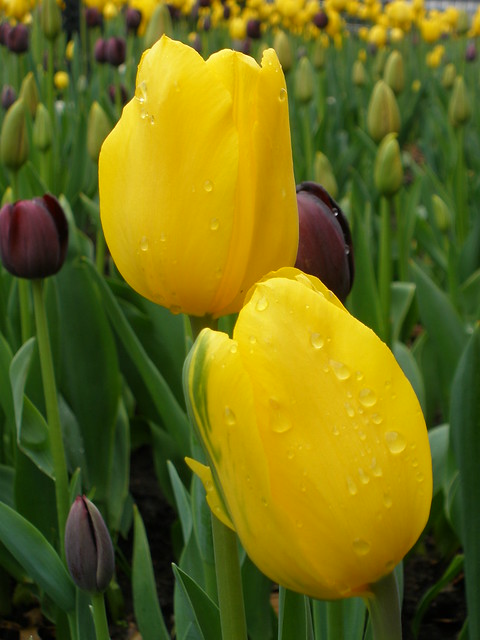
Yellow Tulips
Beautiful yellow tulips after a rainfall.
(Taken on April 29, 2009.)

We read about tulips in the Handbook of Nature Study since we had some tulip bulbs that we were going to plant. Some things we wanted to remember about tulips include:
=> Tulips came from the Orient to Europe in the sixteenth century. One hundred years later, the Netherlands were buying and selling tulip bulbs at an almost manic level. Rare varieties of tulips were going for $1,800...per bulb!
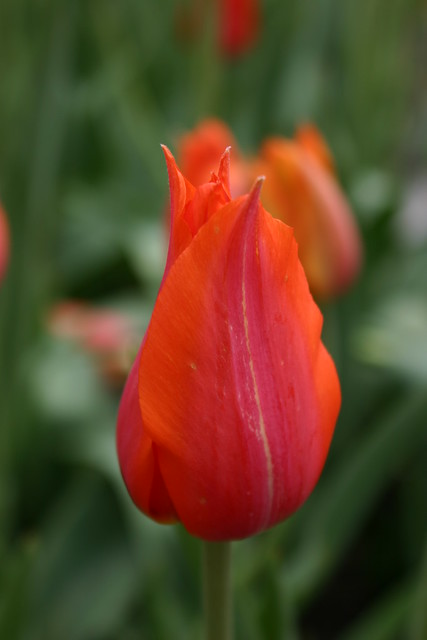
=> In the red varieties, there is a six-pointed star at the heart of the flower, usually yellow or yellow-margined.

Barley Open Red Tulip
This was a tulip that hadn't opened yet.
(Taken on May 1, 2009.)

=> In the heart of each bulb is a flower bud, sheltered by the fleshy leaf-layers around it, which furnish it food in the spring.
=> The true roots are below the bulb. 
=> Tulips will grow in almost any soil as long it it is well-drained so that the roots don't rot.
=> Make sure that the bulb is upright and doesn't fall over on its side.
=> Bulbs can be planted in September and October. The more root growth the bulbs have before the ground freezes the better. (Note: We planted the bulbs perhaps a bit too late since the ground froze within days after we planted the bulbs.)

Hundreds of Tulips
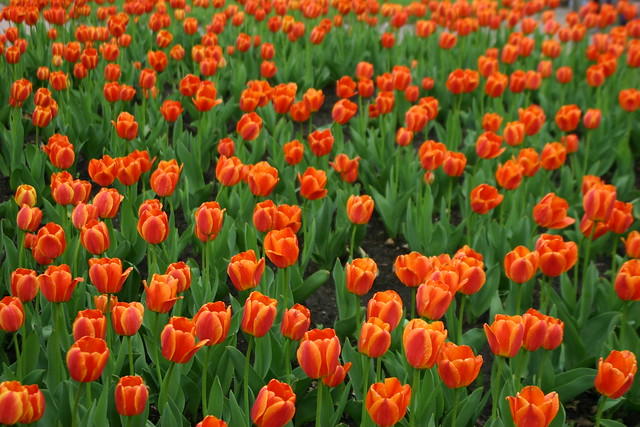
Everywhere we looked in Pella, Iowa, there were beds of beautiful tulips.
(Taken on April 30, 2009.)

=> Blossoms should be cut as soon as the flowers wither so that the plant's energy can go back into the bulb.

Next, we read about crocuses in the Handbook of Nature Study. Some interesting facts about crocuses:
=> The crocus has a corm instead of a bulb. A corm is a solid, thickened, underground stem, and is not in layers, like the onion. The roots come off the lower side of the corm
=> The leaves number from two to eight, depending on the variety.
=> The petals and sepals are similar in color. The three sepals are on the outside and their texture is coarser than that of the three protected petals.
=> Crocus blossoms have varied colors: white, yellow, orange, and purple (striped or feather-veined).
=> The crocus multiples by its corms.
=> Crocuses need to be replanted every two or three years.
=> Crocuses can be planted in flower beds or in the grass. The flowers bloom and mature before the grass needs to be mowed.

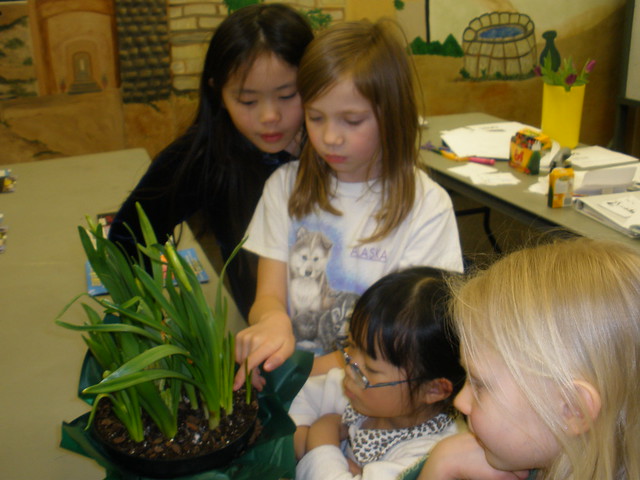
Exploring Bulbs - Netherlands Unit
The girls with some friends at the homeschool co-op looking at spring bulbs.
(February 16, 2009)

Although we didn't plant daffodils, we still read about them in the Handbook of Nature Study. Some key facts to remember:
=> There are six segments of the perianth - three bright-colored sepals and three inner petals. These sepals and petals are different shapes and look like a corona or crown.
=> There is one flower on a stalk in the daffodils, compared with jonquils or paper-white narcissus that have two or more flowers on the same stalk.

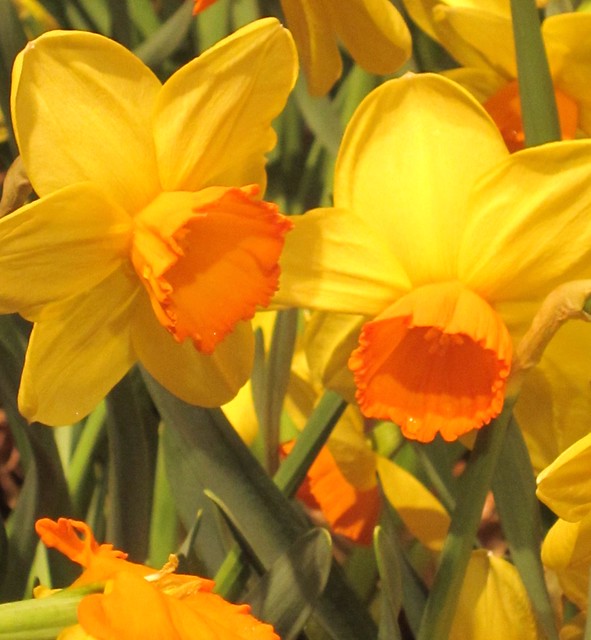
Daffodils at the Macy's Flower Show
Daffodils at an indoor flower show
(Taken on April 5, 2013.)

=> The bulbs should be planted in September or early October, about four to six inches apart.
=> As soon as the surface of the ground is frozen in the winter, the beds should be covered with four to six inches in depth with straw mixed with stable manure. (Note: We did not do this when we planted the crocus, tulip, and hyacinth bulbs this year. It will be interesting to see if this step is needed for the other bulbs, or is something that we would do in the future when we plant daffodils.)
=> New bulbs are formed on the sides of the old one.
=> The leaves of the plant should be allowed to stand as long as they will after the flowers disappear so they will furnish the bulbs with plenty of food for storage.
=> The seeds shouldn't  be allowed to ripen because it takes too much energy away from the bulb.
=> The flowers should be cut as they are opening.

Nature Journals:

Each of the girls did an entry in their nature journal about tulips, crocuses, and daffodils.

Outdoor Hour Time:

For this week's nature journal focus, we spent time outdoors planting bulbs that will bloom in the spring. It was a great way to bring learning about flowers alive.

Sophia, Olivia, and I planted 70 crocus corms under the four big pine trees in the front yard. (I have always called them bulbs, but they are technically called "corms." Honestly, I don't see us using that term. They'll still always be "bulbs" to us.)

Olivia putting a crocus corm into the soil.

Looking at the trees now, I can envision the beautiful purple, yellow, and white flowers emerging in the spring after a cold, snow-filled winter. It will be a welcome sight!

Sophia working under one of the pine trees.

Thankfully, the ground was still relatively easy to dig into. It hadn't completely frozen yet.

Sophia planting one of 17 crocus corms under the pine trees.

The soil under the pine trees is relatively "fluffy" since so many pine needles have fallen into it over the years.

Olivia looks so small compared to the pine tree.

Under each tree there are about 17 bulbs. Seeing the bulbs in a bag and then seeing them spread out under the tree made me realize that we could have easily planted four times as many bulbs to give a fuller and more colorful look under the trees.

This is a crocus corm. 
There's another one in the background.
The one in front is the way that you plant it in the ground.
The one in the back shows the flat underside that
faces the ground when it is planted.

At least this is a good starting point in terms of a long-term vision. Each year we can add more bulbs under the trees.

Sophia creating a nice space for the crocus' roots to grow.

Under the pine tree that's adjacent to the house on the northwest side, Olivia and I planted orange and yellow tulips with purple flowers.

Two of the bulbs we planted by the pine tree 
near the fairy house door.

The fairy house door is on the pine tree, and the tulips and purple flowers now will surround it in the spring - like a miniature, colorful front yard with the secret little door hidden among the colorful flowers.

This winter we can spend some time thinking about ways we can enhance that space and make a bigger fairy garden.
This was a smaller area in which to work, 
so the tulips will be closer together.

As we were planting the bulbs, Olivia came across one that was already starting to shoot out another section. She wondered if it was still okay to plant. It is. Hopefully we'll see two flowers instead of one in the garden.

Hopefully we'll have a bonus flower in the spring.

Because the sun was setting and it was getting dark, we decided to wait to plant the remaining tulips until Tuesday morning. I planted the tulips by the door of the mudroom (our main entry to the house) to add some color to that area. It will be nice to have some color there since we are at that entryway a lot with letting the dogs out; and going in and out of the home.

Then I planted two different types of bulbs next to the driveway. If all goes well over the summer, we should be enjoying tulips in the back and muscari in the front. The flower garden is visible from several rooms in the home, so it will be nice to see the bright colors after a relatively colorless winter.

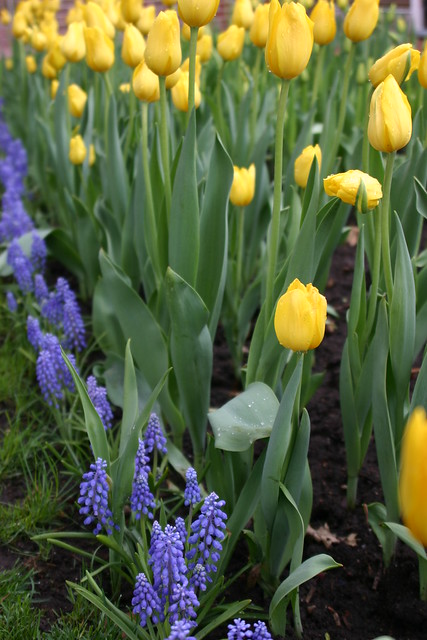
Tulips and Purple Flower Bed
Purple muscari in front of yellow tulips.
(Taken on April 30, 2009.)

In about 150 days, we should see our front yard transformed by colorful flowers! What will be nice is that we can also cut some of these flowers and bring them indoors to enjoy their color and fragrance.

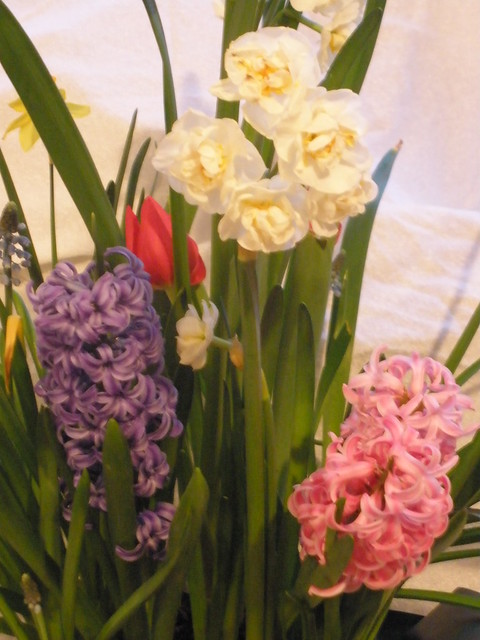
Spring Flowers in Indoor Bulb Garden
An indoor garden filled with a variety of fragrant, spring flowers.
(Taken on February 26, 2009.)

Perhaps later in November we will plant bulbs to force indoors. We've done this before and it always a joy to see the flowers growing and emerging indoors. We try to pick fragrant flowers, so the scent reminds us of spring time.

Note: We used Winter Series #10 - Early Spring Bulbs for inspiration.