Saturday, January 16, 2016

Waldorf Grain Schedule - A Week of Recipes

When Sophia and Olivia were younger, I remember reading about a grain schedule that was used in Waldorf Kindergarten classrooms. Having a schedule provides children (and families) with a sense of rhythm and predictability.

In addition, according to The Parenting Passageway, "A different grain for each day is...connected to the cosmic origins of the days of the week. A different grain a day fits in with the nourishing weekly rhythm the Kindergarten thrives on."

The website continued, "The most common listing of grains...is the following, taken from The Waldorf Kindergarten Snack Book:

Sunday (Sun): Wheat

Monday (Moon): Rice

Tuesday (Mars): Barley

Wednesday (Mercury); Millet

Thursday (Jupiter): Rye

Friday (Venus): Oats

Saturday (Saturn): Corn

"Waldorf teachers and those who cook with whole grains attribute different properties to different grains. According to The Waldorf Kindergarten Snack Book, wheat is often seen as a harmonizer of the organ systems; rice is seen as acting on the digestive system; barley is seen as strengthening to the connective ligaments due to a high silica content and also seen to be soothing to the mucous membranes of the stomach and intestines; millet is seen to have warming properties; rye nourishes the head and bones; oats loosens stiffness and increases stamina and resistance to disease; and corn stimulates the metabolism in muscles."

I thought it would be interesting to try following the Waldorf Grain Schedule for a week using recipes I found on Pinterest that I've wanted to try now for some time. On the schedule I used this past week, I switched two days (Tuesday and Friday). Otherwise, everything matches the above schedule.

Sunday - Wheat

This pin for Baked Cheese Sticks led to the Living Well Kitchen. The recipe called for using cheese sticks. These are well-enjoyed by Olivia, and I forgot to tell her that I was going to use the package of cheese sticks for a recipe. Needless to say, between the time they went into the refrigerator and Sunday, only one cheese stick was left.

So, I thought I'd try cutting regular blocks of cheese. I had Swiss cheese and a Monterey Jack cheese on hand. What I found was that the string cheese held its shape whereas the other block cheese melted despite the breaded covering.

I baked the cheese sticks for only 8 minutes. They probably could have baked for less time. They tasted good, despite their flattened appearance.

Baked Cheese Sticks

The only two cheese sticks that retained their shape.

Ingredients (Serves 2)

1/2 cup whole wheat bread crumbs
1/4 tsp salt-free Italian seasoning
1 egg
2 tablespoon water
4 pieces string cheese, cut in half

Instructions

Preheat the oven to 375°F. Line a baking sheet with foil and spray with non-stick spray. Set aside.
In a sandwich sized zip-top bag, mix together the bread crumbs and Italian seasoning. (I put everything in a bowl so as to not waste a bag.)

In a shallow bowl, whisk together the egg and water, and add 2 cheese stick halves, making sure they are well-covered.

Add the egg-coated cheese sticks to the bag with the bread crumbs, and shake until fully coated. Put the cheese sticks back in the egg and shake in the bread crumbs again.

Put the breaded cheese sticks on the prepared baking sheet.

Repeat process with the remaining cheese halves until all are breaded and on the prepared baking sheet.

Spray the tops of the breaded cheese sticks with cooking spray.

Bake in the preheated oven for 8-10 minutes, until the tops are golden brown and the cheese is just starting to melt.

You can tell which ones are cheese sticks and 
which ones are from the blocks of cheese.

*~*~*~*~*~*~*~*~*~*~*

Monday - Rice

Today, rather than having a Chinese stir fry over rice (which would be something that I typically would have made for a day focused on rice), I wanted to try Rice Paper Rolled Sandwiches that I saw on this pin on Pinterest. The pin didn't lead to a recipe, so it was up to us to figure out what we wanted to put in the sandwiches.

Rice Paper Rolled Sandwiches

We need more practice rolling the sandwiches.

This was a healthy lunch that included shredded cabbage, avocado, carrots, cucumber, and cilantro. We dipped the sandwiches in peanut sauce.

The ingredients ready to be rolled into a sandwich.

There isn't a lot of filling that is needed for each sandwich. If you put too much, there isn't enough rice paper to stretch around the ingredients.

Sophia rolling a sandwich.

We were surprised at how forgiving and flexible the rice paper is after it soaked in water. The key, we found, is to keep an eye on the rice paper as it soaks. One minute it is hard as a rock and the next minute it seems like if you aren't paying attention, you'll have a soggy clump of rice paper on your hands. Ours didn't get to this point, thankfully. One more minute in the water, though, and it would have reached that level.

Sophia and I thought that these type of sandwiches would be especially good in the summer when the produce from the garden or farmers market is ripe and most flavorful. Adding edible flowers would give the sandwiches a decorative and pretty look.

*~*~*~*~*~*~*~*~*~*~*

Tuesday - Oats

Our dessert after dinner on Tuesday was Chocolate-Peanut Butter Granola Apple Bites. The recipe comes from a pin on Pinterest that doesn't lead to anything. Found another pin that has the recipe.

Sophia and I liked this recipe. Olivia said she liked the peanut butter on the apple, but not the granola.

It's an easy snack and healthy dessert; and we would make the recipe again. It also could be eaten as part of a meal. They would be something that would be good to take on a picnic since the granola sometimes falls off the apple. The birds and wildlife could enjoy eating whatever falls to the ground.

Chocolate-Peanut Butter Granola Apple Bites

A Granny Smith apple covered with 
peanut butter and granola.

Ingredients:

2 apples, sliced into wedges (We used Granny Smith which are a bit on the tart side. I think we all would have preferred a sweeter apple)
1/4 cup peanut butter
1/4 cup granola, your favorite
1/4 teaspoon ground cinnamon, for sprinkling (We didn't put cinnamon on the apples)
Semisweet chocolate chips, optional* (We didn't use chocolate chips)

Three ingredients for a simple dessert or snack.

Directions:

Coat the tops of the apple wedges in peanut butter and sprinkle with granola and cinnamon.

Melt chocolate chips in the microwave, stirring in 30 second increments until melted. Be careful not to overheat.

Drizzle wedges with melted chocolate. Set on a large platter and serve.

Tips:

To substitute the chocolate drizzle, you can sprinkle mini chocolate chips on top of the wedges. Or, leave the chocolate out altogether. They’re still delicious.

Olivia eating the apple slice and 
determining whether or not she liked it.

If not eating this immediately, brush each side of apple wedges with a little lemon juice to avoid browning. Makes 16-20 wedges.

Sophia with an apple slice covered in 
peanut butter and granola.

*~*~*~*~*~*~*~*~*~*~*

Wednesday - Millet

Today's grain is millet. This is not an easy grain to find in grocery stores in rural areas. I could find it at the local grain store in the bulk bird seed section. However, I thought it might be more appropriate to find it elsewhere for human consumption. So, the co-op is the place to go to get millet.

At any rate, I found a pin on Pinterest that led to the Alkaline Sisters website. Interestingly, the website said that millet "...is one of the six most important grains in the world and sustains one-third of the world's population as a significant part of the diets in China, Japan, Manchuria, and some areas of Russia, Africa, India, and Egypt; and it has an amazing 10,000 years of cultivation history in parts of East Asia."

The website noted that, "Millet is an excellent source of manganese, phosphorus, and magnesium - all of which are key minerals required for optimal health that you won’t find in white pasta."

I underestimated the amount of millet I had on hand, so I ended up using couscous along with the millet. What I should have done was cook each grain separately since each had a different length of time it needed to cook. Millet takes about 18 minutes and couscous about 5 minutes. The former needs to simmer and the latter doesn't. Needless to say, the millet was a bit on the firm side while the couscous was overly soft (event though I did take the pan off the stove).

At any rate, once the millet-couscous mixture was added to the other ingredients, the unusual texture of the grains wasn't as obvious. I still like my recipe for tabbouleh that I've had for a good 15+ years. This one didn't seem to have quite as much flavor. It also was missing the black olives and feta cheese I usually include with my tabbouleh.
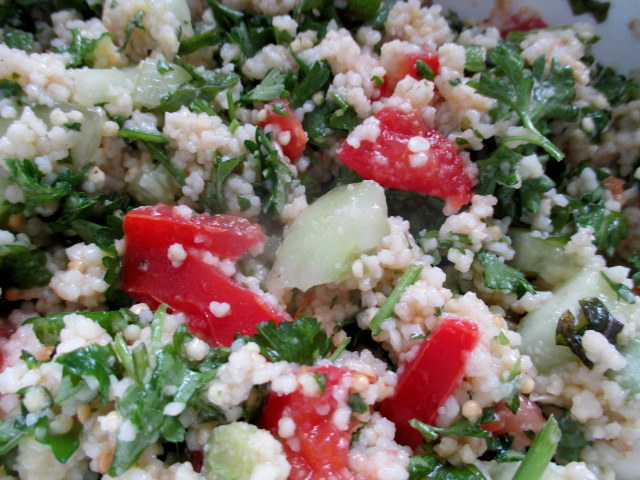
It was nice to have fresh produce in the middle of winter.


Millet Tabbouleh

Ingredients:
1 cup millet, rinsed
2 cups filtered water
1 tsp celtic sea salt
1/3 cup extra virgin olive oil
juice of one lemon
1 large garlic clove, crushed
1 1/2 cups roma tomatoes, diced small (3-4 romas)
1 1/2 cups English cucumber, diced small (almost 1 cuke)
3 green onions, sliced finely
1 1/2 cups fresh parsley, chopped small
3/4 cups fresh mint, chopped small
1/2 tsp Maldon sea salt flakes

Directions:

In a medium sauce pan bring water to boil, add millet and then reduce heat to low, simmering with lid on for 18-20 minutes.

Remove from heat, and fluff with a fork.  Allow to cool with the lid off for 30-60 minutes. The texture should be firm but not crunchy and neither mushy.

Combine olive oil, lemon juice, and crushed garlic and allow to stand.

Meanwhile chop vegetables as per above descriptions and place in a large bowl.

Add millet when it is completely cool and then pour dressing over mixture.  Toss well, seasoning with sea salt to taste.

Garnish with parsley or mint and serve at room temp or chilled. Flavors will become more pronounced after resting.  Yield: Approximately 7 cups.

*~*~*~*~*~*~*~*~*~*~*

Thursday - Rye

Rye is Thursday's grain. The recipe I selected is one that I saw on Pinterest that led to All Recipes; and is for Swedish Limpu Bread. Unless it is started right away in the morning, it takes a bit too long for me to make on a weekday.

Thursdays are now our "4-H Day" with some weeks having up to three meetings (club and committee) that run from morning to late afternoon. The best thing to do would be to make this recipe on the weekend when I have a bit more time, and then serve the bread on Thursday.

I am going to let the bread rise more next time and 
see how that affects the texture of it.
I'm not sure how to bake it differently so that it doesn't brown quicker 
on the sides touching the pan.
It doesn't affect the taste...I just don't like the way it looks.


When I made the  bread, the kitchen smelled wonderful. From the scent of orange zest, caraway seeds, and fennel seeds boiling in water on the stove and then cooling in the mudroom to the hours when the bread was rising twice...it made me think back to being a child when my dad would make bread on Sundays.

When it came out of the oven, he would ask if anyone wanted a hot slice of bread with butter (actually it was margarine since it was less expensive). My sister, brother, and I would run up the stairs to the kitchen and wait patiently which he used the electric knife to cut the bread for us. It was such a special treat for us.

This recipe, for Swedish Limpu Bread, makes enough for two loaves of bread. It is a denser - an very flavorful - bread. It tastes equally as good right from the oven or cooled. We all liked it, and I'll definitely make it again.

The bread has two types of seeds and orange rind in it.

Swedish Limpu Bread

Ingredients:
5 1/2 cups all-purpose flour
2 (.25 ounce) packages active dry yeast
2 cups water
1/2 cup packed brown sugar
2 tablespoons vegetable oil
2 teaspoons salt
2 teaspoons orange zest
1 1/2 teaspoons caraway seed
1 1/2 teaspoons fennel seed
2 eggs, room temperature
2 cups rye flour

Directions:

Boil water, sugar, oil, salt, orange rind, caraway seeds, and fennel seeds in a saucepan for 3 minutes. Cool until warm.

In a large bowl, whisk together 3 cups flour and yeast. Stir in cooled orange rind mixture. Beat with an electric mixer on medium speed for 2 minutes. Blend in eggs. Add 1 cup flour, and beat 1 minute on medium speed. Add rye flour and enough additional white flour to make a stiff dough.

Turn dough onto a lightly floured surface. Knead for 8 to 10 minutes, or until smooth and satiny.

Shape into a ball. Place in lightly greased bowl, turning to grease the surface. Cover with a damp cloth, and place in a warm spot. Allow to rise for 1 1/2 hours, or until doubled.

Punch dough down, and divide in half. Shape into 2 balls. Let rest for 10 min. Shape into 2 loaves, and place into ungreased 9 x 5 inch loaf pans. Brush with oil. Allow to rise for 1 hour, or until doubled in size.

Bake at 400 degrees F (205 degrees C) for 30 to 35 minutes, or until done.

*~*~*~*~*~*~*~*~*~*~*

Friday - Barley

Today's recipe is for Barley Beef Soup. The pin on Pinterest led to Better Homes & Gardens.

Had I read the instructions early in the day, I would have noticed that it was supposed to start in the morning in the crock pot. At 5:00 p.m., I realized that I would have to find a quick way to make this soup or we weren't having a normal dinner.

With the exception of Olivia (who isn't a big fan of vegetables or this type of soup), we all enjoyed it and would make this recipe again.

Barley Beef Soup

Beef Barley Soup cooking in the skillet.

Makes: 8 servings Prep: 25 mins Cook: 8 hrs to 10 hrs (low) or 4 to 5 hours (high)

Ingredients

12 ounces beef or lamb stew meat (I used beef stew meat - about 16 ounces)
1 tablespoon vegetable oil
4 14 ounce cans lower-sodium beef broth
1 14 1/2 ounce can diced tomatoes, undrained
1 cup chopped onion (1 large)
1 cup peeled parsnip or potato cut into 1/2-inch pieces (I used a potato)
1 cup frozen mixed vegetables
2/3 cup regular barley
1/2 cup chopped celery (1 stalk)
1 cup bay leaf (I didn't include the bay leaves. One cup also seems like a very high amount. I would maybe do 1 or 2 bay leaves, but certainly not one cup.)
2 cloves garlic, minced
1 teaspoon dried oregano or basil, crushed (I used Italian seasoning instead)
1/4 teaspoon ground black pepper

Directions

Trim fat from meat. Cut meat into 1-inch pieces. In a large skillet, cook meat in hot oil over medium-high heat until brown. Drain off fat.

Transfer meat to a 5- or 6-quart slow cooker. (At this point, I didn't transfer things to a slow cooker. I continued adding everything except the barley to the meat. The barley was cooking separately on the stove. I added it once it was done cooking.) Stir in broth, undrained tomatoes, onion, parsnip or potato, frozen vegetables, barley, celery, bay leaf, garlic, oregano, and pepper.

Cover and cook on low-heat setting for 8 to 10 hours or on high-heat setting for 4 to 5 hours. It didn't take nearly that long - about 30-35 minutes - basically until the barley had cooked and I could add it to the other ingredients in the skillet.

Nutrition Facts (Barley Beef Soup): Per serving: 168 kcal cal., 4 g fat (1 g sat. fat, 25 mg chol., 492 mg sodium, 20 g carb., 3 g fiber, 13 g pro. Percent Daily Values are based on a 2,000 calorie diet

*~*~*~*~*~*~*~*~*~*~*

Saturday - Corn

Today I made Jicama Salsa with Blue Corn Chips. The recipe is from a pin I saw on Pinterest that led to My Recipes.

The fresh produce smelled wonderful on a chilly January day. It was almost as if summer were here again when I tasted the fresh cilantro, green onions, and red bell pepper.

If I were to make this recipe again, I would chop the jicama, pepper, and onion much smaller. This could be made in the Vita-Mix Mixer so that the vegetables all are finely-grated. I think the salsa would stay on the chips and the flavors would blend with one another better.

It's a colorful salsa that looks so bright 
when it is on blue corn chips.


Jicama Salsa

Ingredients:

3/4 cup diced, peeled jicama (Note: one jicama makes about 3 batches of this recipe)
1/2 cup chopped red bell pepper
2 tablespoons chopped red onion (I used green and yellow onions instead)
1 minced garlic clove
2 tablespoons chopped fresh cilantro
2 tablespoons fresh lime juice
baked blue corn chips

Directions:

Combine 3/4 cup diced peeled jicama, 1/2 cup chopped red bell pepper, 2 tablespoons chopped red onion, 1 minced garlic clove, 2 tablespoons chopped fresh cilantro, and 2 tablespoons fresh lime juice in a medium bowl. Serve with baked blue corn chips.

Red Waldorf-Inspired Window Star

A long time ago, I pinned an image on Pinterest that led to a pattern for a Waldorf-inspired window star on a blog called Deschdanja.

There are several patterns featured for window stars - some of which I've already done. However, there was a pattern for a blue star that I had never seen.

So, being that it it very cold outdoors, I created a windows star. It has been a while since I've tried a new pattern and is the perfect day to do it with the windchill in the double-digits below zero.


I chose red kite paper since Valentine's Day is coming up. There are 12 fold/unfolds per point. With eight points, that's 96 folds/unfolds to make this window star.


It was a simple star to make...and a quick creative activity to do on a weekend morning.

Sunday, January 10, 2016

Home for Dinner - Read 52 Books in 52 Weeks - Week 2

For the second week in the Read 52 Books in 52 Weeks challenge, I read Home For Dinner - Mixing Food, Fun, and Conversation for a Happier Family and Healthier Kids by Anne Fishel.


This would be a great book for families who are not eating together as a family and want to know where to start. There's a lot of helpful and inspiring ideas in each chapter.

For our family, we have always eaten together. Working out of the home, running a non-profit, and then becoming a stay-at-home mom who homeschools her daughters made it easy to prepare food at home and enjoy it with one another.

Perhaps it goes back to how I was raised. My mom - who learned to cook when she was 34 years old and just married to my dad - prepared nutritious, well-balanced meals at home. Every once in a while we would have a t.v. dinner or food from a jar (like spaghetti sauce). That was atypical, though. Generally she prepared everything from scratch and tried new recipes since she had not been cooking up until that time.

When she lived with her mother (my grandma), my mom would receive simple instructions for getting the main course started while my grandma was working. When my grandma came home from being being a baker, she would finish preparing the meal that my mom had started. Never - until the time she was married - did she ever have to make a meal to completion.

So, as I reflect on home-cooked meals, my mom learned quickly how to make food, set a table, and create mealtimes that were memorable and meaningful. We always sat down and waited for my dad to join us for evening meals. We never would eat before he was seated and we prayed as a family.

Even on weekdays when she wasn't working the night shift, she would make sure that my sister, brother, and I would sit at the table together and have breakfast before going to school.

In my own family, we aim to eat as many meals together as possible. Sometimes the girls aren't hungry or may wake up on the weekend at times that are too spread out to have a meal together. This is the exception...not the rule in what our meals look like.

The book, Home for Dinner, although interesting, did not have a lot of relevant information for our lives. What I did like was an idea for a meal-in-a-bowl salad. Below are the ideas to choose from when creating a salad:

Pick a green: arugula, Bibb lettuce, spinach, kale, dandelion greens.

Pick a fruit: plum, peach, watermelon, grapes, pears, strawberries, raspberries, blood orange.

Pick a vegetable (or more than one): tomato, avocado, mushroom.

Toast some nuts: walnuts, pine nuts, almonds, and pecans.

Add some optional whimsy: Parmesan chips, edible flowers (violets, dandelions, chive blossoms, bee balm, basil flowers, lavender, mint flowers, Johnny jump-ups, marigolds, or nasturtiums).

Make a dressing: Mix three parts oil (walnut, hazelnut, olive) to one part vinegar (balsamic, raspberry, or strawberry). For extra flavor, whisk in a little mustard and any herbs that you like.

Pick a protein:Grilled shrimp, leftover roast chicken, black beans, tofu, and kidney beans.

Top with cheese: Sprinkle or shave some Parmesan cheese on top.

Tuesday, January 5, 2016

Learning about History through Movies for Homeschooling

What seems like a long time ago, I found a pin on Pinterest that led to the Heart of Wisdom's post about learning about American history through movies.

There is a list of movies that is divided between time periods. I deleted ones that were marked R (restricted). However, there are additional ones on the list that I believe are R-rated which I would not show my daughters as part of homeschooling and because of their age.

Ideally, we should have started using the timeline at the beginning of the year when the girls began their American History courses. However, we can always go back at a future date and watch more movies that tie into what we are studying if this seems to be a good way to learn for the girls.

So, this week we are starting with the 1815-1860 Westward Expansion section and moving forward from this point on for the remainder of the 2015-16 homeschool year. I've italicized the movies that I want us to watch. I am hoping that they are available through the library at no cost. If they aren't, I will choose other ones to replace them.

Pre-America Period
National Geographic: America Before Columbus
Lost Colony(NR)

1630-1763 Colonial Period
Desperate Crossing: The Untold Story of the Mayflower
The Mayflower Pilgrims (Amazon Instant Video)
National Geographic – The New World: Nightmare in Jamestown
William Bradford- The First Thanksgiving DVD
Where America Began: Jamestown, Colonial Williamsburg, Yorktown [VHS]
The War That Made America: The Story of the French and Indian War
When the Forest Ran Red
Roots (Miniseries 4 DVD)
Freedom & Repression In Colonial America
Benjamin Franklin
Crucible
Deerslayer (French Indian War)
Hawkeye (1755, 4 DVD)

1763-1783 Revolutionary America
American Revolution Documentaries
Liberty: The American Revolution
The History Channel Presents The Revolution
John Adams
1776 (Musical)
April Morning
Johnny Tremain (NR)
A More Perfect Union: America Becomes a Nation
Just The Facts – The United States Bill of Rights and Constitutional Amendments/ The Constitution
Benedict Arnold – A Question of Honor
The Crossing
Drums Along the Mohawk

1783-1815 Young Republic
George Washington DVD
Centennial (Miniseries 6 DVDs)
Thomas Jefferson
War of 1812
The History Channel Presents The War of 1812
Louisiana Purchase
National Geographic – Lewis & Clark
Sacagawea – Heroine of the Lewis and Clark Journey
Lewis and Clark The Journey of the Corps (Ken Burns documentary)
The Awaking Land

1815-1860 Westward Expansion
The West (Ken Burns documentary)- ordered from the library to watch during Homeschooling Week 17
Thomas Jefferson (Ken Burns documentary) - ordered from the library to watch during Homeschooling Week 18
Ken Burns: America
Amistad
Alamo
Red River
Davy Crockett
Fort Apache
High Noon
Wild West Tech – Gold Rush Tech (History Channel)
Shane
Stagecoach
Wyatt Earp (PG-13)
Walt Whitman
Into the West

1830-1876 Civil War and Reconstruction
Gone with the Wind
Roots (Amazon Instant video)
The Cause 1861 (Amazon Instant video)
We Shall Remain: Trail of Tears (Amazon Instant video)
North and South (Mini Series Emmy Award, 8 DVD)
The Blue and the Gray (Miniseries 3 DVD)
Hatfields & McCoys (Mini Series, 3 Emmy Awards, 2 DVD)
Gods and Generals (Amazon instant video)
Glory
Red Badge of Courage
Shenandoah
Friendly Persuasion (Amazon Instant Video)
Civil War Documentaries
The History Channel Presents The Civil War
Dances With Wolves
Gettysburg (Widescreen Edition)
The Civil War (Ken Burns: Commemorative Edition)

U.S. Mexican War 1846-1848
Amistad
Santa Fa Trail
Gangs of New York (1840s to 1863)
The Autobiography of Miss Jane Pitmen (100 years from Civil War to Civil Rights)

1871-1914 Industrial Revolution
Backstairs at the White House (Taft to Eisenhower)
Industry and Empire: The Birth of the Industrial Revolution
Ford Motor Company Auto Manufacturing
Henry Ford
Thomas Edison
Railroad
The Great Locomotive Chase
The Vanderbilts: An American Dynasty
American Experience: The Rockefellers
The Men Who Built America
Far and Away (PG13)
Industrial Revolution
Instant Expert: Oil
Empires of Industry: Black Gold – The Story of Oil
Empires of Industry – Andrew Carnegie and the Age of Steel
Spanish-American War
Seven Wonders of the Industrial World
Learn to Read

1880-1920 Political Reform
Yankee Doodle Dandy
Winds of Kitty Hawk
Mark Twain
Teddy Roosevelt – An American Lion
When Giants Roamed: The Golden Age of Steam (The History Channel)
Ellis Island
Christy Complete Series
Anne of Green Gables (Canada)
Mark Twain (Ken Burns documentary)
The Rise and Fall of Penn Station

1914-1933 WWI / Prosperity/ Depression
The Long Gray Line (50 years Westpoint, Amazon Instant Video)
Sergeant York (NR)
Lost Battalion
Spencer’s Mountain
The War: A Ken Burns Film (Amazon Instant Video)
The Aviator
The Dawn Patrol
Twelve O'Clock High
Seabiscuit
The Color Purple
The Roosevelts (Ken Burns documentary)
Probation (Ken Burns documentary)
War Horse (PG-13)

WWI Documentaries
All Quiet on the Western Front
Biography: Amelia Earhart – Queen of the Air
Mr. Smith Goes to Washington (Amazon Instant Video)
All the King’s Men
The Grapes of Wrath
The Dust Bowl (Free w Amazon Prime Instant Video)
Cinderella Man (Amazon Instant Video)
Annie
Wilson
J Edgar

WWII Documentaries
War and Remembrance (12-disk series)
The Longest Day
In Harms Way (Amazon Instant Video)
The Pacific Amazon Instant Video)
Tora, Tora, Tora (Amazon Instant Video)
Patton
Empires of Industry: Victory at Sea: Mass Producing Liberty
The Great Raid (Amazon Instant Video)
Hope and Glory
The Great Escape
The Hiding Place
Anne Frank – The Whole Story
The Diary of Anne Frank
The Pacific
From Here to Eternity
Hiroshima
The House on 92nd. Street
Passage to Marseilles
Airforce
Watch on the Rhine
Atomic Cafe
Hiroshima: Out of the Ashes
Truman
Red Tails
Seabiscut

1945-1960 Post War/ Civil Rights
Korea The Forgotten War
West Side Story
The Best Years of Our Lives
The Jackie Robinson Story
The Kennedys
Ethel Kennedy
The Right Stuff
Freedom Riders
Lee Daniel’s The Butler
To Kill a Mockingbird (Amazon Instant Video)
The Help
Rosa Parks Story
Something the Lord Made
Freedom on My Mind
Guess Who’s Coming to Dinner

1960-1980 Vietnam Era
JFK
Spaceflight: The Complete Story from Sputnik to Shuttle – And Beyond
Vietnam Documentaries
Thirteen Days: A Memoir of the Cuban Missile Crisis
Mississippi Burning
Martin Luther King Jr
Bay of Pigs
JFK Assassination
Civil Rights
Nixon
Apollo
Frost/Nixon
When we Left Earth
Apollo 13

1980-2000 End of the Century
Argo (hostage crisis in Iran in 1980)
The Wolf of Wall Street
Ronald Reagan and the Triumph of American Conservatism
The Challenger Disaster (Amazon Instant Video)
Fall of the Berlin Wall
All the President’s Men
Persian Gulf War
Black Hawk Down
Three Kings (Gulf War, R, Amazon Instant Video)
Untold Stories of Columbine
Game Over in Littleton
Primary Colors

2000- Today
Remembering 9/11
Flight 93 (Amazon Instant Video)
Last Letters Home
Live from Bagdad
The Finest Hour
The Social Network
Supersize Me
Inside Hurricane Katrina
The Blind Side
2016: America’s Obama

Monday, January 4, 2016

Poet/Poetry Study - The Oxford Illustrated Book of American Children's Poems

This year, as part of Olivia's homeschool lessons in English, we are doing poet/poetry studies. We've been doing this for a few years now using the list at the Simply Charlotte Mason website.

In addition to the poets listed there, we also are using the Sonlight book list which includes The Oxford Illustrated Book of American Children's Poems edited by Donald Hall. We did a combination of me reading the poems aloud to Olivia; and Olivia reading some of the poems on her own.

From the book, she chose ones that resonated with her. The poems follow.

Mother's Song to a Baby
Brian Swann based on adaptations from "Mother's Song to a Baby" from Song of the Sky: Version of Native American Song-Poems and "She Will Gather Roses" from Native American Songs and Poems: An Anthology

First
this little baby
has been given life
through the medicine man's song
through the medicine man's prayer
for this baby the songs
have been sung

Next
the baby's mother
has taken care of him
with the songs of the rain gods

This
little baby
in his cloud-cradle
was watched over
by his mother

It
was
nice
how the clouds
came up like foam
and
as if he
was among them
this little baby
was cared for

Taken May 22, 2013

*~*~*~*~*~*~*~*~*

The Cow-Boy's Song
Anna Maria Wells

"Mooly cow, mooly cow, home from the wood
They sent me to fetch you as fast as I could.
The sun has gone down: it is time to go home.
Mooly cow, mooly cow, who don't you come?
Your udders are full, and the milkmaid is there,
And the children all waiting their supper to share.
I have let the long bars down, -- why don't you pass through?"
The mooly cow only said, "Moo-o-o!"

"Mooly cow, mooly cow, have you not been
Regaling all day where the pastures are green?
No doubt it was pleasant, dear mooly, to see
The clear running brook and the wide-spreading tree.
The clover to crop, and the streamlet to wade,
To drink the cool water and lie in the shade;
But now it is night: they are waiting for you."
The mooly cow only said, "Moo-o-o!"

"Mooly cow, mooly cow, where do you go,
When all the green pastures are covered with snow?
You go to the barn, and we feed you with hay,
And the maid goes to milk you there, every day;
She pats you, she loves you, she strokes your sleek hide,
She speaks to you kindly, and sits by your side:
Then come along home, pretty mooly cow, do."
The mooly cow only said, "Moo-o-o!"

"Mooly cow, mooly cow, whisking your tail,
The milkmaid is waiting, I say, with her pail;
She tucks up her petticoats, tidy and neat,
And places the three-legged stool for her seat: --
What can you be staring at, mooly? You know
That we ought to have gone home an hour ago.
How dark it is growing! O, what shall I do?"
The mooly cow only said, "Moo-o-o!"

Taken April 30, 2008.

*~*~*~*~*~*~*~*~*

Fable 
Ralph Waldo Emerson

The mountain and the squirrel
Had a quarrel;
And the former called the latter "Little Prig."
Bun replied,
"You are doubtless very big;
But all sorts of things and weather
Must be taken in together
To make up a year
And a sphere.
And I think it's no disgrace
To occupy my place.
If I'm not so large as you,
You are not so small as I,
And not half so spry.
I'll not deny you make
A very pretty squirrel track;
Talents differ: all is well and wisely put;
If I cannot carry forests on my back,
Neither can you crack a nut."

Taken January 18, 2013.

*~*~*~*~*~*~*~*~*

The Camel's Complaint
Charles E. Carryl

Canary-birds feed on sugar and seed.
Parrots have crackers to crunch.
And as for the poodles, they tell me the noodles
have chicken and cream for their lunch.
But there's never a question
about my digestion.
Anything is okay for me.

Cats, you know, can sleep in a chair.
Chickens can rest upon rails.
Puppies are able to sleep in a stable,
and oysters can nap in pails.
But no one supposes
a poor camel dozes.
Any place is okay for me.

Lambs are indoors out of the sun.
Coops are built for hens.
Kittens are treated to houses well heated,
and pigs are protected by pens.
But a camel is handy
wherever it's sandy.
Anywhere is okay for me.

People would laugh if you rode a giraffe,
or rode the back of an ox.
It's nobody's habit to ride on a rabbit,
or to try to ride a fox.
But as for a camel,
he carries families.
Any load is okay for me.

A snake is as round as a hole in the ground,
and weasels are wavy and sleek.
And no alligator could ever be straighter
than lizards that live in a creek.
But a camel's all lumpy
and bumpy and humpy.
Any shape is okay for me.

Taken August 5, 2007.

*~*~*~*~*~*~*~*~*

Eletelephony
Laura Elizabeth Richards

Once there was an elephant,
Who tried to use the telephant—
No! No! I mean an elephone
Who tried to use the telephone—
(Dear me! I am not certain quite
That even now I’ve got it right.)
Howe’er it was, he got his trunk
Entangled in the telephunk;
The more he tried to get it free,
The louder buzzed the telephee—
(I fear I’d better drop the song
Of elephop and telephong!)

Taken on February 2, 2011.

*~*~*~*~*~*~*~*~*

The Little Turtle
Vachel Lindsay

There was a little turtle.
He lived in a box.
He swam in a puddle.
He climbed on the rocks.

He snapped at a mosquito.
He snapped at a flea.
He snapped at a minnow.
And he snapped at me.

He caught the mosquito.
He caught the flea.
He caught the minnow.
But he didn't catch me.

Taken on May 30, 2013.

*~*~*~*~*~*~*~*~*

About the Teeth of Sharks
John Ciardi

The thing about a shark is—teeth,
One row above, one row beneath.

Now take a close look. Do you find
It has another row behind?

Still closer—here, I’ll hold your hat:
Has it a third row behind that?

Now look in and...Look out! Oh my,
I’ll never know now! Well, goodbye.

Taken on January 31, 2008.

*~*~*~*~*~*~*~*~*

The Folk Who Live in Backward Town
Mary Ann Hoberman

The folk who live in Backward Town
Are inside out and upside down.
They wear their hats inside their heads
And go to sleep beneath their beds.
They only eat the apple peeling
And take their walks across the ceiling.

Taken on October 1, 2010.

*~*~*~*~*~*~*~*~*

The Witches' Ride
Karla Kuskin

Over the hills
Where the edge of the light
Deepens and darkens
To ebony night,
Narrow hats high
Above yellow bead eyes,
The tatter-haired witches
Ride through the skies.
Over the seas
Where the flat fishes sleep
Wrapped in the slap of the slippery deep,
Over the peaks
Where the black trees are bare,
Where bony birds quiver
They glide through the air.
Silently humming
A horrible tune,
They sweep through the stillness
To sit on the moon.

Taken on January 31, 2008.

*~*~*~*~*~*~*~*~*

The King of Cats Sends a Postcard to His Wife
Nancy Willard

Keep your whiskers crisp and clean.
Do not let the mice grow lean.
Do not let yourself grow fat
like a common kitchen cat.

Have you set the kittens free?
Do they sometimes ask for me?
Is our catnip growing tall?
Did you patch the garden wall?

Clouds are gentle walls that hide
gardens on the other side.
Tell the tabby cats I take
all my meals with William Blake,

lunch at noon and tea at four,
served in splendor on the shore
at the tinkling of a bell.
Tell them I am sleeping well.

Tell them I have come so far,
brought by Blake's celestial car,
buffeted by wind and rain,
I may not get home again.

Take this message to my friends.
Say the King of Catnip sends
to the cat who winds his clocks
a thousand sunsets in a box,

to the cat who brings the ice
the shadows of a dozen mice
(serve them with assorted dips
and eat them like potato chips),

and to the cat who guards his door
a net for catching stars, and more
(if with patience he abide):
catnip from the other side.

Taken on May 7, 2007.

*~*~*~*~*~*~*~*~*

Good Luck Gold
Janet S. Wong

When I was a baby
one month old,
my grandparents gave me
good luck gold:
a golden ring
so soft it bends,
a golden necklace
hooked at the ends,
a golden bracelet
with coins that say
I will be rich
and happy someday.

I wish that gold
would work
real soon.
I need my luck
this afternoon.

Taken on April 29, 2009.

*~*~*~*~*~*~*~*~*

There were old favorites that she liked as well:

The Three Little Kittens
Eliza Lee Follen

The three little kittens, they lost their mittens,
And they began to cry,
"Oh, mother dear, we very much fear,
That we have lost our mittens."

"Lost your mittens, you naughty kittens!
Then you shall have no pie."
"Mee-ow, mee-ow, mee-ow."
"No, you shall have no pie."
"Mee-ow, mee-ow, mee-ow."

The three little kittens found their mittens,
And they began to cry,
"Oh, mother dear, see here, see here!
See, we have found our mittens!"
"Put on your mittens, you silly kittens,
And you shall have some pie."
"Purr-r, purr-r, purr-r,
Oh, let us have some pie!
Purr-r, purr-r, purr-r."

The three little kittens put on their mittens,
And soon ate up the pie,
"Oh, mother dear, we greatly fear,
That we have soiled our mittens."
"Soiled your mittens! You naughty kittens!"
Then they began to sigh,
"Mee-ow, mee-ow, mee-ow,"
Then they began to sigh,
"Mee-ow, mee-ow, mee-ow,"

The three little kittens, they washed their mittens,
And hung them out to dry,
"Oh, mother dear, do not you hear,
That we have washed our mittens?"
"Washed your mittens? Oh, you're good kittens!
But I smell a rat close by."
"Hush, hush! Mee-ow, mee-ow."
"We smell a rat close by,
"Mee-ow, mee-ow, mee-ow."

Taken on November 27, 2012.

*~*~*~*~*~*~*~*~*

Olivia also liked an old favorite that had additional verses that we had not heard before.

Mary’s Lamb
Sarah Josepha Hale

Mary had a little lamb,
Its fleece was white as snow,
And every where that Mary went
The lamb was sure to go;
He followed her to school one day—
That was against the rule,
It made the children laugh and play,
To see a lamb at school.

And so the Teacher turned him out,
But still he lingered near,
And waited patiently about,
Till Mary did appear;
And then he ran to her, and laid
His head upon her arm,
As if he said—“I’m not afraid—
You’ll keep me from all harm.”

“What makes the lamb love Mary so?”
The eager children cry—
“O, Mary loves the lamb, you know,"
The Teacher did reply;—
“And you each gentle animal
In confidence may bind,
And make them follow at your call,
If you are always kind.”

Taken on March 23, 2008.

Sunday, January 3, 2016

50 Things to Do When You Turn 50 - Read 52 Books in 52 Weeks - Week 1

This year I'll be turning 50 years old. When I visited the library recently, a book that was featured on the "New Books" shelf caught my eye: 50 Things to Do When You Turn 50 edited by Ronnie Sellers.


The book features short stories or narratives written by 50 people who share what they believe you should do when you turn 50. I had thought the book would be like a bucket-list of sorts...something to create a list of things to do and mark off. The book turned out to be more along the lines of advice that wiser, older folks are passing along to those younger than them who are reaching this milestone birthday.

It would be like if my parents had sat down with me and said, "Ann, these are the most important things that we want to share with you as you enter this new decade and season of your life based on what we learned in our lives." How I wish I would have asked them what they thought when they were still alive. I would have added it to this list.

This is the advice that I want to remember:
- When you hit 50, you have to stop complaining about getting old, the strangeness of it, the fascination, the horror, etc.
- When people ask how you are, tell them, "Absolutely great. Never better."
- Fifty is the time to try giving up television and newspapers and radio for six months or a year and see what the simple, unmediated life of direct experience is like.
- By 50, everyone can stand to lose 20 pounds, so do it.
- Eat to satisfy hunger; if you're not hungry, don't eat. As you get older, your metabolism changes, and now you can sustain yourself quite well on one meal per day and two snacks. So that's what you do.
- Find something in the here-and-now that absorbs you and take up with that, a garden, yoga, knitting...
- Turning 50 was harder because...there was a lot of real life going on. With so much loss [e.g., death of family members], it became about survival. It made me think, what's precious to me? What do I really care about?
- You know there isn't an endless amount of time. You just know it. But you still have to believe that you can change things. If you didn't believe you could change things, it would be horrible.
- You have to show up every day and hope for the best.
- Go with the hope. Look for what's hopeful and try to find that hope.
- Somewhere around two or three months before the big day, I started to be haunted by memories of a youth now irrevocably over. I had waking nightmares of blazing memories - things I hadn't handled well, stupid choices I had made and could not make over, chances I thought were never more to be retrieved. Grieving the glory of my younger years, I had to face myself and all the pain that comes   with that. Not to worry - all of a sudden the anxiety would lift.
- 50s are great because you don't care anymore what others think.
- Hold onto your sense of adventure and remember what's important.
- Facial lines are hard-earned proof that you've lived a rich, emotion-filled life. Take them all away and you end up looking like a blank, plastic-faced mannequin.
- Instead of fighting the body you have, accept it and make the most out of it. Focus on being healthy, strong, and fit. Commit to making smart food choices and exercising regularly.
- Beauty goes far beyond the physical and what you see in the mirror. It begins from within and it's all about self-confidence.
- 50 marked the beginning of a period of rejuvenation.
- Always being with young people is my way of staying youthful.
- People have to be comfortable. The most important thing that makes a woman feel attractive is being confident; in order to feel confident you have to wear clothes that are comfortable and that you feel make you look better. But ultimately, you just have to live your life and not think too much about it.
- Keep yourself agile in body and brain. Pay attention, be curious, be engaged, and live.
- Climb to the highest of places - whether that be within or without (or both) - and discover all you can be. Stride through life with spirit and strength. Hike for health, happiness, and harmony.
- Regular hiking transforms flesh into firm, defined muscle in a matter of weeks; cardiovascular-fitness levels improve; circulation and skin tone are rejuvenated; and the sport is a useful tool for combating stress and fatigue.
- Hiking improves eye-foot coordination and dexterity, and it's great for developing balance.
- Do yoga for about 3 hours each week. Begin with a gentle approach and then move to a more intense practice.
- Keep away from fast foods.
- Eat lean proteins. Stick with white meat chicken or turkey, pork, and fish; and trim the fat from all red meats.
- One way to reduce inflammation is to eat fish, such as salmon, regularly. An even better bet is to take a daily fish oil supplement.
- Load up on fruits and vegetables.
- Stick to whole grains.
- Eat nuts and seeds.
- Avoid fruit juices.
- Choose local and seasonal foods.
- Go organic whenever possible.
- Blood pressure should be below 120/80.
- Control the stress in your life if possible, or at least your responses to it. Try yoga or meditation.
- Osteoarthritis is a chronic, progressive, often crippling condition.
- Arthritis is enough to force you to use a cane or crutches, keep you from sleeping, or steal your ability to walk from point A to point B. When it affects your hands, it can make the simplest activity either miserably painful or downright impossible.
- Preference of osteoarthritis for the spine, particularly the lower back, is one of the universal miseries of mankind and the most common reason Americans miss work or become permanently disabled.
- Osteoarthritis can result from damage, injury, or even inherited weakness in any of the structural components that work together to create a healthy joint.
- Osteoarthritis can't be cured. So early on, the goal is to control your symptoms through exercise, simple medicines like Tylenol, nonsteroidal anti-inflammatory drugs like ibuprofen,or glucosamine and chondroitin.
- We build up a certain amount of bone in our bone mineral bank by age 20 or so and then we either maintain it or spend it.
- Maintaining a dietary calcium intake of greater than 1,500 mg a day and a vitamin D intake of 400 to 800 IU per day, and by performing weight-bearing exercises such as walking. It's hard to get enough calcium in your diet to meet that requirement, however. So plan on taking a daily calcium supplement.
- To measure the strength of your bones or bone mineral density is the DEXA scan.
- Your brain shrinks. In fact, your brain's potential peaks at age two, when it contains the largest number of cells it will ever have.
- That doesn't mean your brain function has to go downhill. You have to exercise your brain to maintain its health. If you have high cholesterol, are overweight, smoke, have diabetes, eat an unhealthy diet, or don't get enough physical exercise your brain will suffer.
- Stretch your brain, continue learning, expose yourself to new experiences. These can be as minor as taking a  new route to work every day and as major as returning to school for another degree. As simple as completing the daily crossword puzzle and as complex as learning a new language. How about a new hobby, like growing orchids?
- Aerobic exercise and resistance training appear to contribute uniquely to mental efficiency. They also help your memory by helping you manage stress.
- Really use your calendar. Add things that you'd like to or simply need to remember. For example, add exercise onto your calendar, reminders to get the furnace checked, to water the plants.
- See your eye doctor for a yearly exam. Make sure you are checked for glaucoma cataracts, and early signs of macular degeneration.
- Flaxseed reduces the risk of breast cancer and slows tumor growth. It also lowers cholesterol and reduces clogging in the arteries.
- Experts recommend eating about one-quarter cup of ground flaxseed or 1-3 tablespoons of flaxseed oil each day. You can  sprinkle ground flaxeed on yogurt,  cereal, soup, or salads.
- Consider teaching or coaching as a line of work.
- Your best move financially is to concentrate on getting your costs down. If you will need less to live on in retirement, then you won't need to risk desperate accumulation strategies now.
- Make cost reduction Plan A in your Late-Start Retirement Strategy. And the single biggest cost you can eliminate is your mortgage.
- If you are getting a late start on your retirement investing, getting your mortgage paid off ASAP is going to give you the  best, safest return for your money, not to mention great peace of mind. Get it paid off before you retire.
- Make sure your beneficiaries are current and up-to-date on your life insurance.
- Keep current documentation on what you own, including photos, receipts, and records.
- Select an executor or trustee for your estate.
- Name people to handle your financial and health care affairs if you are unable. This means executing a general power of attorney, health care power of attorney, and living will.
- Evaluate what portions of your estate you wish to be divided among people and charities (if desired). For children, decide if the money should be given outright or in trust.
- Inheritance: Go through grieving process first and then six months later determine how to best spend the money. Look at your debts first. Hire help to make sure you are making the best use of the money.
- Do catch-up contributions into an IRA.
- The rewards of philanthropy isn't recognition, it is the empowerment of using your voice and your resources to create change.
 - The Buddhist view is that you make yourself, or unmake yourself, all the time. If you behave well and cultivate your good qualities, they will intensify and you'll be better. You'll be happier. You'll b e a better person. And if you let yourself go, you'll be worse. That belief becomes the meaning of life - that you do more good things and become a better being.
- If you've realized that the really important things in life are friendships and kindness, that you've been most happy when you've helped others to be happy. Look back and remember the moments of your life that were the great moments - moments when you were  caring for another and forgot about yourself.
- Because of your age, you now have the some authority with the young. You can help them have a good life. Don't spoil them too much, but don't be too hard with them either. Help them find a good path - doing so can make you happy.
- If you ask, "Well, now I am 50. How can I use that well, to have a better moment?" Then you will find that turning 50 is an enriching experience. Live moment to moment. Help others more. Have more fun with them, and appreciate what is of value.
- Regrets can be a great teacher, too. People often fin themselves making amends on their deathbed. You've got the opportunity to fix things now, when you reach a milestone like 50, try to anticipate those future regrets and deal with them now.
- People do not regret not having spent more time with their loved ones. Not having read more poems. Not having looked at more sunsets.
- Live as if you're going to live forever. And live as if you're going to die tomorrow.
- Live your faith and enjoy the world.
- We will die. You cannot predict the time for that. So be prepared.
- As you move along, hopefully you mature. You learn more, you understand more. You become more introspective and less materialistic. You become more spiritual and do what you're expected to do in a more focused manner.
- Wisdom is o greater value than physical strength, and that therefore we should rejoice when we reach that stage in our lives when physical agility begins to decline but wisdom increases.
- The wisdom of middle age should include expanding your social network, making new friends to replace friends lost to distance or illness. It should include finding new interests, especially ones that stretch your mind. It should include a sense of obligation to give back to your community and your world some of what life has blessed you with. But most of all, it should include a sense of optimism, the feeling that, in the words of Robert Browning, "The best is yet to be, the last of lie for which the first was made."

Saturday, January 2, 2016

16 Nature Goals for 2016

Last year, I enjoyed setting and working on 15 nature goals for 2015. For 13 out of the 15 goals, I either met and/or made progress on them. Had I not set the goals, I would not have done or enjoyed as much as I did outdoors as I did.


So, for 2016 I've set 16 goals. Some are new goals, some are continuations of ones I enjoyed last year, and others are ones that I didn't have a chance to complete last year.

1. Take 12 new hikes.
2. Coach the Wildlife Project Bowl teams for our 4-H Club. Last year, I coached our club's first-ever junior team for the Wildlife Project Bowl from January-April. This year, all the team members returned and six new youth joined. There's a junior and senior team as well a three associate coaches that I'll be working with to help the youth prepare for the regional (and hopefully) state Wildlife Project Bowls.
3. Read 6 nature books or publications. There are two new publications for the Wildlife Project Bowl that I need to read this year. That leaves four books that I can select that are my choice.
4. Visit 5 state parks in Minnesota that I’ve never seen. I would like to visit Afton, Fort Snelling, Lake Maria, Frontenac, and Forestville/Mystery Cave. Go as a family when possible, and take the dogs with us on some of the visits as we explore new trails and parks.
5. Visit 4 nature centers that I haven’t visited before.
6. See a National Forest. Aim for Mt. Baker-Snoqualmie National Forest in Washington (state) in June.
7. Identify and journal about 3 new types of wildlife. I'll use the Handbook of Nature Study for information as well as the internet.
8. Identify and journal about 3 new birds.
9. Do a Nature Photo of the Week challenge using prompts I found from various challenges.
10. Go on 2 camping trips.
11. Plant on our nature trail 10 trees and shrubs that are native to Minnesota. We used to have a closed-loop trail on the back part of the farm when I did an art and farm camp for children.
      After I stopped doing the camp and a development was built adjacent to our property, I no longer had a desire to walk back there. Now, after planting evergreens about a decade ago along the border, they have filled in quite nicely.
       It's time to revisit having a trail again and using that part of the land. I'd like to focus on trees and shrubs that are particularly beneficial to bees and other pollinators.
12. Do 2 entries per month in my nature journal.
13. Attend 4 workshops, classes, or activities at state parks.
14. Visit two new national wildlife refuges in Minnesota (Sherburne and Upper Mississippi). Sherburne is 1 hour and 4 minutes to the west of home; and Upper Mississippi is by Winona – or about 3 hours away.
15. Have 6 picnics when the weather is pleasant and we aren't battling with mosquitoes.
16. Learn 3 new outdoor skills, hobbies, or sports.

Friday, January 1, 2016

52 Weeks to an Organized Home - Kitchen Organization: Counter Tops and Sink (Week 1)

Last year I wanted to do the 52 Weeks to an Organized Home challenge that is coordinated by Home Storage Solutions. On that website, there is a one-page sheet that has the schedule for the year as well as links with information and ideas for each of the weekly challenges.

Below is a list of the 52 challenges that are part of the Organized Home series:

Week 1: Kitchen organization: counter tops and sink (January 4, 2016)
Week 2: Kitchen drawers and cabinet organization (January 11, 2016)
Week 3: Organize pantry, spices and food storage areas (January 18, 2016)
Week 4: Organizing refrigerator and freezer (January 25, 2016)
Week 5: Organize recipes and cookbooks (February 1, 2016)
Week 6: Create a home recycling center (plus dealing with trash) (February 8, 2016)
Week 7: Organize coupons (February 15, 2016)
Week 8: Healthy meal planning and creating grocery shopping list (February 22, 2016)
Week 9: Laundry room organization (February 29, 2016)
Week 10: Laundry organization and schedule (March 7, 2016)
Week 11: Create a house cleaning schedule and organize cleaning supplies (March 14, 2016)
Week 12: Create a morning and evening routine (March 21, 2016)
Week 13: Basement organization (March 28, 2016)
Week 14: Organize your garage (April 4, 2016)
Week 15: Attic organizing (April 11, 2016)
Week 16: Organize contact information (April 18, 2016)
Week 17: Organize mail (April 25, 2016)
Week 18: Organize bills (May 2, 2016)
Week 19: Organize receipts and tax documents (May 9, 2016)
Week 20: Organize files and create home filing system (May 16, 2016)
Week 21: Organizing magazines, newspapers and catalogs (May 23, 2016)
Week 22: Organize passwords, manuals and warranties (May 30, 2016)
Week 23: Home office organization (June 6, 2016)
Week 24: Organize email and digital information (June 13, 2016)
Week 25: Bathroom organization (June 20, 2016)
Week 26: Cosmetic and makeup organization (June 27, 2016)
Week 27: Organize linen closet (July 4, 2016)
Week 28: Organize master bedroom closet (July 11, 2016)
Week 29: Master bedroom organization (July 18, 2016)
Week 30: Organize jewelry and other accessories (July 25, 2016)
Week 31: Organize shoes (August 1, 2016)
Week 32: Back to school organization (August 8, 2016)
Week 33: Organizing closet space for your kids (August 15, 2016)
Week 34: Kids' bedroom organizing (August 22, 2016)
Week 35: Outgrown and seasonal clothing storage (August 29, 2016)
Week 36: Yard and garden storage and organization (September 5, 2016)
Week 37: Organize toys and games (September 12, 2016)
Week 38: Car organization (September 19, 2016)
Week 39: Mudroom and entryway organization (Septmber 26, 2016)
Week 40: Organizing living room and family room (October 3, 2016)
Week 41: Organize dining room and stuff for entertaining guests (October 10, 2016)
Week 42: Organize photos, both physical and digital, plus negatives (October 17, 2016)
Week 43: Craft organization (October 24, 2016)
Week 44: Organize books (October 31, 2016)
Week 45: Create an emergency preparedness kit (November 7, 2016)
Week 46: Organize medicine and first aid supplies (November 14, 2016)
Week 47: Organizing purses, handbags and wallets (November 21, 2016)
Week 48: CD and DVD storage and organization (November 28, 2016)
Week 49: Holiday decoration and gift wrap storage and organization (December 5, 2016)
Week 50: Create home inventory (December 12, 2016)
Week 51: Organize pet supplies (December 19, 2016)
Week 52: Keep a family calendar (December 26, 2016)

This week, the focus is on organizing the countertops and sink in the kitchen.

Before and After: in my kitchen by the phone (east side).
Things just needed to go back to where they needed to be.
A simple solution...it was about five or so minutes of 
bringing items to different rooms of the home.

The link has many ideas for clearing counter space.

  
Before and after: by the microwave (southeast side).
This took a bit more time because it involved 
finding space in the cupboards for items from my parents' home; 
putting items into the freezer; and 
bringing items to various rooms in the home.

It also has suggestions for decluttering kitchen tools and equipment, but I didn't do that since that falls under Week 2.

 
Before and after: the southwest side of the kitchen.
This section had quite a few things out to 
make a birthday cake for Sophia and 
food that I hadn't yet had a chance to 
put away after a trip to the grocery store.

Basically this week is focused on taking control of an area in your home that is central to so many aspects of living.

After: the south counter/window space.
There wasn't anything in front of the plants before.
There were some items in front of the two containers (to the right)
that were put away in the cupboards.

For me, it was a matter of having the time now (after a busy month of homeschooling, volunteering, and 4-H commitments) to focus on picking up and going back to the way that I like to have the kitchen looking. Having space on the counter, the sink clean, and room to make food is relaxing and less stressful than looking at items that weren't put in their proper place.

After: sink area (east side).
The African violets like the east window.
There are quite a few bottles on the right side still.
However, these are all ones that we use on an almost-daily basis.
Perhaps if I free up some more space under the sink 
I can put them under the sink so it looks less cluttered.


What the process did, though, was also remind me that I need to add some items to the "To Do" list: re-caulking/re-sealing where the walls meet the counter top; fixing some drawers and a cupboard that are misaligned; fixing the seal on one of the windows; and re-potting plants that are getting too big for their pots.

It would be nice to re-paint everything, get a new lighting fixture, upgrade the windows, and replace the door (which is an interior door that technically should be an exterior door). However, those are major projects that will have to wait until my parents' home sells and there's money available to do these improvements. Even then, I need to consider which are most critical.

Perhaps with a greater focus on having a more organized home and life these things will be done this year.