Sunday, December 21, 2014

Zen and the Art of Motorcycle Maintenance - Read 52 Books in 52 Weeks - Week 52

This is the final book in the Read 52 Books in 52 Weeks challenge for 2014: Zen and The Art of Motorcycle Maintenance. I had hoped that it would be great ending to year of reading, but after about 150 pages into the 540-page book, I had to call it quits. It just wasn't engaging enough for me to want to trade my time for it.


Conceptually, the book is intriguing - a man, his son, and two friends go on a cross-country motorcycle trip. I had envisioned more descriptions of the scenery and the natural landscape that they seeing. Those descriptions were present in parts, but not nearly to the level I would have enjoyed.

The majority of what I read was a man free-writing his thoughts about life, philosophy, motorcycle maintenance, and mental illness (though the latter was done more "in code" than it was clearly articulated).

Apparently, the author suffered a nervous breakdown and spent time in and out of psychiatric hospitals in the early 1960s. He was diagnosed with clinical depression and paranoid schizophrenia as a result of an evaluation conducted by psychoanalysts, and was treated with electroconvulsive therapy on many occasions. He briefly refers to the treatment in the part of book that I read.

I would have been interested in hearing more about mental illness and the treatment he received rather than motorcycles. Yet, as I continued to read nothing more was mentioned about it.

Maybe Zen and The Art of Motorcycle Maintenance was just too esoteric for me. At any rate, I felt like I gave the book a fair shot after reading 150 pages of it.

During 2015 I am hoping to read 52 books as well. I'm going to be doing a Spiritual Practices from A to Z (one spiritual practice per alphabet letter). Each spiritual practice will span two weeks and include two or more books to read.

It is a very different approach to the Read 52 Books in 52 Weeks challenge than I've done in the past, but I'm really looking forward to it. I think the books will be very meaningful - and perhaps - life changing.

Sunday, December 14, 2014

The Zookeeper's Wife - Read 52 Books in 52 Weeks - Week 51

For Week 51 of the Read 52 Books in 52 Weeks challenge, I read The Zookeeper's Wife - A War Story by Diane Ackerman.


A couple of weeks ago, I read Yellow Star  by Jennifer Roy - also about the Holocaust and WWII. The Zookeeper's Wife, though, is written from an adult perspective (versus a child's perspective in Yellow Star) and had significantly more details about the brutality of war; the Nazis' views and actions; and the impact on animals. It was truly a difficult book to read for these reasons...particularly around the holidays.

That being said, I did learn quite a bit about these subjects that I had not known before. In high school history class, I don't remember the teacher covering even a fraction of what was covered in this book.

On the eve of World War II, there were 380,000 Jews in Warsaw. Most did not survive the Holocaust. The director of the Warsaw Zoo (Jan Żabiński) and his wife were responsible for saving about 300.

Backing up a bit, in 1928, Jan Żabiński was appointed director of the Warsaw Zoo. Before World War II, Jan oversaw the creation of several exhibits including the monkey house, elephant house, enclosures for antelopes, a seal pond, and the giraffe barn. The Warsaw Zoo was as esteemed as any zoo in Europe.

In 1937, the zoo's female elephant (Kasia) gave birth to the first Indian elephant born in a Polish zoo.

Led by the criminal zoologist Lutz Heck, the Germans (when they invaded Poland) carted off the best animals for their own collections. At the start of the war, it turned out that the Nazis were interested in the zoo for two primary reasons:
(1) they wanted to "move to safekeeping" any rare animals it had - the safekeeping being in a German zoo; and
(2) they were obsessed with resurrecting extinct species of animals that they thought "wild" and "untamed" and "pure."

In September 1939, the zoo was bombed and many animals died. Then Heck and the SS held a shooting festival on New Year’s Eve, 1939, to finish the job. Their brutality at the zoo foretold their brutality in the war, as Antonina intuited in her diary, which Ackerman draws on heavily for her book. “How many humans will die like this in the coming months?” Antonina asks herself, watching the Nazi shooting spree.

Despite killing the animals, the Nazis let the zoo continue to operate at a lower level much longer than they otherwise would have as both a pig farm and fur farm to provide food and warmth to their soldiers. This allowed Jan Żabiński along with his wife (Antonina) and their son (Ryszard) to save more than 300 Jews from the Holocaust.

While the Nazis depopulated the ghetto where hundreds of thousands of Jews lived, the Zabinskis repopulated the zoo — this time with humans. The Nazis had allowed Jan to turn the zoo into a pig farm, as mentioned earlier. So Jan and his staff had reason to enter the ghetto to pick up unused scraps to feed the animals. They brought in non-kosher food and smuggled out people.

The Zabinskis hid Jews in sheds, enclosures, and even the lion house. Those who had papers or Gentile looks were passed via the underground to other parts of Poland. The rest stayed.

After Jan brought the Jews to the zoo, it was up to Antonina to safeguard them: to find them room and food, to keep their spirits up, and most of all to hide them from the Nazis.

Jan Żabinski was seriously injured during the 1944 Warsaw uprising, and taken prisoner. When he returned, animals started being reintroduced to the zoo, which was reopened in 1949. Jan was re-appointed as the director of the zoo in 1949 and continued in the post until 1951.

One of the things that I found challenging about this book is the author's style of writing. It seemed to drag on in places, and I was skimming through these sections. The book could have been shorter and still as effective in conveying the important role that the Zabinskis contributed to saving 300 people's lives.

Despite the author's writing style, I still felt like the The Zookeeper's Wife was a worthwhile book to read.

Some of things that I learned by reading The Zookeeper's Wife included:
- Nazism hoped, not only to dominate nations and ideologies, but to alter the world's ecosystems by extinguishing some countries' native species of plants and animals (including human beings), while going to great lengths to protect other endangered animals and habitats, and even to resurrect extinct species like the wild cow and forest bison.
- Lindens (a type of trees) were planted throughout the zoo and Poland. They are frequented by bees that provide mead and honey for the table and beeswax candles for church services.
- every bomb that went off created a different scent, depending on where it hit. When a bakery was hit, the rising dirt cloud smelled of yeast sours, eggs, molasses, and rye. The mingled odors of cloves, vinegar, and burning flesh spelled the butcher's.
- Germans, Poles, and Jews stood in three separate lines to receive bread, and rationing was calculated down to the last calorie per day, with Germans receiving 2,613 calories, Poles 669 calories, and Jews only 184 calories.
- Jan was given the nickname "Francis," after Francis of Assisi, patron saint of animals. He was known for risk-taking, and for hiding weapons and guns in areas close to Nazi encampment. Discovery would have meant on-the-spot death for him and his family.
- inside the ghetto, crowded apartment buildings quickly became hovels ravaged by tuberculosis, dysentery, and famine, and typhus plagued the ghetto with high fevers, chills, weakness, pain, headaches, and hallucinations. Since lice spread the disease, jamming people into a ghetto made epidemic inevitable.
- the SS officers viewed antisemitism as the same as delousing. Himmler said on April 24, 1943, "Getting rid of lice is not a question of ideology. It is a matter of cleanliness...we shall soon be deloused. We have only 20,000 lice left and then the matter is finished within the whole of Germany."
- most people know that 30-40% of the world's Jews were killed during World War II, but not that 80-90% of the Orthodox community perished, among them many who had kept alive an ancient traditional of mysticism and meditation reaching back to the Old Testament world of the prophets.
- for most people in the Ghetto nature lived only in memory - no parks, birds, or greenery existed in the ghetto - and they suffered the loss of nature like a phantom-limb pain, an amputation that scrambled the body's rhythms, starved the senses, and made basic ideas about the world impossible for children to fathom.
- Poland lies at the intersection of several great flyways - south from Siberia, north from Africa, west from China...autumn laced the air with a stitchery of migrating songbirds and chevrons of blaring geese.
- A Christian doctor's daughter with many Jewish friends...reconfigured her job at the Social Welfare Department, recruited ten like-minded others, and began entering the ghetto via a "sanitary epidemiological station" to deal with infectious diseases. In truth, the social workers smuggled in food, medicine, clothing and money, while freeing as many people as possible, particularly children. That meant first persuading parents to give her their children, then finding ways to smuggle the little ones out - in body bags, boxes, or coffins. The people and children were placed with Catholic families or put in orphanages. A jar she buried in the garden held lists of the children's real names, so that after the war they might be reunited with family.
- Nuns often hid children in orphanages in or near Warsaw, with some specializing in hard-to-place Semitic-looking boys, whose heads and faces were bandaged, as if they'd been wounded.

Friday, December 12, 2014

Birds of Prey/Scavengers - Outdoor Hour Challenge

“As soon as a child is old enough, he should keep his own nature notebook for his enjoyment. 
Every day’s walk will give something interesting to add–
three squirrels playing in a tree, a blue jay flying across a field,
a caterpillar crawling up a bush, a snail eating a cabbage leaf,
a spider suddenly dropping from a thread to the ground, 
where he found ivy and how it was growing and 
what plants were growing with it, and how ivy manages to climb.”
Charlotte Mason in Modern English, volume 1 page 54

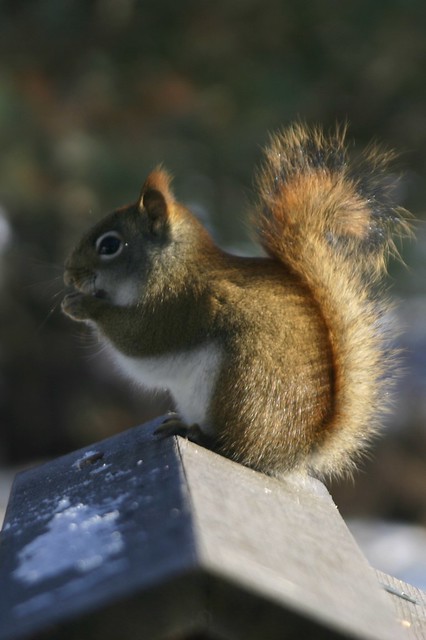
Squirrel Eating at the Birdfeeder
Squirrel eating food from the bird feeder 
on January 19, 2008.

This is such a lovely quote with all the different natural images that are shared. I'm hoping that by encouraging the girls to keep nature journals that they, too, will have beautiful memories and images to look back upon.

For this week's theme, we focused on birds of prey and scavengers.

We have been learning about hawks, owls, and other birds of prey. Now we're backing up a bit to look at the bigger picture.

The order Falconiformes is a group of about 290 species of birds that contains the diurnal birds of prey. (Diurnal means the birds are active during day and sleep at night.) They live almost everywhere in the world except Antarctica and eastern Polynesia.

Birds of prey, also known as raptors, hunt and feed on other animals. The term "raptor" comes from the Latin word rapere (meaning to seize or take by force). These birds have keen vision that allows them to detect prey during flight, and powerful talons and beaks.

Many species of birds may be considered partly or exclusively predatory. However, in ornithology, the term "bird of prey" applies only to birds of the five families of two orders listed below:

Accipitridae: hawks, eagles, buzzards, harriers, kites and Old World vultures. These birds have very large powerful hooked beaks for tearing flesh from their prey, strong legs, powerful talons and keen eyesight.

Pandionidae: the osprey. This family of fish-eating birds of prey, possessing a very large, powerful hooked beak for tearing flesh from their prey, strong legs, powerful talons, and keen eyesight.

Sagittariidae: the secretarybird.

Falconidae: falcons, caracaras, and forest falcons. These birds differ from hawks, eagles, and kites in that they kill with their beaks instead of their talons.

Cathartidae: New World vultures. (See below for more information about these scavengers.)

All of the birds that have very good eyesight for finding food, strong feet for catching, killing, and/or holding food; and a strong curved beak for tearing flesh.

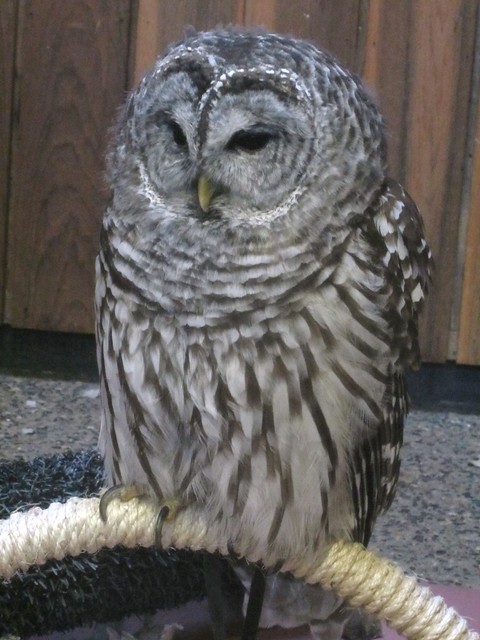
Owl at Nature Center
This owl is at a nature center.
We saw it on January 18, 2013.

The nocturnal birds of prey – the owls – are classified separately as members of two families of the order Strigiformes:

Strigidae: typical owls. The typical owls are small to large solitary nocturnal birds of prey. They have large forward-facing eyes and ears, a hawk-like beak and a conspicuous circle of feathers around each eye called a facial disk.

Tytonidae: barn and bay owls. Barn owls are medium to large owls with large heads and characteristic heart-shaped faces. They have long strong legs with powerful talons.

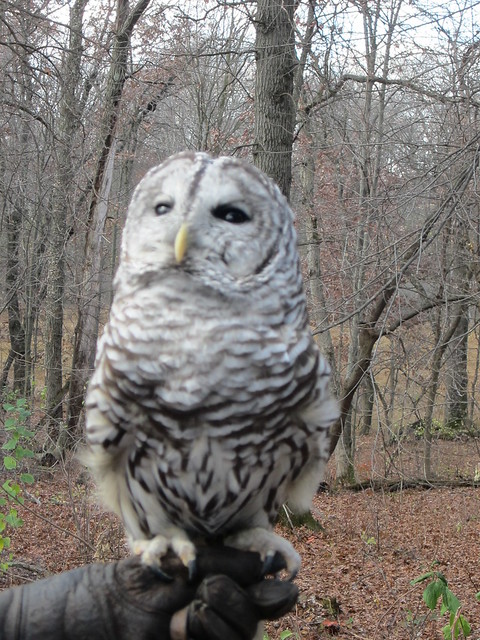
Owl at Warner Nature Center
We saw this owl was at Warner Nature Center 
on October 27, 2012

The wing shape of birds of prey vary depending on the type of bird:


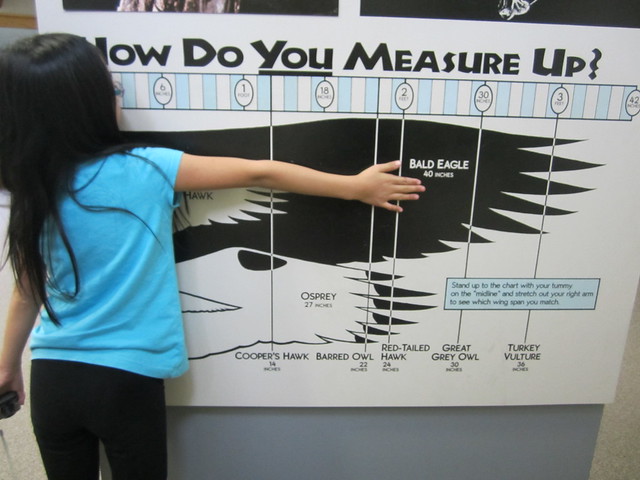
As with the wing shape, the wing size varies considerably as well:

Olivia - Arm and Wing Span Comparison
Display about the wingspan of various raptors.
This display was at William O'Brien State Park.
We were there on May 26, 2012.

SCAVENGERS

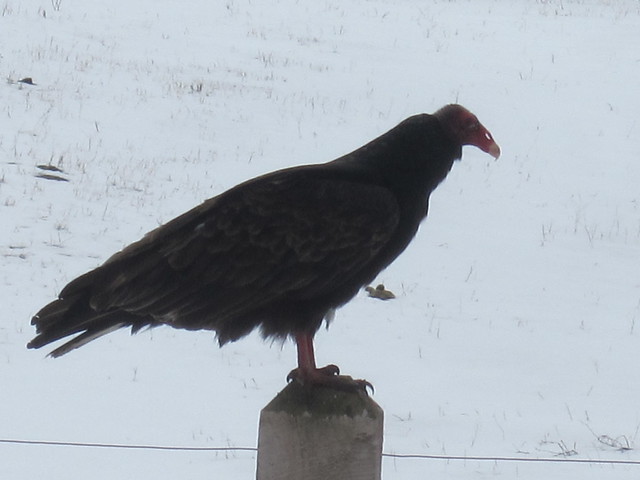
Turkey vulture sitting on a post
We saw this turkey vulture resting on a fence post 
at the end of the road we live on.
This was taken on April 16, 2013.

Vultures are scavenging birds, feeding mostly from carcasses of dead animals without apparent ill effects. It prefers those recently dead, and avoids carcasses that have reached the point of putrefaction. They may feed on plant matter, shoreline vegetation, pumpkin and other crops, live insects and other invertebrates, but this rare.

Bacteria in the food source, which would be pathogenic to other vertebrates, dominate the vulture’s gut flora, and vultures benefit from the bacterial breakdown of carrion tissue.

New World vultures have a good sense of smell, whereas Old World vultures find carcasses exclusively by sight. A particular characteristic of many vultures is a bald head, devoid of feathers.

In Minnesota, we commonly see turkey vultures. This type of vulture, as noted above, is a scavenger and feeds almost exclusively on carrion. It finds its food using its keen eyes and sense of smell, flying low enough to detect the gases produced by the beginnings of the process of decay in dead animals.

In flight, the turkey vulture uses thermals to move through the air and it flaps its wings infrequently.It is a large bird, with a wingspan of 63–72 inches, a length of 24–32 inches, and weighs 1.8 to 5.1 pounds. In flight, the tail is long and slim.

The turkey vulture is gregarious and roosts in large community groups. It breaks away to forage independently during the day. Several hundred vultures may roost communally in groups which sometimes even include black vultures. It prefers to roost on dead, leafless trees, but will also roost on man-made structures such as water or microwave towers.

Lacking a syrinx,which is the vocal organ of birds, its only vocalizations are grunts or low hisses.

Another interesting aspect of its body is that the two front toes of the foot are long and have small webs at their bases. Tracks are large, between 3.7 and 5.5 inches in length and 3.2 and 4.0 inches in width. Both measurements include claw marks.

The feet are flat, relatively weak, and poorly adapted to grasping. In fact, the talons are not designed for grasping, as they are relatively blunt.

The turkey vulture nests in hollow trees, caves, or thickets.

Each year it generally raises two chicks, which it feeds by regurgitation.

It has very few natural predators. In the United States, the vulture receives legal protection under the Migratory Bird Treaty Act of 1918.

It is found in open and semi-open areas throughout the Americas from southern Canada to Cape Horn. It is a permanent resident in the southern United States, though northern birds may migrate as far south as South America.

The turkey vulture is widespread over open country,pastures, shrublands, grasslands, deserts, subtropical forests, wetlands, and foothills. It is most commonly found in relatively open areas that have nearby woods for nesting. Turkey vultures generally avoid heavily-forested areas.

The turkey vulture forages by smell, an ability that is uncommon in the avian world, often flying low to the ground to pick up the scent of ethyl mercaptan, a gas produced by the beginnings of decay in dead animals.

The olfactory lobe of its brain, responsible for processing smells, is very large compared to that of other animals. This heightened ability to detect odors allows it to search for carrion below the forest canopy.

In areas where others types of vultures and condors live, the turkey vulture sets itself apart from others because it can smell carrion. King vultures, black vultures, and condors, which lack the ability to smell carrion, follow the turkey vulture to carcasses.

The turkey vulture arrives first at the carcass, or with greater yellow-headed vultures or lesser yellow-headed vultures, which also share the ability to smell carrion. It displaces the yellow-headed vultures from carcasses due to its larger size, but is displaced in turn by the king vulture and both types of condor, which make the first cut into the skin of the dead animal.

This allows the smaller, weaker-billed turkey vulture access to food, because it cannot tear the tough hides of larger animals on its own. This is an example of mutual dependence between species.

Like other vultures, the turkey vulture plays an important role in the ecosystem by disposing of carrion which would otherwise be a breeding ground for disease.

Nature Journaling

Both the girls did an entry in their nature journal about birds of prey/scavengers. Sophia focused on birds of prey in general.


Olivia focused on peregrine falcons.

Sunday, December 7, 2014

A Year on Ladybug Farm - Read 52 Books in 52 Weeks - Week 50

I'm nearing the end of the Read 52 Books in 52 Weeks challenge, and have chosen A Year on Ladybug Farm by Donna Ball to read this week.


Initially when I began reading the book, I thought I wouldn't like it. It was about a group of three women who were focused on fashion, their shoes, parties, and - to me - things that weren't that meaningful in the greater scheme of life.

My opinion changed when the three women - Cici, Lindsay, and Bridget - all single for different reasons (e..g, divorced, widowed, never married) decided to make a major decision and investment together: to purchase a run-down mansion in the Shenandoah Valley.

They named their farm "Ladybug Farm" because of the multitude of ladybugs that were present in the home as well as the fact that ladybugs are symbols of good luck.

The old home - although beautiful in design - had fallen into a state of neglect and needed quite a bit of repair and improvement to make it suitable to live in. They take on many home improvement projects either themselves or with the help of local residents who slowly transform the mansion into a home.

Despite the improvements, they are met with disaster after disaster. Each improvement seems to cost significantly more than they envisioned, and they become concerned that they have made a grave error in purchasing the home...despite the agreement that they would commit to it for only one year and then decide what to do at the end of the year.

Some of the sections of the book reminded me of the ongoing challenges we've had with our own home and land; and how problem after problem seems to surface...and the cost of dealing with the issues continues to rise. It made the book a rather realistic portrayal of what life is like living in an old home that had a good amount of neglect and needed improvement.

On a more positive note, there were parts of the book that made me long for a vegetable and herb garden again after reading about all that was being harvested, preserved, and enjoyed at meals. I'm hoping that in 2015 we can find a large enough spot close to our home to start a garden. It would be nice to be able to pick fresh vegetables and herbs, and use them for meals like I used to do.

One of the things I learned was that there are things called "follies" (or the singular "folly") that are essential little buildings with no practical purpose. Ladybug Farm had a folly in its woods. At one time it was "like a little fairy  castle....It used to be painted green with white gingerbread scrollwork."

So, I looked up "folly" and found what defines it, according to Wikipedia:

- They have no purpose other than as an ornament. Often they have some of the appearance of a building constructed for a particular purpose, such as a castle or tower, but this appearance is a sham. Equally, if they have a purpose, it may be disguised.
- They are buildings or parts of buildings. Thus they are distinguished from other garden ornaments such as sculpture.
- They are purpose-built. Follies are deliberately built as ornaments.
- They are often eccentric in design or construction. This is not strictly necessary; however, it is common for these structures to call attention to themselves through unusual details or form.
- There is often an element of fakery in their construction. The canonical example of this is the sham ruin: a folly which pretends to be the remains of an old building but which was in fact constructed in that state.
- They were built or commissioned for pleasure.

In the end, the women realize that they all have changed for the better, and that their previous lives were in no comparison to the richly-rewarding life they were leading now. As Lindsay said, "This is not about the house. It's about who we've become because of the house. And I can't go back to the person I was before, even if I wanted to."

And that's something that I feel when I think of living at the farm here. I think of all the lessons I've learned and opportunities I've had because of living here; and for those reasons I can't envision living anywhere else. It simply wouldn't be the same.

Friday, December 5, 2014

Colored Carnations - Junior Master Gardener Activity

Sophia and Olivia belong to a 4-H club that I'm leading for homeschoolers; and one of our major activities is doing the Junior Master Gardener program. 

The first chapter of the book focuses on "Plant Growth and Development" and has a variety of activities for youth to do as a group as well as individually at home.

One of the activities to do at home focused on turning a white carnation different colors. The book suggested doing a red, white, and blue carnation. Since it was close to  Christmas, Sophia chose to do a green and red carnation; and Olivia chose to do a green and white carnation.

The first step was to cut the stem in half using a knife or scissors. (Had we tried to do a tri-color carnation, we would have had to split the stem into thirds which would have been quite difficult.)

The girls filled two different cups up with water and then added food dye to each one. 

They placed their carnations into the water and realized that they would need to affix the stems to the side of the cups if the flower was to stand upright. (Otherwise, the flower fell to the side and the bottom of the stem came out of colored water.)


Sophia hypothesized that the leaves would start changing colors the same day, while Olivia thought that it would take until the following day when her flower would change colors.

Within a few hours, the tips of the carnations were changing from white to either green or red. 

We all thought that the the flowers would have an all-over color change. However, we left the flowers in the colored water for well over 1 1/2 weeks, but there was still white on all of the petals. (Thus, the flowers also look a bit wilted since we were curious to see how much the petals would change in color.)

What we did notice, in Sophia's carnation in particular, was that the petals had a deeper color around the edges and had rows of coloration as one looked from the edge to center of the flower.


It was an interesting experiment to do, and showed us all how the stems transport the water from the glasses to the petals. 

Hawks - Outdoor Hour Challenge

For this week's Outdoor Hour Challenge, we focused on hawks. Here in Minnesota, there are many nine types of hawks that can be seen: broad-winged, cooper's, ferruginous, northern goshawk, red-shouldered, red-tailed, rough-legged, sharp-shinned, and swainson's. 

Hawk Looking Down
This hawk was very close to the wetland observation deck 
at the Minnesota Valley National Wildlife Refuge. 
The girls and I watched it on March 16, 2009, 
as it kept scanning the ground for a meal. 
It didn't seem to bother the hawk that we were there. 
The person in the visitor center said it was either a
Cooper's Hawk or Sharp-shinned Hawk.

Collectively, all of the hawks can not be seen in all parts of the state, though. Some have certain areas they prefer (e.g., along the western border of the state) while others are prevalent throughout the state. Nonetheless, there is quite a variety of hawks in Minnesota - far more than we knew.

This year, one of the things that Sophia and Olivia are doing this year is being a part of the Youth Raptor Corps through the The Raptor Center at the University of Minnesota. It's an opportunity for youth in grades 5-8 to learn more about raptors, how to protect them, and then teach others about raptors at a spring event.

Their first Raptor Corps meeting was held on October 14, 2014. At the first meeting of the program in October, there was a presentation about the center itself and how its purpose.

Sophia and Olivia were listening to a presentation about raptors.

After that, the youth and parents were introduced to three different raptors - including a red-tailed hawk.

This is the foot with talons from a red-tailed hawk.

Items were passed around so that attendees could get a better (and safer) look at different raptor body parts.

Each of the raptors received meat to eat. It was interesting to see the difference in eating habits between the birds.

The hawk is eating its dinner for the evening.

There are additional sessions beginning again in January (there was a break in December) and running until May. By the end of the school year the girls should both have a much deeper understanding and appreciation of raptors.

For this entry, I'm focusing on the most common hawk we see around our area: red-tailed hawk. It is also the most common hawk in North America. In addition to being in rural areas where they can be seen soaring over the open fields, hawks often can be seen perching on tall light posts along the highways with their eyes fixed on the ground to see the movements of a rabbit or vole.

All About Birds had some great information about hawks that is good to know.

Size and Shape
Red-tailed Hawks are large hawks that are very broad with rounded wings and a short, wide tail. Large females seen from a distance might fool you into thinking you’re seeing an eagle. (Until an actual eagle comes along.)

Hawk at Nature Center
This hawk was at a nature center. 
Due to injuries it had in the wild, it cannot be released 
for its own safety and well-being.
We saw this hawk on Olivia's 10th birthday - 
on January 18, 2013.

Color Pattern
Most red-tailed hawks are rich brown above and pale below, with a streaked belly and, on the wing underside, a dark bar between its shoulder and wrist. The tail is usually pale below and cinnamon-red above, though in young birds it’s brown and banded. “Dark-morph” birds are all chocolate-brown with a warm red tail. “Rufous-morph” birds are reddish-brown on the chest with a dark belly.

Sophia with Hawk
This gentleman had a hawk he trained like a falcon.
He was at a restaurant where were eating at with friends,
and we had the opportunity to touch its feathers.
The hawk was so soft and calm.
(This was on September 13, 2012.)

Behavior
Red-tailed hawks tend to soar in wide circles high over a field. When flapping, their wingbeats are heavy. In high winds they may face into the wind and hover without flapping with their eyes fixed on the ground. They attack in a slow, controlled dive with legs outstretched – much different from a falcon’s stoop.

How Wide is Your Wingspan
We were at the Science Museum of Minnesota on October 12, 2007, and 
saw this display about the wingspan of different raptors. 
The largest is the California Condor, then the American Eagle, 
Turkey Vulture, Osprey, Redtailed Hawk, and 
one more (can't remember that one). 
Olivia's armspan was about 3' total (1 1/2' on each side). 
Sophia's was as big as a red-tailed hawk...or about 4' total 
(slightly less than 2' on each side).
The girls were 6 1/2 and 4 1/2 years old at the time.

Habitat
The red-tailed hawk is a bird of open country. It is most commonly seen along fields and perched on telephones poles, fence posts, or trees standing alone or along edges of fields. It can be seen in grasslands, roadsides, the desert, broken woodland, scrublands, fields and pastures, parks, and (in Mexico) tropical rainforest.

Food
Mammals make up the bulk of what most red-tailed hawks eat. Frequent victims include mice, voles, rabbits, wood rats, snowshoe hares, jackrabbits, and ground squirrels. The hawks also eat birds, including starlings, blackbirds, pheasants, and bobwhite as well as snakes and carrion. Individual prey items can weigh anywhere from less than an ounce to more than 5 pounds.

Nest Description
Both males and females build the nest or refurbish one of the nests that they have used in previous years. Nests are tall piles of dry sticks up to 6.5 feet high and 3 feet across. The inner cup is lined with fresh foliage, bark strips, and dry vegetation. Construction of the nest takes 4-7 days.

Nest Placement
Red-tailed hawks prefer to place their nests in the crowns of tall trees where they have a commanding view of the landscape. They may also nest on a cliff ledge or on artificial structures such as window ledges and billboard platforms.

Nesting 
The clutch size is 1-5 white or buffy, blotched, or speckled with buff, brown, or purple eggs. There is one brood per year. The eggs incubate for 28-45 days and the nestling period is 42-46 days.

Sound
Adults make a hoarse, screaming kee-eeeee-arr. It lasts 2-3 seconds and is usually given while soaring. We listened to more sounds that both adults and young hawks make. When we played the sounds (especially the adult ones), the dogs immediately looked up from resting. This is a sound all-too common and one that can indicate trouble for small mammals and birds.

Interesting Fact
The Red-tailed hawk is one of the largest birds that is in North America, yet even the biggest females weigh only about three pounds. A similar-sized small dog might weigh ten times that.

Nature Journal Entries

Each of the girls focused on a different hawk. Olivia chose the ferruginous and Sophia chose the red-tailed hawk.

This is Sophia's journal entry:


This is Olivia's journal entry:


We used Backyard Birds - Hawks and Their Calls as inspiration.

Thursday, December 4, 2014

Aloe - The Medicine Plant - Junior Master Gardener Activity

At the December 4-H meeting, Sophia and Olivia participated in a Junior Master Gardener activity that focused on aloe vera. This activity is from the first chapter in the curriculum that is focused on plant growth and development.

The group lesson looks at the aloe vera plant and its medicinal properties.

Aloe vera is a succulent plant that has been used for thousands of years to heal a variety of conditions, most notably burns, wounds, and skin irritations.

It is grown in subtropical and tropical locations, including Latin America, South Africa, and the Caribbean.

Aloe was one of the most frequently prescribed medicines throughout most of the 18th and 19th centuries and it remains one of the most commonly used herbs in the United States today.


Extracts from aloe vera are widely used in the cosmetics and alternative medicine industries, being marketed as variously having healing, rejuvenating, or soothing properties.

In pots, aloe vera requires well-drained, sandy potting soil and bright, sunny conditions. However, aloe vera plants can burn under too much sun or shrivel when the pot does not drain the rain.

The use of a good-quality commercial propagation mix or packaged "cacti and succulent mix" is recommended, as they allow good drainage.

Terra cotta pots are preferable as they are porous.

Potted plants should be allowed to completely dry prior to re-watering.

When potted, aloe vera can become crowded with "pups" growing from the sides of the "mother plant." If this is the case, they should be divided and re-potted so the pups can further grow.  This also helps prevent pest infestations.

At the 4-H meeting, the youth had heard about using aloe vera for its soothing, moisturizing, and healing properties.  Many of the youth had aloe vera plants at home and used them for burns - especially ones from cooking or baking.


We had examples of products containing aloe vera, and most were for sunburns and moisturizers. There were also products for hand sanitizing that contained aloe vera.

When one of the leaves were cut from the plant, the youth squeezed a bit out and noticed that the gel was a pale yellow and sticky.

When the leaf is cut open and the gel removed from the inside, it is clear and sticky. This plant gel was mixed with a commercially-purchased aloe vera gel for moisturizing purposes. Mixed together, it would seem that it would be even more effective since there is a higher concentration of gel in the product.

Interestingly, aloe vera contains active compounds that may reduce pain and inflammation and stimulate skin growth and repair. For this reason, is has gained popularity for relief of burns. In one study, burn sites treated with aloe vera healed completely in less than 16 days compared to 19 days for sites treated with silver sulfadiazine.

In a review of scientific literature, researchers found that patients who were treated with aloe vera healed an average of almost nine days sooner than those who weren't treated with the medicinal plant.

Aloe vera is best used for minor burns and skin irritations and should never be applied to an open wound.

Sunday, November 30, 2014

Yellow Star - Read 52 Books in 52 Weeks - Week 49

On this 49th out of 52nd week of the Read 52 Books in 52 Weeks challenge, I read Yellow Star by Jennifer Roy.


Yellow Star is a biographical children's novel that is written in free verse. It depicts life through the eyes of a young Jewish girl whose family was forced into the Łódź Ghetto in 1939 during World War II.

The story revolves around the author's aunt (Syvia) who shared her childhood memories with Roy more than 50 years after the ghetto's liberation. The author added fictionalized dialogue, but did not alter the story.

The book covers Syvia's life from age 4 1/2 to 10 years old in the ghetto. Syvia, her older sister Dora, and her younger cousin Isaac were three of only twelve children who survived.

In 1939, the Nazis invaded Poland and forced that nation's second-largest community of Jews, 270,000 strong, into one section of the city of Łódź, which they later walled off to form a ghetto. In 1941, thousands of Jews form other countries were also moved into the Łódź ghetto. They came from Germany, Austria, Czechoslovakia, and Luxembourg.

Before the invasion, Syvia and her family lived in Łódź. After her father heard rumors that Germans were planning to invade, the family traveled by buggy to Warsaw. Unable to find housing or work, the family returned to Lodz.

When the Germans did invade, they forced Łódź-area Jews (including Syvia's family) to relocate into a ghetto - a segregated section of the city.

The book relates Syvia's explanations of what life in the ghetto was like: her friends, people around the ghetto, jobs, and her schedule. It shares how Syvia's family was forced to sell her doll, leaving her with rags and buttons as her playthings.

When the other Jewish children were sent to Chelmno, Syvia's family smuggled the children from cellar to cellar. The adults would provide a distraction so the soldiers attention would be focused elsewhere while children were smuggled from cellar to cellar. As Syvia's father said, "Many people worked together to save [the] children. We are blessed to have such good people around us."

From Syvia's perspective, she said, "This is not what it was like when I played with Hava and Itka. We had energy to have fun, but now that we are children of the cellar, we just lie around or sit propped against a wall and wait for the grown-ups to visit. We all know how to hide, to keep quiet so that the Nazis don't find us."

The book also many tragic events and the way people were treated:
- the average daily food ration per person was about 1,000 calories. The quality of food was very poor. Dirt, ground glass, and other particles were found in the flour, and the only food available was often rotten.
- people did not have any of their pets in the ghetto. They would have been killed for meat.
- in January 1942, the Nazis began deporting people from the Łódź ghetto. They ordered people onto trains, telling them they were needed to work elsewhere. This was a lie. The Nazis had planned their "Final Solution"...by [building] concentration camps, also called extermination camps.
- in September 1942, the Germans declared a curfew called the Gehsperre (ban on movement). Survivors of this brutal time called it the Sperre. The Sperre's main focus was on children under the age of ten and adults over sixty-five. Parents were reassured that their children were being taken to a better, safer place where they would have food and fresh air; and be watched while the parents are at work. Again, it was a lie. They had gone to the Chelmno extermination camp to die.
- to hide from the Nazis, children and their parents would lay in graves in cemeteries. When danger had passed, the little ones would emerge from behind gravestones and return to their families.
- there were 69 factories in the Łódź ghetto with more than 70,000 workers. Most of the factories produced textiles; and some built munitions.
- by mid-1944, all of the ghettos - except for Łódź - had been destroyed. The Nazis came to Łódź to ask for volunteers to help clean up cities in Germany that had been bombed. The Jews in Łódź were suspicious, but the Nazis made it seem like a legitimate request. So, volunteers lined up at the train station. Soldiers carefully checked their luggage, and apologized for the uncomfortable method of travel. Freight cars, they explained, were the only transportation not being used to fight in the war. By July 15, 1944, 7,175 "volunteers" had taken the trains and were taken to Chelmno extermination camp, where they were killed.
- from August 27-30, 1944, the Nazis ordered the Łódź ghetto to be emptied of people. Over 74,000 residents of Łódź were transported by freight trains to Auschwitz-Birkenau, where crematory ovens burned 24 hours a day. Approximately 1,200 Jews were left behind in the ghetto to clean it up.

When the people remaining at the Łódź ghetto were freed at the end of the war by the Russians, the Russian soldiers brought chocolate for the children. Many had never tasted chocolate before, so it was a welcome treat...in addition to being liberated and free.

This is a very sobering book to read since it is told from a child's perspective. The strength and courage these children had throughout their childhood is impressive...and unfathomable. What bravery these young ones - and their families as well - showed through such challenging times is a testament to their character. Yellow Star is definitely a book worth reading for this reason alone.

Friday, November 28, 2014

Screech Owl - Outdoor Hour Challenge

Sophia and Olivia are involved with the Raptor Corps program this year that is sponsored by and held at the Minnesota Raptor Center once a month from October through May (with the exception of December).

When the girls went to their first meeting in October, we saw an Eastern screech owl there. At first it looked like a stuffed animal or toy because it was so small. It wasn't...it was an adult female screech owl named Mestaae.

Screech owl at the Minnesota Raptor Center in St. Paul, Minnesota.
We were surprised at how tiny it was since 
we've seen larger owls that live around our home.

Mestaae was hatched in spring 2008 and was found as a nestling outside of the nest. Unfortunately she was not brought to The Raptor Center quickly enough and became a human-imprinted bird. Due to this, she lost some of her human fear and does not display all the normal screech-owl behaviors that she needs to in order to survive. Therefore she will have to spend the rest of her life in captivity.

She weighs approximately six ounces - about the equivalent of 1 1/2 sticks of butter. Her name is a Cheyenne word for “spirit of the night/owl” and was chosen from over 800 entry suggestions.

We were curious to learn a bit more about Eastern screech owls, so we found information out them from the Minnesota DNR website:

=> This tiny gray or reddish owl can be found throughout southern and central Minnesota.
=> It is named for its surprising call, which can sound like a crying child.
=> It has ear tufts; and big yellow eyes and a yellow beak.
=> Like other owls, the screech owl has eyes that face forward. This gives it depth perception (the kind of vision you have when you look through two eyes instead of one).
=> They are 7 to 10 inches tall.
=> When flying, their wingspan can stretch up to 2 feet across.


Sophia - Arm and Wing Span Comparison
Different types of owls and raptors are shown on this display.
Sophia's arm span is the equivalent of a great gray owl and 
Olivia's is about the width of a red-tailed hawk.
(Taken on May 26, 2012.)

Olivia - Arm and Wing Span Comparison

=> They weigh 7 to 8 ounces.
=> Screech owls nest in a second-hand nest or tree cavity. They are willing to nest in boxes built for them and sometimes nest in wood duck nest boxes.
=> The female incubates the eggs, eating little food during the 26 to 32 days it takes the eggs to hatch.
=> Owlets fledge in about four weeks.
=> Screech owls eat insects, small rodents, small birds, and reptiles. Sometimes they perch, waiting for food, then swoop down when something attracts their attention. They also may walk along the ground or in shallow water looking for insects or other prey.
=> Great-horned owls, hawks, dogs, cats, minks, weasels, skunks, otters, and bobcats have all been known to kill screech owls. Sometimes snakes rob their nests.
=> Screech owls can be found in deciduous (hardwood) forests, lakeshores, and suburbs throughout most of Minnesota.
=> In Minnesota, owls may not be shot, captured, transported, or owned without a permit.
=> Like other owls, one of its ear holes is higher than the other. This helps it identify the source of a sound.

We also took a look at the All About Birds website. There was a section about the Eastern Screech Owl.

Size and Shape
The Eastern Screech-Owl is a short, stocky bird, with a large head and almost no neck. Its wings are rounded; its tail is short and square. Pointed ear tufts are often raised, lending its head a distinctive silhouette.

Screech Owl
We saw this screech owl at 
Warner Nature Center on June 4, 2011.

Color Pattern
Eastern screech owls can be either mostly gray or mostly reddish-brown (rufous). Whatever the overall color, they are patterned with complex bands and spots that give the bird excellent camouflage against tree bark.

Feather from a screech owl.

Behavior
Eastern Screech-Owls are active at night and are far more often heard than seen. To know what they sound like, we listened to the songs of the screech owl.

Habitat
This owl is fairly common in most types of woods (evergreen or deciduous; urban or rural), particularly near water. It does not like treeless expanses of plains or mountains.

Nature Journal

Both of the girls did a nature journal entry. Sophia's is here:


and Olivia's is here:


Dissecting an Owl Pellet

For this nature study we didn't dissect an owl pellet since both the girls have done this twice already. However, it was worth revisiting what the girls discovered when they dissected an owl pellet.

First, they pulled away all the fur from the bones in the pellet. We were all surprised at the amount of fur that was in one pellet.

Fur in One Owl Pellet
The fur in one owl pellet.
Take on May 26, 2012.

As the girls were pulling away the fur, we could see little glimpses of bones that were part of the owl pellet.

Inside an Owl Pellet
Inside an owl pellet.

Sophia Dissecting an Owl Pellet
Although tweezers were supplied, 
Sophia found it easier to break apart and 
separate the different parts with her fingers. 
The pellets were all sterilized prior to using them, 
otherwise it would be best to wear gloves and/or use tweezers.

Even though Sophia preferred to use her fingers to dissect the owl pellet, Olivia liked using the tools that were provided.

Olivia Dissecting an Owl Pellet
Olivia using different tools to 
separate the elements in her owl pellet.

By the time that the pellet was completely dissected, there was a wide range of bones that were discovered.

Inside the Pellet Sophia Dissected
All the bones that were in one owl pellet.

Olivia dissected her first owl pellet on September 13, 2007...when she was only 4 years old. She used toothpicks to break apart the pellet.

Olivia with an Owl Pellet
Olivia using toothpicks to dissect the owl pellet.

Interesting Discoveries
Some of the bones that Olivia found in the owl pellet 
that she dissected on September 13, 2007.

To identify the bones found in an owl pellet, there's a free owl pellet bone chart.

OHC Summer Series - #5 Owls were referred to as inspiration.

Thursday, November 27, 2014

Highlights from Thanksgiving 2014

Last year we did a Countdown to Thanksgiving. This year, between homeschooling and trying to stay on track with all the subjects; rehearsals twice a week for the Christmas play; music lessons; the homeschool co-op; and volunteering at the nursing home, it seemed like it was just too much to try to take on doing the Countdown to Thanksgiving.

So, the only thing that we did prior to Thanksgiving was that Olivia colored a picture at one of the 4-H meetings for Color-A-Smile. 


Color-A-Smile sends pictures that children have colored and/or drawn and mails them to residents at nursing homes and veterans facilities; people who are homebound; and those who could use some cheering up.

Other than that, we focused preparing a meal and cleaning the home for family members who were joining us for a Thanksgiving meal.

The girls were excited to see their cousins.


They liked having their own table to eat together. The six youngest cousins ate together (those who were 13 years old and under).


The older cousins (15 years old and older) plus the adults ate in the dining room/living room.


It was nice having Thanksgiving up at our home again this year. Last year, because of my mom's health, she wanted to host it at her home. This year, she felt like she was able to make it up to the farm which was great.


There's something about the smell of food cooking throughout the day that makes it feel like Thanksgiving.


One thing we did differently (in addition to not doing the Countdown to Thanksgiving) was hold the dinner earlier in the afternoon so that it was closer to my mom's lunch time. Having regular meals that are on a relatively set schedule is important for her since she's diabetic. That just meant waking up a bit earlier than normal and getting the turkey in the oven a couple hours before I normally do.

It was well worth it, though. It was a nice Thanksgiving...and much more relaxed than in past years.

Sunday, November 23, 2014

We Day - Celebrating Empowerment

Sophia and I (along with Sophia's friend, Amelia) went to We Day earlier this month. It was an inspiring, thought-provoking event just as it had been the prior year. 

The focus this year was on empowerment; and the speakers and projects that We Day/Free the Children were promoting all revolved around that topic.

We arrived early and were seated in the third row from the floor.
Music played while the 18,000 youth and adults 
made their way to their seats.

One of the first speakers was Marilyn Carlson from The Carlson Companies and an author. she talked about the power of one person to make a difference. She shared that Ghandi was only one person who lived a very simple, yet made a tremendous difference throughout the world. He had only five possessions: a staff, glasses, two yards of fabric, sandals, and a pocket watch.

She said that each person should remind her/himself that s/he is on a journey and can make a difference. The ability to impact others' lives is her definition of "powerful."

The Carlson credo is:

Whatever you do, do with integrity.
Wherever you go, go as a leader.
Whomever you serve, serve with caring.
Whenever you dream, dream with your all.
And never, ever give up.

Sophia and Amelia listening to music and 
watching as everyone finds their seats.

Another speaker was Magic Johnson. After sharing an inspirational message, he told everyone that he was donating $1 million to build schools in Africa.

Magic Johnson sharing that he is donating $1 million
to build schools in Africa.

Just thinking about how many schools and lives will be positively impacted by his generosity was inspiring!

There was a speaker named Clemantine Wamariya was six years old when the genocide began in Rwanda.

She and her sister Claire fled across the border to Burundi. According to the United States Holocaust Museum, "They found themselves among a sea of refugees—with no immediate access to shelter, food, or other supplies. While international aid soon improved conditions, they constantly struggled to survive. Because of rumors of continued troubles inside Rwanda, they wandered from refugee camp to refugee camp for six years.

"In 2000, Wamariya and her sister gained asylum in the United States, and they settled in Chicago. A year later, Wamariya learned that her parents had survived the genocide. In 2006, Wamariya won Oprah Winfrey's National High School Essay Contest that asked, "Why is Elie Wiesel's book Night relevant today?" The Oprah Winfrey Show surprised Wamariya and her sister Claire by reuniting them with their family on the show. Wamariya has become an eloquent advocate against genocide today."

There's another more detailed story about Wamariya's life that includes the story she shared at We Day. She spoke about a turning point in her life that was when a relief worker gave her ice water and banana, and how she no longer felt invisible.

"One year of empowerment can make a lifetime of change."

One of the speakers was Spencer West. He does not have legs, yet has done some very remarkable things during his lifetime. He spoke about the power of technology and how it can make a tremendous an positive difference. He shared examples about how technology has enabled him to do things that he didn't think were possible - like driving a car.

Spencer introduced Colonel Eileen Collins who was the first woman to pilot the Space Shuttle. She said that when you volunteer, not only do you help your community, but you become stronger and more confident. You become a leader.

Colonel Eileen Collins talking about volunteering and leadership.

One of the We Day/Free the Children staff talked about how seven in every ten children or teens are bullied. That figure was staggering. Even more sobering was when they asked people to stand up if they or someone they knew had been bullied. Almost every person in the audience stood up.

KDWB shared a bit about their Christmas Wish program that has been happening for 15 years. Dave Ryan said that it is "ordinary people helping others out." He talked about social empowerment, and encouraged people to nominate someone who needs help.

The next speakers was the grandson of Nelson Mandala. His name is Kweku Mandela, and he said that the best way to live up to his grandfather's legacy is to give a voice to others. He talked about how many people in Africa are still struggling for the basics - including education. With education, comes empowerment.

Kweku Mandela, the grandson of Nelson Mandela, 
speaking about how education is the route to empowerment.

He shared a quote from his grandfather: "Sometimes it falls upon a generation to be great. You can be that great generation. Let your greatness blossom. Of course the task will not be easy. But not to do this would be a crime against humanity, against which I ask all humanity now to rise up."

The Chairman, President, and CEO of Allstate spoke at We Day. Something that stood out that he said was the "The willingness to get involved is the strongest power we have."

A representative from the Bush Foundation and Springboard for the Arts said that "...you believe you can make things happen...and that makes you all artists." She said that the "...arts give us the tools to communicate."

Ashley Murphy was a young speaker who is HIV+. She was born HIV+, and knows all too well how access to health care can change lives. "We all face challenges...our weaknesses can turn into strengths...and you can overcome them to help others." She encouraged the youth (and adults) to "own your differences and be you."

Another interesting speaker was J.R. Martinez who was injured in Iraq when he was 19 years old. He spent three months in a hospital recovering from his injuries. He said, "I wear my scars proudly and those who love me will accept me as I am."

He continued, "Life with throw adversity at you. Stand up. Surround yourself by positive people and they'll help you realize that you're not a victim."

One of the speakers asked the attendees: "What do you care about? Is it an issue that was presented at We Day or is it one that you feel motivated to address and change?" Each person has "a gift to make this world a better place" whether it's through writing, baking, or being a good listener. The list could go on.

A surprise came in the early afternoon when Colbie Caillat singing "Try." It is such a beautiful song with an important message. After she sang the song she spoke briefly to attendees telling them, "Don't change yourself for anybody!" A very good reminder.

Colbie Caillat singing "Try" at We Day.

We Day/Free the Children focused heavily on empowering women in Kenya by raising $50 which would buy a woman a goat. This, in turn, would not only provide food for her family, but give her the ability to expand her herd, trade livestock for poultry with other farmers, and give her income as she sells some products (e.g., goat milk, eggs) to others in her community. 

A local woman who is from South Africa spoke about looking at challenges as stepping stones. "You can achieve anything you set your mind to," she said.

Martin Sheen gave a powerful presentation about how he viewed his life and activism. He said acting is what he does for a living, and activism is what he does to stay alive. What was interesting - and gave us pause for thought - was a statement he made about how food and shelter separate us, but the need for justice, healing, and mercy unite us.

He said that he learned early on that you serve yourself best when you serve others first.

Sheen continued, "Whether we acknowledge it or not, we are all responsible for each other and the world, which is exactly the way it is, because consciously or unconsciously, we have made it so. And while none of us made any of the rules that govern the universe or the human heart, we are all beneficiaries of a divine promise, that the world is still a safe place despite our fears and we in it, are not asked to do great things; we are asked to do all things with great love."

Later in his talk he said, "The Irish tell the story of a man who arrives at the gates of heaven and he asks to be let in and St. Peter says, 'Of course. Show us your scars.' The man said, 'I have no scars.' St. Peter says, 'What a pity. Was there nothing worth fighting for?'"

Sheen concluded, "However we perceive the purpose of our journey or the route we pursue, at the final twilight, when we must confront the reality of that undiscovered realm from which no traveler returns, the only things we can take with us, are the things which we cherished and gave away with love, including our precious time and talent."

The power of We Day is in the activities leading up to our ability to attend (we volunteer many ways both at the local and global level); having the privilege of listening to powerful and inspiring leaders because of volunteerism and how integrated it is in our lives; and taking the messages back home and turning them into actions that will make a difference.